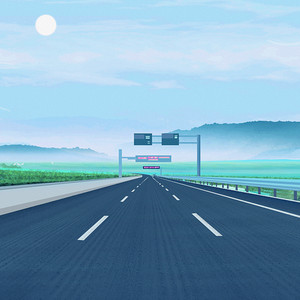
Recently, the toll collection periods for two major expressways in Chengdu, that's in the southern part of China, along with several other roads across the country.
They've officially expired.
Many are now ceasing toll collection entirely.
So, how will this impact daily commuters and the logistics sector?
And with the toll revenue gone, who will now cover the ongoing costs?
We are live from Beijing.
This is Roundtable.
I'm Steve.
Thank you so much for being with us today.
And for today's show, I'm joined by Fei-Fei and Yushan.
First on the program.
A big change is taking place on China's roadways.
The expiration of toll collection periods for key expressways, including two major routes down in Chengdu, is leading to a gradual phasing out of fees for an increasing number of drivers.
But will the elimination of tolls lead to increased traffic congestion or will it simply ease financial pressure on families and supply chains?
And more critically...
The expiration of these revenue streams forces a bigger question.
Who's going to pay for the upkeep from now on?
We'll explore all the answers and hopefully that will reveal the challenges and opportunities in transitioning from a user pay model to a publicly funded system for critical infrastructure.
Fei-Fei and Yusheng, good afternoon to you both.
Yeah, this is a tricky one, isn't it?
Because there's advantages that are quite obvious, but there are also disadvantages as well.
We're going to talk about all of them.
So Yusheng, kick us off.
This is down in the southern part of the country, this news story.
Yeah, a huge shout out to southwest China's city of Chengdu, where lately two of their expressways the Chengdu-Mianyang Expressway and the Chengdu-North Exit Expressway both saw their toll collection period going expire on September 4th and September 17th this year respectively, meaning that toll collection on the two expressways is ended starting from 12 am on September 5th and from 12 am on September 18th respectively.
So there were probably cars just sitting there at 11.59.
I'm not going to go home until one minute later, so I don't have to pay for it.
I was looking forward to see just how, you know, local people are going to flock up or use these two highways more specifically, given that it's going free very soon.
So these aren't the only ones, though.
There are more that are doing this as well.
Yeah also.
A reporter from China City News announced that quite a number of expressways have reached the end of their toll collection period in recent years.
That includes the Shanghai Jiading Expressway, the Guangzhou Foshan Expressway, the Wuhan Huangshi Expressway and Beijing Pinggu Expressway, the one that us people living in Beijing use quite often these days.
These are all among those that had already canceled on the tolls.
The one here in Beijing where we are.
Is that one of the ring roads that goes around the city, or does that connect Beijing to other provinces?
Well, I think it's not the ring roads.
It's an expressway.
So it's only, I think, a section of that expressway from a place called Li Tianqiao to the border of Beijing and the Tianjin city.
Okay.
The ones that we've spoken about so far, though those are dotted around different parts of the country.
But these are all major highways that we're talking about, right?
These aren't little tiny sections of road.
You can say that because these are all vital highway fast links between major cities within the province like say, Wuhan Huangshi Expressway, or between city and nearby regions, like Shanghai and Jiading Expressway, where Jiading is a nearby say district surrounding Shanghai.
So these are all like important, say, linking roads or fast links.
Some of them are parts of a longer or busier highway projects, like you mentioned, but they're all like vital projects that links important cities or regions together.
Highways in China, the country has built a lot of them in a relatively short period of time.
This goes back to what, the late 1980s, am I correct?
Yeah, the first highway ever built on the Chinese mainland is the Shanghai Jading Expressway that we just mentioned.
That one was completed back in 1988 and it began waving Tofu. since 2012.
So about 24 years then.
Yeah, yeah.
But quite a long time ago, it's kind of free.
And also we have the data from the Ministry of Transport.
It shows, by the end of last year, the total length of Expressways in China has surpassed 190000 kilometers, which is the longest in the world.
That'll wrap around the world a good few times then, I guess.
4.7, I think.
Oh, you do that to be exact.
That's quite the commute.
So then, in this development process, they have a model of building roads with loans and then repaying them.
Can we talk about that a little bit?
Yeah, this one.
It has provided essential financial support for the construction and operation of the expressway network in china.
So this model you just mentioned steve, it refers to a system in which the government or enterprises borrow from banks or other financial institutions during expressway construction and then repay the loans through the collection of vehicle tows or like businesses opening nearby the highways.
Yeah, but for the toll collection period, that depends on the situation, right?
It can be different depending on the highway or depending on the deal.
Yeah, actually there is a regulation on this calling the regulations on the administration of toll roads, which took effect on November 1st in 2004.
This one specified that the maximum toll collection period are 15 years for government repaid expressways and 25 years for operational expressways.
So there are two different say, mechanisms in running this with extended limits to 20 years and 30 years respectively, in the central and western regions here in China.
Well, what's the difference between a government-paid expressway and an operational expressway?
I'll say government-paid is quite literal, like it's funded by the government through incentives for funds.
Then the operating expressway.
That one follows another pattern, where the government grants companies the right to invest in and construct goods and operate highway projects through agreements.
And after the operation period ends, the projects are handed back to the government free of charge.
And, during the operational period, companies who constructed the highway.
They can generate revenue primarily from toll collection.
So that's like giving enterprises and companies the right to operate and also construct, then operate on the rights of using that highway.
Sure, but the point is that the point of the tolls is to help repay the debt.
Should there be debt and there often is debt or at least hopefully generate some revenue to pay for management and upkeep along with those costs as well.
What are experts saying about this then?
Well, I think a lot of experts have this consensus that tolls won't be in place forever.
They will definitely, we'll see the termination of toll collections, especially upon expiration.
Data approaching, for example, the example that Yushan gave the Shanghai Jading Expressway, the very first one in mainland China, on the Chinese mainland, that has approached the expiration dates and more and more and more such expressways will face similar situations and it actually benefit the people, because that's what infrastructure is for is a public, so it should be a public service and any anybody can enjoy this kind of service free of charge.
But that also brings another issue is with when we look at the costs for constructing these expressways.
They can be very expensive.
I think we have a calculation from Dongguan Securities.
They indicate that the average construction cost is about 175 million yuan per kilometer.
Yeah, per kilometer.
It's a shocking number to hear, isn't it?
But that's often the case when you hear about highway construction around the world.
It's millions for a very short period of the road.
Right.
Yeah, and then we also have maintenance and everything else to keep it up, especially after the expressways being in operation for a longer period of time.
You need more money to maintain that, for repair or for greening or for whatever, or sanitation or whatever reasons are there for?
So we are also seeing the regulations that Yushan mentioned, the regulation on the toll roads.
They are reviewing it.
We are seeing a draft revision of that regulations, which I think are trying to find more diverse ways to financing this maintenance of the expressways.
For example, when it comes to the operation period of commercial toll road projects, it should be determined according to the principle of recovering investment with a reasonable return and generally must not exceed 30 years.
So I think it's longer than the 15 or 25 years.
Well, that would depend, wouldn't it, on the loan, the amount of the loan and then the amount generated from the expressway.
Yeah, exactly.
And for roads with huge investment and long payback periods, the operation period may exceed 30 years.
So it's more of a case-by-case study.
And I also think it depends on in which regions. these expressways are in.
For example, in the older version of the regulation it says for expressways in central and western regions, where it's less populated may see less commute on the roads and they can extend limits to 20 or 30 years.
Okay.
But this is just a draft, right?
Yeah, exactly.
They're still reviewing it and contemplating.
Yeah, it was in May that the Ministry of Transport included these revised regulations in its annual legislative agenda.
And that means that probably clearer rules may soon be established on whether expressways can be toll-free after the toll period expires or how toll collection can be extended.
And like you said, Fei-Fei, it's probably going to be a case-by-case situation.
But why are there so many expressways that are extending?
I mean we're hearing a couple of examples about roads in Chengdu that will be canceling their toll fees, but there are many more examples of expressways that are extending their toll-free schedule.
So what's the reason behind that?
Well, one major reason is on the high cost of construction, like Feifei mentioned.
For some sections due to the high investment costs and low traffic volumes, they're finding it difficult to recover costs and say, achieve a reasonable return within the prescribed tolling period.
So many of them are trying to extend as much as they can within the regulation to, you know, just attract more revenue in some ways.
And also calculation, by don't grant security, like you mentioned earlier feifei, they indicate that the average construction cost is very high per kilometer and i think is it a recent or has it been running going around for a few years that For those highways that do not yet cancel their toll fees, they open freely to the public during vacations like the upcoming one in early October.
From October the 1st to the 8th.
In Beijing's case, many highways around Beijing is going to be free for people to travel by in and out of Beijing, which encourage a lot of local tourism surrounding Beijing, in surrounding regions in Hebei or Shandong or nearby provinces and regions as well.
So that's one of the incentives that was trying to do the same in some way.
That's encouraging people to travel more often and increase the volume of people going around, shopping around and booking hotels while filling up their gas tank along the way.
That's all opportunities created for people to travel around and shop around.
See, that's one of the problems, I think, when we have toll free expressways.
Do you know how congested those highways are during holidays?
Especially, for example, the upcoming national holiday, which I think it's a nationwide campaign a few years back to cancel all the toll fees on expressways across China.
And basically in Beijing's case, you need to wake up in the middle of the night and hit the road.
Otherwise, you will be stuck in the traffic for three, four hours easily.
Three, four hours?
That seems pretty reasonable.
Reasonable?
Well, I've heard stories of, you know, being on the road for 15, 16 hours plus, depending on where you're going and how far you're driving, of course, right.
Only stuck in the traffic, like you're waiting in line.
Oh, just sitting there.
Yeah, just sitting there.
Oh, I thought you meant like from one place to another.
In some cases, I think it was during one year's spring festival season, when it's during cold winter and it was snowy in, I think, central China.
Was it southwestern China?
And people were waiting on the highway, all crowded up and it was heavily snowing and it's passed for hours and sometimes some cars may have like engine issue or issue with their AC inside the car and people were freezing.
It was like quite a big news back then.
And the local authorities were sending aids, like helps and resources allocating to those people piled up on the highway.
So these are all very practical issues.
How can we perceive this in a more say, efficient way for all that's traveling by highways?
Yeah, I get it.
But we're talking about national holidays here, right?
I don't think having a toll-free idea or having people pay for their tolls during a national holiday, I don't think that's going to alleviate the traffic.
People are going to be on those roads anyway, right?
Hmm.
But you know, speaking of the tolls and this has been an issue in recent years the revenue and expenditures have shown a pretty significant shortfall all around the country.
Back in 2021, the national toll road statistics bulletin released by the ministry of transport.
That report said that the toll road vehicle fee revenues amounted to about 663 billion yuan, that's about 93 billion dollars.
Again, that was 2021, but the expenditures reached nearly 13 trillion, or 182 billion.
Now you don't have to be a math expert To know that that's a problem, right.
That left a gap of about 628 billion yuan or about $90 billion.
That is a huge, huge gap.
And also, we need more money in maintenance.
For example, in China, major maintenance is typically required after 8 to 12 years of services.
So that's the case for most expressways now in China.
And so an expert called Zhang Yuling and other researchers from the Highway Science Research Institute of the Ministry of Transport.
They estimate that by 2030, the additional demand for the fund for maintenance is expected to exceed 300 billion yuan or 42 billion US dollars.
Yeah, it's not cheap, is it?
And that's why the decision, I think the decision to build a road.
We know how expensive it is millions and millions of dollars per kilometer.
And you know how much money needs to be invested in that.
It's a calculation, isn't it?
How much money can be... recouped from that investment.
But it's also hard to predict, I suppose, how much that road will get used, or if it will be underused and you'll be operating at a deficit.
It's a very tricky thing to do.
Yeah, the efficiency of highway traffic is one very important element to look at.
And in the meantime we also mentioned how the government's fiscal and tax capacity could also create an impact here on just how much money can be allocated to the highway for maintenance and for further construction in the future.
So it's important to prevent serious congestion, let's say reduced capacity and declining service quality and lower logistics efficiency that could result from the cancellation of tolls.
And also it's not a very direct and simple math problem when it comes to building roads and expressways.
Because yes, it's a big money to invest in building them and maintaining them.
But also when it comes to the ripple effects coming from this new connection to the outside world.
What do you mean?
There is a saying in China, if you want to get rich, build a road first.
Like this is the step one in poverty alleviation.
Hold on, if I want to be rich...
Build a road.
And then you need the money.
Talk to my wife about that one.
And you need the money to build a road.
We need $24 million for one kilometer, babe.
Good luck.
So that's the step one for most of the poverty alleviation efforts here in China is that you get connected first.
And then we have other efforts coming.
So it's expensive to build the road.
And also we are seeing the massive gap currently.
But thinking about the economic development after... From region to region, city to city, right.
Yes, so I don't think it's a very direct math problem that we can see.
But when it comes to the toll problems in particular, It's also not a very direct math problem.
As we mentioned yes, canceling of the toll fees is a good news for travelers, especially for the logistics industry, that they are cutting down the costs for transformation, cutting down the costs for travel, and may lead to increased mobility.
And that means public benefits and everybody gains.
But what about congestion?
Yeah, no, exactly.
And that's very hard to predict, right?
Because Yes, for everyday people who use those roads, individuals commuting or traveling on those highways, they would save money.
And that would be a big deal for people who use those roads every single day, right?
For some highway toll collection stops.
I saw one report saying that, depending on where they are and how popular they are, they can collect up to millions of yuan per day.
That's like a...
Quite a bit of a revenue for such a big project.
100%.
Yeah.
And we have a similar situation in Canada.
We have the Trans-Canada Highway that goes from one side of the country to the other.
And the maintenance, I think, is taken care of and the upkeep is taken care of, depending on which province has that section of highway.
So Nova Scotia, where I'm from, they'll be responsible for the Nova Scotia section of the Trans-Canada Highway.
And then the federal government.
I think they take care of if it goes through national parks or something like that.
But the upkeep itself is paid for by individual provinces.
And it used to be the citizens in Nova Scotia if we wanted to use a section.
They built a new section of this highway.
And if we wanted to use it, it was $4 every time we wanted to use it.
Now, that's pretty expensive if you're going to be using that every single day, right?
That's $20 a week, $80, maybe almost $100 a month.
In 2021, I think it was 2021, they lifted the fee for Nova Scotia citizens.
So only people coming from outside of Nova Scotia needed to pay that toll fee after that.
And people started to use it more.
Before that, I remember... my dad would refuse to pay for that, right?
So there always has to be an alternate route, because you can't force citizens to take a paid road right.
And we used to go oh my goodness, we used to spend an extra 45 minutes going on the non-highway section so that he wouldn't have to pay the 4 charge.
My long story.
The point of it is that, for many people who weren't using it before, who are using alternate routes, this will be their new choice, right.
And this will probably lead to increased congestion.
Yeah, especially when it comes to truck drivers, for example, who rent or buy a truck themselves and they need to think very delicately in details about the costs and the revenues and these tolls are one of their big part of their expenditure costs of running a truck, but also when it comes to the maintenance of a very long expressway.
I think in China we also have a very similar system to Canada that for an expressway which passes through different provinces and regions.
Each province and region is responsible for the maintenance of that segment.
And you can see the differences when you're traveling between them.
From province to province.
Yes.
For example, the design will be different. in some cases.
And if you are traveling from provinces and regions of different economic development levels, there is also a difference when it comes to how well this section is managed.
And I think that reflects on the fairness of the use of infrastructure.
Is it really fair for the poorer regions to have rows of worse conditions?
Isn't that supposed to be public resources and everything like that?
Revenue needs to be generated because they need to be paid for somehow, some way.
So let's talk about that then.
So if highways become free of charge for people to use, then who should be responsible for those maintenance and management costs?
Well, experts also say that operators nowadays they must rely on alternative sources such as fiscal subsidies and businesses and service areas and integrate just more diverse development on road or roadside land to utilize that land to create more opportunities for consumption and business opportunities.
And this would help highways, to help them transit from a single-toll revenue model to a diversified operational model and attract more state revenue through elsewhere.
So what we're talking about there is the government would pay the basics to cover the essentials like fixing potholes or what have you on the roads.
That would be the fiscal funds.
But then they have to get creative, I suppose, for how to make that extra money.
And that's where the social capital would come in, where you'd have investments from businesses, perhaps that were allowed to make sections of the highway more useful or more profitable in new ways.
You could have rest stops where there could be restaurants and coffee shops and places where those businesses could pay taxes and that tax money could be used in the upkeep.
I remember, like back a few months ago, service areas in Zhejiang province got quite an online sensation because of the diverse services that they offer.
Not only they have like convenience stores, restaurants, you can also shower there.
There are also like massage rooms.
It's a very different experience. surface area compared to other regions in China.
So that's not a nationwide standard.
If you're going on highways all around the country, you're not going to find that in many different places.
I wouldn't expect to.
Yeah, I think when it comes to surface areas, we do have very regional differences.
In some regions, it's more of a basics, just offering the basics, you know, toilets. um food that's it convenience stores yes and but when it comes to like um zhejiang provinces and also i think more developed regions they are more innovative when it comes to what services and what functions can these service areas bring and that is the place i think can generate more revenues i would think i don't do you have them in china or not along long sections of highway do you have small motels or hotels They have that in the United States commonly, and I think we do in Canada, too, where it's not going to be like a five-star luxury resort, but just a really affordable, cheap kind of overnight place with very basic rooms.
Do you have that kind of thing?
I have an encounter.
Yeah, it's definitely not common, probably in some regions, but it's definitely not a national thing.
Internationally, if we could have a look at a couple of examples there.
One of the more famous highways on the planet is Germany's Autobahn.
Famous, I think, because there's no speed limit on that road, as far as I know.
That's safe.
If there's a speed limit, it's much higher than it is in other places.
You're hearing that for the first time, I guess, yeah.
Anyway, we're not talking about that today.
There passenger vehicles under three and a half tons.
They can use the entire Autobahn highway system network for free.
They don't have to pay for it.
Germany operates a truck-only toll system with cars exempt from the uh costs.
In the united states, most us highways are toll free.
Um, there's an interstate system that's free of tolls for the for the most part.
There are certain segments though, where there are collection spots on the highways, and i think this happens a lot in the northeast part of the united states.
I remember traveling with my parents from Maine down through New Hampshire and Connecticut and on our way down south.
And there were all these.
They're called turnpikes, I think is what?
Correct me our American listeners please correct me if I'm wrong called turnpikes.
And you have to pay for sections of that, of the highway if you use it.
But it's not nationwide, most of the highways there.
So how are the conditions if they're toll free in it?
Very good.
Yeah, very good.
Very safe, very wide.
The sections of roads that I was on in the United States, they divide them into two.
So you'll have traffic, all traffic, headed in one direction, on one side, and then there'll be like a large grass kind of middle part.
And then you'll have the other two lane section on the other side.
So the traffic going in opposite directions doesn't even come close to each other and the road conditions are typically very, very good.
Yeah, that's nice.
Yeah, it is um.
So it's a, it's a again.
It's a tricky situation, isn't it?
Because you know the money has to come from somewhere.
But do you, just before we wrap it up, do you support this kind of toll-free idea or do you think they should stay in place?
Well, I don't have a big problem with tolls, but I do think if the law is the law, if the law stipulates that it should be expired at a certain period of time, then it should be expired.
We just need to be more careful when it comes to the design for the next phase of the operation of the roads.
Agreeing with that, and also I do support the fact that if more of such roads with enough time limits or coming to the expiry time anytime soon, it's something worth anticipating as someone who drives and are willing to travel via self-driving.
Yeah, we'll have to see what happens as a result of these toll-free changes.
We can expect more congestion, but people are going to be excited about that change for sure.
You might see my dad on Chinese highways. coming soon.