Hi, everybody.
Welcome to Women in Retail Talks, the podcast where C-suite executive women in the retail space share their stories of professional growth leadership development, personal journeys and more.
I'm Melissa Campanelli, the co-founder of the Women in Retail Leadership Circle, a membership-based community of executive women at leading retailers and brands.
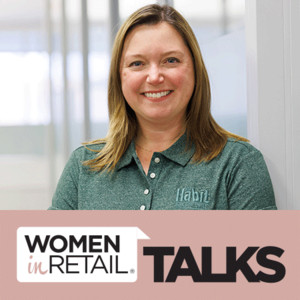
And joining me today live from Shop Talk is Shannon Hennessey, the CEO of the Habit Burger Grill, which is a made-to-order food chain that's a subsidiary of Yum.
Brands.
Today we're going to talk about Shannon's career journey, her leadership tips, her thoughts on work-life integration and so much more.
Thanks for having me, Melissa.
You're totally a natural at this.
Thank you.
So let's start by talking a bit about the Habit Burger Grill, just in case our audience hasn't heard of it.
So tell us about it.
Where's the locations?
And what about the name?
Yeah.
Yeah.
So the Habit Burger Grill is actually not a new company.
We were founded in 1969 in Santa Barbara, California.
But because we have 370 stores and only 14 of the US states, there's still a lot of people out there who haven't heard of us before.
So for those folks, we're a fast growth, fast casual company.
We sell burgers, sides, sandwiches, salads and shakes inspired by our California heritage.
Really yummy food.
We have the number one ranking best burger in America and now actually the number one grilled chicken sandwich in America, thanks to being awarded by the Daily Meal recently.
So the food's incredible.
But what really makes us different versus our better burger competitors is how the customers feel after they eat us, which is they feel good.
And that's because we cook our proteins over an open flame on a char grill.
We freshly prep our ingredients in the back of the house.
So the avocados and mushrooms look like avocados and mushrooms you find in the grocery store before you come in and have them in our restaurant.
And we have a pretty wide variety of menu items as well.
So we sell things like ayu tuna, we lettuce wrap, our sandwiches, which are not things people would necessarily expect to find.
You asked me about the name as well.
Yes, I was just going to say that.
So I always like to say there's two types of people in the world.
There's people who love the habit and people who have never heard of the habit because the food is so good.
Once you eat it, you make it a habit.
That's great.
That's great.
My mouth is watering just listening to this.
I'm hungry as well.
Um, so you're the CEO, which is amazing.
Um, can you briefly walk us through your career journey and how you came to be the CEO?
It's sort of the leading up to it as well.
So I'm relatively new in the second chapter of my career.
I was actually a McKinsey consultant for almost 20 years was kind of chapter one.
Um, I like to say I like people in problems, so that kept me captivated for a long time.
But about four years ago, I left McKinsey and joined Yum!
Brands right before COVID actually.
So it was kind of comical timing and I joined KFC as the global CFO.
Learned the business real quick as one had to do during COVID, and really, really liked that job there.
The title of CFO is kind of different at Yum than it is in other places.
So, in addition to having the accountability for division level finance, I also oversaw strategy and supply chain and analytics.
So it's a pretty broad role, a really interesting one.
And I realized through that experience that the aspects of my non-consulting role I liked the most were about shaping the news more than reporting it.
So I was trying to think through what would make sense for the next growth role.
And right around that time I was approached by the leadership of Yum and the longtime CEO of The Habit, Russ Bendell.
Habit had also joined the Yum family right before COVID, acquired almost the same day that I started with Yum Brands.
And Russ was looking at retirement.
He knew that after he joined Yum he would be there for three to five years and he felt like the time was right to start looking for somebody to come in and replace him.
And so I was so fortunate that I got to come in and spend a year learning from him, because he had built the business from 16 stores to 350.
He knew anyone and everyone, everything to know about the business.
Just an incredible leader, incredible operator.
And so I was able to learn from him, really get my land legs in the business and then take over as CEO after about a year.
Wow, that's amazing.
I really love that story.
Succession planning is a hot topic for our women and I think that's a great lesson for those that are interested in moving an executive to a higher level women or man is to give them the time to work with them for a year or so to just learn the business before just being plopped into a position like that.
I think that's really great.
It was an incredible privilege, honestly.
Now I can imagine there would be leaders who would find it hard to have somebody alongside them with different opinions and different ways of thinking.
Russ was just amazing because you know he really would take me aside if he felt like the direction I was going in was not going to be right for the business and kind of address that with me and give me some, maybe pieces of information I didn't have.
But on a lot of places, he just really let me run.
And I felt like he was there to have my back and make sure that I was set up for success.
Great.
So the other follow up I wanted to to mention was your work as a CFO and how that prepared you for the CEO position.
It is interesting that the CFO position at Yum is a little different, but I do think it's important for our listeners to understand the importance of having the finance and the strategy in their background if they want to move up to the CEO level.
So could you kind of talk a little bit about that?
Yeah, I mean, being the CFO at KFC was such an amazing opportunity.
It was a combination of things I knew well, coming into the role a bit stronger on the areas of strategy and supply chain.
And I had a little anxiety about overseeing finance for a big global corporation.
My degree was in finance, but it was 20 years before I took this job.
And I asked a lot of questions about the team that would support me to make sure I would actually be set up for success in that role.
So it was an awesome combination of things to really get to know, because you could see how you could impact the business.
And one of the things I worked on as the CFO was figuring out how we could find more money for digital, which is a big area of growth for KFC.
And so you're able to be very strategic but also then hardwire that back to the financials.
So I find that experience quite relevant to what I do now.
Habit is a 700 million business, so it's the sort of role as the CEO where you have to both coach the plays and coach the players.
So I get into a lot of detail on the decisions that we make, whether it's how we price our products or where we put our stores.
So I really roll up my sleeves in that background of having been a CFO and the analytics and also the background of having been a consultant is very useful on that.
Coaching the plays.
And then coaching the players is really about being a great coach.
And I feel like I've been auditioning on that for probably my whole career to date.
Yeah, I'm so excited to talk a little bit with you about leadership in a minute.
But let's talk a little bit about the Habit Burger Inn before we move there.
And what would you say is your vision for the future?
You have this role as CEO.
You've been there about a year.
What do you plan to achieve in your role and for the company?
I really want the Habit to be the winner in the global better burger space.
I love the space that we play in.
A lot of people hear burgers and they think, you know, the big QSR players.
But the area that we're in that's more cooked to order.
It's slightly more premium for a customer that is looking for something better.
It's so fast growth and it's a race that's yet to be won.
Even the players that are a little bit bigger than us are not that much bigger than us, and none of them have the backing of the world's largest restaurant company the way that we do.
So I really feel like we are equipped to win in that space.
When I came to The Habit, I fell immediately in love with how good the food was and with the culture in the restaurants.
So when you walk into our restaurants, you would immediately know.
And it's so hard to bring to life in an audio format like this, but it feels so different from going into other restaurants.
There's no timers.
There's no beepers.
We're going to greet you right out of the gates.
I was talking to a customer the other day who said it's like a sit down restaurant quality and experience at prices that are just a little bit more than fast food.
So I think that's really, really compelling.
But I also realized there was quite a lot of opportunity on figuring out how we could accelerate more profitable growth.
So make the things that we do in the back of the house easier to scale.
We're still largely owned and operated right now.
So part of our growth story will be more franchisees over time, and we need to be able to plug them in more readily into our growth system.
And then from a profitability standpoint.
We continue to carry so much about quality, but we just hadn't done a lot of work in terms of our supply chain, making sure we were getting the best prices for what we put forward.
We hadn't really updated our labor model, for the fact that our business has pivoted pretty significantly to more of an off-premise business.
So more people buying the food and consuming it either through delivery, right, or takeaway.
And so there was, you know, quite a bit of work on that kind of accelerating profitable growth side.
And that's what I think will be the big unlock for us in becoming the leader in the Better Burger space.
Sounds exciting.
You have a lot of growth ahead.
It's fun.
Sounds like a great. great opportunities all around.
So I'm going to jump ahead to leadership.
You talked about coaching.
We've talked about that a lot in our content about being a coach as a leader.
So I'd love to talk a little bit about your leadership lessons.
What are some of them that you've had from your years?
Probably the biggest one for me in my career was building my own confidence which, when I talk to people now some of the folks I work with just kind of like wow, it's hard to imagine that you struggled with that.
But I talk about it a lot because at the time that I was struggling with it I felt to me like I was the only one in the world who was struggling with it.
And I had a great coach early on in my consulting career.
And she said to me, Shannon, your confidence lags your competence.
So when you hold back, when you don't say something that you're thinking, you're holding the whole team back.
You realize that.
And that was a big moment for me of like, oh, it's not just about me.
It's about the contribution I'm making to the bigger whole.
But I would say I struggled with imposter syndrome for the first 10 years of my career and had some really great mentors who recognized that I needed not just developmental feedback but positive reinforcement as well.
Give me a couple atta girls.
Help me understand that I'm growing and I'm moving in the right direction to build that confidence.
And so I really try to pay it forward by sharing that same experience I've had with other folks who may be younger in their career and wondering if anyone else is feeling the way that they do.
So I think building your confidence invest as much energy in that as you do your skill set, right?
And that'll make everything kind of multiply and go better.
Another big leadership lesson for me is really being my authentic, true self in the way that I lead.
I've had many different experiences over my career.
Where I'll go, you know, either get feedback from a client, or you know somebody who's reviewing me, or I'll go take like an indicator, like a Myers-Briggs test or strengths finder, and the person will sit down with me and be like wow, you're a unicorn.
And you know, of course, then I feel like a pariah in that moment, a little bit like oh goodness, why is my profile so different from everyone else's?
But I do tend to lead in a pretty unique way, in that I care as much about the people as I do the problem.
And you tend to see people who are a little bit more on one side or the other, right?
Very collaborative but afraid of conflict or empowering the team but not getting into the details.
So I think that combination is a very different profile.
And I've learned, as opposed to feeling self-conscious about it, to embrace that.
That's who I am right.
And that's actually uniquely well-suited in a lot of situations.
And if it's not, maybe I think about how I build the team to go after it with people who have different leadership styles to myself.
So I do think a lot of getting comfortable in my own skin as a leader was learning to trust that, even if my strengths and my profile are different, that's all right, right.
And in fact, that might actually be a good thing.
I love that.
Confidence is so important as a leader.
And imposter syndrome is another topic that we continue to really discuss.
And so many women have it.
So let's talk a little bit about a time in your career when you had a failure or a setback or a challenge.
I'd love to hear about how it maybe turned around for you and it ended up becoming a positive or helped you grow in your career.
Yeah.
I think the time I was struggling the most in my career I was coming back from maternity leave after having my son.
He's 13 now.
And I was just going up for partner at McKinsey.
So it's kind of like going up for partner at a law firm.
It's like this big, rigorous process you've been working towards for years and years.
And no woman in her right mind would be on maternity leave, you know, if you had any say on the timing when all of this happens.
But, you know, life happens and that's how it worked out for me.
And what happened while I was away is I went through this process.
I literally remember talking to my evaluator three weeks postpartum, like just trying to, you know, make sure I had my hair was clean and I looked presentable and that sort of thing.
And while I was out, I didn't get elected.
I got what was called positively deferred, where they basically said we think you're a partner in the future, but not yet.
And here's some things you need to work on.
And the other thing that happened was my client platform fell apart.
So it was right around the time of the 2009, 2010 kind of softening in the overall sector.
I did a lot of work in retail, even as a consultant.
And so I came back to a pretty scary situation where I was going to be reviewed again, given the timing of my maternity leave in about three months.
And I had no clients really active to be able to show progress around this.
And my biggest lesson in that moment was ask for help because I actually could not have done it myself.
I didn't get elected three months later, I got elected nine months later.
And I only got elected because the people who really believed in me and cared about me and some of those people had worked with me and knew how good I was
And some people just knew me, right, from the office and wanted to see me succeed.
They created opportunities for me to be able to act on this feedback, with the knowledge that, in the long term, I would be a productive member of the partnership, and I might just need some help right now.
I still wouldn't say I'm the best at asking for help.
You know, there's something about it that feels like a mission of defeat, or I just worry about what others may think.
But when I do struggle in those moments I think about that, because without that I would definitely not be where I am now.
That's a great answer.
Yeah, asking for help.
It's definitely not a setback, but I could see how maybe you felt that situation you were in was a setback and asking for help was how you were able to solve it.
It was.
I really couldn't solve it for myself.
But as somebody who's always been pretty independent and likes to get in there, always does more than her fair share in any team, that was a vulnerable moment for me to realize that I wasn't going to get where I needed to get.
And sometimes you ask for help and you don't get yes every single time, right?
So you have to.
Yeah, I mean it's a testament to your team too and your relationships that were built with the team.
So it's great.
And it helped you move up.
So that's great.
Work-life balance is such a big topic.
We call it work-life integration with our group.
I know you have a son, you said.
Son and a daughter.
Oh, and a daughter.
So can you talk a little bit about how you keep, keep everything, keep all the balls in the air.
So I you didn't use the word balance, you said integration, which I really like, because whenever I hear the word balance it always sounds so neat and pristine and clean and I call it my beautiful chaos.
That's really what it looks like if you peek underneath the, underneath the hood, and I I think part of my tactic is just understanding that that's how it's going to be right.
It's not all going to be neat and clean and um, i actually feel the most fulfilled when i'm really busy at work and really busy at home, and so just that kind of knowledge that it's going to sometimes be messy, but at the end of the day that's all right and that is very freeing to me.
But the other thing i'm pretty relentless on any assistant who's ever worked with me would tell you even better than i do is i have very, very clear boundaries on what i will and will not do.
I was told early on in my career like if you have to get up and leave a meeting early, You don't have to explain to people why you're going.
It could be another client.
It could be something else.
Only you need to know that.
Only your assistant needs to know that.
You don't have to make apologies.
Just go and live your life.
And I actually did that for a while.
And so I figured out my boundaries and that kind of era of my life.
And then I had other women come to me and say, like, how the hell do you do it?
And I was like, well, you know, when I'm getting up to it's not always a flight I have to catch.
Sometimes I'm going to drop off at school.
So now I actually talk much more openly about it, because I feel like that's part of being an inspiring leader who has a life and has children is that people understand that's what you're doing.
But I am.
I take my kids to school pretty much every single day I'm in California and not traveling.
That means being on the West Coast.
I don't take meetings before 9 on Mondays and before 8 15 on the other days.
And that's hard, being part of a global company.
Sometimes I have to call and ask people.
I'm sorry or you know what.
You can talk to me then, but I'll be in the car for 20 minutes.
And generally people are more than happy to accommodate.
I have found, if you actually just ask the question,
Figuring out what the boundaries are, I think they're different for every person.
For me, it's really about being present and part of my kids' lives.
That's amazing.
Yeah, I love the idea of time blocking on your calendar too.
Nobody needs to know what you're blocking it for, but just block it.
You can't have any whatever, just meetings at that time period.
Another one of my boundaries is i don't book meetings after one on fridays, because otherwise i end up working the weekends.
Because a lot of people send me things at the end of the week that i need to respond to.
So if they all come in friday, you know, and i'm in meetings until four o'clock on friday, i end up working the weekend.
So that's another one i've figured out to make sure i'm present right, and that's, and that's the bottom line.
It's you want to be present.
You don't want to be exhausted and overworked and resentful and all of that good stuff.
So I love it.
So I'm just going to ask you one more question in closing.
So what are you most looking forward to as we round out 2024?
I mean, I can't believe I'm saying that it's the first day of spring, but you know, people are planning, you know, for the end of the year already.
So, like what is, is there anything that you're looking forward to, professionally and personally?
Either one or both.
We're still kind of new California residents.
We're almost two years into the journey there, and I'm still new in my role.
So honestly, I think I'm looking forward to just seeing some of these seeds that I planted both professionally and personally bloom, you know, and see which ones bloom. how we lean into them.
My kids have made a great transition out to California and so watching them kind of flourish and make friends and get in their space is really, really nice.
And for me, we have so many things going work-wise.
I'm excited to see how they turn out.
Great.
Well, it was so great to meet you, Shannon.
So nice to meet you.
I really enjoy talking to you and I'm sure that your knowledge and wisdom will be shared with our audience, and they'll love it.
So thank you so much for your time and happy Shop Talk.
Thanks for listening.
For more information on this podcast, please go to womeninretail.com slash podcasts for show notes.
Women in Retail Talks is available on Apple Podcasts, Google Podcasts, Stitcher and Spotify.
Make sure to subscribe on our podcast channel page as well.
If you've enjoyed this episode, please take a few moments to rate and review our show.
Lastly, if you're a female retail leader interested in joining our community at Women in Retail Leadership Circle, visit womeninretailcom.
Slash apply.
Thanks and until next time, this has been Women in Retail Talks.