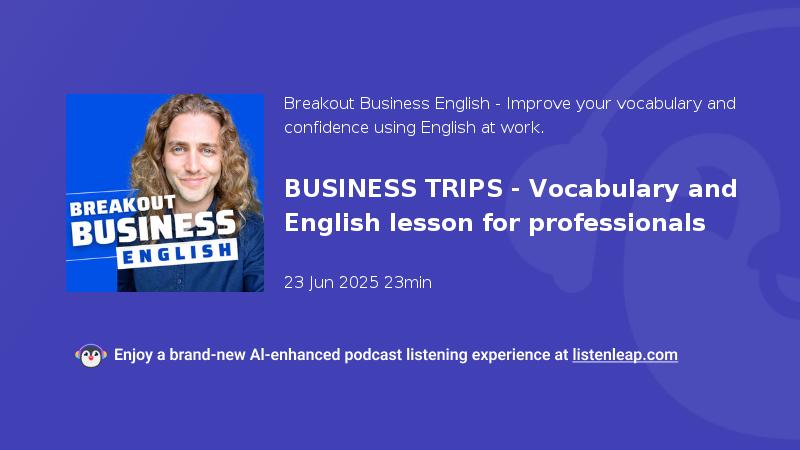
Welcome to the Breakout Business English podcast. Hi everyone, my name is Chris and I am a business English coach. I have worked with over 1 ,000 non -native English -speaking professionals from new graduates up to CEOs and government leaders to help them to improve their communication skills.
Thank you so much for listening and today's topic is business trips and travelling for work.
So one of the things that I enjoy discussing with people most is travelling for work and the business trips that they take.
I spent two years travelling full time and working online and now I live in the UK and I don't travel as much. but it's still something that I'm passionate about.
In fact, I have a four month old daughter, so it will likely be a little while before I'm traveling again.
But one of the things I love about my job is that it really is a window on the world.
Over the course of just today, day, I've had conversations with people from China, from Japan, from Germany, Italy, the UAE, and one person down in Brazil in South America.
So I really do get to speak to the whole world.
It's one of the best things about the work that I do.
I know that people travel for work a lot lot less than they used to.
But I do feel like the amount of business trips that people are taking is increasing.
It seems like I talk to someone every day who is preparing to attend a conference or travel to a factory or office in another country.
So whether your next trip is for work to the other side of the country, or for vacation to the other side of the world.
Hopefully, I can help you out today with some natural and native vocabulary to talk about travelling in a professional context, as well as the formal and informal grammar structures that you need to communicate with colleagues, clients, and customers about this topic.
Okay, let's start our podcast today with some examples.
Listen closely to these natural and native -sounding examples of people talking about business trips.
I'm going on a business trip, so I've set my out -of -office.
I'm going on a business trip, so I've set my out of office.
I'm going away to Italy for work.
I'm going away to Italy for work.
I'll be on the road for a few days next month.
I'll be on the road for a few days next month.
OK, let's start with that first example.
And, in specific, the verb that we associate with the noun.
Business trip. Talking about a business trip is very similar to talking about any other kind of trip.
For instance, a vacation, a road trip or a holiday.
So, we use the verb to go and then the preposition on.
We go on business trips.
If you want to make your life a little more simple, then you can use the verb to take.
As in, I'll be taking a business trip to Germany next week.
However, the most natural and native way to do this is with the words go on, to go on.
I should say a common mistake here is to use the verb to visit or to do.
I often hear people saying I'm going to visit a business trip.
That definitely doesn't work.
Or maybe I'm going to do a business trip.
Both of these sound slightly strange and unusual to native speakers.
One more thing that you can say here is I have a business trip.
I have a business trip.
So, if I tell you I have a business trip next week, then this sounds really natural and native.
This is a great example of when we might use the present simple tense to talk about the future, especially when talking about plans and scheduled events.
So, I have a business trip next week is a really common thing to hear.
In the first example, we also heard the phrase out of office.
Out of office. As in, I've set my out of office.
I've set my out of office.
In this phrase, out of office is actually short for out of office reply.
You're out of office reply.
reply. This means that if I send you an email or I call you, then I'll get a pre -written email or a pre -recorded message telling me that you are not in the office.
You're on a business trip.
And the message should let me know the specific day that you will be back.
This is often abbreviated just to the letters 000 in messages so the next time someone reminds you to set your 000 before you leave the office you know what they're talking about it's your out of office reply just don't forget to include a suggested alternative person to contact in your out out -of -office reply.
It's always annoying when someone is away from the office and you don't know who to contact in their absence.
I should say that I had an experience a couple of months ago.
I called someone. I got an out -of -office reply.
It told me to call a second person.
So I called this second person and found out that this second person was also out of the office.
But it was okay. they had an out of office reply telling me to call a third person and you guessed it this third person was also out of the office and their out of office reply well that sent me back to the first person again I found myself in an infinite loop of out of office replies if you can avoid creating creating an infinite loop of out -of -office replies, then I definitely encourage you to do this.
And if you're looking for something even more natural and native than the phrase business trip, then maybe you can use the phrase to go away for work or to go away with work.
Both of these are really natural and native.
however, to go away with work kind of suggests that there is a group of people who are all travelling with work.
So, in our second example, we heard, I'm going away to Italy for work.
I'm going away to Italy for work.
If you tell someone that you're going away, then they might think that you're going on vacation.
However, if you specifically tell them that you're going away for work or going away with work, then they should know that you are going on a business trip.
We often hear this phrase in slightly different grammar structures too.
For instance, instance, David is away for work this week.
Can I help you? David is away for work this week.
Can I help you? Or maybe, I'll be away with work next week.
So, contact Emily if you need anything.
I'll be away with work next week.
So, contact Emily if you need anything.
thing. Another phrase in our third example was to be on the road, to be on the road.
In our third example, we heard, I'll be on the road for a few days next month.
I'll be on the road for a few days next month.
Although, as you can tell, this phrase was originally used to talk about driving between places, literally traveling on a road.
These days, it's used to talk about all kinds of traveling.
So, whether you're taking the train to your next meeting or flying internationally, you can still talk about being on the road.
And if communicating in English with people from around the world, whether you're on the road or not, is important for your job, then maybe we can work together.
My full -time job is helping international professionals who use English at work to improve their communication skills.
So, if you need English to do your job, but you don't speak it natively, then I would love to meet you.
If you'd like to book some time to meet with me through one -to -one video calls, just you and me, then you can go to BreakoutBusinessEnglish .com.
That's the title of the podcast, BreakoutBusinessEnglish .com, and find out more.
Starting on our very first call, we can focus on the specific opportunities opportunities that you personally have to improve your English and communication skills and the mistakes that you make most often or cause the biggest problems with your communication.
And right now, you can use the code PODCAST30, that's P -O -D -C -A -S -T -3 -0 at checkout to get a 30 % discount off your first booking of 30, 45 or 60 minutes.
Sometimes my calendar gets a little busy so if you have trouble finding a time that works for you, you can always send me a message through the contact page on the website and let me know that you're trying to find a good time.
I've worked with well over 1 ,000 non -native English speaking professionals from new graduates up to to CEOs and government leaders to help them achieve their communication goals and I look forward to meeting you.
Okay, next let's talk about hotels.
If you're anything like me, then the most exciting part of any trip is finding out about the hotel.
How nice it is, what the pool is like, what the location is like, or maybe how bad the hotel is and how bad the location is.
If your company is feeling generous, then they might have put you up somewhere really nice.
If you're less lucky, then maybe they saved a little money on the hotel and they've booked you into the cheapest hotel in town.
Let's listen now to some natural and native sounding ways to talk about hotels that you might be staying at on your next business trip they put me up at a really nice hotel right in the middle of the CBD they put Well, it's not the writs but it'll do.
What did you spend your per diem on yesterday?
what did you spend your per diem on yesterday okay let's start with something fun that I included in our second example and that's the phrase it's not the writs it's not the writs So, first we need to establish what The Ritz is.
The Ritz is a shorter way to say The Ritz Carlton.
This is an expensive, well, very expensive and luxurious chain of hotels.
It's usually the nicest hotel in town.
You might also know The Ritz from the song Putting On The Ritz by Fred Astaire, if you're into old music from time to time like I am.
So The Ritz has been synonymous with luxury and opulence and expensive lifestyles for a very long time.
For that reason, the Ritz has become a quick and informal way to talk about a really nice hotel.
Your boss might tell you, we can't afford the Ritz.
We can't afford the Ritz when they're telling you where you will be staying, for instance.
You'll notice that we usually use this phrase in negative sentences.
We use it to say that something is not as good as this famous chain of hotels.
Having said that, if you are staying at the Ritz, I guess you could say, wow, this is the Ritz.
I checked out their prices, though.
I don't think I'll be staying at the Ritz anytime soon.
In the first example, we heard the phrase, they put me up at a really nice hotel.
They put me up at a really nice hotel.
Here we've got the phrasal verb to put someone up.
To put someone up is to provide them with temporary accommodation or a place to stay.
If you're in the UK and not sure where you're going to stay, then I might say to you, don't worry about it.
I'll put you up. Don't worry about it.
I'll put you up. By this, I would mean that you can stay at my house.
I'll put you up at my place.
Alternatively, I could say that I'll put you up at a hotel near me.
I'll put you up at a hotel near me, which would mean that I'll pay for you to stay at a hotel near me.
This is a phrasal verb that is almost always heard in two parts, separated.
We use the verb put, then we add the person who needs accommodation in the middle, and then we add the preposition up.
So, So, if I need somewhere to stay, then I might call a hotel and ask, can you put me up for two nights, please?
Can you put me up for two nights, please?
One more time. We can't say, can you put up me for two nights, please?
That would be strange.
We need to separate this phrasal verb.
So, instead we say, can you put me up for two nights, please?
We separate those two parts of this phrasal verb.
Also, at the end of the first example, we have the acronym CBD.
This is three letters that we use to describe a part of a city, usually the very center of a city.
This stands for Central Business District.
Central Business District.
If you're in London, this could be an area called Canary Wharf, or in New York City, this might be Midtown Manhattan.
It's often harder to say specifically where the CBD is in bigger cities that might have two or three areas full of commercial activity.
However, in smaller cities, this is often just another way to talk about the city centre.
Let's talk about one more piece of vocabulary here, and that is per diem, per diem.
That's P -E -R, and then the second word, D -I -E -M.
This is a phrase that we heard in the third example.
What did you spend your per diem on?
What did you spend your per diem on?
One thing that I really like about the English language is talking about etymology.
This is where a word or a phrase comes from, the root or the origin of that word. English has been influenced by so many languages from around the world, not just around Europe, and shares ancient influences with a lot of languages too.
however the phrase per diem comes specifically from ancient Latin from the streets of ancient Rome itself this is one of those fantastic phrases which has not changed at all since well the days of ancient Rome now if we break it down we get the word per p -e -r which is still a very common word today, meaning each or every.
And we also get diem, which means quite simply day.
So the phrase per diem literally means for each day.
When you're traveling for work, your per diem is an allowance or an amount of money that you're given each day to spend on expenses or the things that you need to buy while traveling.
Most of the time this is spent on food of course.
Whether this is given to you in cash before you travel or you need to keep your receipts and claim your expenses back when you return to the office, everyone always hopes to get a nice big per diem for the next trip.
So, don't forget that you can book a session with me to work on your English communication skills by going to www .BreakoutBusinessEnglish .com That's BreakoutBusinessEnglish .com, the title of the podcast, or clicking the link in the show notes.
and use the code PODCAST30, PODCAST30 at checkout to get a 30 % discount off your first booking.
I've worked with over 1 ,000 non -native English speaking professionals from new graduates up to CEOs and government leaders to help them achieve their goals and I look forward to meeting you.
between episodes of the podcast you can get videos every few days on youtube just search for breakout business english or click the link in the podcast episode notes the podcast show notes again to go straight there also if there's a topic that you'd like to hear me talk about on the podcast, then I'd be excited to hear your ideas.
Leave me a message or a comment on one of my YouTube videos and I look forward to hearing from you.
Finally, if you're listening on Apple Podcasts, then I invite you to leave a review.
Every review helps me out and helps to push the podcast to new listeners and to grow the show.
If you have found this podcast useful and you think there are some valuable things in here, then feel free to write a couple of kind words and I thank you for that in advance.
Also, a review is another great place to request a topic for a future podcast. That is it for today.
Thank you so much, as always, for listening and for your time.
I really do appreciate it.
And I'll talk to you next time on the Breakout Business English podcast. Thanks a lot, everyone.
Talk to you soon.