Chapter 20 Farmer Thorogood and His Grandson I shall never forget my new master.
He had black eyes and a pointed nose.
His mouth was as full of teeth as a bulldog's and his voice was as harsh as the grinding of carriage wheels on stones.
His name was Nicholas Skinner.
I had heard men say before that seeing is believing.
But I should say that feeling is believing, for I never knew what misery was until then.
Skinner took no care of his cabs or men.
Most of the men who worked there were hard on the cabs and the horses.
In this place, we had no Sunday rest, even in the heat of summer.
'Sometimes on a Sunday morning, a group of men would hire the cab for the day.
'four of them inside and another man with a driver?
"'I had to take them ten or fifteen miles out into the country and back again.
"'None of them ever got out to walk up a hill, no matter how steep or how hot it was.'
Occasionally, I wouldn't go up.
I was too feverish or worn out to move.
Only then would the driver call them out to walk."
When I got back to the stable, I was so tired sometimes that I wouldn't touch my food.
How I used to long for the nice bran mash that Jerry would give us on Saturday nights in hot weather.
It would cool us down and make us so comfortable.
Then we would have two nights and one whole day for rest.
On Monday morning we would be as fresh as young horses again, but here with no rest.
My driver was just as mean as his master.
He had a cruel whip with something so sharp at the end that it often caused me to bleed.
He would even whip me under my belly and flip the whip so it hit my head.
This took much out of me.
But still, I did my best and never hung back.
As Ginger used to tell me, it was no use putting up a fight.
Men are the strongest.
My life was so awful now that on some days I wished I would die at work just to be out of my misery.
One day my wish almost came true.
I went on the cab stand at eight in the morning.
I had done a good bit of work when we had to take someone to the railway station.
A long train would be coming in, so my driver pulled up in the back of the line like so many other cabs did.
It was a full train, and as most of the other cabs were called for, we soon had our turn.
It was a group of four, a loud, noisy man with a lady and two children, one boy and one girl.
They had a lot of luggage as well.
The lady and the boy got into the cab.
While the man yelled orders to my driver about the luggage, the young girl came and looked at me.
Papa, she said, this poor horse can't take all our luggage.
He's so weak and worn out.
Look at him.
Oh, he's all right, miss, said my driver.
He's strong enough.
The porter from the train said there was so much luggage to take that the man should hire two cabs.
"'Can your horse do it or not?' said the grumpy father.
"'Oh, he can do it all right,' said the driver.
"'Papa, please,' the little girl cried.
"'Take another cab.
This is so unfair to the horse.'
"'Nonsense, Grace.
Get in at once and don't make all this fuss.'
The driver knows his horse.
My little friend had to obey while box after box was loaded on top of the cab.
At last, all was ready and we drove off.
The load was very heavy and I did pretty well until we came to Ludgate Hill.
It was there that my heavy load and my weary body stopped me.
The driver hit me hard with the whip.
Then I lost my footing and fell to the ground on my side.
The fall took all the breath out of my body.
I lay perfectly still and heard loud noises around me.
I heard one man say, he's dead, he will never get up again.
Still, I didn't open my eyes.
I could only take a gasping breath now and then.
Cold water was thrown on my head and some medicine was poured into my mouth.
A blanket covered my still body.
A man with a kind voice stroked my neck and told me to try to get up.
I tried very hard to stand.
Finally, on the third day, I got to my feet and was led gently into a nearby stable.
Here, good food was brought to me, and I ate the warm gruel thankfully.
In the evening, I felt good enough to go back to Skinner's stables.
A doctor examined me and said if you would let him rest for six months he would be ready to work again.
But right now, there is no strength left in him.
Then I'll get rid of him, barked Skinner.
He might get better, he might not.
I work them as long as they can go, and then I sell them for what I can fetch.
There's a sale of horses coming in about ten days.
If you rest him and feed him well, he may get better and fetch you a good price.
Skinner gave orders for me to be well fed and cared for.
It made me so much better.
I began to look forward to being sold.
Any change from here had to be an improvement, so I held up my head and hoped for the best.
Of course, at this sale I found myself with all the other broken-down horses.
There were some there I couldn't imagine anyone buying.
The men and women there, buyers and sellers, looked as poor as most of the horses.
There were old men with only a few dollars trying to buy horses to drag around carts.
Some other old men were trying to sell horses that weren't, in my opinion, worth anything.
There were other buyers, though, whom I would have willingly used my last strength in serving.
They had kind voices who I could trust.
There was one tottering old man who took a great fancy to me but I was not strong enough for his work.
I was very worried about what would become of me.
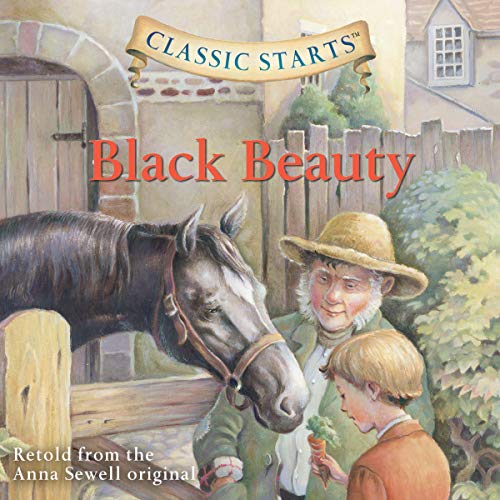
In a while, I noticed a gentleman farmer with a young boy at his side.
He had wide shoulders and a kind face and wore a wide-brimmed hat.
When he came over to me, he stood still and gave me a sad look.
I pricked up my ears and looked at him.
There's a horse, Willie, who has seen better days.
Poor old fellow, said the boy.
Grandpapa, do you think he was ever a carriage horse?
Oh, yes, my boy, said the farmer, coming closer.
Look at his nostrils and his ears, the shape of his neck and shoulders.
That horse came from a good family line.
He put out his hand and gave me a kind pat on the neck.
I put out my nose in answer to his kindness.
The boy stroked my face.
See, Grandpapa, how well he understands kindness.
Could you buy him and make him young again, just like you did with Ladybird?
My dear boy, I can't make all old horses young.
Besides, Lady Bird was not so old.
She was just run down and badly overworked.
Well, Grandpapa, look at his mane and tail.
He's very thin, but his eyes are not sunken like some old horses.
Please, Grandpapa, ask the price.
I'm sure he would grow young again in your meadow.
The man who had brought me for sale now put in his word.
The young gentleman is smart, sir.
Fact is, this horse was overworked, pulling cabs.
I heard the vet say that a six-month rest would make him right again.
I've taken care of him these past two weeks, and I have never met a more pleasant horse.
Pay this small price for him now, and he'll be worth double that next spring.'
The old gentleman laughed, and the little boy looked up eagerly.
The farmer slowly felt my legs, which were strained and swollen.
Then he looked at my mouth.
"'Thirteen or fourteen years old, I'd say.
Can you walk him around a bit?'
I arched my poor thin neck, raised my tail a little and threw out my stiff legs as well as I could'.
What's the lowest you'll take for him, said the farmer as I came back.
The price I told you is firm, sir.
I hope I'm not making a mistake, the man said, digging in his pocket.
Can you take him to the end for me?
Yes, sir, the seller said.
They walked forward and I was led behind.
The boy could hardly contain his happiness.
The old gentleman seemed just as pleased.
I had a good feed at the inn and was then gently ridden home by a man who worked for my new master.
When I got there, I was turned loose in a large meadow with a shed in one corner of it.
My new master, Mr. Thorogood, gave orders that I should have hay and oats every night and morning.
He also said I should have free run of the meadow all day.
His son, Willie, was in charge of my care.
The boy was proud of his job, and there wasn't a day that he didn't come to see me.
He always came with kind words and softly patted my neck.
Of course, I grew to love him very much.
He called me Old Crony because I used to come to the gate and follow him about.
Sometimes he brought his grandfather, who always looked closely at my legs.
The rest, the good food, the soft grass and the gentle exercise soon began to help my health and my spirit.
During the winter, my legs improved so much that I really did start to feel young again.
One day in March, Mr. Thorogood noticed that my legs were no longer stiff.
He's growing young, Willie.
We must give him a little gentle work now, and by midsummer he will be as good as Lady Bird.
He has a beautiful mouth and steps well.
We couldn't have hoped for better.
Oh, Grandpapa, I am so glad you bought him.
So am I, my boy, but he has you to thank more than me.
We must start looking for a quiet place for him where he will be valued.