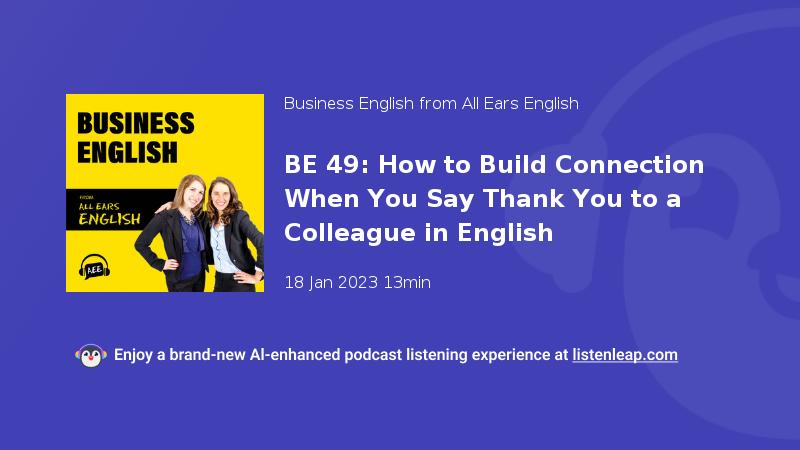
This is the Business English Podcast, Episode 49.
How to build connection when you say thank you to a colleague in English.
Welcome to the Business English podcast from All Ears English.
Get the English skills you need to achieve your dreams in global business.
For a presentation, a meeting, or your office party, this is Real Business English with your favorite American hosts, Lindsay and Michelle, coming to you from New York City and Colorado, USA.
Still translating in your head when you speak English?
It's time to change that. The Connected Communicator course from All Ears English helps you train your ear, speak naturally, and finally connect with real people.
In our tailored study plan, you'll hear unscripted interviews from tattoo artists to entrepreneurs from all across America. and you'll use new AI tools to practice speaking anytime you want.
No more stiff, scripted English. Build confidence, fluency, and cultural insight all in one course.
Plus, get real-life speaking experience at our Open Conversation Club every single week and build community with Allers English teachers and students.
Go to allersenglish.com slash connection to save $50 this week only.
Offer ends August 10th. allearsenglish.com slash connection.
Hey, Michelle, what are you excited about these days?
Do you have any trips coming up? Anything exciting happening?
Well, I talked about it a little bit last week, but yeah, I had that trip to New Orleans, so I was pretty excited about that.
Oh, my gosh. Live music in New Orleans, right?
That's awesome. Yeah. Yeah. So that was exciting.
How about you? Oh, I'm going to go out to California in the month of August for a couple of days for a conference.
That'll be fun. And, you know, just soaking in the summer, you know, spending time at the beach, trying to relax a bit, but also getting a lot of fun stuff done for All Ears English at the same time.
Oh, a conference. That's cool. Yeah. Yeah, it should be fun.
Conferences are always a fun way to kind of network and meet new people and learn new stuff and come back super motivated, right?
Yeah, yeah. That's awesome. Yeah, I know.
I know. So today, Michelle, we're going to answer a listener's question about how to say thank you to someone for the work that they've done.
Is this a crucial skill for connection in your mind?
Yes, absolutely. I think it's important.
Like if you want to build your connection, you've got to be able to do this.
Yeah. Yeah. Yeah. It's definitely a crucial skill.
Huge skill, guys. So important to remember.
Keep in mind as you listen today, our mission at All Ears English is connection, not perfection.
Focus on that. Okay. Okay. Michelle, would you mind reading the question for us?
Sure. Okay. Here we go. Hi, I'm a big fan of you.
I have a question about the word trouble.
I wanted to use thank you for your trouble when I really am thankful for someone's work, but I'm afraid to use the phrase.
I just worry if a native speaker misunderstands the word trouble.
I know that trouble has various definitions and the word in the context is not a real trouble, like a negative.
Would it be okay to use it? And could you recommend another phrase to use to thank someone?
All right. Good question. Good question.
Thank you. I know. It's a really good question.
That is from, I believe the student's name was Moon O, okay?
So thank you to Moon. Cool name. I like that.
Yeah, me too. Yeah. I actually know somebody here in Boston named Moon.
Oh, cool. And it's just a very interesting name, but very cool.
So good question, but we need a little more context here, Moon, because we don't know whether you're talking about at work, thanking a colleague at work, or...
Are you thanking a neighbor for doing a favor?
Right, right, right. Yeah, it really kind of depends.
So what's our assumption for today's episode, Michelle?
Well, so let's assume that right now we're at work thanking a colleague, but the colleague has gone beyond what she was expected to do to help you.
Yeah. I mean, for example, maybe she stayed late at work until 2 a.m. to help you with your presentation when she didn't have to.
Well, that would be really nice. That's definitely above and beyond.
Exactly. Way above and beyond. Really nice.
So, well, let's answer Moon's question straight up.
So thank you for your trouble. Right. So, yeah, it's clear that this word is not that the person has created trouble, but she has gone to a lot of trouble.
Right. Right. Right, right, right. Exactly.
That's an important distinction. So would you say this?
Does this sound natural to you? Thank you for your trouble?
Thank you for your trouble. Would I say this?
I don't know. Maybe not so much. Yeah, it doesn't sound – it sounds like it's missing a few words to me.
I would say thank you for going to so much trouble, for going to trouble, right?
Going – that's something I would say. Thank you for going to so much trouble.
To help me. Yeah. We're saying the word trouble so much.
It's like one of those things where my mind is now like... Double trouble.
Yeah. Thanks for your trouble. I don't know.
Or I may say like sorry for your trouble.
I don't know. Interesting. I got to think about this now.
So it's a little bit of a debate. I would say thank you for going to so much trouble.
And so what we're going to do for Moon today is we're going to give her other options because that's the key to connection is having options, right?
Yeah, absolutely. Yeah. So what would be a few other things that we could say here, Michelle?
So I would say thank you for going to so much trouble.
What's something else we could say? Thank you for going out of your way to help me with this.
I like that one a lot. I like that one. It's very descriptive.
You went out of your way. You did something that was way outside of what you had to do and what was convenient for you.
Absolutely. Right. Yeah. And then another one is I don't know how to thank you for helping me with this.
Yeah, that's good. That's good. Yeah. What's another one?
Another one is, I just want to say how grateful I am that you stayed late to help me with my project.
Okay. And you're going to see that that one's going to fit.
So you could just say, I just want to say how grateful I am that you blank, right?
So that plays in with the role play a little bit later.
Or another one is, I so appreciate your help.
And it's really important there with the intonation, Michelle, what's the right intonation?
I so appreciate your help really emphasizing the so and dragging it out a little bit.
And this one, I like it a lot. I think it sounds very natural.
You might not want to say this to like your boss or something.
Maybe. Yeah, I can't imagine saying it like that.
But yeah. Yeah. So it's more casual, right?
Maybe to a colleague. Good to use to a colleague.
Maybe not to a boss. Yeah, that's what I think.
Excludes clearance. Price reflects discount.
Code valid in US and Canada through August 11th, 2025.
Exclusions apply. See details online. What's another one?
One more. I like this one. Yeah. You're a lifesaver.
Thank you. Yeah, very nice. Short and sweet, but it does get the point across.
So we've given you, Moon, a bunch of different ways that you could say this.
So you don't need to be locked into that phrase trouble if that phrase is giving you some trouble.
You don't need to worry about it. You got other options here.
Okay, cool. So, Michelle, what's happening in this role play?
We're doing this role play. Again, guys, remember, if you want to get these role plays and really see them written out, you do need to subscribe to the transcripts.
So go to allearsenglish.com forward slash subscribe.
You'll save 50 percent and you'll be billed every week and you'll get them in your inbox every Monday.
OK, cool. What's going on here, Michelle?
Okay, so we are colleagues, and it's 5 p.m., and we're finishing work.
But Lindsay is preparing for her presentation for tomorrow morning.
Okay, here we go. Hey, Lindsay, I'm heading home for the night.
Are you ready for your presentation? I think so.
I just need to save this to a flash drive and I should be ready.
Oh, my gosh. What just happened? What? My computer crashed.
I didn't lose my presentation, I hope. Okay, let's see.
Let's reboot and I'm sure it will be there.
Oh no, it's gone. The system deleted my files.
I have this presentation tomorrow at 8 a.m.
Okay, well, let's get started on it again.
I'll type the slides if you can tell me what to type out.
Oh my gosh, you are a lifesaver. So now it's six hours later.
Oh my gosh, okay. Yawn. Well, it looks like we're done.
That was a nightmare, but I'm lucky I had your help.
Oh, no problem. Really, I just want to say how grateful I am that you stayed late to help me with my project.
Happy to help. That was really nice of me.
My God. I know. And you didn't even hesitate.
You just sat down. I know. My God. I was leaving.
That really stinks. You're a team player, Michelle.
You're a team player. Six hours. That actually happened in graduate school to my team member.
So we had a huge presentation of the semester.
And it was like the night before. Maybe it was like two days before.
We had been working on this PowerPoint for like days.
And she saved it to a different place on the computer.
And when she went to pull it up, she didn't have it.
So she had to start over and do it all again.
It was crazy. Oh, geez. Yeah. Yeah, horrible.
Oh, gosh. So let's go back through it and see what we used.
Okay. All right. Okay. So let's see. So I said, the first thing I said to thank Michelle was, oh, my gosh, you are a lifesaver.
Okay. And then, sorry, lost my spot. Okay.
You are a lifesaver. And then you said, really, I just want to say how grateful I am that you stayed late to help me with this project, with my project.
Yeah. Yeah. So by that, by saying, I just want to say, you're kind of making a more formal thanking of the person.
Like you're opening it up and you're saying, I just want to say this.
Okay. You're just kind of, you're trying to draw attention to the fact that you really want to thank them.
So that's useful. Okay. Sure. Sure. And then we could do a different episode another day about how to respond, right?
You said happy to help. No problem. I'm sure we've done episodes like that too.
You know, you guys could go to our site, allearsenglish.com and look around and see what you can find.
Okay. Yeah, yeah, yeah, yeah. Well, this was a great question and very important skill to have.
Exactly. So what should our listeners keep in mind here?
Always save your information. Always save your power.
I like Google Drive. Google Drive is cool.
I know. As long as Google doesn't go down, we won't go down.
Exactly. You never know what's going to happen, but save, save, save.
So that's number one. No, but really just remember to thank people when they go out of their way and realize, you know, like just remember to help someone the next time.
Yeah, and also this moment, right, this key moment about thanking someone, it's a moment of connection, not perfection.
Really important to focus on connection, not perfection.
So focus on making eye contact, sounding genuine.
Don't worry about getting the perfect grammar structure, the perfect vocabulary, because when we focus on that, we freeze, we lose eye contact, we drop contact, and then the person feels weird.
Like it feels like a weird interaction. So it's more important to get a genuine, thank the person genuinely than to get the grammar perfect, guys.
Okay? Okay. Good point. Yeah. Yeah. Yeah, absolutely.
And if you guys want to get the seven simple secrets to connection in English, that's a new video lesson that we've just released.
Go on over to allearsenglish.com forward slash bridge and you can get, figure out what those secrets are and get started on them to get to connection.
Okay? Cool. Awesome. All right. Well, thanks again for this question.
And thanks, Lindsay. Okay, Michelle, thanks for hanging out.
Take care. Bye. Thanks for listening. Bye.
Bye. Thank you for listening to Business English, a podcast just for you, the high achieving global professional.
Want more from All Ears English? Don't miss our biggest and best podcast with 8 million monthly downloads.
Just search for the All Ears English podcast and hit follow to get four new episodes per week on fluency, American culture, grammar, and so much more.
Or tap the link in the show notes. Remember, we believe in connection, not perfection when it comes to learning English.
Follow the All Ears English podcast now.
Thinking about funding your business? You've got more options than you realize.
FinSync's Funding Navigator connects you to a powerful network of banks, SBA lenders, alternative financing, and investors, all in one place.
Getting started takes as little as nine minutes.
Just answer a few simple questions and let Fin, your AI assistant, provide personalized funding options tailored to your needs.
Let's get you funded.