You know, I do challenge my own perception all the time.
Learning to listen changes how you see.
I think that's the biggest experience I've had in my life.
There's this kind of way in which art can be a way to actually force you to abandon your preconceptions about the world and to chip away at them.
And that applies not only in aesthetic terms, but also in social terms, in political terms.
If people are so anchored in their own perception of the world, how are they ever going to understand the view of someone else?
I would have said that my material is sound, but it's really not.
I have a very musical understanding of the world and I've always had this kind of sensitivity to sound, and it's part of my language.
But I guess the material is more memory.
I've been asking myself that a lot.
You know, I think especially when you've been working for so many years in different media, you start to build this kind of constellation of very different works which ultimately tell a much bigger story.
And the materiality of the work you know.
Sometimes it's vibrations and sometimes it's songs from childhood.
Sometimes it's my mother or my grandmother.
You know, it's really hard to put my finger on what my material is, and I just don't think about the material at all.
I just think about the work and the kind of need for that to exist in whatever form it takes.
Same with paintings.
The paintings are physically present in the world, but they also represent this completely ethereal, ephemeral thing which is music and sound and voice.
I grew up in a home really with not much access to culture or music or arts, like it was in the countryside, very isolated.
And when I was about eight years old, a woman came in off the street with my sister, who brought her in saying that she was running away from a bailiff.
We had like an old ruined house that we were living in.
It had a barn and she wanted to hide her piano because it was the last thing that she had.
And my parents very kindly said, yeah, sure, you can hide this piano in the barn.
And it turned out to be a Steinway.
Next thing we know, there's this truck arriving, and this Steinway Model B is in the barn.
And I'm like this kid, eight years old, and I was totally mesmerized by this machine.
And I kept teaching myself.
And my parents didn't know what to do with me.
And so they took me to the local school, a music school, and said this is our kid and he's doing this.
And they took me in on a full scholarship and it totally changed my life because suddenly I went from no music to total music.
Our culture prioritizes the visual so much.
And even our phones, which are like these bright, multicolored multipixel screens, have such terrible little speakers on them.
And you go on Instagram and not only is everything shortened in terms of your attention, but also it's thinned out in terms of the experience.
And the acoustic experience online is just so awful.
And that's the opposite of our lived experience.
Our ears are incredible.
They're so subtle.
They have such an incredible ability to understand and hear nuances and create emotions within us.
And so I think, when you start to try to rebalance that, when you start to really listen deeply to things, to the world, to each other, there's this sense of rediscovery.
And that's what's exciting.
Why do any of this?
Why try to make a work that makes a building sing?
Or why build an orchestra of vessels from an ancient collection of artefacts?
I think it's because we've looked at them so much.
We've looked at them to death.
We can't see any more by looking.
But when we listen to them, suddenly what we see changes and what we understand about the object or the place or the person changes.
So that's why I do it.
There's this constant sense of revelation and excitement.
When you see something that you think you know, and bam, it's totally, totally transformed, because suddenly its voice exists in a different way.
So when I talk about sound having a sculptural presence, it's that the sound physically has a shape which, if you could just see the air, you'd see these amazing shapes but also that physical things have a sound.
So if you make a vessel, like a ceramic vessel or any kind of vessel, every vessel has its own shape and every shape has its own sound.
And that's a really beautiful truth about the world.
There's no pot in the history of potters in the world that has ever not had a musical note.
And from the moment that that ceramicist finishes the pot, that musical note will be in there forever.
And I did an exhibition at the Met many years ago, working with the vessels of their collection at the Metropolitan Museum in New York and the curators.
When we went into these store rooms and we went into these galleries and we just listened to these objects and we heard that a 7000 year old ceramic from what is now Iran sings a denatural and it's been singing a denatural for thousands of years.
It's very humbling and it's.
It's very, But it's also very sculptural, you know, like that is a shape That has a sound, and then that sound is Has its shape as well.
Every physical form has harmony.
And it's not even a woo-woo thing to say.
It's just true.
It's true of the world.
So for me, working with resonance, resonance is what this is all about.
Resonance is a scientific word which has a very specific scientific meaning.
But it's a word that we use all the time when we talk about art, music, literature.
And it's very elusive because even though it's so precise, and I work with resonance in buildings, with vessels, with the voice, I'll find the resonance of the body itself by having singers sing through each other's mouths. many ways to explore resonance.
But what's really interesting is when that physical resonance translates into an emotional experience which, for some reason, I think that's why people use the word resonance so much.
It's actually a kind of catch-all word for something which is hard to express.
It's this kind of sense of of almost like an empathy with the world or a synchrony, you know?
It's a sense of being connected in some way through something invisible.
There's one that came after composition for mouths that's called composition for face and hands.
It's a percussion piece where you have two people, two percussionists facing each other.
There's microphones all around them, really, really sensitive microphones.
So the slightest touch on the face becomes incredibly loud and it's very ASMR.
If you know what that is, it's like really intimate.
And I'm one of the two percussionists and basically I wrote a score for the face and we calibrated each other's faces by like drawing and finding out where each of the sounds could be found.
And someone's like a bass drum on the forehead and there's like the hi-hat on the beard, you know, And this composition starts very intimately and it's very gentle and it's very sweet.
But as the music gets more complex and louder and more rhythmic, the face, as an instrument you know, becomes really.
It sounds incredible, but it also becomes very violent.
And so by the end of the piece, these two guys and there's two girls as well in a separate video we're basically beating each other up musically.
And that was a funny one because it was, again, a very intuitive work to make.
It's the sense of we feel sound through our bodies.
We feel music through our bodies.
And when you go clubbing and you feel that incredible rhythm And there was this kind of desire to feel that in the deepest way possible.
But when your face becomes the instrument and when you're being, you know, played and slapped rhythmically in this way, it was almost like quite euphoric.
Because every time you get slapped, you as a reflex, you blink.
It's like stroboscopic.
It's really extraordinary.
But it's also like a very, how do I say this?
You're playing each other in this piece and so you're kind of giving each other this musical experience and you're collaborating in the moment.
I actually got a concussion from making the work and I sometimes wonder whether I should have made it.
So the cave is a really important work for me.
I'd say in my life there's a kind of before and after this work, this experience.
It's a video opera, for want of a better word.
It's like a video installation with eight screens, eight singers.
On each screen is a different singer, and you can follow their voices individually as you walk through the space.
And I shot it in the Paleolithic caves in France.
You know, the famous painted ancient, beautiful caves which are, you know, in the first pages of all of our art history books.
And I had the chance to go visit, I think it was about 2020 or so.
And I went with the chief curator of Lascaux, Jean-Michel Genest, incredible man, great expert on paleolithic art.
And I went into the cave with him and I did what I always do when I'm making a space resonate, which is to sing very quietly under my breath these sliding notes.
And if you sing them really quietly so you can barely hear them when you hit the note that resonates in the cave, the cave amplifies it, or the space amplifies it.
And suddenly that note has its own strength, its own life, and you focus on it.
And then, at that moment, we lift up the flashlight and in front of me there's this frieze of bison, you know, like a huge concentration of paintings.
And you were standing in exactly the same space that they were standing in 16, 17,000 years ago.
And I went through the cave progressively just looking for these different places which would resonate, and I made a map of the cave showing where each of those places was found within the cave and we cross-referenced the map, even just empirically.
Every time I found this huge note we would find an amazing like center of human activity there paintings or broken stalactites or something.
And when you look at the map of harmonics and resonance and you compare it with the map of paintings, it seems as though there is more painting in the places where there's more resonance.
But the idea that in the very earliest art of humanity there was already maybe, a relationship to music.
And for me, that connection between music and art is so fundamental.
It's so arbitrary to separate them.
I went down into that cave eight times over three years with eight different singers.
Everyone from Rufus Wainwright to Woodkid to Melissa Laveau, incredible Haitian-Canadian singer.
Hamed Sino from Mashu Leila.
Singers who brought with them their music and who I was able to spend time in the cave with, and it's still really hard for me to put words on what that experience was like.
It was three years of like really obviously profound emotion of going in there and singing with singers who brought with them their music and their childhood memories, which I had to write.
As a composer, I had to write the composition so that all of those different melodies would interact with each other in a polyphony, which was a real head fuck.
Big Ben!
There is a need to connect in the work that I make.
I hadn't thought of it like that, but it's true.
Resonance is about connection, whether it's connection of ideas or connection of bodies or sounds or materials.
But yeah, like this, this piece in the cave is yes, it's this kind of desperate desire to not even a desire because it's a, it's a fact we're connecting with this art and this music that existed in a time before any of our cultures or nations or political differences or languages existed.
You know, this is a shared space that we really, really inherit together as human beings and When I took singers into the space, they are connecting to the place.
They're connecting to the art there.
They're connecting to the earth because it's a natural space.
One of the singers said it's like being in the womb, because it's this kind of amazing, comforting place to be.
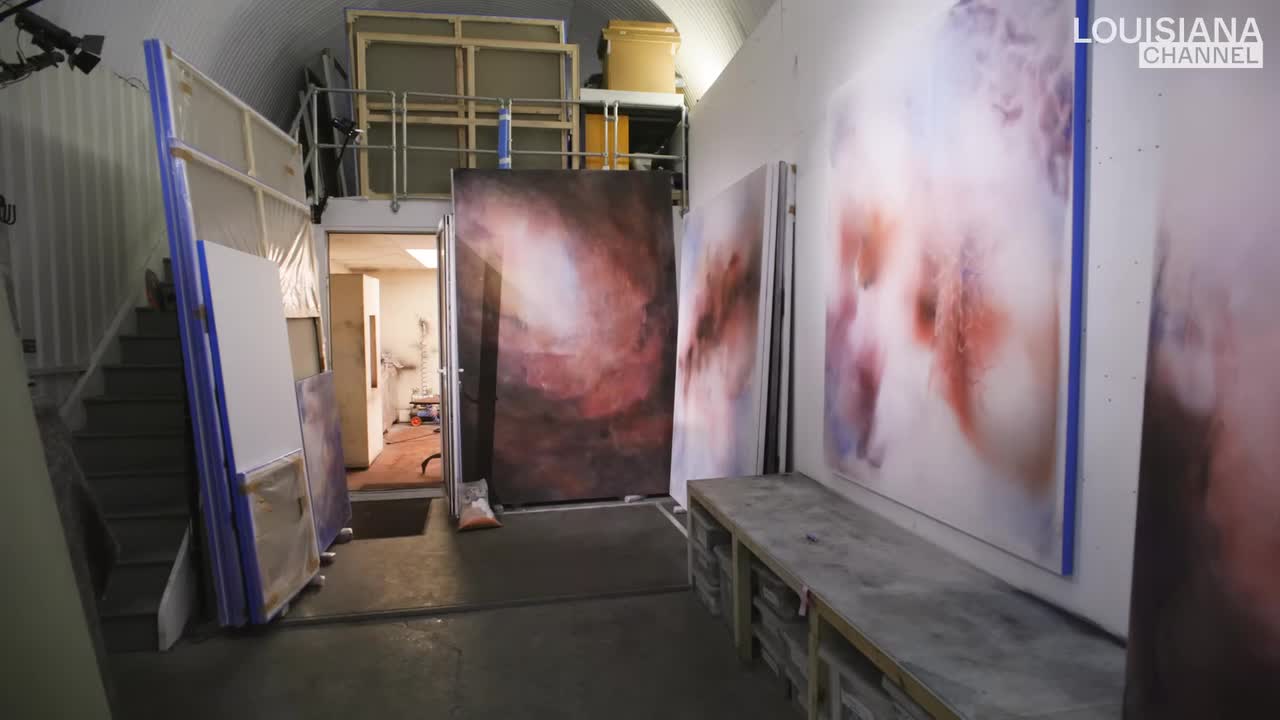
I only started making paintings from sound about five years ago.
Where you know it's funny, my whole life I could see the sound of a space or the sound of an object.
I could just see, like with the cave, I could see that it was going to sing, you know.
But it's quite abstract for people to hear that.
And like I said before, everyone's totally prioritising their visual experience of the world.
And it was during the lockdown that I was by myself, squatting in Soho in this big warehouse studio, when I started to play with an idea that I first had, actually When I was still a student at the Ruskin in 2008 I think.
I made a resonance piece with flower on the surface of a drum and a speaker underneath and making beautiful patterns in the flower as it vibrated.
And I took that idea and I ran with it and I'd always wanted to do paintings of sound with sound.
And I put my canvas horizontally in my studio and I put the finest possible pigment you can imagine, so fine that the tiniest vibration will move in.
And I put a speaker under the canvas and I started to play pure sine waves, pure sounds.
And the speaker vibrates the air, and the air vibrates the pigment, and the pigment takes on the shape of the sound.
And what I realized when I started painting in this way was that the beauty of music could be encapsulated in a painting and there could be in some way a real parallel, not like an arbitrary link, like even though you know.
And even though Kandinsky and Klimt were making paintings about music, they were still paintings about music.
They were not paintings of with music.
That's why I thought it was interesting and exciting when I saw how far it could go, and not only how magical the experience is, because painting like this is totally magical.
It's honestly a bit like sitting at the piano.
Because I've learned over the years.
I've learned the notes that have these different shapes, and which frequencies, which volumes.
So I know exactly how I'll be able to move the pigment.
And it's just like when you learn your scales and your harmony and everything.
But when you sit at the piano and you can play and you just get totally lost and you can improvise, you can play things that you know.
It's just like that when I paint now.
It's this totally fluid, flowing, again, like a kind of non-verbal experience.
I get totally lost.
It's like when you're driving somewhere and you arrive without realizing that you've got there.
There's this flow state that you enter into.
In terms of painting, I accepted that beauty could be a way into the painting and a way into the experience.
So when I made paintings for the cave, I made them using the same pigment as they used in the cave.
I made them, as I always do, using very pure sine waves and pure sounds.
And some of those sine waves were recorded in the cave.
So some of the cave sound made its way into the paintings as well.
And it kind of opened the floodgates for me.
I guess an artist who's always worked in many, many disciplines.
It was the deepest and furthest I've ever been able to go into painting.
And I can't stop, partly because it feels like, Like I say, it feels like making music and it feels so the same as all of the performance and sound and film works that I've made.
It is literally the same thing as standing in the corner of a museum and making it resonate, putting your sound into the corner of a painting and seeing that resonance and seeing how you can see it in the paintings behind me.
There's this kind of infinite possibility of combination of colour and sound.
You know, it's hard because I'm actually a very private kind of person in some ways.
And yet, as an artist, and as a musician, it's all about communicating and connecting.
For me, that tension actually has given rise to more collaboration.
The Cave is about the childhood of every one of those singers.
I didn't put myself in the film, but it's also about my childhood and my loss and you know, I grew up with my grandmother.
She was like my second mum, she was my best friend and when she died and I was 17 I was just totally blown out of the water.
You know, I loved her so much and she was so funny, and so you know she's just an incredible person and And the earliest piece of art that I made is actually her kitchen floor.
It's something that she made.
So when she died, rolled up her linoleum kitchen floor because she'd put it down in our kitchen in the 1960s.
And after 40 years of walking around from the fridge to the sink to the oven, her path had been worn through the surface of the lino, so you could see her life on the ground.
And I was 17 and I just didn't want anyone else to walk on that because it was a portrait of her life and a life with all those complications.
A woman in her kitchen, born in 1913, who was not allowed to be a musician by her father, who was a musician.
I saw this floor and I rolled it up and I put it in the barn.
I wasn't an artist, I was a kid.
But when I had my first exhibition at Modern Art Oxford, I unrolled this piece in 2008 and I hung it on the wall like a painting.
And it's still for me the kind of key to why I do all of this because that empty space that she inhabited it's a cave.
In a way, it's an empty volume.
Now I can look at that floor and I can tell you exactly what note the kitchen would sing, based on its shape, you know.
You asked me about the tension between basically public and private in some ways.
And for me, like, Why is my life so interesting that the work should be about me in particular?
We all have grief and we all have childhood and we all have love and we all tease each other.
And there is no reason for me that my personal experience has to be at the center of the work.
But my experience of making the work and learning to make music with great musicians and learning to make a building sing in a way that it's never sung before, or discovering i mean honestly discovering discovering a connection between art and music in this cave it's all like deeply personal, but there's something about the the process of making art which allows you to turn the personal into something that is shared And that's interesting to me.
And I'm always like, How do I say this?
Like, I'm quite shy really.
And yet, when you're a musician and you're an artist, you can't be that shy, because you have to share and you have to communicate, you know.
So as I get older, I'm also learning to share.
Thank you.