

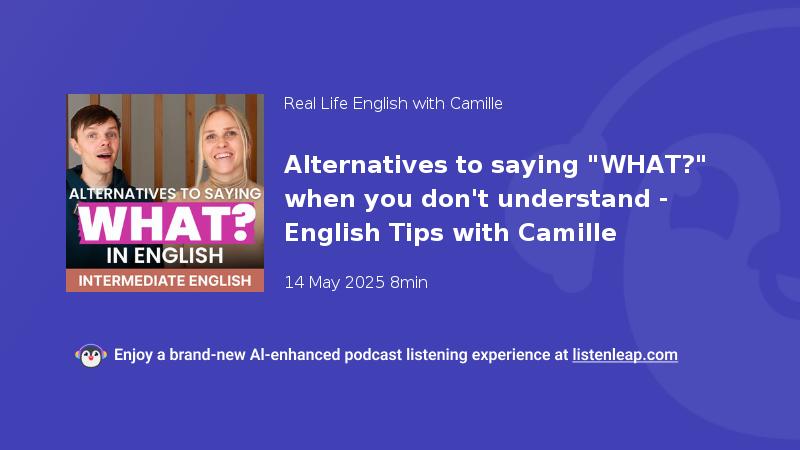
[Beyond 'What?': Mastering Polite Ways to Ask for Clarification in English]-[Alternatives to saying "WHAT?" when you don't understand - English Tips with Camille]
📋 Summary
Navigating Clarification: Beyond the Simple 'What?'
For language learners, the most instinctual reaction to not understanding a conversation is to blurt out "What?" While this is a universal experience, the hosts of the podcast emphasize that understanding the nuance of social context and intonation is essential to sounding natural and polite in English.
The Contextual Appropriateness of 'What?'
The hosts clarify that saying "What?" is not inherently offensive or rude, provided the setting is appropriate. When interacting with close family, children, or intimate friends, it is perfectly acceptable. However, they warn that using "What?" in professional settings, with teachers, strangers, or older individuals, can come across as "abrupt" or even confrontational.
The Power of Intonation
Before exploring alternatives, the speakers highlight that intonation—the way the voice pitch moves—defines the tone of the request. A flat or dropping pitch can sound like a challenge or a fight, whereas a rising pitch at the end of the word "What?" makes the speaker sound more inquisitive and polite. Mastering this subtle shift is a foundational skill for learners.
Polite Alternatives for Professional and Formal Settings
When the situation calls for more decorum, the hosts suggest several refined phrases:
- Pardon / I beg your pardon: These are described as quick and easy alternatives. "I beg your pardon" is categorized as "hyper super polite," making it an excellent choice for formal interactions.
- I didn’t quite catch that: This is highlighted as a "very, very common way" to indicate a failure to hear or understand. The addition of the word "quite" acts as a softener, effectively raising the level of politeness.
- Come again: This phrase is noted as more formal English. The hosts advise that this is not typically used between friends, but rather in situations requiring a more structured approach.
- Would you mind saying that again? By using conditional phrasing, the speaker maintains a high degree of courtesy suitable for business meetings or important phone calls.
Supporting the Language Learner: Asking for Speed Adjustments
A significant portion of the discussion is dedicated to the reality of language learning: native speakers often talk "blazing fast." The hosts encourage learners to be vocal about their needs. Phrases such as "Can you say that again a little slower?" are not just acceptable; they are necessary. The hosts stress that most people are not accustomed to talking with English language learners, so it is the learner's responsibility to ask for clarity.
Conclusion
The overarching message of the podcast is to move away from the singular reliance on "What?" by building a repertoire of phrases that match the formality of the situation. Whether using "I didn’t catch that" or requesting a speaker to slow down, these tools empower learners to navigate English conversations with confidence and social awareness. As the hosts conclude, "Don't be afraid to ask people to repeat themselves... you're a language learner and it is totally fine."
Deep Learning with ListenLeap


