A quick warning, there are curse words that are unbeaped in today's episode of the show.
If you prefer a beeped version, you can find that at our website, thisamericanlife.org.
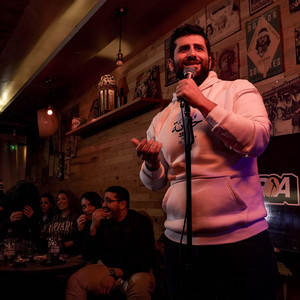
Sharif Homsi is a stand-up comic in a place that's not really known for its comedy scene.
Damascus, Syria.
As maybe you've heard, the place was run by a dictator for a long time, Bashar al-Assad.
Back then, there were a lot of jokes that Sharif was not able to tell on stage.
Definitely nothing about Assad or Assad's family.
Nothing about politics at all.
Those kind of jokes could get you killed or disappeared into one of Assad's infamous prisons.
So during those years, Sharif kept jokes like that in a folder on his computer labeled Lebanon, because he pretty much only felt safe telling them when he would take trips abroad.
There is one joke.
I love this joke.
I want to bring it back.
There is one joke I used to say when I go to Lebanon.
Like, listen, we have a lot of problems, but you don't have a president.
And our problem is that we have one.
So maybe if you take him and you can rent him for a bit.
And if you like him, you can keep him.
You cannot say anything like this, man.
That joke, if I say it over here, we will get killed.
There is no joke with that.
Bashar al-Assad's family ruled Syria for 53 years, the last 13 of which were a brutal civil war.
Over 300,000 Syrian civilians died.
Then, a year ago, to everybody's surprise, a bunch of rebel groups overthrew the regime in just 12 days.
Assad, his wife Asma, and their family flew to Russia.
The rebels were led by an Islamist group called Hayat Tahrir al-Sham, HTS for short.
And then the new people in power surprised everybody again by not immediately becoming another repressive regime.
HTS leader, Ahmad al-Sharah, says he's acting as interim president and has promised to hold elections in the next few years.
And Syrians have been experiencing a freedom that they have not experienced before.
I had dinner a couple weeks ago with somebody who was just there and they were talking about how kind of inspiring it is to be there right now.
She met lots of people who were moving back, ready and excited to rebuild their country.
But at the same time, parts of Syria are still violent.
There was fighting this month in and around Aleppo.
Over 150,000 people were displaced.
In July, Sharif had to cancel a show in a city called Soweta because of a massacre there.
800 people were killed.
And then in October...
In the middle of this chaos and hope, Sharif and the other comedians in his comedy group the group is called Styria decided to go on tour.
They planned 16 cities in 21 days all over Syria, in conservative regions, in liberal areas like Damascus, areas under Kurdish control and areas that were once under ISIS control.
And they really weren't sure how this was going to go.
Nobody had ever done this.
And this is the tricky part.
Under the dictator, it was clear what they could not say on stage.
But now there seemed to be no rule book at all.
If anything, the new government was saying, go ahead.
You can make jokes about us.
We're different from the old regime.
But the comedians didn't know if they could trust that.
And then beyond that.
There are lots of just very conservative, very religious people around Syria.
Some of them are figures of authority in towns and provinces.
The comedians wondered how they would react to things that they heard on stage.
They worried about random hotheads, hearing about them and things they said, deciding to show up with a gun.
Even before they left, they got death threats in their DMs.
Stuff like If you ever talk about the revolution, we're going to come kill you one by one, and blah blah blah, blah.
These messages freaked Sharif out, but he got where they were coming from.
The country's been through 13 years of war.
Yeah, most of the other comedians are from Damascus, a city that saw the least of the fighting because it was controlled by the regime.
By Syrian standards, They're the soft liberals.
I understand because some people, man, they see what we do as a luxury.
My house was destroyed and my brother was dead, my mother was dead.
And you here in Damascus were having fun.
You didn't have anything wrong.
And you were going to make people laugh.
This is like luxury, you know.
So they cannot take the joke.
And I understand.
They have the right to be sad.
Any comedy show in Syria right now for everybody comedians, the audience, they're all figuring out what's okay to say out loud.
Eamon Ogana, a reporter based in Damascus, heard about all this.
And he also was very curious to see what the comedians could get away with and whether they would even get all the way through the tour.
He hung out with them on tour for two weeks on long van rides across Syria backstage of their shows.
Lots of stuff ended up happening.
Stuff, I think it's safe to say, they did not see coming.
From WBEZ Chicago, This is American Life, I'm Ira Glass.
We hit the road with these comedians today.
And with that introduction, here's Eamon with Act One.
An Actual Calling.
Too soon?
I meet up with the comedians in Safita, a city about three hours' drive north of Damascus.
They're in a shared apartment that doubles as a green room.
The venue owner let them all crash for free.
There are several mattresses to a room, suitcases under the beds and the comics are walking in and out of rooms getting ready and telling jokes to warm up.
Hello.
I need to get naked.
Maliki is Maliki Mardinalli, one of the founders of the group, along with Sharif.
If you ask him anything while he's dressing.
Okay, Maliki, while you're dressing, I'm going to ask you the same question I just asked Sharif.
Is there a joke you're thinking of saying tonight that you're not sure?
If you want to say it, that might be a bit dangerous.
Actually, there was a few, but a few minutes ago we were speaking about it.
Here the audience is new to this for this kind of art, you know so I don't want any joke to be uncomfortable for them, you know.
So I'm going safe side this time.
I feel if I say something on the government it would be a little bit dangerous.
They will not feel comfortable.
You know, something like this for the sensitivity of this place, not because we don't, we can't say it, you know.
But here I don't know how they will react to it And what is the joke you're not sure about telling.
Maybe something about how the Ministry of Defense dress.
They don't wear shoes.
They only wear flip-flops, you know.
That's how they fight.
I feel something like this.
It's a lot dangerous to see someone's feet in a war, you know.
This is actually a joke about the current government that they were such a ragtag army that they came to power in flip-flops.
Comedy and poetry are probably the hardest things to translate from any language.
I swear to God in Arabic it's very funny.
Just anyone is hearing us right now, it is funny in Arabic.
You should learn Arabic and come and watch the show.
Maliki plays it safe that night in Safita.
He skips the flip-flop joke.
Styria is a small crew, around 20 comics.
Two of them are women.
Some still keep their day jobs.
There's a dentist, a university lecturer, an engineer, students.
They are mostly in their 20s and 30s.
The group's name Styria, is a combination of Syria plus hysteria, because that's what it felt like to laugh in Syria when the group got together three years ago.
A manic release.
Sharif and Maliki do this full time.
Sharif is the group's spiritual leader, the one who used to have a folder labelled Lebanon.
He's got a laid-back stoner vibe, covered in tattoos, light beard, 33 years old.
Maliki is the one running the tour.
He's 29 years old, with dark hair and a cheeky grin.
He's the Paul McCartney to Sharif's John Lennon, more tightly wound.
He's the fixer, lining up venues, negotiating with government officials, driving the van, keeping track of permits, schedules and constantly updating the list of things that could go wrong.
He worries out loud, cracks jokes as he does.
It a kind of nervous humor that makes it clear he's holding the whole operation together.
He actually thinks they're going to be fine on this tour.
I don't think something bad will happen to us.
Because nobody cares about it.
Let's state the obvious.
Nobody cares about us.
Who the fuck we are?
I'm not like a superstar, you know?
I'm not George Clooney on the tour.
I'm Melky, he's Sharif, that's Khaled, that's Aziz.
Nobody cares about us.
Nothing bad will happen to us.
A few people telling some jokes, let them.
But there are two stops on the tour he's worried about.
I'm most scared of Aleppo and Hama.
Aleppo and Hama, those two cities are very dangerous.
Very dangerous.
Oof, man.
Oof.
So we have to be careful dealing with... I don't know what the... I don't know what it's the term.
Mind field.
Mind field, yes, yes, yes.
So it's a minefield in Hama.
Hama is a conservative city, Stop 7 on the tour.
Aleppo is Stop 9, a city divided by different factions.
Before they could go on the tour, Maliki had to sign what he translates as an obligation with the Ministry of Tourism a pledge to avoid certain jokes.
Unlike during the old Assad regime, they're allowed to make fun of the current leaders.
The pledge is a promise not to use hate speech and to avoid jokes that could rile people up and cause civil unrest, like jokes about religion.
It's a written commitment tied to the permit.
If they breach it, the Ministry of Tourism can cancel the show or penalise the group.
The first four shows go pretty smoothly, playing in mostly liberal towns where they didn't expect problems.
One gets oversold because the app they use to sell tickets malfunctions, which is a huge pain in the arse.
But mostly, it's sold out rooms.
So far, so good.
Stop five on the tour, Latakia.
A sunny port city with a beachfront and blue Mediterranean waters.
Fish restaurants and clubs line the shore.
It's been called the Miami of Syria.
And it would be except for what happened here last March, when sectarian violence killed around 1500 people.
That's the stage the comedians are walking into tonight.
Fun, but tense.
Okay, it's Wednesday, the 15th of October.
We're in Latakia.
We're just arriving at the venue to see Sharif, Maliki, and the guys as they set up.
It's a beautiful venue overlooking the sea.
My friend!
Hello, welcome, welcome.
Hi, how are you?
What's happening?
We're preparing for the show.
Sharif is unloading equipment and making sure everything is in place, working.
Maliki's putting up posters and banners at the entrance.
I told you, we're the logistic, we're the reservation, we are the comedian, we are the management, we are the president of Syria.
The same, we are Syria.
So we're preparing the show and we just learned we might have, we cannot do our show in Hama.
Hama, one of the cities Maliki was worried about.
Man, this is insane.
This is insane.
This is crazy.
You're pissed off?
Yeah, very, very, man.
Very angry about it.
They had gotten a call from their fixer in Hama, the guy setting up their show there.
He said he had gone to pay the fees for the show but was told the local government in Hama wasn't going to allow it because we got a report that we are, so this is a new one prepared.
It's a fresh.
We are supporting the gay rights in Syria or in Hama.
Why, we don't know, like the one who's preparing the venue in Hama, they send him to the.
They are assuming we didn't say anything about this kind of topic ever.
Maliki talked to the guy in the government telling him bro, this is really offensive.
If you tell me I'm threatening the people, the religion anything, I'm talking against politics, I understand.
But gay rights, why?
Like, when?
You don't see it?
The stereo comedians can talk about whatever they want in their sets.
Their only rule is no hate speech.
But still, nobody campaigns for any rights of any kind in their shows.
Imagine like you cannot think about supporting any rights, like you see gay rights, vegetarian rights, any rights.
So the idea, we don't know much.
They care about Hama because it's symbolic.
A full house in a town with a conservative reputation.
A real test of what they can or can't say in the new Syria.
They weren't even going to play Hama when they planned the tour.
Too conservative.
Too many ways it could go wrong.
This is the place where, in 1982, Hafez al-Assad, Bashar's father, crushed the Muslim Brotherhood uprising.
Thousands were killed.
Many disappeared.
People there still carry that history.
It shapes what you can say in a room.
But then a fan of the group DMs Sharif, begging him to come.
We like you here.
We want you here.
We want to change the conservative stereotype of our city.
So Sharif said, okay, fuck it, let's do Hammer.
They figured if they could play Hammer, it could open the doors to other conservative cities too.
And they sold out the Hammer show, 230 tickets.
It's Wednesday.
The Hama show is supposed to happen Monday.
So Maliki calls the guy in charge of culture in Hama a local bureaucrat.
He calls the Sheikh to convince the Sheikh to not cancel the show.
I am beyond worried right now.
My mind in Hama.
That night, they still have a show to do.
Welcome.
It's a simple format, six comedians, seven minutes each.
The room is full, maybe two, three hundred people.
Maliki opens the show.
He asks the audience not to take videos or photos or post on social media, because they just got in trouble with the government for promoting homosexuality.
Today we ate a report, support for Muslims.
Maliki tells a version of the flip-flop joke how security forces have been fighting for 14 years, but keep their toes out.
It gets a big laugh.
Then he hands the mic over to Sharif.
Sharif tells a joke that definitely would have gotten him into trouble under the Assad regime.
It shows you how much things have changed in Syria this last year.
It's about Asma al-Assad, the dictator's wife, who had breast cancer.
Technically, it's about her bra.
Here's the setup.
December 8th, 2024.
The Assads flee for Russia.
Syrians go to the abandoned presidential palace to loot it, taking little trophies, souvenirs.
People went to Bashar al-Assad's house.
People stole posters.
So in that joke I say people went to Bashar al-Assad to steal some watches, some expensive painting.
Me, I go what I get, Asma al-Assad bra.
And I have it one piece.
He holds up half of a bra.
The other half is missing.
Because she got one breast taken because she had cancer.
And people start to laugh and feel shy.
And I say, don't feel sorry about her.
She have cancer.
Feel sorry for the cancer you have.
And people say, I love this joke.
Biggest laugh of the night.
Afterwards, I talked to a few members of the audience.
How was the show tonight?
Tremendous.
Extraordinary.
I haven't witnessed anything the same in my life.
It was amazing.
It was unbelievable.
No one expected this.
They say things that you cannot say, especially in Latakia.
They're amazing.
One guy said he was depressed before the show.
But after five minutes in the show, I felt myself like flying in the night sky.
The only criticism I heard was that they were not political enough.
I would like to hear more about politics.
Because the more you talk about politics, the more you are free.
I don't think that in the coming years they will be able to mention the same jokes.
I don't believe that they are going to be free like this.
I feel that Syria now is going to be like the Assad period.
Some Syrians have told me that they feel as though they're speaking on borrowed time.
They're happy the old regime is gone, but are unsure about the future.
Syrians are setting precedence for what can be said, post by post, room by room.
But maybe it's a bubble.
They can joke for now, but there's real trepidation about what comes next.
By the end of the night, the comedians haven't heard back from the Sheikh.
The fate of the Hammer show is still on the line.
Eamon O'Connor.
Coming up.
The comedians head into Hama province, the Sheikh's province, and the Sheikh brings all the boys to the yard.
Figuratively, I mean.
Stay with us.
Just American Life.
If you just tuned in, reporter Eamon Ogana hit the road with a group of Syrian comedians on their first nationwide tour since the Assad regime fell a year ago.
We have arrived at Act 2, the drama in Hama.
Here's Eamon.
The comedians have a two-day break after Latakia, so they go back to Damascus to recuperate.
They still don't know what's going to happen with their show in Hama.
I meet up with them at Sharif's place in Damascus, his family's house.
It's big, in a nice leafy neighborhood.
How are you feeling?
Sharif's parents are drinking tea in the living room with his aunt and uncle.
We step into Sharif's bedroom, the operating base for Styria.
Maliki Sharif and Omar, another founding comedian have all kicked off their shoes and are drinking coffee and discussing what's to come.
They are waiting for the sheikh to call with an update on Hama.
Maliki's phone stays face up on the table.
Psychedelic stoner posters are taped to the wall.
A desktop computer obscures the window.
A few childish pictures sit on the mantle.
Maliki points to them.
A Harry Potter poster and a painting made by a small child.
That's from Kareem al-Assad's room, the sons of Bashar.
So this is taken from the palace?
Yes, and I have few stuff also from his house.
What we get also I get from his house.
I took shitty stuff, not something with it value to me more than it value in the real world, you know, because that day was magnificent man yeah yeah, i say this in my stand-up i said i really hope we don't have to feel this feeling again of us getting liberated because in order to feel it again another dictator would have to come.
So in that day i felt totally free.
It was total chaos, man.
Like i spent from six o'clock until six at the evening.
I was outside in the road with my friend celebrating.
We went to al-asad home.
You see i have his bra, his painting and stuff.
We went to the parliament, to the ministry, his wife so that's really his wife's bra.
You're not kidding?
Yeah, i'm not kidding.
I brought shitty stuff for me.
I has, and the half of the bra i give it to my girlfriend, my ex-girlfriend, because I thought you were joking.
It's a real shit.
I turned it into a joke.
Let me show you the book of my stand-up comedy.
When I was inside, it's here.
When Sharif says he was inside, he means prison.
Sharif was jailed in Dubai for a little more than three years, from 2018 to 2021.
He hands me a paperback book with a worn cover.
So this was me in the inside.
See what I write?
Be a Great Stand-Up is the name of the book.
Wow, it's covered in handwritten notes.
This is your notes?
This is my notes.
This is me writing stand-up in the inside.
So you're inside your cell, just reading about comedy and writing in this book.
Yeah.
Yeah, I can show you a book where I write what I want to do when I'm going to go out.
So this is a notepad you had in prison?
Yeah.
And you can see in English, I say new laptop, writing, and stand-up comedy.
And I read here some gym, never, never speak the plan.
What's the Never Never Speak the Plan?
I used to talk a lot, man.
This is what got me into shit.
The shit is a narcotics charge.
Sharif was dealing drugs in Dubai and got caught by the authorities.
I got greedy and I got caught by a kameen, by an ambush.
And they gave me marked money and it was all a play, all a game.
I was the one who burned.
According to court documents, Sharif sold drugs to an undercover cop.
A snitch had tipped off the police.
He was arrested and given a life sentence, which in the UAE, is a common penalty for drug offenses, no matter how small.
He says he got out because his father wrote a mercy petition, a letter to the prosecutor begging to let him go.
My name was 71.
It was 70 people who meant to go out.
And they added my name after three years and three months.
And... Thank God.
And then you came out and you were like, I know what I want to do.
I'm going to be a comedian.
Actually...
The first year, I was an animal.
You know, you're basic.
I want to eat, I want to have sex, I want to hear some music.
It was taken from me.
And after nine months, I was going into the same cycle that got me into jail.
A friend called him out for how he was acting.
Sharif said enough and broke the cycle by focusing on saving money for his comedy dream, taking any job he could.
And when that happened, everything started to happen.
Like someone asked me to do stand-up comedy between parties and stuff and i was like i will not do this and i thought Is it possible?
In all Syria, in all the dark humour and shit we have, I am the only one in Syria or Damascus that want to do stand-up comedy.
Just let me put the news out and see who are interested.
I needed a team so I can start, so we can do something.
That's how he met Maliki.
They both grew up in Damascus.
Sharif is Muslim, Maliki is Christian.
They had mutual friends but didn't know each other.
Maliki was working in a bank at the time.
But they both dreamt of being stand-up comedians.
Here's Sharif.
Someone sent me his Facebook and I went to research his Facebook.
He had some bad content on Q Media.
Then I find him start to do stand-up comedy.
He tried in 2020 alone.
How do you start to do stand-up comedy on your own?
I don't know.
I don't know.
You just got up in the bar and actually actually this is a very good one.
I don't know if i told the guys of it.
Uh kamal, my friend, we were having a drink in mad monkey pop, so we were talking, and I don't know, I'm just saying stories and something like this.
He started to laugh, laugh very hard.
So he called Bisan, the owner of the place, and told her that I should start doing stand-up comedy at her venues.
She refused, of course.
But then, a week or so later, the owner of the bar changed her mind.
Maliki's friend called and told him.
And that was just because you're like a funny guy and people thought that's it.
I don't know shit about stand up at that time.
Like I'm coming from NGOs and bank background, you know?
So you worked in a bank, but you told jokes to your friends?
Yes, yes, yes.
Most of my jokes come from that.
I'm a good roster at the bank.
And how did it go at Mad Monkey, your first gig?
Shit, shit, shit, man.
Pure shit.
It's the purest shit you'll ever seen in your life.
Did people laugh?
The people were sick.
Not laugh.
They told me, son, come on, turn the music on, man.
Maliki had decided to quit the bank, tired of counting other people's money.
And out of the blue, Sharif called him to invite him to a stand-up workshop he was hosting.
At the same day, man, at the same day, 2pm, I signed that paper.
4pm, Sharif called me.
At the same day.
I remember when I called, he said, I cannot come at this time.
This is the sheikh.
The sheikh is calling Maliki now.
Maliki answers the phone.
Sharif paces the room, smoking and listening carefully.
The call lasts about 15 minutes.
Oh, my God.
What the Sheikh said in the call was that he didn't know who cancelled the show, but he understood why someone would cancel it.
He'd actually seen their set in Mojadeh a few months back and he thought some of the content was inappropriate.
And certainly it would be for Hammer, but not because of anything to do with LGBTQ material.
So what were the kind of things he was saying to you?
Man, this is insane.
He told me that you can't say your material in Hama because it's offensive to the family values.
Because we are talking about our parents.
So he felt that they are breaking the bonds between the families.
They are affecting the people who watch this kind of shows.
We are a threat.
That's how we are a threat to the family, you know.
We are a threat to the family value this is.
This is much more insane than the LGBTQ support thing.
Man, this is, this is really new.
Man, this is really new.
All of us have jokes on our parents.
Man, everybody This is insane.
It's my dad, man.
It's my dad.
If I can't speak of my dad, what should I speak?
For what should I speak?
This is my family.
This is my culture.
We are doing stand-up comedy for the sheikh, not for the people.
You know, this is how things are now going.
The first three months we had freedom.
What was that like?
Amazing.
It's like coming from dark to the light.
Then we are slowly closing the window.
Now slowly closing the door.
Slowly closing the curtains.
This is bad.
This is bad.
It's like it's better if I never had it.
Yes.
Wow.
You know?
Oh shit, here we go again, you know?
Oh shit, here we go another Assad regime.
On the call, Maliki told the Sheikh they wanted to perform in Hama to show that Hama isn't just some strict and conservative city where nothing happens.
The Sheikh said he'd look into it and get back to them with a final answer soon.
So he's going to call back in a few hours with his decision?
I think he will call the brothers.
The brothers is Malik's sardonic way of referring to the Islamist officials now running things.
They will call the Brotherhood.
He will call them and will have their advice.
The next day we hit the road again.
Piling into a bright yellow van with stickers lining the sides saying Styria.
In the font of Grand Theft Auto.
Maliki is driving.
Sharif sits behind him.
There's so much equipment in the back that Maliki can't see out the rear window.
It's about three hours to Salamia, stop six on the tour, depending on checkpoints.
What's the latest with the sheikh?
Sharif sent me a screenshot that he is pushing also in Mhardeh.
To stop you?
Yes.
Muhaddith is the show tomorrow night.
The Sheikh is now saying that show might be cancelled as well.
I think in a few hours I'm going to make some phone calls to understand what the hell is going on.
And what's your strategy with the Sheikh?
How are you going to convince him or control him or influence him?
He's going to turn to Islam.
You're going to convert to Islam?
I hope I don't have to.
Because if the Sheikh didn't kill me, my parents will.
So I'm dead either here or there.
I told him we will not stop.
So if they want to stop, let them stop us.
If it's going to go to jail, please take me to jail.
I miss it.
And with all this drama, do you want to perform in Hama?
Yes.
Our show is sold out in Hama.
Man, there is 200 people right now.
The only entertainment they have here is us, so far.
Besides killing each other, you know?
So... We are a must, not a need.
A few minutes later, still on the road to Salamia, Maliki gets a text.
The sheikh just texted me that it's not going to be a show in Hama.
This is final decision.
So what are you going to do?
We're going to tell the people in Hama to come to our show in Mohardeh.
Are you going to tell them why?
Yes, of course, I'm going to tell them why.
For them, this isn't over.
They could let it go, but Maliki won't.
They decide to test the limits another way make it public and see who's stronger right now the government or the people.
They want to use public opinion to force them to reinstate the show.
The Styria comedians are all pretty young.
They think in TikTok and Instagram.
They believe a big enough online following will give them protection from government officials trying to silence them.
They have hundreds of thousands of followers on Instagram.
Syria's revolutionaries also use social media to rise to power.
But now that they run things, they fear it.
Fear posts that inflame sectarian tempers.
Fear looking weak.
At the same time, they don't want to look like the old regime, repressive and censoring in public.
So they pressure quietly, in private, and the comedians answer loudly, online.
Maliki and Sharif go on the offensive.
They post that the Hammer show is cancelled and tell Hammer fans to come to Mahadeh instead.
They'll add seats, they'll arrange buses.
They're trying to turn the followers into force.
It's a respectful post, not calling anyone out.
But they figure their fans will understand why it was cancelled.
Get pissed off and put pressure on the government.
But then, one of the other comedians, Abu Aziz, goes rogue on his personal Instagram account.
So Abu Aziz, you know him.
Abu Aziz is much crazy.
He's not diplomatic, you know?
He's not diplomatic.
He did something really funny.
Very, very stupid and very... Very Aba Aziz.
Very Aba Aziz, you know?
On Instagram, Aba Aziz goes off.
We're just us.
I'm Aba Aziz.
And the guys with me are threatening the peace of the people.
The peace of the people.
He rants about the Secretariat for Political Affairs in Hama, says they accuse the troop of LGBTQ content and of being a threat to family values.
He blames them for cancelling Hama.
We're back to how we were before, he says.
Which sounds pretty mild, but he's comparing the new government to the old regime, which is dangerous.
Abu Aziz has nearly 300,000 followers.
Him posting online left some in the group nervous, but excited Maliki and Sharif.
The comments start right away.
Angry at the government.
Word gets back.
Someone from political affairs calls Abu Aziz.
Political affairs also contacts the sheikh.
The sheikh calls Maliki.
Maliki doesn't pick up, so the sheikh follows with the text.
I didn't answer.
I will let him.
We have cancelled this show.
But then when... In an hour, answer him.
In an hour, answer him.
I think I will tell... Now, leave him in half an hour.
Let things boil up, you know?
So leave him now.
I think an hour later, or maybe in the evening, they will tell us, do your show in Hamun.
Some members of the group are worried by the strategy, wishing they had been consulted first.
But almost as quickly as they stir up the online shitstorm, Sharif gets a text from the Hammer venue owner.
No matter what, he won't let them use the venue.
It's not worth it to him.
He's scared of a visit from the authorities, a fine, a lost license, a knock at the door or worse, an attack.
Maliki and Sharif have officially lost the battle for Hama.
They're still trying to direct people to come to the Mahadeh show instead, but now that might be cancelled as well.
They play Salamiya that night.
It goes great, standing ovations.
Then, after the show, a call from the Ministry of Media.
This guy is furious about Abu Aziz's post and tries to stop the show they've just finished.
Are you worried they're going to stop your other shows?
Now, tomorrow it's going to be Mhardeh.
No, they are not going to come to Mhardeh.
Maybe they will do some phone calls and that's it.
It's now our move.
On the chessboard, it's now our move.
We have the media.
We have...
The people.
They have weapons.
So Abu Aziz is a very powerful chess piece.
No, he's very tahash.
We call it that.
The one who, like a tank, you know?
This is the first to come into the battle.
And then people come, like snipers and military.
Everything is a war.
In Syria, everything is a war.
Even art is a war.
Maliki isn't worried about the show in Mahadeh.
He tells me it's a Christian town, so the sheikh has no power there.
Eamon O'Connor.
Coming up, Muharda, she wrote.
The comedy show moves on to Muharda.
That's in a minute from Chicago Public Radio when our program continues.
This is American Life, Myra Glass.
Today's show, a Christian and a Muslim walk into a bar.
We pick up with the reporter Ayman Ogana and the comedians of Styria on their tour of the country.
For act three, an act of calling.
Is this thing on?
It's morning.
We're back in the van heading from Salamia to Muhardeh, a show they hope will still happen and where a busload of fans from Hama will join them.
We pass a car with a rocket launcher on the roof.
It's a rocket launcher, man.
On a Humvee.
Monuments of Syria's bloody war still dot the roads.
We see bombed-out buildings and burnt-out cars on the way.
We have a system for checkpoints.
Maliki flashes a big smile, and I hide my recording equipment under a coat.
Checkpoints.
OK, checkpoint.
I need to take my headphones off.
Maliki is flying high this morning.
We're leaving the more conservative Sunni Muslim areas and heading to a Christian town.
Christians are a minority in Syria, about 10% before the war.
And Maliki is Christian.
He's relaxed, in shorts, grinning as he drives.
Welcome to the Christian people.
Fuck you, Sharif.
Hallelujah.
Hallelujah.
Now we are safe.
Now we are safe from HDS and all the governments.
This is a Christian country.
Here, this is a Christian land.
No Muslim is allowed to go here.
Ayman, are you Christian?
I am.
Yes, welcome home.
You get into town, go into a cafe.
Maliki, have you heard from anyone who's from Hama who's taking the bus tonight?
I don't know, but I think there's 40, 50 people, something like this.
I feel that when the evening comes, it will be 60 or I think 70, something like this.
I hope it's going to be good.
This is where we drink a lot.
This is the...
They are very, very, very generous, very generous here, because they are Christian.
Everyone is happy, smiling.
They order pizza.
I go back to us.
I love this song.
But an hour later, the mood changes.
Maliki looks distressed.
He is changed back into jeans as conservative Syrians frown upon men wearing shorts.
We get back into the car with the venue owner for the show tonight.
OK, Maliki, tell me exactly what's happening.
A lot.
Happening a lot.
Let me think about it first, then I will talk to you.
The venue owner has gotten a call from the local government in Mahardeh asking him to come in for a meeting.
We drive to the local municipal building.
I walk with Maliki but get stopped at the stairwell while Maliki and the venue owner go into an office.
A few minutes later, Maliki comes back and says I can come in.
They take my bag, the recorder, everyone's phones.
There are two government men inside the office.
Beards, shaved moustaches, military outfits.
They look straight out of central casting.
But they're polite.
One asks if we want coffee.
Another then brings glass cups of Nescafe 3-in-1, a sugary instant coffee ubiquitous across the Middle East.
My translator waits downstairs so I don't follow everything.
But one of the government guys says he recognizes me.
I'd covered the Syrian war and we had been in the same towns in Idlib province.
Maliki later jokes that 10 years ago they may have kidnapped me.
It's a different country to report in now.
I watch the room.
The older one sits behind a desk, does most of the talking.
Eventually, another brings in a piece of paper and beckons the venue owner to come to him.
The owner is nervous and doesn't hesitate to sign it.
Maliki explained to me what was going on afterwards.
They were very angry.
So they told us that we can't do our show in Mhardeh because there is no permission from Hama political affairs.
So now we are making some phone calls to have that permission.
I hope to have it.
Maliki had miscalculated.
He figured that because Mahadeh is a Christian town, the Sheikh and the local Hama government wouldn't have reach here.
But instead the local politicians in Mahadeh are telling them, if they want to do tonight's show in Mahadeh, they need to get permission from the Sheikh and the other bureaucrats in Hama, the ones they started a battle with yesterday, the ones now threatening a libel case.
What was it?
They made the owner sign obligation, saying he promises that he promises that he won't let us do the show without a written permission from their office.
Has this ever happened before to you?
No, no.
When you arrived in Mahardeh, you were like we're free now, no one can stop us.
So how do you feel now?
Shit, shit, shit.
They have more power than I thought here.
This is dangerous.
Yesterday, they were very upset with us doing the show in Salami.
So now they will prevent us from doing the show here.
I don't know what things would happen in the next few hours.
Their only path tonight is persistence.
If they can get permission from the Hamer officials Abu Aziz just insulted, they can still go on in Mahardeh.
It's 3.15pm.
The show is at 7.
It's sold out.
Buses of fans are supposed to come from Hamer.
We get in the car, me Maliki and the venue owner, and head towards Hammer to try to talk to the politicians and see if there's any way to save tonight's show in Moharde.
Ten minutes out, the venue owner answers his phone.
I can't tell what the call is about, but he goes quiet, then asks us to turn back.
We head back to Moharde, to the same cafe.
Maliki smokes a cigarette on the street outside, defeated.
Why did we turn back from Hammam?
Because they started to hurt him now.
They started to hurt him.
I'm sorry, man, I have to stop this because I'm very tired now.
Maliki later told me that the venue owner got a call from his dad.
The government is also putting pressure on him.
Real enough pressure that he got scared and didn't want to cause more trouble by heading to Hama.
To make matters worse, on the way back Maliki also gets a call.
First, they've been told they needed permission from the political affairs office in Hama to run the Mahathir show.
Now the bar moves even farther away from them.
Officials are now saying they need free permissions from political affairs and also from the ministries of tourism and culture.
And the guy running the local office of the Ministry of Culture is the Sheikh.
All because of what?
What have you guys said or dunks?
This is because of jokes.
This is because of jokes.
I can't think of a place shitter than here, you know.
I hate this country, I swear to God, I hate it from the bottom of my heart.
This is a message that you don't play with us.
They think you're troublemakers.
Yes, yes, for them.
This is insane.
This is insane.
I'm tired now.
Mentally and physically tired.
I'm using all my connections.
And when I put nine on the table, they put ten.
I put a guy, they put a queen.
I put a king, they put an ace.
So it's always fuck.
We're going to wait one more hour, and then we will know what to do.
We need an hour, I think.
Man, I don't know what to do.
I don't want to be a fighter.
I want to be in agreement.
Well, you want to be a comedian, and you can't do that.
This is the last thing I think of right now, actually.
I swear to God, this is the last thing I think of.
Maliki hasn't eaten since yesterday.
He's running on coffee and cigarettes.
He's getting impatient with my questions.
He and the other comedians start talking in Arabic around a crowded table.
The conversation is heated.
I find Sharif outside the cafe emotional.
OK, man, I can see you have tears in your eyes.
You're upset.
I feel sad, you know.
I'm sad because The people who got influenced now they're using Bashar's ways and Bashar's law to stop us from making people have some fun.
Yeah, how is freedom of expression working out for you in Syria now?
It's not working.
Like, at all.
Like, it's not working and... And...
The thing are working as not freedom or who have the bigger balls.
How are the other guys taking the news?
Some of them are scared.
Some of them, Qasem, imagine, he's scared.
He's a doctor in the university.
He's scared that might reach him in a way that they will let him go from the university.
Other want to make money, other want to make fame, other want to make the project continue.
It's their own right to feel and do whatever they want.
But for me, I push by myself.
Yeah.
So, let's see.
But soon after this conversation, they call it.
Maliki can't secure the free permissions in time, so they're forced to cancel just three hours before showtime.
They post on Styria's Instagram that the show's off due to unforeseen circumstances and tell people they'll refund tickets.
Now they're worried.
The government is also going to cancel their show in Aleppo, which is two days away.
I find them hours later in Sharif's hotel room.
One of the other comedians is giving Sharif a massage.
So I see you guys are promoting LGBTQ.
That night, instead of doing their show, they get drunk and dance until three in the morning.
The next day, the politicians in Hama want Abu Aziz to bend the knee, apologize.
Maliki says he won't make Abu Aziz do that alone.
We get in a car to Hama to meet Abu Aziz, who's already driven up from Damascus.
Maliki is anxious and frustrated.
I didn't sleep well, actually.
So what are you hoping?
You're going to see these guys and what?
To end this madness, man.
To end this madness.
I think we've been, in this case, three days now.
Yeah.
What the fuck is this, man?
Three days?
Three days for a fucking comedy show?
They are wrong, okay?
They are the political pair.
They are wrong.
But we didn't play well.
When we play, we give them our neck.
We get to the political affairs office and inside a large, drab, concrete government building.
At the door, the security guard says they're expecting us and Maliki tightens.
Up a dim stairwell to a large office, three suited officials sit in a row like judges facing out.
One of them is the infamous Sheikh.
We're shown to chairs by their side.
Abu Aziz is already there.
Maliki tells me to put my recorder outside again.
Please, we're going to take this outside, then we're going to talk.
All right.
The meeting begins.
It's all in Arabic, but my translator is there and takes notes.
The government officials are stern and condescending.
Their age and authority looms over Abu Aziz and Maliki.
They have the room.
The men from Political Affairs tell the comedians they were insulted by Abu Aziz's post that it's unacceptable to compare them to the Assad regime.
They ask Abu Aziz how many people saw his post.
He says 47,000 and apologizes, says what he did was wrong.
The officials say that in addition to the post being inappropriate, it wasn't true.
They never canceled the show.
Maliki pushes back.
That's what his fixer was told when he had gone to pay the fees for the show.
Whatever the truth of that, the three officials do have a lot to say about the content of the shows.
One of them says that he went to one of their shows a few months back, that he sat in the front row with his son.
He says, I regretted bringing him, but what calmed me was that he fell asleep during the show.
From the start, all your jokes were about religion, sex and sensitive topics that threaten civil peace.
They remind the comedians that under Assad, they could joke about anything but politics.
Now, they can joke as much as they want about politics or the government, but they can't joke about topics that could disturb the civil peace.
They point to a little dance Abu Aziz does at the start of his set.
They say it's sexual.
They say society's morals have deteriorated.
Abu Aziz apologises a second time.
He tries to break the tension with a joke.
He says, There are three things I love, Ahmad al-Shara, Bashar al-Assad and sport.
But the truth is, I only like two of them.
You can choose whichever you like.
It's a joke, because Abu Aziz is overweight, not a big athlete, and it's impossible to both love Shara and Assad.
Silence.
No smiles, no laughs.
It's awkward.
The message is clear.
This is not a joke.
The meeting wraps up after an hour.
Afterwards, I ask Abu Aziz about it.
Do you regret the post now?
Yes, I regret my reaction and putting the story because if I do that and comparing them to the old regime, if I do that with the old regime, I will be killed or forcibly disappeared.
But the new government have at least sat with me, discussed the issue with me, and they let me leave.
It says a lot about where Syria is now.
Not the old terror, not real freedom either.
The state will absolve you if you apologize, rather than make you disappear into the prison system.
You can post, you can film, you can even argue in a room like that.
But you have to bow down to authority which, after 50 years of dictatorship, Syrians know how to do.
It seems to me like in Syria today everyone has tasted freedom for the first time and they're not sure what to do with it.
Even the government don't even know what to do with freedom.
Yes, of course.
You have said it a lot.
We are learning and they are learning.
I spoke to the Sheikh afterwards.
He reiterated that he didn't cancel the show.
He said his remit is cultural centres only and the comedians are banned from the cultural centres in Hama.
But anything in a private venue, he said, is outside his authority.
He never told anyone to stop anything.
He is lying, man.
I told Maliki about the conversation.
He said it was a misunderstanding.
No, that's what they say after when you feel the heat.
You know, I'm sorry, it's a misunderstanding.
Fuck you and fuck your misunderstanding.
Understand well because you are in a position, you have to understand well.
Any misunderstanding can lead to blood.
You have to be aware of what kind of business you do.
I also learned the sheikh is not actually a sheikh.
Did you call all the politicians sheikhs?
Not all, only the Muslim ones.
We tried to figure out who cancelled the show in Hama, and didn't get anywhere either.
The next two shows are in Aleppo and, even though Maliki was worried about Aleppo from the start, the shows there are not cancelled.
They sell out both shows, a thousand tickets in total.
Maliki does the joke about his dad, and one about being a Christian in a mosque.
Sharif tells the bra joke.
See?
Maliki was right.
They kill in Arabic.
Eamon O'Connor is a reporter in Damascus.
Our program was produced today by Dana Chivas and edited by Fia Benen David Kestenbaum, with fact-checking by Hany Hawasli.
The people who put together today's show include Michael Comaday, Suzanne Gabber, Tobin Lowe, Catherine Raimondo Stone, Nelson Ruthie Petito, Nadia Raymond Ryan Rumery, Frances Swanson, Christopher Sotala, Julie Whitaker and Diane Wu.
Our managing editor is Sara Abdurrahman.
Our executive editor is Emanuel Berry.
Haraf Ali Kurz worked with Eamon in Syria.
Jude Taha did translations.
Our website, thisamericanlife.org.
This American Life is delivered to public radio stations by PRX, the public radio exchange.
Thanks as always to our program's co-founder, Mr. Torrey Malatia.
You know, when people walk up to him on the street before they barely get a word out, he lets them know.
I'm not George Clooney.
I'm Ira Glass.
Back next week with more stories of This American Life.