Support for This American Life comes from Indeed.
A quick warning, there are curse words that are unbeaped in today's episode of the show.
If you prefer a beeped version, you can find that at our website, thisamericanlife.org.
Okay, so I want to tell you a story, and I'm going to start with the part you probably already know about.
In November, six Democrats all veterans of the US military or intelligence communities came out with a video saying to people in uniform you took an oath like we did.
Our laws are clear.
You can refuse illegal orders.
You can refuse illegal orders.
You must refuse illegal orders.
Those are Senators Mark Kelly and Alyssa Slotkin and Congressman Chris DiLuzio.
They did not specify what illegal orders they might be referring to.
At the time, just like now, the Trump administration was shooting boats of supposed drug runners out of the water off the coast of Venezuela.
And lots of military experts and veterans are saying this did not seem to be legal.
In the past, if we found boats of drug renters, we arrested them.
We didn't just kill them on the spot in cold blood with no due process.
The video also didn't mention the president trying to order the National Guard into American cities Portland and Chicago where judges stopped the orders saying they were illegal.
Like I say, the video mentioned no specific orders at all.
And really the video might have vanished into the daily noise of a million news stories and online videos, like almost everything else does these days.
It really could have come and gone and been forgotten.
Except that the president went on Truth Social and called the video seditious behavior punishable by death.
Said he wanted the lawmakers to be tried as traitors.
Stephen Miller, who seems to run so many things in the White House these days, went on TV to declare.
It is insurrection, plainly, directly, without question.
It's a general call for rebellion, saying that those who carry weapons in America's name should defy their chain of command and engage in open acts of insurrection.
So, in other words, we ended up in one of those completely exhausting and very familiar standoffs between Republicans and Democrats, with the Democrats saying we're just telling people to obey the law.
And Republicans saying the Democrats, as always, are trying to overthrow Trump, this time with a military insurrection.
And in the middle of all that are the two million people serving in the active military or National Guard or reserves right now.
What are they thinking?
Aren't many of them worried about getting illegal orders or getting legal orders that they're not comfortable with?
We reached out to the handful of organizations that service people can call if they want confidential legal advice on that kind of thing.
None of them could put us in touch quickly with any of the service people they talked to.
But they all did confirm that they've seen an uptick in calls since the Trump administration came in.
Most did not see more calls after the Democrats' video.
And I want to emphasize, the numbers of calls that they get are low compared to the immense size of the armed forces.
GI Rights Hotline has been getting a little over 200 calls a month on average since June.
An organization called About Face only gets a few calls a week.
Brittany Ramos-DeBarros answers all those calls.
She's an Army vet who served in Afghanistan.
Lately, I think we've seen a lot of people who are in the National Guard saying that Orders are being circulated to support ICE or to occupy an American city.
I'm really concerned that I'm going to be forced to participate in one of these operations and I don't believe that that's right, and I want to know what my options are if I don't want to participate in that.
Right.
People signed up thinking I'm going to help rescue people from floods and, you know, help with the aftermath and cleanup of hurricanes.
I didn't sign up to go police American citizens.
That's not what the military is for.
The Pentagon wants to create these quick response forces 500 National Guard in each state to control civil unrest and riots.
Have you heard about that?
Yes.
I spoke to someone last week who said that their unit has had voluntary orders where they're asking people to volunteer to be part of these QRFs and that they so far had been able to decline them.
But they were calling because they were worried that it was going to not be optional soon, because they weren't seeing a lot of people volunteer.
And that the sentiment within the units that they were in and connected to seemed to be that people thought this is bullshit.
Like, I'm not going to be part of an anti-protest force in my own state.
That's not what I signed up for the National Guard for.
Earlier in the year, most of her calls were from the National Guard.
Then that changed in June.
Then we saw the Marines be mobilized to LA and suddenly I think a much larger swath of people in the active military were like wait a minute, this is wild and I might be implicated in this and I need to know what my red lines are and what are my choices and what are the consequences I'm willing to take on.
We have more and more people, with the escalations that we're seeing in the Caribbean, that are saying I am connected in some way to units that are carrying out these boat strikes or these preparations for attacks on Venezuela and things like that that are really gravely concerned.
Have you heard from people who have refused orders already?
No.
I have heard from people who said, I got orders and I decided not to show up for them.
What do I do now?
And what were the orders?
What kind of orders?
This person I'm thinking of was active duty, and so he just stopped showing up.
He was supposed to be supporting the establishment of immigrant detention facilities and he went what's called AWOL, absent without leave, and he just stopped showing up.
I think he kind of... The way he described it, he panicked because it wasn't this drawn-out process.
He was just like this is bad and I don't know what to do, and he didn't have anyone to reach out to about it, so he just stopped showing up.
He panicked.
So we connected him with legal support.
Since he already made that choice, it's just a matter of helping him to navigate the legal consequences.
Because of her hotline's confidentiality rules, I should say we could not confirm this story or the others that she told us by talking to the service people involved, but we were able to verify many details.
Brittany says she does not advise anybody on what they should do, but tells them what their options are.
People can stay in their units and speak out publicly about things that they object to within certain limits.
Even if they follow the rules, they could face all kinds of consequences.
People who want out can file papers to be conscientious objectors, which can lead to wildly various outcomes.
They can be reassigned to other duties, or they can be discharged.
Somebody refusing to obey orders can get you court-martialed.
Of course, people can choose to do nothing.
I've talked to active military members who were really upset about what's happening but who said my kids are in school.
We're struggling to get by as it is.
And unless I'm actively being asked to do something that I believe is wrong, I can't afford to do anything about what I believe right now.
Can you think of somebody like that and tell me about that conversation?
Well, we've been doing a lot of outreach in D.C. to the National Guard members in D.C.
And you know our members will go out and have conversations with people while they're patrolling.
Give them flyers that share that if they ever want to reach out for resources they can.
And when we initially started those conversations and that outreach we had no idea how that was going to be received, kind of what the disposition of people was.
And they were really willing to talk to us.
And most of them said, yeah, I don't know why we're here.
This is pointless.
This is dumb.
I'm away from my family.
I'm losing pay even, right, in my regular job because of this.
And what we heard from many of them was, this is really good information.
I believe my orders are legal currently.
But if I ever am given an illegal order, I'll keep this in mind.
It can be hard to figure out what to do sometimes.
I was in Mexico, in Oaxaca, a couple weeks ago.
And in this church, in Spanish, on one of the walls, it said here are the remains of people like you and like me.
People who knew how to act with faith and charity in the historic moment and the circumstances that God decided to put them in.
And I read that and I thought am I doing the best I should be doing in the historic moment that God decided to put me in?
Today on our show, history comes knocking, and a bunch of people have to figure out what to do.
From WBEZ Chicago, this is American Life.
I'm Ira Glass.
Stay with us.
Support for This American Life and the following message come from AT&T.
AT&T believes that hearing a voice can change everything.
Whether it's a favorite podcast, saved voicemail or a call with someone close, familiar voices can bring connection and comfort.
This holiday season, ATT encourages the sharing of voices through a call, a voicemail or a voice note, because every conversation can create lasting connection.
AT&T, connecting changes everything.
Support for This American Life and the following message come from Dignity Memorial.
When we think about the people we love, sometimes it's not the big things that we miss the most.
It's the details.
What memories will the people you love cherish and remember once you're gone?
Dignity Memorial helps families create meaningful celebrations of the lives of the people who mean everything to them.
Where the details aren't just little things.
They're everything.
To find a provider near you, visit DignityMemorial.com.
This is American Life, knock one.
Mother knows best.
Thela Kuti is at a special level of fame where, yes, lots of people have no idea who he is.
But for people who do, there could not be a bigger musical star.
He was a worldwide musical phenomenon by the 1980s, iconic from Nigeria.
He ushered in an entire new genre of music, which he called Afrobeat.
Afrobeat.
Fela is also a profoundly political figure.
Nigeria was still a newly independent country in the 1970s and 80s, still very much trying to answer questions about what kind of nation it was going to be.
Fela's songs criticized colonialism in all of its forms, openly challenged Nigeria's ruling military government.
He took on apartheid South Africa and the United States.
They were called for the complete rejection of most things, European and Western, and tried to live that way.
Went so far as to found his own commune and declared it to be its own republic, free of government control.
His politics were radical but also messy.
His version of being an Africanist led him to pretty ugly views about gay people and women that make him a complicated person to explain.
But recently, Jad Abernbrod embarked on a journey to do just that.
Jad is the creator and longtime co-host of Radio Lab, and he did a big series on Dolly Parton that won all kinds of awards and lots of people heard.
Now he's put out a whole series about Fela.
And a big chunk of it is about how Fela's music and his politics spoke to each other.
And one of the stories that Jad tells a story that we're going to excerpt here today is about where Fela's anti-colonial politics came from.
Jad says that some of those beliefs can be traced back to his mother, Funmilayo Ransomkuti.
The story of her political accomplishments is not that well known outside of Nigeria, and it's kind of an amazing story on its own.
What she did in her small town helped transform the entire country.
Here's Chad with the story.
The story starts in the 1940s, Abiakuta, Nigeria, a town that is about 50 miles north of Lagos.
In Yoruba.
Abiakuta means refuge under the rocks, because what you see at the center of town is this massive granite boulder.
It's a really beautiful place.
And the British felt that Abiakuta was their crown jewel, really proof that the colonial project was working.
Everything in Abiakuta was exactly as they wanted it.
And our main character, Fumalai Ransom Kuti Felakuti's mother.
She was kind of part of that system, at least initially.
She taught at a very Christian, very British prep school.
Is this it, you think?
That is still there today.
Felakuti Grammar School.
When we visited, we saw hundreds of small kids in Christian prep uniforms, little boys in yellow shirts and ties, little girls in Czech skirts.
And everywhere we went, about 20 young people ages 12 to about 15 stared at us very confused why we were there.
Hello.
Can I talk to you for a minute?
Do you know Fumalaya Ransomkuti?
What do you know about her?
She's the first woman to drive a car.
She's the first woman to drive a car?
Yes.
This is something you hear a lot.
And in fact, her car is on display at a museum in town.
What do they teach you about her at the school?
She's a teacher and a woman leader.
She's a teacher and a woman leader.
Sir, she was the first woman to stop the pain of tax of women.
To stop the pain of tax of women?
Yes.
Boom.
That's the story we're going to tell on the radio.
Yes, I think.
Okay, last question, last question.
Do you have an anthem for Abiyokuta Grammar School?
Yes.
Can you sing it for us?
Yes.
Abel put our grandmas to Nigeria.
For Sinebra land and Hidoku state.
Let all of us be on deck to make our grade.
Our mother school, center of excellence.
The fear of God is our knowledge.
Okay, scene set done.
It's the 1940s.
Fumalaya Rensamkuti and her husband are running the grammar school.
If you see pictures of her from this era, she dresses in almost Victorian-style clothing.
Puffy sleeves, buttons going down the front.
She reminds you of the person you knew at school who was president of all the clubs.
Colonialism had basically created this whole new class of Nigerian elite who worked with the British.
And she was basically that.
At least at first.
The first organization that she creates is actually an organization to teach Christian girls how to be good wives.
This is historian Judith Byfield.
She showed me photocopies of handwritten notes from Fumalaya Ransom Kuti's archives.
Minutes of the Abiyakuta Ladies Club.
It's called the Abiyakuta Ladies Club.
Are these the actual minutes of...
From 1945?
Yeah.
And actually I have a couple more for envelopes.
Make yourself comfortable.
They were planning picnics.
Picnic at 10 a.m. to 4 p.m. on the 31st.
God, we have a whole dance program here.
They were planning dances.
Foxtrot.
Hokey-cokey.
Wow.
They were planning cookery classes.
They were talking about how to recruit.
It was again suggested that more ladies should be asked to join the club.
For the next set of girls.
That's her handwriting right there.
Wow.
Very loopy, precise cursive.
F. Ransom Cootie President.
It's a weird thing when you see someone's handwriting.
Oh, yeah.
They're there suddenly.
And it turns out, reading and writing would become one of the things, one of the catalytic agents that would take Fumaliya from cooking classes to coup plotting.
This is historian Cheryl Johnson-Odom.
She says it started one day in church.
She says she was in church one time and there was a market woman, friend of hers, who was singing but holding the hymnal upside down.
And she said that was when she realized she couldn't read.
That, you know, she had just learned the words.
So she said the market women, because of the little group she had, started coming to her.
We can imagine after the service, Fumalaya told the woman, hey, I have this club.
Why don't you come?
We'll teach you.
How to read.
This woman was not the kind of person who would have typically gone to the ladies club.
So the ladies club were all these elite Christian women.
She worked in the markets.
Very different class.
We might guess that she sold dyed cloth.
A tie dyer.
Judith says that was a major industry in Abiyokuta.
The market.
Women would use indigo dye to create these very particular undulating patterns that look like water.
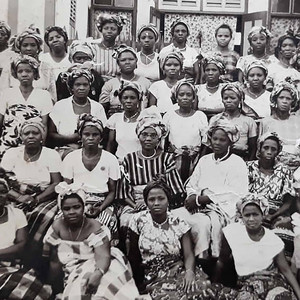
Pretty soon all of the cloth dyers and the rice sellers and the red pepper sellers and the potato sellers were all coming to Fumalaya's ladies club for reading lessons.
He's written about how he would sometimes be at her compound.
Women of every occupation the cloth dyers weavers, basket makers.
They arrived in ones twos groups.
They came from near and distant compounds.
They smelled of the sweat of the journey, of dyes, dried fish, yam flour.
In addition to the head tie, their shoulder shawls, neatly folded, were placed lightly on their heads.
Well, you saw the swirling colors and the women's sashes.
That's Nobel Prize-winning writer Wole Soyanka, who is actually Fela Kuti's cousin.
He spent a lot of time around Fumalaya Ransom Kuti and has written about her extensively.
You saw the movement of the clothing, which meant, get out of my way.
He talked about them being the wrapper wearers.
He said when the wrapper wearers showed up, boy, something was going down.
And so the ladies club then sets up this literacy program and Fela is involved.
Fela apparently, would sit with the cloth makers and the peanut sellers and he would teach them how to write their letters.
Wole Shayinka is involved.
They're all helping to teach the market women to write.
But as I confessed, I was a great eavesdropper as a child.
Wole Shayinka said that inevitably after their reading and writing lessons the talk would turn to politics and the kids would have to leave the room.
But he, and we might imagine Fela next to him, they would crouch down and listen just out of sight.
And when they did, he says, they would hear the same words coming up over and over.
Taxes.
Taxes.
Taxes.
Taxes.
Taxes, taxes, taxes, taxes.
And also... The alake.
The alake.
The alake.
The alake of Abe Okuta was a formidable personality in his own right.
This person, the alake, is going to come up a lot.
So let me explain the situation and who he was.
Nigeria was a British colony, which we know.
But colonialism took many forms, unlike, say, South Africa.
The Brits in Nigeria didn't have many white people on the ground.
Instead, what they did was they ruled Nigeria through surrogates.
Like the alake.
The alake, which is the king of this town.
Technically, the alake was a king.
And he definitely looks like it.
In one photo of him, he's decked out in flowing robes with gold detailing, big crown studded with jewels, and someone is always holding a fringed umbrella over his head.
But if you look to the side of the picture, you see a white guy with a mustache and a shiny top hat.
In most photos of the alake, there is a guy like that standing right at the edge of the picture.
Basically, the alake is being told what to do by the British.
And he's being held in power by the British.
And the decision-making is the British, even if it comes out of the alake's mouth.
This was the basis of indirect rule.
That was what the British said was so important about their system that they left those indigenous political leaders or titles, at least in place.
This is why the British loved Abiyakuta so much, because it was the perfect case study for their classic move.
British government did this all over Asia, in what is now Singapore India, Bangladesh and, of course, Africa.
They would go in, take control of the leaders and then use a local man dressed ostentatiously to execute their plans.
Okay, so full confession, I'm not really supposed to be recording in here.
This is his diary from 1912 to 1915.
Our producer Ruby Walsh found a diary of one colonial officer who put it pretty plainly.
The titular ruler is the Alake, who knows no English and started life as a canoe boy.
However, the British commissioner, Mr. Young, is of course the dominating factor.
The little state is somewhat in the position of a would-be independent but really very dependent child.
Getting back to the story, the market women coming to those literacy meetings were pissed because around 1938 the British colonial officers those men in suits at the margins of the photos they went to the alake and told him we need you to tax the women in the market.
Because at that time, Germany has invaded Poland and has bombed many towns.
World War II was about to happen.
Hitler was rampaging his way through Europe.
General mobilization has been ordered in Britain and France.
And this is something that no one teaches you in history class but a lot of the manpower for the war effort came from European colonies in Africa.
The people of Africa are doing excellent work to help the Allied cause, both by the production of raw materials and by finding men for the armed forces.
You saw the soldiers being moved across Habeokuta in lorries and they were going to fight some nasty man called Adolf Hitler, the vague ogre overseas, who in some way or the other was involved in our local politics on the wrong side.
This was happening all over Africa.
You had the Nigeria regiment.
You had stations on the shore of Sierra Leone.
You had the Gold Coast regiment.
And so the British government now had this problem.
They're trying just to make sure they get enough rice to feed the soldiers.
And so there are all these conversations about how can we, in a sense, put more of a squeeze on the population.
It's a really combustible situation for these market women.
What the British decided to do was create a contingent of tax collectors.
These were native tax collectors, so non-white.
But like the alake, they were directed by the British colonial officers.
Oh, they were hated.
They were hated.
They were considered the slaves of white district officers.
The tax collectors would march into the markets demand that the market sellers unload all their potatoes and their rice for a third of what they were asking.
And if you don't sell to me, I'll actually just confiscate it and you get nothing.
So during the war, they have no control over the prices.
On top of that, the tax collectors would levy all these new fines on the women.
Not only tax them, but make sure they pay.
So at those literacy meetings, the market women would tell Fumalaya these stories about how they were being harassed, how they would try to sell at night to avoid the tax collectors but often get caught.
Taken to court and tried, and sometimes get hard labor.
They were put in them in jail.
At one point, they started...
She was so old that she had to be assisted up.
The meeting was her first, and she had dragged her feeble body to the assembly as a last hope for the menace now hanging over her head.
She tells her story.
Her son died and left 13 children behind, so she took over the farm to provide for them.
Then tax officers came to her and said because she has a large farm, she gets a special assessment asking for far more money than she has ever had.
You know, one of the things that the colonial enterprise did was it made assumptions about the way society was organized and structured.
It made assumptions about women.
For instance, it went into the marketplace and it started telling women where they could locate their markets.
Well, nobody told women where they could locate their markets, not even African men, because there was a really different status between the public status of women and the private status of women.
And private women were, I'd say, generally oppressed by Indigenous patriarchy.
In public, it was like a whole different thing.
I mean, I saw a woman I don't tell this story often who was telling everybody what to do in the market.
You know, blah, blah, blah, blah, blah, men too.
But I went to her house one time, and she was serving her husband on her knees.
I'm like, this can't be you.
This cannot be you.
And so the colonial enterprise began interfering with what had been the traditional rights of women.
We decide where a market went, how much to charge for something.
And so the women began to get very agitated.
All of which is to say that, as the meetings went on, the nature of the relationship between Bumalaya, Ransom Kuti and these market women began to shift.
At first it was just reading lessons, but then the market women began to approach her and ask her if she would write letters for them, letters to the alake, to the British colonial officials.
Wow.
So where we are right now used to be her study, familiar study.
We took a tour of her house, a small two-story house with a balcony overlooking a busy street, and our tour guide, My name is Akin Labi.
I'm the manager at the Kuti Heritage Museum.
...showed us her home office, a spare room, tiny rug chair.
These are our original furnitures that we had to refurbish.
Is that an original turntable?
Oh, yeah, it is.
Wow.
She probably listened to hymns, would you guess?
Yeah.
There was an old wooden desk facing out the window and it was very easy to imagine her sitting there typing, just rifling off the hundreds of letters found in her archives.
The Egba women's suffering is becoming unbearable.
Egba women have been summoned, worried, harangued and ill-treated by tax collectors.
They said the soup they were given would not be eaten by dogs.
They have to spread their blankets out to sleep on.
Young girls are sometimes stripped naked in the streets by the men officially designated collectors in order to ascertain whether they are mature enough to pay tax or not.
A woman was jailed with a nine-day-old baby after she had paid her tax to the tax collector.
Back with Judith.
So this is a letter to Fumali Ransom Kuti from, I guess, an officer.
In one exchange about that jailed woman, an officer replied My dear Mrs Kuti, what does it matter if a woman is jailed with a day-old baby?
What we want to know is that she pays her tax.
Wow.
So they were taking these stories to Ransom Cootey.
And then Ransom Cootey would try to talk to the alake on their behalf.
He would basically say, there's nothing I can do.
He'd say, you have to talk to the British.
This is their policy.
And she was like, we have exhausted all these channels.
We go to the colonial officials.
They tell us it's their lucky.
They go to him and he says, it's not me.
It's the colonial officials who you have to talk to.
They had had it.
They were like, this runaround has to stop.
Wole Sheyanka remembers the moment when the vibe irrevocably shifted.
It happened at the grammar school.
A tumult overspilled the courtyard.
Market women had come from all over.
There was no question of my going home that night.
I sensed the beginning of an unusual event and was gripped by the excitement.
The women's group met till late.
I had long fallen asleep on the bench in the dining room and woke up the following morning in the bed in the dormitory of Mrs Kuti's class.
On the following morning at breakfast, I heard for the first time the expression Abeokuta Women's Union.
The Abeokuta Women's Union.
Wow, this is...
At this point in the archives, you see a switch flip.
No more ladies club.
This is a union.
And no more Western clothes.
From this point forward, she would dress in the same wraps and headscarves as the market women.
She started only wearing Nigerian clothing.
She never wore Western clothing again.
Okay, this is Constitution rules and regulations, aims and objectives of the unions.
To establish and maintain unity and cooperation among all women in Egbaland.
Egbaland, by the way, is a reference to one of the dominant ethnic groups in Nigeria to cooperate with all organizations seeking and fighting genuinely and selflessly for the economic and political freedom and independence of the people.
Dang.
Number five, to raise and maintain necessary and adequate funds.
It's like I read this stuff and I'm like, we got to get our shit together.
These people were organized.
And you know she had a car, so she used to drive to different communities and hold meetings with them.
And we know, because Fela told it to his biographer, Carlos Moore, that when she got in a car to go to a meeting she would often take him with her.
So she and her husband owned this school.
And so the school had huge grounds.
And that's where the rapper-wearers would meet.
Oh, yes, yes, yes.
While we were at the school, I kept looking into the field behind where the kids were doing the Bible study.
I mean, it wasn't the same field, but I kept trying to imagine what it would have looked like, filled with thousands of women.
You know, there were, the estimates are between 10,000 and 20,000 members.
According to Woloshanka, the first protest happened almost spontaneously.
They poured out of the grammar school compound, filled the streets and marched towards the palace of the alake.
It was a bust.
The authorities quickly shut it down and jailed Fumalayo, saying she didn't have a permit to march.
When she was released, she thought, OK, fine, if you're not going to let us have a protest.
They said they were going to have a picnic.
So they gathered 10,000 women to go have a picnic when they were carrying little packets of food.
A week before, Fumalayo had held a massive meeting in her courtyard.
And she said it at her compound.
And she came out and she said to them.
And she said she was screaming because there were so many of them.
Because she started talking, they were like, I can't hear you.
So she was screaming through her hands.
And she was saying, look, this is the time.
I'm going to turn my back to you.
And anybody who wants to can scurry away.
I won't know who you are.
I won't see you.
But when I turn back around, everybody I see better be on board.
And so she turned her back.
And according to everybody, nobody left.
Oh, my God.
And then, as Woloszynka describes it, all at once, all 10,000 women took off their head wraps.
It is always a dramatic moment.
Normally, there's a head tie nestling peacefully on the head.
The moment there's going to be conflict, off would come the head tie.
To the waist.
They would tie it around their waist like a belt.
It's like throwing down the gauntlet.
When a woman takes off her head tie, ties it like a sash around her waist, men scatter.
Oh my God, you can see her addressing the crowd.
What?
Wow, you can see the crowd.
After three and a half hours of digging through the archives that Judith Byfield had laid out for me, I found these black and white pictures.
There's literally like 10,000 people.
10,000 heads.
In one picture shot from above, you see thousands of heads covered in white scarves, white circles filling every millimeter of the picture.
And to the side, on a platform, one woman addresses them.
And next to her, maybe a young boy.
Probably, I'm just imagining it.
I'm getting a little too excited.
Oh, my God, these pictures.
This rally is perhaps the moment right before they march to the Alakes Palace, which is when things really go down.
My sense of it is you would see this sea of women approaching the palace.
What you would see is you would see men getting out of the way.
And they would often tell the British.
The British would come to them and say get these women to stop it.
And they would say, we don't tell the market women what to do.
We cannot stop it.
And there's a wonderful passage in Ake where Shoyinka talks about one of the chiefs running into his mother's shop and hiding there because the women had stripped him off his clothes and just reduced him to his underwear.
Speaking of Wole Shevenka, he snuck ahead of the women to the palace, which we visited.
Picture a gated mansion painted canary yellow.
He snakes through the gate, under the stone archway, and into the spacious square.
Okay, this must have been the courtyard where they were.
It's a big open space with peacocks milling about.
As you walk into the courtyard, you see a building in front of you, yellow building.
There's an image of them talking to the alaqa.
The alaqa coming down from a balcony.
That might have been the balcony.
That's probably the balcony.
Up high, there was a single balcony with glass doors, the alake's bedroom.
He initially stayed inside as the women flooded the courtyard.
So they were probably right here.
You just see a sea of white head scars.
At first some of the alake's junior chiefs come outside, try and hold the women back to keep them from entering.
They comply, but only in exchange for a conversation with the alake.
So the juniors go inside.
Then the glass doors on that balcony opened and the alake stepped out. dressed in his gold robes.
When the alake appeared, they cut seed, going down on their knees.
But no more.
The alake had obviously resolved to receive the emissaries courteously.
A protester, one of Mrs. Kuti's lieutenants, stepped forward and called up to the alake.
The message which I bring you today is the message of all women who have left their stalls, their homes and children, their farms and petty affairs to come and visit you today.
They are the suffering crowds who are gathered on your front lawn.
You can see them yourself, Kabyesi.
They are all the womanhood of Egba.
The voice with which I speak is the voice of our bearer, Mrs. Kuti.
The words which you hear from me are the words of Mrs. Kuti.
She asked me to tell you, on behalf of those women you see outside, that the women of Egba have had enough.
In hindsight, it was rather like protagonists and the chorus.
Woleyshenko describes the scene almost like it had a kind of mythic choreography.
You had the masked women.
You had the moment when the white district officer came in through the gates and was booed roundly.
A policeman ordered a district officer to clear his way through the crowd towards Mrs. Kuti.
As he moved through, the women threw insults at him from all directions, getting in his face.
Mrs. Kuti stayed rooted.
Officer, look here, Mrs. Kuti.
We are trying to hold a serious meeting here.
Will you kindly keep your women in order?
Mrs. Kuti, so are we holding a serious meeting?
Or do you think we're here to play?
Officer, we'll tell them to shut up.
Shut up your women.
Mrs. Kuti apparently squinted her eyes.
I think her exact words were, you may have been born, but you were not bred.
Those words would fly around Abiyakuta for weeks.
I think that's the one which then became translated that you lack bread in your house.
And all kinds of other versions.
Anyway, she gave it to him back with interest.
And it was at that point that the women began to sing.
Inalola, tarara.
This is one of the most interesting parts of the story to me.
Oh, look at this.
All songs sung during the women's union demonstrations from... Oh, hello.
This is... what?
In the archives that Judith showed me, Fumalaya has documented all of the songs protest songs that the women sang when they occupied the palace.
First of all, there's a lot of these songs.
There's 200 different songs they were singing.
Every protest movement is defined by its music to some degree, and there are pages and pages of these songs in the archives.
CHANTING
All the songs are in Yoruba, so we hired a language expert to help us translate them and then a choir in Lagos to sing them.
And these songs are wild.
Because they would sing insulting songs.
And a quick warning, they get kind of graphic.
They would say things like...
You know, a white man is not going to get back to his country alive.
You've got to cut off Delake's head.
Delake's genitals are small.
I mean, all kinds of just mean, mean things to just insult.
My favorite, by far.
The chorus that we got to sing these songs were gasping when they read the lyrics.
The alake has a penis as big as a horse, however...
We will cut it off, basically.
The literal translation is as best as we can tell.
We will emit fire from our vaginas that will wound his penis.
This is one of the reasons why the protest movement became known as Vengeance of the Vagina Head.
There is an African tradition called sitting on a man.
Sitting on a man means gathering outside of a man's house and singing insulting, derisive songs and daring him to come out.
And men were scared to death of it.
Now, no one woman could talk to her husband like that.
So like if a man beat a woman, she might run to her market women's group and then they would descend in the hundreds on her house telling her husband, if you ever beat her again, they were going to deal with them.
Wow, so they would start singing those songs yeah, they weren't mincing their words.
And then they would say and we're not leaving either.
Coming up after the break, the women make the British experience something they have absolutely no answer for.
That's in a minute for Chicago Public Radio when our program continues.
Support for This American Life and the following message come from AT&T.
AT&T believes that hearing a voice can change everything.
Sometimes, a familiar voice can bring back a memory, a moment, a feeling of connection.
This holiday season, ATT celebrates the voices that stay with you and the ones that continue to connect even when they're miles apart.
AT&T, connecting changes everything.
So we're for this American life and the following message come from Freshworks.
Software is a choice that can make or break a business, create better or worse experiences, propel or throttle growth.
Too often, so-called solutions end up becoming blockers instead of enablers.
Freshworks builds uncomplicated service software designed to deliver exceptional customer, and This message comes from Apple Card.
Apple Card members can earn unlimited daily cash back on everyday purchases wherever they shop.
This means you could be earning daily cash on just about anything like a slice of pizza or a latte from the corner coffee shop.
Apply for Apple Card in the Wallet app to see your credit limit offer in minutes.
Subject to credit approval, Apple Card issued by Goldman Sachs Bank, USA, Salt Lake City branch.
Terms and more at applecard.com.
It's Just American Life.
I'm Ira Glass.
Today's program Bigger Than Me.
Stories of people trying to rise to the historic moment that they find themselves in.
If you're just tuning in, we're in the middle of an excerpt from Jad Abramov's new podcast about Fela Kuti.
This particular story is about Fela's mother, Funmalaya Ransom Kuti.
Jad picks up where he left off.
The women are trying to convince the alake to stop taxing them unfairly.
The market.
Women camped out in the courtyard of the alake's palace, and then they began round-the-clock shifts.
Woloshenko remembers that those encampments became like a city.
There were moments of absolute stillness.
For instance, when they started cooking.
Because they laid siege.
They were there all night.
And they took turns, sometimes go home, look after the children, come back to their position.
So there was cooking also.
And the activity, especially at night when they lit their lamps, oil lamps, to stay on the siege.
At some point, you described yourself as a courier.
Yes, it's true.
I was a courier since I was so small.
And there were police, lots of police around, and the Alakazon guards.
Since I was so tiny, people didn't take much notice of me, and so Mrs. Kuti in particular.
He says she would entrust him with these notes.
Little notes to her forces who were scattered in front of the palace.
These protests happened on and off as the year went on.
I mean, they literally made the town ungovernable.
They shut down the market and they stayed camped out just outside the alake's window.
The sea of women is in the palace and he can't get out.
After several months of this, he starts to crack.
Yes, yes.
And is he amassing soldiers to try and drive a wedge through the protesters?
So that's a really interesting story.
I learned from the memoir of the main colonial official that they did have soldiers on the edge of town.
And they were contemplating bringing the soldiers into town.
In fact, Elake was trying to beg him to bring the soldiers in.
This is not theoretical.
Almost 20 years earlier, in a different part of Nigeria, there had been a different revolt, also led by women.
Also a struggle around taxation.
And in the 29 protests, they did call out the army and women were killed.
Army opened fire on a crowd and killed over 50 women.
A few years before that, in 1918, a similar rebellion ended up with 600 people dead.
Fela would actually sing a song about this.
Heaven!
He would adapt a folk song that was used in the protests and set it to music.
But that's many years later.
Let's not get ahead of ourselves.
At that moment, if anything, Fela is in the encampment with his mom as the tension mounted because it looked like this protest with the market women was going to end the same way as the others.
Because what the Alake was saying essentially to his British masters was what you did last time.
Do it again, please.
They were very conscious of that earlier era.
And so in 47 now, they have the army closed basically on the edge of town.
The market women are camped out, well aware of the violence that might be about to go down.
But both Judith and Cheryl say that somewhere around this point in the standoff the women begin to protest in an entirely new way.
A few of them step forward.
And they take their clothes off.
They actually stripped naked.
Apparently, right there in the plaza, some number of women protest.
We don't have accurate details on how many, maybe a dozen, maybe a hundred.
They got together and while facing the alake's window all at once, they disrobed.
And the idea is that if you see an older woman naked, that that's an abomination.
Judith explained that in many West African cultures and in fact in many other cultures around the world, women disrobing, particularly older women, was thought of as a kind of weapon, a summoning of a spiritual power.
Partly because of their ability to procreate, women are thought to be in touch with the spiritual powers around them and thought to be able to really sort of weaponize that.
That when they disrobed, any man who looked on them was now a target.
Ooh, ooh.
I find this moment so interesting.
You have these women shoulder to shoulder, putting out a kind of spiritual power, almost like a force field.
And then just outside of town, you have an army.
Yeah.
It's like two different epistemologies in a way of power.
Yes, yes.
You have military power and then you have this no less potent symbolic power.
Yeah.
And they're lined up against each other.
Exactly.
And so they have the army closed basically on the edge of town.
And Judah says...
If you read the correspondence that was flying back and forth between the alake and the generals and between the various British officers, they were like fuck, what do we do with this?
We could march in, kill them all as we've done before.
But they're saying, do we want to create martyrs?
The British understood on some level that women hold the culture of a place.
They are traditionally the child-rearers, the relationship tenders.
So if you attack them, If they go in and attack these women, That might unleash an energy that they can't contain.
That could then bring young men, and the ones you usually fear, out into the streets as well.
Don't forget the British were outnumbered.
They didn't actually have a lot of soldiers on the ground.
And so on one hand, the state is... a little hamstrung about how you deal with women.
I think in general, it's fair to say that a lot of politics is driven by the fact that men are afraid of women.
In this case, the British definitely were.
We lived in a constant strain, for we never knew when the pot would boil over.
That is how John Blair, the main colonial officer stationed in Abiokuta, put it in his diary.
When the tension was at its worst, I got quite ill, and the doctor sent me to hospital in Lagos.
I was sure I was suffering from nervous exhaustion.
On July 29th 1948, in the dead of night, as protesters were camped all around the palace, the British sent a car to the palace to take the alake, his wives and his family away.
They snuck him out of town.
He didn't want to leave.
They snuck him past all the people?
Yeah.
They put him in a car.
So one of the colonial officials I interviewed had been involved with getting him out of town.
And he said they put him in the car and had him lie down on the back seat.
So they were sneaking him out without the women being aware that he was leaving town.
Wow.
He went into exile.
Okay, so this is a speech that the alake made a few months after they took him away.
After more than half a century of service to my country, 28 of which I have given in the capacity of native authority, I cannot bear any longer the sight of turmoil, strife and discontent.
I have therefore decided, after mature consideration and in order to avoid bloodshed, to leave the environment of my territory, in the hope that, after a time, frayed tempers will subside and an atmosphere of calm will prevail.
Wow.
Quiet speech.
In other words, he abdicated the throne.
That was huge.
Wow.
No other woman is ever credited with unseating a sitting drum.
Drumming began in the Olubumi houses at 5 pm on August 21 1948, followed by firing of guns by hunters and dance by all at Alake Square.
Fifty different forms of African dances were in attendance.
They were dancing at the dawn of a new day.
They talked about Abe Okuta being liberated.
And they have this Thanksgiving ceremony.
There's this minister who speaks on behalf of the women.
He said it took the women to do what the men couldn't do for 28 years.
And in the archives, what you see from this point forward are hundreds of letters from other women.
Women from unions all over start to reach out.
We, the Alawa Oribe Women's Union, send this letter to ask for your assistance.
Copycat women's unions start to appear everywhere.
South Africa, the anti-apartheid movement, Ghana.
Arab Women's Society, Union of Albanian Women, Union of Australian Women, Union of Korean Women.
So you can look everywhere.
Democratic League of Finnish Women.
Democratic Union of German Women.
Federation of Cuban Women.
League for Lebanese Women Rights.
Union of Luxembourg Women.
And I'm only at the M's.
And you see women everywhere.
We in the West tend to emphasize the legacies of Africa's male leaders the Kwame Nkrumahs, the Nelson Mandela's.
But if you look across the continent from this point forward, you see women leading revolts in Senegal Cameroon, South Africa, Gold Coast Algeria Kenya Mozambique, Ivory Coast Togo Mali Somalia, Egypt.
It's a story we've largely missed.
And the erasure of it all kind of landed on us when we went off in search of Fumalaya Ransom Kuti's grave.
Aki, our tour guide from earlier, pointed us toward the Anglican church.
That was 300 feet from the house.
We were told that Fumalaya Ransom Kuti is buried in this church, or we're not sure which church.
We went there, asked around.
The guy walked us to the backside of the church.
There was a grave set in concrete.
Mrs. Kuti is buried with her husband.
There's a headstone and then above the headstone is a bust of Reverend Kuti.
And there on the tombstone is his bust and on the epitaph.
Reverend Israel Odun Ransom Kuti. all the details of his life.
President Nigerian Union of Teachers Association, 1930 to 1954.
He was a very impressive man, did a lot to revolutionize the educational system in Nigeria.
But his wife, who was buried with him and who led a revolt to depose the king, she's hardly mentioned.
It's crazy they didn't say anything about her.
Barely a word.
All there is is this one line that says, RIP, my love.
Fumalaya.
Are you surprised?
A little bit.
I was expecting her to have a thing.
Me too.
Yeah, that says a lot.
Even people who do remember her, says Judith, tend to think of her as a footnote in Fela's story rather than the hero of her own.
I so appreciate that you're doing this, though, because that's the thing that drove me crazy.
She became reduced to Fela's mother.
And so even when I would give talks in Nigeria...
People would be surprised at all the stuff that I bring out, because her activism has just really been forgotten.
Fela Kuti himself would eventually take up positions about the role of women in society that were very controversial and in many ways flew in the face of what his mother was fighting for.
And yet he did honor her.
He referred to her as the mother of Nigeria.
And in 1978, when she died...
After the government raided his compound and literally threw her out of a window, he records a song called Unknown Soldier where he sings about the incident and you can hear his voice break.
Political mama, Influential mama, Ideological mama.
Them throw my mama Out of from window.
Them kill my mama.
Them kill my mama.
Them kill my mama.
Them kill my mama.
Them kill my mama.
Them carry everybody go home.
So he never forgot what she'd accomplished.
And neither did those market women who marched with her.
So let me tell you my grandmother This is Yeni Kuti, Fela's oldest daughter, Fumalani Ransom Kuti's granddaughter.
My grandmother, when we were burying her...
We went in a convoy to Abekuta.
Abekuta is her town.
When we got to the border of Abekuta, there was this mammoth crowd of women.
Mammoth crowd of women.
We had to stop.
They took her body from us and they walked with her and they honored her as the voice of the women.
It was a people's funeral.
It was a people's funeral.
Jed Abramad's podcast about failure is called Failure Kuti.
If you're no man, you can get it wherever you get your podcasts.
That's my mama where you get it.
She fought for universal adult suffrage.
That's my mama where you get it.
Well, today's program was produced by Valerie Kipnis and Emmanuel Jochi.
The people who helped put the show together today include Michael Kamate, Susan Gabber, Sophie Gill, Cassie Howley, Seth Flint Stone, Nelson Catherine, Raimondo Nadia, Raymond Alyssa Shipp, Christopher Sotala and Marisa Robertson-Textor.
Our managing editor is Sara Abdurrahman.
Our senior editor is David Kastenbaum.
Our executive editor is Emmanuel Berry.
Jad's collaborators in making his Phelous series were Ian Wheeler, Ango Phan Mutupwele, Ruby Heron Walsh, Fefe Odudu and Oluwakimi Uladosowi.
The series was edited by Ben Adair.
Special thanks as well to VTech Funmi Arewa and Debbie Ohiri, who put together the choir singing protest songs throughout this episode.
Adairan Kay helped translate those songs.
The episode was fact-checked by Robin Reed and Jamilah Wilkinson.
And we'll see you next time.
Bonus episodes, ad-free listening, an archive of greatest hits right in your podcast feed.
To join thisamericanlife.org slash lifepartners.
That link is also in the show notes.
This American Life is delivered to public radio stations by PRX, the Public Radio Exchange.
Thanks as always to our program's co-founder, Mr. Torrey Malatia.
All his exes live in... Taxes.
Taxes.
Taxes.
Taxes.
Taxes, taxes, taxes, taxes.
I'm Eric Glass.
Back next week with more stories of This American Life.
Support for This American Life and the following message come from Dignity Memorial.
When we think about the people we love, sometimes it's not the big things that we miss the most.
It's the details.
What memories will the people you love cherish and remember once you're gone?
Dignity Memorial helps families create meaningful celebrations of the lives of the people who mean everything to them.
Where the details aren't just little things.
They're everything.
To find a provider near you, visit DignityMemorial.com.
Business with a customizable website.
Visit squarespace.com slash NPR for 10% off your first purchase of a website or domain.