Stop making these advanced grammar mistakes in English.
Today, we are looking at advanced mistakes, conditionals, relative clauses, reported speech.
It's going to be complex, but I'm going to make it digestible for you.
To help you digest and retain.
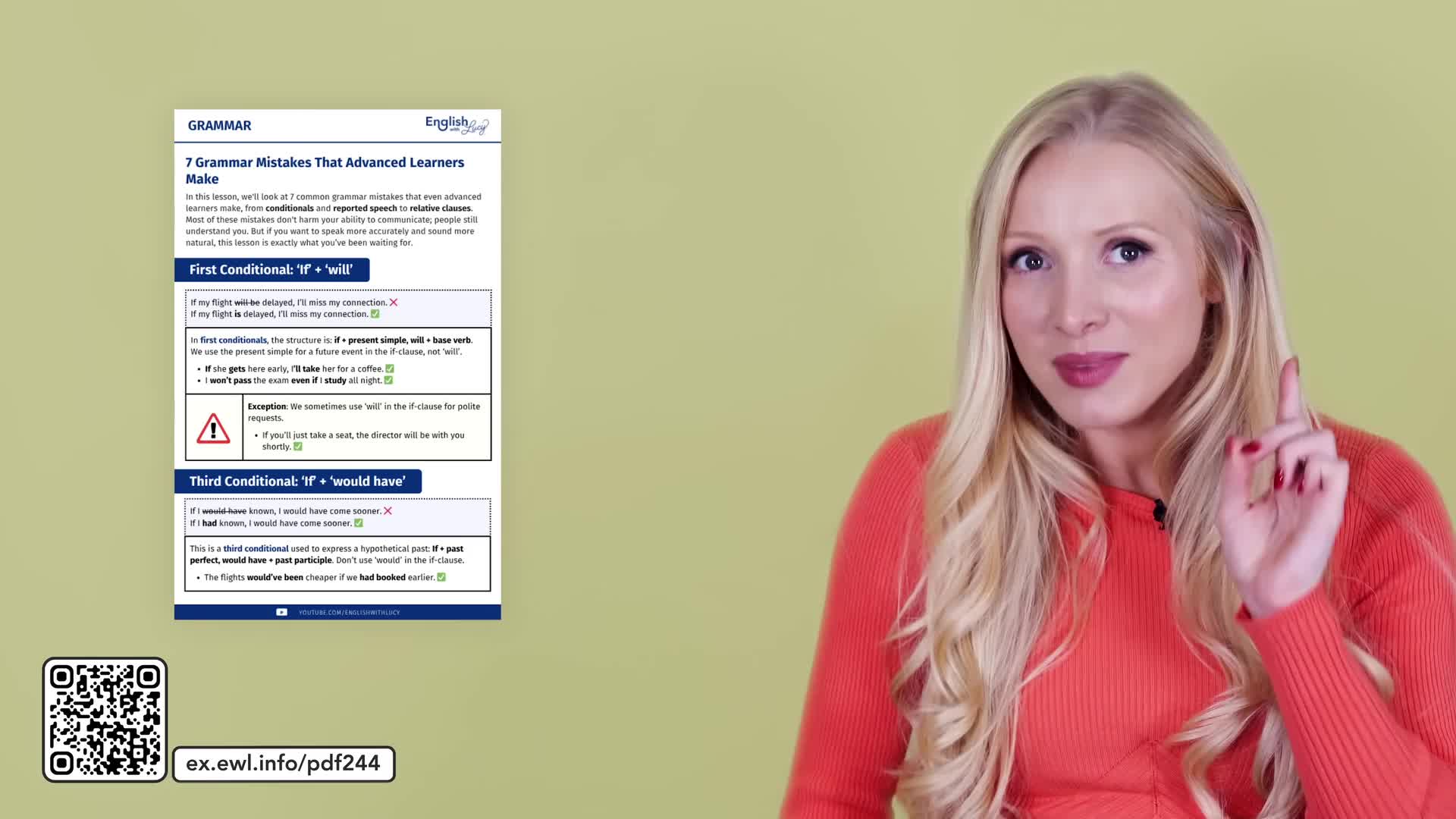
I have made a beautiful lesson PDF.
You can download it for free.
It contains a review of everything we cover today, and it contains a quiz.
At the end of this video, I'm going to give you an extra common mistake to figure out.
The answer is in the PDF.
To download this lesson PDF for free, just click on the link in the description box or scan that QR code there.
Just sign up to my mailing list and the PDF will arrive directly in your inbox.
Now, a lot of the time, the mistakes that my advanced students make don't impede communication.
People still understand them easily.
Having said that, most of us want to speak correctly if we can.
We're proud people.
So let's dive into our seven common mistakes.
We will start with conditionals.
First, spot the incredibly common mistake here.
If my flight will be delayed, I'll miss my connection.
The use of will in the first clause is not correct.
It should be, if my flight is delayed, I'll miss my connection.
In first conditionals, the basic structure is if plus present simple, comma, will plus base verb.
We don't tend to use if and will in the same clause.
That's a good thing to keep in your brain there.
Using the present simple to refer to a future event seems to trip a lot of my students up.
Another couple of examples.
If she gets here early, I'll take her for a coffee.
Not if she'll get, if she gets.
Or I won't pass the exam even if I study all night.
Not even if I'll study.
Now there are some exceptions to this rule.
One is when making polite requests, we sometimes use will in the if clause.
If you'll just take a seat, the director will be with you shortly.
Now, sticking with conditionals, Find and try to correct the mistake here.
If I would have known, I would have come sooner.
Now, don't worry if you've said that before.
I guess almost every English learner has at some point.
And in fact, you might have heard native speakers say this.
It's actually considered correct in some dialects.
But in standard English, there is a mistake in the if clause again.
Would have known is incorrect.
Instead use if i had known, if i'd known.
Now this is a third conditional and the basic form is if plus past perfect comma would have plus past participle, So don't use would in the if clause.
The third conditional expresses a hypothetical past.
Another example, the flights would have been cheaper if we had booked earlier.
Native speakers tend to use contractions in conditionals when speaking, and I think this might cause some of the confusion among students.
The flights would have been cheaper if we'd booked earlier.
See how both would and had become ud.
There's no wonder students don't know where to put would and had.
Next, here's another very common mistake, which is not a correct option.
I'll text you when I will get home, When I get home or when I've got home.
When I will get home isn't right.
Again, we need to use a present tense to refer to the future.
We see this after certain time expressions such as when, as soon as, after, and until.
We tend to use the present simple or the present perfect simple.
With the present perfect, the focus is on the completion of one action before the other.
Often you can use either tense with no change in meaning.
For example, she'll let you know as soon as she makes her decision, or she'll let you know as soon as she's made her decision.
Another example can we talk about this after we finish eating, or can we talk about this after we've finished eating?
Next, let's examine how we talk about the future.
Many of my students overuse the word will.
I feel I should have called this video stop using will.
That word is not getting a lot of love from me today.
Anyway, imagine someone asks you what you're doing next weekend.
Many of my students reply with something like this.
I will go to the beach.
I wonder if you've said that before.
Well, if it's a spontaneous decision made at the moment of speaking, it's okay.
But if you have already planned or arranged to go, I'm afraid it just doesn't sound quite right to native speakers.
What can you say instead?
I'm going to the beach is the most natural option.
Using will to discuss future plans and arrangements isn't correct.
You will be understood, but it's not technically correct.
We use to be going to or the present continuous.
Notice that we don't tend to say, I'm going to go.
We generally reduce it to, I'm going.
Instead of I'm going to go to the farmer's market, I'm going to the farmer's market.
If you already have a plan or arrangement, then this is incorrect.
I'll play tennis with andy at eight tonight.
It should be i'm playing or i'm going to play tennis with andy at eight tonight.
But what's the difference between be going to and the present continuous, or a plan and an arrangement?
The present continuous is used when you've decided to do something and it's fixed or arranged.
An arrangement is a plan with a time, place, or agreement attached to it.
Other people are involved somehow, whether it's a friend you're meeting or an airline you bought tickets with.
Be going to is used when you've decided to do something.
You have a plan, but you might not have an arrangement.
So sometimes there's very little difference, like in the sentence about playing tennis with Andy.
You can use either, though the present continuous might be more natural when you mention a time and another person.
There are times when one is more appropriate than the other.
Let's say you're planning to collect someone from the airport.
You might say, I'm picking Hannah up at four tomorrow.
Her arrival time is fixed and you've arranged with Hannah to pick her up.
Be going to is not wrong, it's just less natural.
But look at this.
I'm going to look for a new job after Christmas.
This is something I've decided to do, but I haven't arranged it with other people.
So, be going to is more natural.
Now, let me be clear.
Native speakers often use these interchangeably, so don't worry too much about the distinction.
This is just a guide.
Just try not to use will when you have a plan or arrangement.
Okay, let's focus on reported speech now.
How would you complete this sentence?
My mum told me she thought it rain next week.
Did you say will?
I bet a lot of people did and I'm sorry, but it's not right.
Would is a great option as is going to, depending on what was said in direct speech.
We often shift back one tense when reporting what someone says.
So in direct speech, we have, I think it will rain next week, said mum.
We can shift think and will back to thought and would.
My mum told me she thought it would rain next week.
But if next week is still in the future, we don't have to back shift.
My mum told me she thinks it will rain next week.
The important thing is that the verbs match.
Now honestly, knowing when to back shift is tricky in English and native speakers are pretty lazy about it.
It doesn't really matter for communication, but if you're in a classroom or doing an exam, it's often required.
All right, can you spot another common mistake that my advanced students make?
We've just got back from Wales.
We've been there for two weeks.
This mistake is the overuse of the present perfect.
Now, it's fine in the first sentence, showing a recently completed action.
But in the second, we should have the past simple, as your being there is finished.
We were there for two weeks.
Similarly, my students overuse the present perfect continuous.
For example, I've been hiking in the Lake District last week.
We have a finished time expression, last week, so we should use the past simple.
I went hiking in the Lake District last week.
Okay, our final mistake, number seven, is in this sentence here.
He baked a cake for the meeting.
That was the highlight of everyone's day.
I wonder if you can see it.
Was the highlight of everyone's day is extra information.
So it's a non-defining relative clause.
It is offset from the main clause by a comma.
And we can't use that in these types of relative clauses.
It should be which.
He baked a cake for the meeting, which was the highlight of everyone's day.
But you could also split this into two sentences.
If we want to do that, we have to fix the comma splice.
A comma splice is a mistake.
That happens when we join two independent clauses together with just a comma, which isn't possible.
There are a variety of ways to fix it, but A full stop is the simplest.
He baked a cake for the meeting.
Full stop.
That or it was the highlight of everyone's day.
Now to finish off, I have one final mistake for you to figure out.
If you can figure out the mistake, leave a comment below with the correct answer.
I've put a full explanation in the PDF that goes with this video.
Click on the link in the description to download that or scan the QR code there.
Here is the sentence.
You haven't to bring anything to the party.
How can you correct that?
No clues from me.
And with that, we've reached the end of today's video.
I can't wait to read your comments on this one.
This was pretty advanced.
I will see you in the next lesson.
Bye.