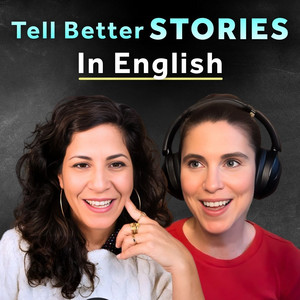
Have you ever wanted to tell good stories, but you didn't know how?
Do you feel like whenever you want to tell a story, you start going off track and you talk about all these different things and you find it really hard to stay concise and speak to the point?
And do you feel like you want to improve your connection and communication skills when speaking to other people, especially at work?
If this is you, then my guest today is going to share with you all things storytelling.
I'm going to interview Bri, who is the podcast host of Into the Story.
Bri is also a public speaking and storytelling coach and an incredible person.
And today she is going to share the best tips and strategies for telling stories.
She's going to share a formula to help you tell a good story.
And she's going to talk about her journey to becoming a storytelling and public speaking coach.
I'm so excited about sharing this conversation with you, so let's not wait any longer and listen to the interview.
Hi, Bri.
How are you doing?
I'm good, Hadar.
How are you?
I'm good.
Thank you so much for joining me on the podcast.
So just to tell people how I got to know you, one of my community members inside Beyond Mary, She contacted me one day.
She was like, I got the most incredible person to come for an interview inside Beyond.
She creates these sessions around women and leadership.
And she reached out to you because she's a listener to, she's a podcast listener.
And to your podcast, of course.
And she was like, I love her.
She's so great.
And I was able to bring her to the community.
And then she was working on this interview and it was such a huge success.
So after that, I was like, oh, this, you know, Bree, like I have to get to know her.
And we were in contact and I'm so happy about it.
So thank you so much for now coming on the podcast.
Of course.
And sharing your story.
Of course, I remember getting that email from Mary.
She's so sweet and telling me about the community.
It was so fun.
It was so fun.
Yeah?
How was, like, it was a good experience for you as well?
Yeah, it was the experience of going to the community Hadar Like this sounds so cliche, but it was like best vibes ever.
Everyone there was so kind.
And when I finished, you know, sometimes when you're speaking or recording, it's really draining.
And it was the opposite.
I was like, I got so much from that.
It was so nice.
And Mary, yeah, Mary's just like such a lovely person.
So.
Anyways, here we are.
Thank you.
Thank you for coming.
So your podcast revolves around storytelling.
And this is what I want to talk about today, because I know this is such an interesting topic to discuss, especially when communicating in a second language.
And we're.
I feel like when I think of storytelling, I think one kind of like what a beautiful way to connect and communicate.
But also on the other hand, there's like something triggering about it and very scary.
Like, how do I tell good stories?
I'm not a storyteller.
Like, I have all these thoughts coming up, even about myself, right?
Like, I don't want to overwhelm.
Am I telling too many stories or like not enough stories?
And how do I do it right?
And what is storytelling to begin with?
Is it like, you know, being able to write a novel or is it just being able to tell a joke?
Like I feel there is so much that goes into that big topic of storytelling.
So what is storytelling, Bree?
What is storytelling?
I think that calling oneself a storyteller feels very grandiose.
There are very few people that would probably call themselves storytellers.
So think it's completely normal.
And I think that with storytelling, people often think it means like performing and or sharing something very private or at least very personal.
Okay.
So a list of a story isn't like a confession, right?
This is not something where you're you're divulging, you're giving personal information about yourself, necessarily.
What storytelling is, is describing a moment of change.
Okay.
So it's when something or someone shifts in understanding and a feeling and in in a perspective, for example, and that's what makes a story powerful.
Okay.
And I don't actually think of a story necessarily as an art type.
What I think of it as more a structure for meaning, like a vehicle, like a vehicle for meaning.
So it communicates information in a memorable and repeatable but simple way.
So it communicates information.
I'm just going to repeat that in a memorable and repeatable way and simple, ideally.
Okay, we can get a little bit more to that later.
But I would say that it's not always going to be personal.
There are many moments when You want to, for example, tell a story about a data point that you're giving.
Something that we can all agree could be very boring.
Exactly.
So 85 of professional success is more dependent on soft skills, like communication, than hard skills, like technical skills.
This is a stat that came from Harvard Business School a long time ago.
This is a real stat.
And instead of saying it in a stat, you could say it in a story or explaining it in a certain way.
That would make it more relevant to the person.
Does that make sense?
How would you do that then?
So let's say that is the piece of data that you have to convey.
Yeah.
So I had a client that works in a European company and they are doing a lot of mergers.
So they are buying companies and merging them into his company, basically.
And he was going to be speaking to 80 of the leaders from that company.
And he needs to basically tell them we are going to rebrand this, all of your companies, and it's now going to be the name of my company.
Okay.
That's basically the data point.
Okay.
It's a difficult thing to say.
And this is a person who is a very good communicator.
Very, when I say good communicator, I mean, this person communicates very clearly.
But I knew that this speech needed to be something personal, and or I believed it needed to be something personal.
He really resisted, but I convinced him and helped him structure a talk where he was going to use a personal story.
And that personal story went a little bit like this.
It started with him at 20 years old in Italy riding on a Vespa, and in his backpack he has some papers that would eventually become a business.
Okay that he was going to start in the United States.
Fast forward.
He actually decides that the smartest thing to do is to sell that company, and it will no longer be his
And he knows that it's the right decision, but it really hurts.
He sells it.
He signs the papers.
And then there's a moment where he goes to an airport and he's sitting and he starts crying.
And this is a man in his late 50s.
He is... very well composed.
He has never said anything personal in front of people like this in a professional setting.
Absolutely not.
And he really lingered there, of this moment of crying in the airport, knowing that something that he loved was going to be now taking a different name, but also understanding that it was going to evolve into something else.
And it was for the best.
And after I was at the session that day and after there were several of the leaders there who knew that I had helped him And they came up to me and they said that was incredible.
We have never felt that type of connection with him before.
Just seeing that different side of him just made him more human.
So-
That's kind of more what I mean when I say a story is a structure for meaning, right?
It communicates this information that makes it memorable and repeatable in a simple way.
These people didn't just, he didn't say, we're changing our name and this is the best thing for the future.
He showed them, not just told them.
When you started the story, I got sentimental when I heard Vespa.
You know, like I was like, I know, like I can picture this.
I was like, oh, so like, I love that.
I already love the story.
Just say Italy and Vespa and I'm like, okay, yes, I'm in.
There is a story of transformation, but what I think made it so special is that it allowed him to be vulnerable.
So not only that he was saying the words, it also did something to his I'm assuming energy and how he showed up and kind of like, even by being there on stage telling that personal story, created vulnerability and people also connect with that as well, which I think only stories can do that.
Like it creates like a connection on an emotional level, apart from the relaying information, that when people feel something that helps them retain information.
So we know that when, like you get new information and you like, there is an emotion attached to it, especially a positive emotion, you're more likely to remember it right.
So there is like the chemistry of that but also like more willingness, like more, like people are more open to hearing it.
So i love that part about stories that um, that is just even beyond and i know you know that and then this is what you meant.
But like, i want to emphasize yeah yeah please the the the, The aspect of like being human and the personality aspect of it and allowing someone who might always be very, very direct and to allow more room.
And I'm sure that he ended up enjoying that as well, right?
I hope so.
I think so.
But I think this is the thing about storytelling.
And again, storytelling being starting somewhere and moving to a different place, right?
It kind of gives you permission to tell things differently. that maybe you wouldn't otherwise tell.
So once you learn about storytelling and how it can be used, this person would have never stood in front of others and said I sat in an airport and cried because I was losing my company name.
But being in the story and it being a true personal story, it kind of gives you permission to be vulnerable.
And absolutely that is what we connect with.
True, honest vulnerability from another human being.
Yeah.
So you work with people, helping them craft their stories when they have something like high, like when they need to communicate something in high stakes situations right,
Usually in business, and or you know like we can think of situations in life, not just in business, where that is the case.
Have you ever come across someone that said, I don't have any stories to share?
Everyone.
Everyone says that.
Everyone.
Yeah, I think that it's very intimidating when someone says tell me a story about your life.
That's going to be fancy.
Okay.
So first of all, on my podcast, that's what happens.
People come on and they tell a true story.
And most people say, you know, I don't have anything to tell that's of interest.
Right.
But then I, you know, scratch around and we, we find a story that works.
And then I work with leaders and people working in high stakes situations.
And that is more so about, okay, what, what are you wanting to communicate?
And let's find a story.
Because certainly there's a moment in your past that absolutely helps illustrate this.
And in that way maybe storytelling in the consulting work that I do with leaders sounds a bit false, but it's really not, because it's simply most of us are not aware.
We're not actually keeping a log of the truth, the things that happen to us.
But once you actually do start doing that which is what someone called person, called Matthew Dix he recommends doing is actually keeping a log of story worthy moments in your life you start seeing, oh wow, that experience actually really nicely kind of shows this kind of point that could be relevant to these people.
Or if you are like me and you're giving a lot of workshops and you're wanting to communicate a point, you're You kind of just start thinking about those moments, you know, and you kind of let your mind go and you think about what's happened to me that could be relevant to this exact thing.
So I think it's normal to feel like you don't have stories, but it's more finding them, it's more having an eye for them.
Right yeah, I used like I didn't know that that was a method, but like I remember that there was a point where I was when I started writing my newsletter and when I first started creating content.
I would track, like I would I.
I would have my notes on the phone and every time I would remember an experience that I had, I would start writing it.
Because every time I would sit down to write the newsletter, I'd be like I don't know what to write about.
So I would have this bank of ideas and stories based on my experience that would come up in my day-to-day life, but then it's not relevant, so that it would be accessible.
So I love that.
So about telling stories, I think that when I talk to my students and I know like a big pain point is like I want.
I love telling stories.
I want to tell stories, but it's really hard to stay concise, right?
It's really hard because they feel like they start and then they go off into tangent and talk about all these unnecessary details, right?
What is the most important part in a story that?
If you were to keep the core of a good story, what would it be?
And how else would you structure a good story?
This is the absolute essence of being a good storyteller.
It's not knowing what to say.
It's knowing like all of the stuff. to not say.
Oh, that's good.
Like what not to say.
Wait, I'm going to say it again.
What not to say.
That's good storytelling.
Because in the end, we want to include everything that happened.
And when we don't practice storytelling, or even if you don't practice the art, let's say, of storytelling, but you don't practice the specific story that you're going to tell, And you have a really hard time seeing what information is not relevant because it's personal to you.
So you think it's all kind of relevant.
So a good practice is think about your story and then start as absolutely close to the end as you can.
OK, and usually what this is going to do is have you starting right in the action of the story.
And you're basically just going to cut everything that happened before that.
So you want to start as close to the end without, of course, cutting out the moment of transition.
OK now this, this moment of transition, is what is the moment in your story where something changed for you or something changed for the main character?
Now, this isn't necessarily going to be like a big grand thing.
It's just going to be that this is the moment where there's a clear before and then a clear after.
And then you go and you say what happened at the end.
Like what was the takeaway?
What did you learn?
What was the moral of your story?
But here you want to really avoid going on, okay?
Once you've said the moral, then you stop there.
Because really your story itself is going to explain the meaning.
You don't need to then explain it, okay?
It's like when you watch a movie, your mind is there watching the characters and you are constantly putting meaning onto the story and taking the lessons and applying it to your own life.
At the end of the movie, you don't need the characters to say this, this, and this.
This is what happened because that really kills the story.
The end of any good story.
Someone just really going back and telling you what you should feel and what you should learn.
And interpreting it.
So just to repeat it, like for just to kind of like...
See if I got it right.
So you want to start as close as possible to the end of the story.
Yes.
Maybe ideally right before the moment of transformation, because you said a story is about transformation.
So you want to also identify a moment of transformation, whether it's something that happened or a decision or something that made you change right.
Am I right?
Yes.
And then you don't want to skip that part.
And then you go into what happened right after, like what The aftermath.
The aftermath of it.
And then you want to stop.
You don't want to over explain.
You don't want to, you just say it as it is and that's it.
Exactly.
But this is personal storytelling.
Like, I mean, storytelling comes in a lot of different forms.
If you're using a story in a speech, OK, it really depends where it is, what it's for.
But let's say as a rule a nice story would be say, two minutes longer than that could feel a little bit drawn out.
But depending if you're doing a story.
To kind of establish credibility and tell who you are, that could go maybe to five minutes.
Okay?
All of these things, it's really hard to put numbers on them.
But in the end, you want to be concise.
I love, love, love that.
And also I use you know in my programs and you know, when I recommend people on ways to build their fluency, I say it like this make videos, talk about different things, tell stories.
And I think that this is like what you're giving us here is really not like just a good strategy for telling good stories.
Also excellent, an excellent way to practice English and practice your fluency and build confidence in sharing stories.
In a minute we'll talk about storytelling specifically in like in a second language, because I think there is another aspect that doesn't go into storytelling in your first language.
But before that I wanted to ask you would you recommend someone to tell a story in the present tense or in the past tense?
There is nothing more powerful than starting a story in the present tense with a location and an action.
And when I say powerful, I mean that you are basically reaching into someone's brain and saying we are going somewhere.
Jump on and listen to me.
So If you feel comfortable, then absolutely the present tense.
You know, you think of that story with the Vespa.
You can imagine him saying it.
It's October in this place in Italy and I'm riding on my Vespa.
It's like I can't not picture it.
My brain has been structured in a way that I am so attracted to that form of speech that I just go there.
It's almost like relaxing.
Yeah, I'm playing the movie in my head.
Exactly.
Yeah.
I love it.
I feel like we're zooming into your brain, into that one memory, and I get to look at it with you as you're telling me that story.
Yeah.
I mean, it's what connects us, right?
We have been telling stories for a long long, long time, and our brains simply are just structured to understand that form.
We are not structured to take in data and Just series of events.
We need meaning.
We need narrative structures to understand ourselves and to understand each other.
And so for me, yes, present tense, action, location.
It's like that is the place to go.
Beautiful.
So you work a lot with international professionals.
Yes.
That English may not be their first language.
That's correct.
Yes.
And they have to tell stories in English.
What are the biggest challenges that you come across and how do you help your clients overcome them?
And also like the people listening to this.
What would you say to them if they're afraid of telling a story in a different language?
In English?
When I started working with leaders and teams that are working in international companies and using English as their second language, I would tell them look, you have a superpower.
Because you only have a certain amount of vocabulary.
When I said before that the best storytellers, they know all the things not to tell, right?
So, in a way, your limitations okay.
You have perhaps less vocabulary, less grammatical structures to use is a superpower.
But you know what?
I don't think I really believed it.
I said it, but I didn't fully believe it.
But now that I see it...
And I've recorded stories with a lot of native speakers that are very good storytellers.
But I've also recorded stories with non-native speakers and worked with people who are not native speakers.
And it's true.
It's a superpower.
It is a superpower being able to...
Know what you want to say because, of course, before we get to and in my trainings that I do, before I get to storytelling, that's a little bit way down, a ways down the line of what I teach.
I first focus on clarity and confidence and then move into connection.
But when you know what you want to say, and then you have a little bit of a formula what I've just said to you now, starting in location and action, present tense, transformation and then you have more of a boundary of language and I say okay, make this 60 seconds long.
And I want you to get through the three acts the beginning, the transformation and the end you can be a very powerful storyteller.
And you're also focusing on explaining what's happening.
You're not needing to use big words.
In fact, you should be using smaller words.
You should be using very direct formats.
I don't want to hear passive sentences and conditionals.
I want to hear present simple, and I want you to tell me what you were doing.
So that's what I believe.
I think that there's something very freeing about it because, like when people think of good storytellers, you think like authors and people who might have a lot of experience with language and you need fancy vocabulary.
And I agree with you.
You know, I once read this book.
What's his name?
The guy that created TED Talks, Anderson.
Wait, Anderson.
Wow.
I forgot his name, but I'm going to link to it in the description because I read it.
And like right at the start, he says TED Talks should be spoken in a language that first graders should be able to understand.
Like you don't want to be too clever.
You don't want complicated vocabulary, no fancy words.
It's creating like detachment.
And I think that this is, first of all, something that people need to know, that they don't need to go all fancy like the basic simple personal direct concise, present tense transformation, like all the things that you said, like that's all you need.
And also like let's talk a little bit about the mindset around being afraid of making mistakes and sounding not professional.
And then that could take away, that focus could take away from the story.
So what would you say to that?
People who are afraid of making mistakes?
I would say that you speak a language that's not your own.
I speak a language that's not my own.
Being okay with making mistakes is part of the game, okay?
This is something that you have to be okay with.
You need to get comfortable being uncomfortable.
So that's like the language side of things.
You will make mistakes.
I still make mistakes.
I've been speaking Spanish for 15 years, which is terrifying.
And every once in a while I will speak.
And then, like five minutes later, I'm done speaking and I'm like making my mistakes.
My kids snack, you know, that afternoon.
And I think, ah, I use the subjunctive tense wrong.
You're like, oh, and, and you feel a little bit, it's like this little tiny feeling of shame.
It's like, but then immediately my, you know, frontal cortex here is like, that is ridiculous.
Like, like that is not important.
Okay.
So that's one thing you will make mistakes.
You will never have as perfect of grammar, as perfect of pronunciation, perhaps as a native speaker.
That is not important at all.
Specifically with stories, your intention is to connect with someone.
And when I say connect with, I mean tell an honest, true story and show your humanity.
And you are – it's like an act of faith.
You're like throwing something out there.
It feels very scary, honestly, telling a story.
You're throwing something out there into the universe and just trusting that it's going to connect to their heart and to their brain.
Okay?
And –
I know that that can feel hard, but if you practice it it actually, when you see the connection that it has and you see the results that it has, and then you keep practicing it, you really stop caring about perfect perfection.
You realize that that is not where I want to focus my effort.
I only have so much time in my life.
I'm going to focus on connecting with human beings and not on some crazy standard of what I think I want to have in terms of fluency.
Yeah, 100, 1000%.
And also you gave us the best formula.
Just use the present tense.
Yeah, exactly.
Like the easiest tense, like no mistakes, right?
That's it, solved.
So speaking of stories, what is your story?
Like what got you into storytelling and doing the work that you do?
There's a story actually that I tell at the beginning of my signature workshop, that I do right now, that I give to companies.
And it's a story that begins with me as a little girl.
I grew up in Western Canada.
So that's the place with more mountains and lakes.
We do not speak French.
We only speak English, unfortunately.
And I grew up as just a very curious kid, constantly asking questions.
It was like a compulsion.
I was always, always asking questions.
And I remember this one day I'm driving into the mountains with my dad and it's just the two of us, which is unusual because I'm the youngest of three girls.
So we were never alone together.
And I was saying, how tall is that mountain?
Why is the sky blue?
Why do people sometimes say one thing but actually mean the other?
And he was like, what is going on with this kid?
And eventually that incessant curiosity led me to study at the University of Victoria, where I studied psychology.
And I started working in a lab where we were helping people with autism and Well, so we were actually helping them specifically understand facial and emotional recognition and basically helping people who tend to really lack communication skills communicate well in a very, very basic way.
And that research and that work led me to eventually open a language school.
And then an intense interest in the art of storytelling led me to start a podcast where I would just invite people on because I loved hearing stories.
And it kind of all came together and led into the work that I'm doing now, which is strategic communication, consulting and kind of bringing everything together.
So this story that I've told you, it kind of shows you a journey of who I was, kind of moments of transformation, different interests that I had, and how it kind of has led to where I am today.
So it's kind of a slow transformation, but it's my story.
I love that.
I love that.
And I'm imagining you as a little girl asking all these questions and being all curious.
And I think you have to be curious about other people's stories to be able to dive into this world of storytelling.
I love how simple...
You make it seem, you know like, not such a huge lift, which always feels like that, I think, for people who are thinking about storytelling.
I was like, no, it's not me.
And I think that you're making it very accessible.
So you're definitely in the right niche for what people need and what you love to do.
Thank you, Heather.
To wrap up, like we talked about collecting stories, right?
You mentioned that strategy of like things that happen to you and kind of like create a story log.
You talked about the formula.
What is maybe one more technique or practice strategy that you could recommend people who are interested in incorporating more storytelling into their work, communication style, or even just like when they make videos inside YouTube?
You know, this is a big part of our community work and like they make videos and share stories.
You know, what can they do to become better storytellers or to tell more stories?
I would definitely say this.
It's called Homework for Life and it's Matthew Dick's, let's say, methodology.
We're collecting moments.
And you can even keep it in your phone, just thinking of things that happened to you like right now, today.
Okay,
Think of your day today.
What is one thing that happened to you that you could say is story worthy, that you could build something around?
Could be something very small.
You realized you were wrong about something, okay?
You were embarrassed.
That's a classic one.
You made a mistake.
So many of these things can be stories.
And then take that moment, okay?
So that has to be the moment today.
Don't go into the past.
Just let's just focus on today.
And practice telling it in front of the mirror or recording yourself, as if you were telling your friend like you're describing a movie of yourself in that moment.
And what you're doing is you're really focusing on images and emotion.
You're not focused on wording.
You're just kind of keeping the delivery natural.
You want them to see what it looked like.
And if you practice doing those things over and over, it will eventually start becoming easier and feeling more natural and you can also spot the stories that are all around us.
Everything is a story.
You open the news, you're reading stories.
It's not just data, it's they're creating the stories of people's lives or humanizing different things.
So i think it starts with seeing them and then it comes with practicing and not trying to be perfect, just trying to tell it as if you were telling a friend.
Yeah, I love that.
So good.
Because there is something very not threatening about imagining that friend in front of you and being like okay, like it doesn't have to.
I don't have a large audience where I don't have people judging me or evaluating me, which allows you to go into that simple direct, vulnerable part of you.
Yeah.
And know that it's hard for most people, that it is an active faith.
Telling it and just hoping that it will land.
But start, try it today.
Choose something.
Tell yourself a story and see how it goes.
Before we go, like one last question.
I'm sure that you know like being a content creator podcaster, business owner, speaking a second language right.
Like moving to a new country, like all of those things you know like.
I'm sure you faced resistance and fear.
Yeah.
Is there like a mantra or an affirmation that you used to say to yourself, where you say to yourself now to keep yourself on a healthy path and like doing the things that you want to do.
My days are a collection of practices and mantras and strict routines.
Love it.
Share one.
Yeah.
I think this year, now that this year is coming to a close, when we're recording, what I want for my next year is what I'll say.
And the mantra that I'm trying to move forward with and that I'm also learning from you Hadar, is do the best you can with what you have put it out there and move forward.
It sounds very simple, but it actually...
If you are constantly struggling, trying to make things perfect sound perfect, be perfect, you stay stuck and your wheels are spinning right.
You're not moving forward.
So in a way, I'm trying to minimize myself and minimize the work that I'm doing.
It's not as important.
It is important, but it's not as important as I'm making it.
It's do the best you can with what you have next.
Yeah.
That would be my mantra right now.
Love it.
Love it.
And I think this can, like so many people, even related to stories, can relate to that.
It's kind of like, you know, tell that story.
Do the best you can.
Move on to the next one.
And...
You know like you learn from the experience, you learn from mistakes, you learn from the response and then you do better.
But if you stay and try to perfect every story or every piece of content or every conversation, then we just we have less impact.
We're not prolific.
And I think this is, it's just holding us back.
Absolutely.
Absolutely.
Yeah, that's great.
You wrapped it up very nicely.
Thank you so much for this conversation.
I had so much fun.
Thank you so much, Brie.
And we're going to link to your podcast and your website in the description so people can find you.
And maybe tell us, where can people find you?
Yeah, they can find Into the Story wherever they listen to podcasts.
And my website is intostory.com.
Perfect.
Thank you so much, Brie.
Thank you.
It was a pleasure.
Take care.
Thank you.