We discussed about the project during the meeting.
Where is the mistake and what is the correct form?
We discussed the project during the meeting.
We discussed the project or about during the meeting.
Why?
Because discuss doesn't take a preposition right after.
You're listening to the Influency Podcast.
I'm Hadar, your host, a pronunciation expert, fluency coach, and a proud non-native speaker.
With over 16 years of experience teaching, I am here to share with you all my secrets on how to show up in English clearly, with confidence and freedom.
On this podcast, I'll provide step-by-step strategies lessons, stories and practical tips to keep you inspired and motivated on your English journey.
Are you ready?
Let's do it.
Hey everyone, it's Hadar.
Thank you so much for joining me.
Today, you are going to play Language Detectives.
In this video I'm going to show you a sentence with one mistake in it, and then you will have to guess what the mistake is.
Then I'm going to explain it and give you a few additional examples.
At the end, I'm going to share with you a tricky one, and let's see if you know it.
So wait until the end now.
If you're new to my channel, then hi.
My name is hadar.
I'm a non-native speaker of english and i am here to help you speak english with clarity, with confidence and with freedom.
You can check out my website hadarshemeshcom for a lot of free resources for you, and you can also follow me on social media for daily lessons.
These are small, nuanced mistakes that people make when they learn a second language, because that's what happens when your native grammar clashes with the target grammar.
There are going to be mistakes, it's not a problem, but highlighting it, recognizing it and then repeating the correct form will help you change and then learn about a whole bunch of other mistakes that you're making and you weren't aware of.
We are here to learn and mistakes are a great opportunity to learn and to improve.
Let's go back to you putting on your detective hat and your looking glass and let's get started.
The first sentence, incorrect sentence is, I'll meet you when I'll arrive.
I'll meet you when I'll arrive.
I'll give you 10 seconds to detect the mistake.
The correct form is I'll meet you when I arrive.
Without will after I.
The explanation is that in time clauses, so when you have words like when, something after something, before something that refer to the future, we actually use the simple present tense okay.
It's just designed to make it easier for you.
I'll call you when I get home, not when I'll get home.
We'll start the meeting when everyone arrives.
I'll send you the report when...
I finish it.
Get it?
Okay, good.
The next sentence for you to detect the mistake in is we discussed about the project during the meeting.
Where is the mistake and what is the correct form?
We discussed the project during the meeting.
We discussed the project or about during the meeting.
Why?
Because discuss doesn't take a preposition right after.
Okay?
The verb discuss doesn't take a preposition.
Other examples.
We discussed the budget during the conference.
We discussed the budget during the conference.
We discussed the new policy at the board meeting.
We discussed the new policy at the board meeting.
I'll discuss the proposal with my team tomorrow.
I'll discuss the proposal.
I'll discuss the proposal.
I'll discuss the proposal with my team tomorrow.
Good.
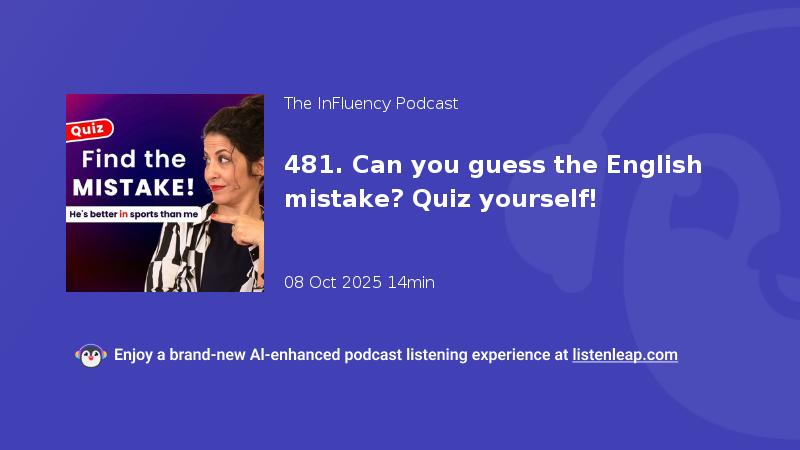
The next one is, she's better in math than me.
Where is the mistake and what is the correct form?
She is better at math than I am.
She's better at math than I am.
So first of all, when you say better, you use at right after.
Better at.
I'm better at speaking than writing.
I'm better at speaking than writing.
Also, better than me is okay, right?
In informal English, in daily conversations, that's probably what I would say.
You're better at it than me.
But in formal English, it's better to use than I am, better than I am.
Better use the subject pronoun and not the object pronoun, okay?
Better than I am.
Better than I am and not better than me.
But again, in informal English, conversational English, you can absolutely say better than me.
He's better at swimming than I am.
He's better at swimming than I am.
Again, in conversational English, he's better at swimming than me.
I'm better at cooking than she is.
I'm better at cooking than she is.
She's better at playing the piano than I am.
She's better at playing the piano than I am.
Okay, the next one.
She didn't know where was the key.
She didn't know where was the key.
Where was the key?
She didn't know where was the key.
Where is the mistake and what is the correct form?
She didn't know where the key was.
She didn't know where the key was.
So the explanation is that in indirect speech we change the word order to match how we would say it in the statement.
So it's not, where was the key?
Where was the key?
But where the key was.
Just like a statement, not like a question in indirect speech.
Let me give you a few more examples.
She didn't know why he was upset.
She didn't know why he was upset.
I didn't know where the restaurant was.
I didn't know where the restaurant was, not where was the restaurant.
I didn't know where the restaurant was.
Okay, the next sentence.
He's been working there since two years.
He's been working there since two years.
Where is the mistake and what's the correct form?
He's been working there for two years.
So we use FOR when we talk about a period of time instead of SINCE.
We use SINCE when we talk about a specific time in the past, but when we talk about the duration of an action, we use FOR.
For example, I've been learning French for three months.
Four, three months.
Month, one month.
Two, one, three, four, three months.
I've been learning French for three months.
I've been living in Spain for five years.
That's not true.
It's not even two years, but anyway.
For the purpose of practice.
I've been living in Spain for five years.
They've known each other for a long time.
Not since a long time, for a long time.
Okay, the next sentence.
I'm used to get up early every day.
I'm used to get up early every day.
I can make it sound convincing.
Where is the mistake and what's the correct form?
Giving you a few seconds.
I'm used to getting up early every day.
I'm used to getting up early every day.
When saying you're accustomed to something, use the gerund form.
Getting after used to.
Used to getting.
Used to seeing.
Used to living.
Used to hoping.
Okay?
So, something that you're used to, that you're accustomed to.
For example, I'm used to walking long distances every morning.
I'm used to walking long distances every morning.
Not, I'm used to walk.
She's used to working late at night.
Used to working, used to working, used to working, used to working.
Say it many times.
I'm used to working late at night.
It's okay.
I don't mind a shift at 9 p.m.
I'm used to working late at night.
He's used to studying for exams on weekends.
He's not going to have a problem with us scheduling a study group on Saturday.
He's used to studying for exams on weekends.
He's used to studying.
Used to studying.
Used to.
Used to.
Used to.
Used to.
Used to studying.
Next one.
I visited Boston last year.
Where's the mistake?
I visited Boston last year.
When you have a specific time in the past, use just the simple past.
Don't make it complicated.
Visited.
Okay?
It happened at a specific time in the past.
You have the indication of when it happened last year.
Right?
Visited.
Simple past.
I traveled to Italy last summer.
I might say I've traveled to Italy sometime in the past using the present perfect, but I traveled to Italy last summer using the simple past.
They moved to a new house last month.
They moved to a new house last month.
Last month, a specific time in the past, they moved.
Simple past.
She started her new job last week.
She started her new job last week.
One more.
She gave me a lot of advices yesterday.
She gave me a lot of really good advices yesterday.
What is the mistake and what's the correct form?
She gave me a lot of advice yesterday.
She gave me a lot of advice.
That's the correct form.
Advice is uncountable, so it doesn't have a plural form.
There is no such thing as advices.
A lot of advice is actually the correct phrasing, even though it might sound counterintuitive to a lot of you.
Let's look at another example.
He gave me some great advice about my career.
Right?
Not advices, even though he shared many different things.
You say some great advice.
He gave me some great advice about my career.
I received a lot of advice on how to improve my writing.
I received a lot of advice on how to improve my writing.
A lot of advice, a lot of advice, a lot of advice.
She offered me helpful advice for my presentation.
She offered me helpful advice for my presentation.
So I'm not saying she offered me a helpful advice.
It's not a singular form, plural form.
She offered me helpful advice for my presentation.
For the last sentence.
I'm going to just say the incorrect form and you are going to write the correction in the comments and why it's incorrect.
She asked me if I finished the report.
She asked me if I finished the report.
This is the incorrect form.
What is the correct form and why this sentence is incorrect?
Let me know in the comments.
All right, my friends, you did a great job as language detectives.
I appreciate your participation and your input and you just simply being here and listening.
Remember that making mistakes is not the end of the world.
It's just a great opportunity to learn where there is a clash between your grammar and the grammar of english, because there is something about the grammar of english that prevents you from using it correctly.
And that is exactly what you need to learn when you make a mistake.
Okay, learning a second language means that you will be making mistakes, Because that is how you learn.
And if you make mistakes, it means that you're actually speaking, which is exactly what we need.
Okay?
If you want to learn more with me, then definitely check out my website, HadarShamish.com.
Subscribe to my channel or my podcast if you're listening to this on the podcast.
And if you want a little bit more support, you can definitely check out Beyond My English Practice Community, where you can absolutely Find your home in English a beautiful community, incredible coaches and a clear plan to get you on the right path to fluency.
Have a beautiful, beautiful rest of the day, and I will see you next week.
You know it, in the next video.
Bye.