On this week's episode of Wild Card, Poet Laureate Ada Lemom tells us how to give yourself
a little grace.
The nice thing about being in my mid-tooled 40s, yeah I forgive myself all the time.
Join me Rachel Martin for NPR's new podcast Wild Card, the game where cards control the
conversation.
This is Planet Money from NPR.
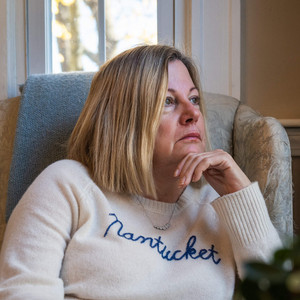
One spring morning, a couple of years ago, Karen McDonough was having her tea at her dining
room table.
She lives in a cute little two bedroom place in Quincy, Massachusetts.
She looks at her window to the neighborhood beyond and she sees something unusual.
They were like 20 cars and they all came at the same time and they parked like in front
of my house across the street, up the street, and down the street.
I just had this feeling like something really bad had happened.
She was right.
Something bad was definitely happening to her.
And then I saw people get out and then they were like coming to my lawn and I'm like,
why is everybody at my house?
Karen puts on her shoes, goes out to the driveway.
At this point a group of men are milling around the lawn, casually dressed, except for one
guy who seems to be in charge.
There was somebody I think he might have had a uniform on or something and he had a piece
of paper and I said, what's happening and he goes, we're selling your house.
And I'm like, what are you talking about?
He goes, don't pretend that you don't know what I'm talking about and I go, I actually
don't know what you're talking about.
And he's like, well, we sent you information and it was like a foreclosure sale on my
home.
This made no sense.
Karen had been in the house for 17 years.
She's a registered nurse, makes a good living, raised two kids here and she was current
on her mortgage.
Sure, there were a few bumps along the way.
A long time ago during the great financial crisis, she had asked for a modification of
her mortgage.
That was perfectly normal back then, lower to payments.
But now these men on the lawn were telling her, this is a foreclosure.
You are going to lose this house.
Karen is thinking, this has to be some kind of scam, right?
I mean, maybe they're trying to rattle me.
She doesn't know what to do so she gets in her car.
I almost didn't feel safe.
Like I don't know what they were doing.
And I said to the people, I said, I'm back and out.
I said, get out of my way and I just left.
For months, Karen had been getting mysterious phone calls from strangers demanding money.
Men insisting that they had dug up some long lost debt she owed.
It seems so sketchy, like some sort of con game, but the men in her lawn seemed pretty
real.
She eventually finds herself at a beach outside Boston.
And was it just like you drove to the beach and like look out at the water and you're
like, what the hell is going on?
Yeah, I was like shaken.
It's like really overwhelmed.
I was crying just to make any sense.
I'm a mother and I'm a nurse and I'm being evicted for my house that I've been making
monthly payments on.
And then I'm current with.
By the time she made it back to her house, it was all over.
The strangers on her lawn had sold the house out from under her.
Hello and welcome to Planet Money.
I'm Robert Smith.
And I'm Chris Arnold.
She'd been looking at a Karen's case for months now.
And what we found was much scarier than some scam.
Karen was right.
She'd been paying her mortgage every month for years.
This whole drama was about all to debt.
Debt that hadn't been heard from in more than a decade.
Debt that everyone had told her was gone and forgotten.
Our investigation revealed that thousands of other people are getting the same calls
and facing the exact same sort of nightmare as Karen.
Who took out loans about 20 years ago, many say they were told the loans had been forgiven.
But now the debt collectors come calling anyway.
They're known as zombie mortgages.
Zombies because they can stay buried for years and then reach out and grab you.
And take everything.
Today on the show, why are all of these old debts coming back to life right now?
Is it legal?
And is there any way to stop the zombies?
On the inheriting podcast, one event can change a family for generations.
We call it Ta-E group.
Did you ever realize when you were a child that you became a orphan?
Camp was such a hard time.
How do you think you got through it?
Listen to Inheriting, our new podcast about Asian American and Pacific Islander families.
From LA studios and the NPR network, wherever you get your podcasts.
Wait, wait, don't tell me isn't just jokes about the week's news.
It's also life hacks.
For example, here's actor Karen Allen revealing how she got her starring role in Raiders of the
Lost Ark.
He said, how well can you spit?
And I just found it coming out of my mouth.
I said, oh, I'm gonna hawk them with the best.
I'm Peter Segal.
If you want to increase your self-confidence, then listen to the Wait, Wait, Don't Tell
Me Podcast from NPR.
Karen remembers the first time she saw her future home, the little yellow cottagey house
in Quincy, Massachusetts.
It was 2005.
She just got divorced and was living in a small apartment nearby with her two sons.
I saw this house.
I really liked it.
I thought the size was kind of charming.
You know, it had little yard.
I thought it would be perfect because it was just the three of us.
Back then, a lot of people wanted to buy houses.
The housing bubble was filling with steam.
I had a friend and she was a realtor and at the time, she was telling me that you could
buy a home right now that it was a good time to buy a home.
And here's how most people do it.
To purchase a house, you put down 10%, sometimes it's 20% in cash as a down payment.
And then you borrow the rest of the money as a mortgage.
Karen had a well-paying job as a nurse at Massachusetts General Hospital, modest savings.
But the house was $365,000 and she didn't have tens of thousands of dollars for a down
payment.
But during the housing bubble, Wall Street and banks wanted more people to buy houses.
So they came up with all kinds of ways to do that.
And one was a system to get rid of the down payment.
Instead of giving you just one mortgage, they would give you two mortgages, two loans.
And that second mortgage would basically cover the down payment.
They used to say no down payment, no problem.
Just take a second mortgage.
And it was called the second because if something happened to the homeowner and they
had to foreclose on the house, the big mortgage, the first mortgage would be first in line
to get their money back.
The second mortgage would be second in line.
It takes longer to explain all this than it took for Karen McDonough to actually get one.
It was the easiest thing I've ever applied for.
I just filled out paperwork and submitted it and it was approved.
It was $292,000 for the first mortgage and $73,000 for the second.
The two-bedroom cottage is hers.
She makes one of the great parental sacrifices for her sons.
I gave them the master room.
My room, I gave them because they shared that room.
And then I took the smaller room, but it was good.
It's all good.
And then, as Karen sleeps in her tiny bedroom, the world just goes crazy.
The housing bubble collapses and the great financial crisis begins.
We were both reporters then, Chris.
Yeah, we covered this together sometimes, Robert.
And it was pretty intense, right?
2008, Lehman Brothers collapses.
Banks were going under the leaders of countries were scared.
It was on the news every night.
And while that was going on, a lot of people were losing their homes.
And as we all looked into it, we discovered it was those easy mortgages.
They had this time bomb in them.
The time bomb was that the interest rates were adjustable.
I saw this destroy people.
They didn't honestly like shook my faith in the banking system that anybody would make
these loans in the first place.
Like people would be chugging along, paying their mortgage that they could afford.
But after just a couple of years, the loans were set to adjust way up.
Yeah.
And when you say way up, we mean like $700 more a month, $1000 more a month.
I mean, millions of people could not pay their mortgages.
They were foreclosed upon and eventually had their houses taken away from them.
And it was so many people that the government had to get involved.
President Obama at the time, his name was on the program just because that many people
needed help there to be this national intervention.
Yeah, they were called Obama loan modifications and they sort of pushed down the interest rates,
essentially allowing people to stay in the place they were living.
Yeah.
Or I talked to people who would say like President Obama fixed my mortgage.
And I didn't really have the heart to tell him like, well, it probably wasn't the president
himself who was like, you know, moving papers around and fixing your mortgage.
So Karen eventually got one of these loan modifications for her big mortgage, her first
mortgage, which was just a huge relief for her.
But you may be thinking, what about the second mortgage, the one she had taken out for
the down payment?
This is the crucial question that will eventually lead to those men standing on her front lawn.
As Karen remembers it, her mortgage company told her that that second mortgage was forgiven.
I was actually in my kitchen.
I was cooking dinner and I was talking to a representative.
And he told me I would never have to make a payment again on the second mortgage.
And I just didn't question any of it because I was so grateful that the loan was modified.
And to be clear, there wasn't any reason to question it.
The same company had given her both mortgages.
And now a representative for that company handling both mortgages was saying, hey, don't worry
about the second.
And sure enough, she used to get two bills in the mail for the two mortgages.
And after a while, she just got one bill in the mail for her first mortgage.
That seemed to settle it, right?
I mean, this thing must be dead.
Years go by a decade.
Karen keeps going to work at Massachusetts General.
She keeps paying her first mortgage or sons grow up.
You can still see the pencil marks on the kitchen wall.
If you look at this, you can see like this is them growing up and like they're high when
you always do that.
That's something.
Yeah, they are.
They're both 12.
In 2020 though, she gets a letter.
It's from a company she's never heard of first American national.
It sounds like a bank, but it sure isn't her bank or even one that she's ever heard
of.
And the letter says, you owe us money.
It had an amount and they wanted like a payment.
And I think the amount was like 77,000.
So I was kind of like shocked.
I was kind of disbelief.
She thinks it can't be about her mortgage.
She's been paying that every month to another company.
So she calls the phone number on the letter.
I'm like, are you the lawyer that's sending this information to me?
And he was like, yeah.
And then I was like, well, I'm like, why are you doing this?
And he goes, well, why do you think I'm doing this?
So he never answered me the way that I thought a professional lawyer would.
So I just thought right away was fraud.
She decides to ignore it.
But soon it becomes impossible to ignore.
There are more phone calls demanding different amounts of money threatening to foreclose
on her house if she doesn't pay up.
And it starts to piece together that these calls are about that second mortgage that she
had so long ago.
The one that she'd been told was forgiven.
So she calls up her first mortgage company.
I was crying on the phone with them, like having a nervous breakdown.
And she says they told her, you know what?
This is probably fraud.
And they kept saying like, we're going to help you.
You can't lose your home through this.
You can't lose your home through this.
That seemed logical.
If someone official says that a loan is forgiven, then it must be forgiven, right?
If no one sends you a statement for a decade, they can't just call you up out of the blue
and demand money.
Can they?
We call lawyers and advocates all over the country, government officials.
They had heard of stories like Karen's anecdotal stories about people losing their homes
or being forced to sell them to pay the debt collectors.
But nobody seemed to know the scale of the problem.
In fact, one top federal official told us, if you find out, let us know.
Yeah.
So we kept digging, filed freedom of information requests.
In just one state, state of Maryland, we found at least 500 people facing foreclosure from
what appeared to be long, dormant, zombie second mortgages, just like Karen's.
And when we looked across several states, we found at least 10,000 people who have old
second mortgages from the housing bubble, where now a company is taking the very first step
toward foreclosure.
Our investigation also uncovered databases with the names of the companies that own these
mortgages and that are trying to foreclose on people.
There was First American National, the people who Karen had said were calling her and answering
her questions with more questions.
And companies with more cryptic names like BCMB1 Trust, first key LLC, and ARC private equity.
We tried to reach out to these companies, but a lot of them are LLCs registered in Delaware,
which makes it extremely difficult to figure out who exactly owns them.
But ARC private equity popped up on LinkedIn, the co-founder, a guy named David Gordon,
was wishing everybody a happy new year and asking if they happen to have any old mortgages
that they wanted to sell.
Which as everyone knows is the traditional Wall Street way to celebrate the new year.
So we called David up to have him explain, why is this happening now?
Why is all this old zombie debt coming back to life?
He was happy to talk to us.
Hey, how's it going?
Good.
How are you, Chris and Robert?
Excellent.
Which ones?
Which ones?
We do get that a lot.
David is part of a whole ecosystem of people that buy and sell mortgages.
And generally speaking, having a lot of investors pouring money into home loans makes them cheaper
and easier to get.
David occupies a particular niche in all this.
He's buying up bad debt.
Now David doesn't own Karen's old mortgage, but he's bought a lot of old mortgages just
like hers, sent letters asking for money and sometimes threatened for closure.
Not him personally, of course.
He uses a debt collection firm.
I'm not looking to take anybody's home.
I want to make that clear.
But you know, an investor deserves to make their money back.
You know, and there is real money at stake.
The zombie mortgage problem was created during the run-up to the financial crisis of 2008.
David was there watching it firsthand.
He was at Morgan Stanley buying and selling mortgages like Karen's putting them into bundles
and then selling them off as mortgage bonds.
And then people started to default on their mortgages.
And Morgan Stanley was on the brink of going under.
He expected to be laid off any day.
We were playing literally pup pup golf on a trading desk for about six weeks.
We all knew it was going to happen.
It was a matter of when.
The mortgage industry was wrecked.
Many of the loans they made close to worthless.
We went from being rock stars to all of a sudden being frozen on the desk.
You know, Wall Street loves you one day, hates you the next day.
He fires you the day after that.
David was suddenly unemployed.
But he noticed something.
All those mortgages he had helped package up into securities and sell for Morgan Stanley.
They were on fire sale.
The bank was a sinking ship and they were throwing bundles of dodgy mortgages overboard.
Mortgage bonds, good ones in with the bed.
You know, I'm looking at some of these bonds that were treated that we helped create.
And that's when I had the aha moment.
There's a great opportunity to have a good business.
The business is to buy these bundles of mortgages for sometimes pennies on the dollar.
Sure, some of them were worthless.
The people who borrowed the money would never pay it back.
But other mortgages might be worth something if you're willing to wait.
And wait, they did.
David and others like him bought up thousands of these mortgages.
We asked him about Karen though.
She had modified her first mortgage.
She said she'd been told explicitly that she didn't need to worry about that second
mortgage.
David says he hears this all the time.
People think they had their loans canceled.
Maybe sometimes they were even told their loans were gone.
But in many cases, he says they still exist.
It's not like they went away.
And I think people were waiting on the sidelines to collect on those at some points.
And that's why so many zombie mortgages are all coming back to life right now.
Something big has changed in the real estate market that is causing debt collectors to
come off the sidelines.
And that is home prices.
This is the fascinating thing about first and second mortgages.
As we mentioned before, it's like that two mortgages are waiting in line to get paid
back, right?
If a house is sold or foreclosed upon, the first mortgage takes all the money.
And anything left over goes to the second.
So when home prices tagged and the housing market crashed back in 2008, the second mortgage
is seemed worthless.
If you foreclosed and sold the house, you wouldn't even get enough money to cover mortgage
number one.
So there's nothing left for mortgage number two.
But if you bought second mortgages and waited on the sidelines for housing prices to go
up, all of a sudden the sad old second mortgage might be worth something.
The house would be worth enough money that people like David could show up and say,
uh, time to pay back.
That long forgotten debt.
This is what was happening to Karen.
The house she'd bought for $365,000 in 2005 is now worth more than $600,000.
And home prices have risen massively all over the country.
And as that's happened, more people like David have been buying up the old second mortgages
and sending those letters.
These zombie mortgages have been opening their cold dead eyes and finally coming to life.
Now David tells us he's reasonable.
He follows the rules, he'll negotiate with the homeowners, even lower the amount that
he says they owe just a bit sometimes.
And we're trying to work with our borrowers nine times out of ten.
We're working with our borrowers and most of those borrowers have been open to that.
But he says, look, if you borrow money, you have to pay it back.
You are sitting on a very expensive home and this debt help pay for that, helped you buy
that home.
And if somebody doesn't pay or doesn't respond, he does foreclose on houses.
Everything is free in this world.
And if you signed up for a loan, you know what you signed up for.
It blows my, it just, you know, it is what it is.
It is what it is.
You know what you signed up for.
Sure.
But in Karen's case, she believed that what she had signed up for had changed, that the
second mortgage was forgiven.
When we last left Karen's story back in Quincy, Massachusetts, she was just starting to get
those phone calls that felt like a scam.
And these debt collector guys, they weren't just asking for the original $73,000 she borrowed.
The numbers kept changing with different calls and different letters.
Like, also, here's a $73,000 note, $77,000.
No, oh, actually it's $112,000.
One document says they were trying to collect two and a half times what she had originally
borrowed $184,000.
She calls her first mortgage company again.
It's called PHH.
These are the people she pays every month.
The ones she says told her it was probably a scam and to ignore the letters.
They told me not to talk to them.
PHH told me not to talk to them anymore.
Don't give them any information.
Hang up on them.
Don't talk to them.
So then I stopped talking to them.
This would turn out to be exactly the wrong thing to do.
We reached out to PHH and they said they have not been able to find any record of giving
Karen this advice or even that they told Karen that her loan was forgiven in the first
place.
In 2021, that mysterious company, First American National, started for closure action on Karen's
home.
They did the usual legal things.
They sent her letters, took out ads on a local newspaper.
They eventually sent that guy in the uniform to stand on her front lawn that spring day.
Well Karen was sitting at the beach wondering what was happening.
They auctioned off her home.
The winning bidder ended up being that same company, First American National.
Her house is now worth more than $600,000.
They bought it for $180,000.
A few weeks later, Karen got an orange eviction notice posted on her front door.
And I saw the orange thing and then it said like, you have like 72 hours to get out.
This is July 1st.
It was a Friday.
They did it on a Friday.
So the 72 hours, because Monday was the holiday.
I'm like, I have this is the fourth of July.
Fourth of July weekend so I couldn't get any legal help even though I was trying to.
So for those three days, 72 hours, I didn't sleep and I just started packing everything.
You actually started to pack?
Yeah, I was crying for three days straight.
I just packed.
And you're calling lawyers?
Yeah.
Most of the lawyers say, look, it's too late.
I mean, lady, your house is sold.
There's nothing we can do.
But she does find one group of legal aid lawyers, a team that agrees to take a look at her
case.
They tell her, look, whatever you do, don't leave that house.
Stop packing.
Don't move out.
We're going to fight this after the break.
On the inheriting podcast, Carol Park was 12 years old, working at her family's gas
station when a big moment in US history changed her life.
Korean businesses in South Central have been torched.
Dozens looted.
The 1992 LA uprising.
Why would this happen?
I didn't get to answer that until I was an adult.
Listen to inheriting from LA studios and band-parent network, wherever you get your podcasts.
Jasmine Morris here from the Storycore podcast.
Our latest season is called My Way.
Stories of people who found a rhythm all their own and marched to it throughout their lives.
Consequences and other people's opinions be damned.
You won't believe the courage and audacity in these stories.
Hear them on the Storycore podcast from NPR.
In any great story, there's a moment that sparks your curiosity.
Tells you there is more to uncover.
How did this happen?
How did we get here?
That's where Embedded comes in.
We are NPR's home for documentary journalism, immersive and intimate stories.
I was stone-called speechless.
Nothing will ever, ever, ever be the same here.
Find Embedded wherever you get your podcasts.
You wish stories could unfold over three hours, rather than three minutes, you tired of doom's
growing, trying to find humanity, or maybe a deeper understanding of where the world is
the way it is.
Listen to Embedded NPR's original documentary series.
Find us wherever you get your podcasts.
I've seen a lot of zombie movies.
I'm kind of an expert.
And the whole thing about zombies is that once they come back to life, they are relentless.
You can cower in your home, but they just keep coming.
And there are thousands of them.
And that's pretty much what's been happening with zombie mortgages.
It's not just Karen.
There are thousands of people waking up and finding that their whole life is threatened.
And just like with zombies hiding in your house and hoping it will be okay, does not work.
You have to fight back.
There are lawyers and there are people out there who are willing to help you because it
is not right.
You should not lose your home.
Christy Kelly has a consumer law firm in Fairfax, Virginia.
She's not Karen's lawyer, but she's represented a lot of people who are in basically the same
situation.
Christy started out doing legal aid work during the housing crash 15 years ago.
And like most of us, she thought this whole housing bubble debacle was over and done
with ancient history.
Until a few years ago, she began to get calls from people who are getting these threatening
letters about old second mortgages.
You know, you see like a lot of scams as a consumer lawyer.
And I thought this can't be right.
There must be something going on.
And then I realized that this is not an error.
It's a new trend.
Christy calls the debt collectors and asks for the records on the loans.
And what she sees is actually really ugly, some of the loans of no documentation, no payment
history.
The record keeping was terrible.
And Christy was especially shocked by how cheap these mortgages are bought and sold for.
Remember, these companies are calling up homeowners and demanding tens of thousands of dollars.
But sometimes these debt collectors have purchased that debt for almost nothing.
We have a case where a portfolio of approximately 9,000 loans was sold for $6,000.
And so each loan was sold for less than a dollar.
Because the loan sell for more could be $10,000 or $20,000 even for a loan.
But in this case, it's conceivable that a company could purchase a loan for pennies.
And even though it's called a second mortgage, they can and do push ahead and take your home
and get say $100,000 or more without the first mortgage even knowing about it.
People don't understand, even very sophisticated people, do not understand that a second mortgage
company can foreclose if you do not do something to stop it.
And they can take everything from you.
And it is just so wrong that this is happening.
It may be wrong, but is it illegal?
Christy starts looking for things she can present to a judge and get these foreclosures
stopped.
She pours through federal and state laws, previous court cases.
There's lots of precedent about first mortgages and foreclosures.
But this whole situation with second mortgages people thought were long dead, that's new.
You know, that was like another panic.
Like there's no protections.
You know, my client thought their loan had been canceled or forgiven, but there's no
database of like all the loans that are canceled or forgiven so you can go and verify it.
So it's hard to prove that the loan was canceled.
But Christy notices something that the debt collectors might have overlooked.
A huge thing actually that they had either missed or ignored in the regulations, something
that she thinks she might be able to fight them on.
We told you about how the debt collectors have added years and years worth of interest
and late fees to the debt, sometimes doubling the size of the loan.
Federal regulations say you can do that, but here's the catch.
You have to send monthly statements like the ones you get for credit cards and student
debt.
Regulation Z, which is part of the Truth and Learning Act, it requires monthly statements
be sent if there is interest assessed on a mortgage.
Did you say regulation Z, Z like zombie?
Yes.
Exactly like zombie.
I love it.
Fighting zombies with zombies, regulation Z.
Christy now had her legal crossbow to take on the zombie mortgages.
In court, she can now ask these debt collectors, oh, one more thing.
Before you foreclose on this home and take away everything from this person, show me the
10 years worth of statements, please.
I want to see every month, every statement with every mispayment, every dime of interest.
But she says a lot of the time that just never happened.
The homeowners hadn't been getting any statements for years and then the companies would pile
on a massive amount of interest in late fees retroactively.
In some ways, the greed of the second mortgage holders has given people leverage in their
cases because it's just not good enough to collect the value of the note and they want
to go and get every last dollar and take every dime of equity.
They then open themselves up to serious legal consequences and provide consumers the leverage
they need to stay in their homes.
As a lawyer, Christy can say, gotcha, you violated regulation Z on sending statements.
So your claim against my client is completely bogus.
This is just one strategy.
But Christy is used it to help homeowners in dozens of cases.
She just resolved a class action case where she was able to get the names of nearly 300
homeowners from one company and help them all.
Still, she's just one lawyer basically in a lifeboat trying to pull in all the people
she can to rescue them, but knowing that there must be thousands more out there who need
help.
Among them, Karen McDonough, back in Quincy, Massachusetts.
Despite everything that has happened, Karen is still in her little yellow house.
We sat down with her in her living room and she explained what had happened over the
last few years.
She got a team of lawyers, she stopped packing her boxes and did not move out.
The eviction proceedings are on hold while they argue the case in court.
First American national legally owns the place, but Karen's still paying her mortgage every
month.
So she's living in this kind of limbo.
I feel like what happened was a terrible thing.
But I'm still like really hopeful that I'm going to stay in my home.
I'm really hopeful I'm going to win this case.
We'll have to wait and see.
At one point, these zombie seconds were real loans, and in some cases, the debt collectors
have a legitimate claim to collect or for close-un people's homes.
In other cases, they don't.
They haven't followed a bunch of rules.
Where all that stands with Karen's case is still playing out.
Karen's lawyers have now been piecing together what happened to that second mortgage over
the past 12 years.
And it's kind of amazing, really.
She spent 10 minutes signing a mortgage, and then it took on a life of its own that she
never knew about.
This filed a lawsuit that lays out the story we just heard that she was allegedly told
the second mortgage was forgiven, that she didn't get statements, and that she was told
the debt collection was probably fraud.
Her lawyers are arguing if the mortgage should have been resolved a decade ago.
Instead, when her lawyers tracked her second mortgage, they found that it got passed from company
to company, and it eventually was sold in a huge batch of about 600 other mortgages in
2020 to an LLC apparently connected to First American National, which her lawsuit alleges
used unfair and deceptive practices to foreclose on her house.
And who exactly is this First American National?
Despite a name that sounds like a bank, it is no bank.
Far from it.
It appears to be a small outfit run by a guy named Ira Bailey out of New Jersey.
He didn't agree to an interview with us, but he said in email he's been doing this for
21 years.
And in a court document, the company disputed Karen's description of their interactions,
denied any allegations of wrongdoing.
And check this out.
Once Karen's lawyers looked into First American National, they found something else.
A state banking regulator had sanctioned the company for operating as an unlicensed debt
collector.
First American didn't admit wrongdoing, but it was fined by the state in order to stop
Karen's lawyers alleged that it then foreclosed on Karen's house anyway in violation
of that agreement.
I'm not really clear why these people were able to foreclose when they weren't even
supposed to be practicing in the state because of their history of what they've been doing.
Buying a home is the biggest financial decision that most people ever make.
Hundreds of thousands of dollars in a loan back by the place that we live in sleep every
night.
That's why after the housing bubble collapsed, the government worked really hard to try
to keep people in their homes and also to try to fix the system.
New laws were passed, mortgages were modified, and everyone moved on.
But now we're seeing that there's one more thing that hasn't been fixed.
And that's that people like Karen, the survivors of that financial crisis who managed to keep
their homes 15 years ago, those same people's homes are now being threatened all over again.
Thousands of them.
And what can you do as a homeowner like Karen, other than fight it in court, beg your
public officials to do something and just try to keep your life together?
I noticed when I came in, like your yard is clean, you have like a basket of like lovely
purple flowers, pansies out there.
You don't technically own this house anymore.
It's still my house.
It's unprinciple.
I'm still making payments.
Yeah, I don't buy it.
Still cleaning the yard.
You're still mowing the lawn.
Yeah, it's still my home.
For more on this story, we have a digital piece with further reporting on zombie mortgages
from NPR's Investigations Team.
We've been working on this for a number of months, digging up all these old mortgages
and figuring out what was going on.
You can find that at npr.org slash zombie or in our show notes.
Read it.
Share it with a friend.
This episode was produced by our friend, Sam Yellowhorse Kessler.
It was edited by Jess Jay with help from Bob Little and it was fact checked by Sierra
Hades.
Engineering by Robert Rodriguez with an assist from Patrick Murray.
Alex Goldmark is our executive producer.
Special thanks to Rachel Seller, Robert Benning Kassa, Nick McMillan, Graham Smith, Ashley
Messenger, Mike Erattner, and Jay Patterson, who is our fantastic forensic accountant on
this episode.
He helped us track Karen's work.
I'm Chris Arles.
And I'm Robert Smith.
This is NPR.
Thanks for listening.
Bridgerton is back and the Netflix series is as gossipy and over the top as ever.
I love the dialogue as ridiculous as it is sometimes.
We're talking about the romance and the clothes and the nudity and obviously the queen's
hair.
Listen to the pop culture happy hour podcast from NPR.
Humans are kind of overrated.
Over on Shortwave, a science podcast were only kind of kidding.
We're bringing you the wondrous world of animal science to your daily life.
From queer animal love stories to songbird memories, we're showing you how critter knowledge
informs human science.
Listen now to Shortwave, a podcast from NPR.
NPR is for going to the movie theater because it's too hot to stay home.
It's for driving the windows down, listening to your favorite music.
It's for stretching out while you're on vacation to gobble up a TV show.
For a guide to some of the TV movies and music, we are most excited about this summer.
Listen to the pop culture happy hour podcast from NPR.