I play Wordle and spelling bee every single day.
That's the first thing I do.
Play Wordle while making coffee.
I pour myself a cup and do the crossword, which is the jewel of my morning.
What's our starting word today?
I think it should be ocean.
I have seen you do spelling bee during meetings.
The New York Times crossword is a moment of zen that cleanses my brain.
I wish the days were shorter and the Wordles were longer.
Join us and play all New York Times games at nytimes .com slash games.
Subscribe by March 16th to get a special offer.
— From The New York Times, I'm Michael Barbaro.
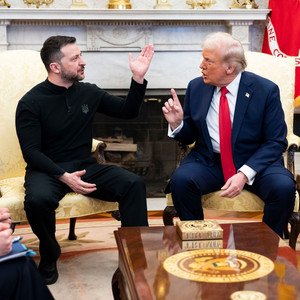
This is The Daily. Today, the fallout from the extraordinary televised Oval Office shouting match between Donald Trump, J .D.
Vance, and Volodymyr Zelensky.
My colleague, Chief White House Correspondent Peter Baker, walks us through the clash and its consequences.
It's Monday, March 3rd.
Peter, thank you for making time for us on a Sunday afternoon, no less.
We appreciate it. Thanks for having me.
I'm curious, Peter, where in the pantheon of moments that you have witnessed at the White House over the past 30 years to date you, does what happened in the Oval Office on Friday fit, would you say?
Yeah, Michael, I've been covering these meetings at White Houses since 1990.
And I've never seen anything like this, never.
You had the president of Ukraine, Vladimir Zelensky, show up for a meeting with the president of the United States, Donald Trump, in the middle of a war with so much at stake.
And so, you know, everybody was looking to this meeting to see how it would come together.
I mean, it was extraordinary.
It was excruciating.
It was a brutal dressing down of a foreign leader in the Oval Office.
Presidents just don't do that.
They get frustrated at times.
And sometimes there are pointed moments, but nothing like this verbal assault that we've seen, even on an adversary, much less on an ally.
And I think in history, we're going to look back on this as a unique, singular moment.
And not just for the spectacle of it, but for its actual consequentialness.
Absolutely right. This is a rupture of a relationship now between the United States and Ukraine.
11 years after Russia first invaded, three years after its full -fledged invasion in 2022.
And America has been Ukraine's best friend, biggest partner, most important patron.
And if this rupture, this blowup, this meltdown in the Oval Office means that the relationship now is on the rocks, it has great consequence for Ukraine especially.
It has great consequences for Russian aggression in the world, for Europe, and for the United States, I would say.
Right, and for all those reasons, I suspect, history will keep turning over this encounter for a very long time, as will we in this conversation in a few moments.
But I think it's worth setting up a bit what led to this blow up and talk through the kind of dynamics into which both men entered the Oval Office on Friday.
Right. Well, first of all, it's important to know the history.
President Trump has never liked Ukraine in particular.
He was convinced way back in his first term that Ukraine had been opposed to his election in 2016.
This is a Russian talking point.
This is a Russian intelligence fable, but one that Trump bought into.
And of course, Zelensky was the other guy on the phone.
He had the quote, perfect phone call, not so perfect, that led to his impeachment in which he tried to bully Zelensky into launching a fake investigation of Joe Biden.
Right. Two men have never had such awkward history, perhaps, as world leaders.
Very awkward history.
And during the last four years, when Trump was out of office, he was never supportive of Ukraine in his war against Russia.
He praised Vladimir Putin for being a genius for sending troops to pressure Ukraine into making concessions.
And he opposed aid to Ukraine, basically blocked it by Republicans in the House, forced them to block it for about six months.
And sitting next to him was J .D.
Vance, who was famously quoted saying, I don't care what happens in Ukraine.
So these are not supporters of Ukraine going into this meeting.
And then over the last two weeks, you see the relationship really change dramatically.
Instead of Joe Biden sending arms and standing with Ukraine saying, we will never, never, never not be with you, you have Donald Trump coming in and calling Zelensky a dictator, saying it was Ukraine, falsely, that started the war, adopting Russian talking points about whether Zelensky should have to
have elections, never mind that Vladimir Putin is the dictator, that he started the war and that he has fake elections at home.
He was basically 180 degrees changing American policy toward Russia and Ukraine, making clear that in this new Cold War that we've been talking about now for so long, America was essentially switching sides.
And for Zelensky, this is existential for him.
And he faced this pressure from Trump to sign a rare minerals deal, handing over a lot of Ukraine's natural resources to the United States without any assurance that the United States is going to give them anything back.
Trump said, you owe us back basically for all the aid that Biden gave you over the last three years.
So Zelensky unhappily, grudgingly comes to Washington as almost a supplicant to sign this agreement, hoping that that will keep Trump on Ukraine's in any future peace talks.
Right. So Zelensky, as you've clearly just laid out here, has no affection for Trump, but will agree to come to Washington to sign this minerals deal, mostly to protect whatever existing frayed, attenuated relationship the U .S.
still has with Ukraine as a supporter of its defense.
Yes, that's right. Because he hopes that it will keep the United States on Ukraine's side, Give it something at stake in the war, in this case, economic stakes.
And he knows how much that matters to Trump.
So Zelensky shows up at the White House on Friday morning and Trump comes out at the door to greet him as he does with foreign leaders.
And they have a polite handshake, but not a lot of warmth, I would say.
And Trump makes a comment as Zelensky arrives that later, I think, becomes kind of telling.
He says, I see you came dressed up for the occasion.
Zelensky, of course, is wearing his tactical dark sweater, one of the versions of the combat type clothing he's been wearing for the last three years in solidarity with Ukrainian soldiers.
Right. And they go into the Oval Office.
They take their seats.
There's a number of top officials there.
J .D. Vance is there.
Secretary Rubio is there.
And the meeting gets off to a relatively fine start.
Well, thank you very much.
It's an honor to have President Zelensky of Ukraine.
And we've been working very hard, very close.
So we've actually known each other for a long time.
We've been dealing with each other for a long time and very well.
But Zelensky's trying to make sure Trump understands that Ukraine is the victim, not the villain in this war.
I wanted to share with you some images.
Just can I know? Yeah, please.
And he shows him pictures of Ukrainian men and women who have been released from Russian prisons and how amazing they are, how terribly, you know, abused they had been in Russian captivity.
He tries to get Trump to see that the Russians are the bad guys here.
I mean, it's looking tragic.
Yeah, that's tough stuff.
Yeah. And the first 20 minutes, 25 minutes are perfectly normal, perfectly fine.
but you begin to hear a little bit of an edge.
You begin to hear a little bit of the tension that's there.
Does that still provide security guarantees, Mr.
President? I don't want to talk about security yet because I want to get the deal done.
You know, you fall into the same trap like everybody else.
A million times you said over and over, I want to get the deal done.
Security is so easy.
That's about 2 % of the problem.
I'm not worried about security.
I'm worried about getting the deal done.
And they just don't see the war in the same way.
Before my presidency, from 2014, Putin broke 25 times.
25 times he broke his own signature.
25 times he broke a ceasefire.
But he never broke to me.
He never broke to me.
No, no, you were the president.
You were the president.
I never broke to me.
In 2016, you've been the president, Mr.
President. You've been the president, but he...
Zelensky does not want Trump to negotiate a ceasefire with Russia with no conditions.
and Ukraine gets nothing out of it.
He doesn't think Putin can be trusted.
That's why we will never accept just ceasefire.
It will not work without security guarantees.
He doesn't think that a ceasefire would hold.
So he says, I need security guarantees.
And that's what he's there to ask the United States for.
And Trump does not want to have anything to do with it.
I don't think you're going to need much security.
I think once this deal gets done, it's over.
Russia's not going to want to go back, and nobody's going to want to go back.
When this deal ends, I really believe this deal is going to be over.
But then in the midst of this back and forth, suddenly you hear a new voice.
I will respond to this.
It's the vice president, J .D.
Vance, who hasn't really been talking in the meeting.
And he pipes up and he says, I want to interject here.
And he offers a point of defense of Trump's approach to the conflict.
Trump is the one, he says, who's going to bring peace.
He's going to be engaging in diplomacy.
That's what President Trump is doing.
Can I ask you? Sure.
Yeah? Yeah. Okay. And Zelensky, who's been listening to all this, really feels like he has to respond here.
During 2014 until 2022, the situation was the same, that people have been dying on the contact line.
Nobody stopped him.
And Zelensky basically proceeds to pick apart this idea that diplomacy is necessarily going to work.
He points out there's a long history here.
The war didn't just start three years ago.
It started in 2014.
when Putin first sent forces into Ukraine, seized Crimea, began seizing parts of eastern Ukraine.
And he points out that this war had been going on ever since, including during Trump's presidency.
Yes, but after that, he broke the ceasefire.
He killed our people, and he didn't exchange prisoners.
We signed the exchange of prisoners, but he didn't do it.
And that seems to get under Trump and Vance's skin.
Right. It feels worth noting that in this moment, Zelensky decides to call the vice president J .D., not Vice President Vance.
What kind of diplomacy, J .D., you are speaking about?
What do you mean? Perhaps history will not note this as an important moment.
I noted it. Yeah, absolutely.
And look, you know, on one level you can say he's trying to be friendly with him.
Sometimes foreign leaders do refer to each other by their first names, but Vance takes offense and then jumps back in.
Mr. President, Mr. President, with respect, I think it's disrespectful for you to come into the Oval Office and try to litigate this in front of the American media.
And this is when things go from bad to very bad.
You should be thanking the president for trying to bring it into this conflict.
You start hearing Vance say, you should be grateful to us and really putting Zelensky on the defensive there.
And Zelensky, of course, has thanked America for three years quite prolifically.
But what's actually, I think, striking about that demand by Vance, you should be thanking us, is he is demanding that somebody thank two leaders who haven't supported Ukraine.
Trump and Vance don't support Ukraine and yet he is saying you have to thank us.
Right. And as Vance and Zelensky are really kind of going at it… Do you disagree that you've had problems bringing people into your military?
But Vance is pushing Zelensky on problems the Ukrainian military is having with manpower and so forth.
And Zelensky says, yeah, of course, we have problems.
You'll have problems too, though.
Even you, but you have nice ocean and don't feel now, but you will feel it in the future.
Yeah, just translate what he's saying there, because it feels like a really important point Zelensky's trying to make.
His point is that Russia poses a threat to the United States, not just Ukraine.
A lot of times Trump talks about this.
He says, this is really a problem for Europe.
It's not for us. In fact, Trump has said we had this big ocean between us.
So what do we care what happens in Ukraine?
And Zelensky is pushing back on the idea.
He says, listen, yes, you have this nice ocean and you don't feel it now.
A lot of distance between you and Russia.
That doesn't mean that Russia isn't also a threat to the United States.
That doesn't mean the United States doesn't have a stake in this, has an interest in who wins this war and whether Russia comes out of it feeling rewarded for its aggression.
Don't tell us what we're going to feel.
We're trying to solve a problem don't tell us what we're gonna feel i'm not this is the moment that trump now jumps in you're in no position to dictate what we're gonna feel we're gonna feel very good and he begins to really kind of berate zelensky in this very aggressive way you're not in a good position you
don't have the cards right now with us you start having cards right now you're not I'm wearing serious, Mr.
President. I'm wearing serious.
You're gambling with the lives of millions of people.
You're gambling with World War III.
You're gambling with World War III.
In effect, what Trump is saying is, Zelensky, all you need to understand is that you have no power right now.
We have all the power.
Get on board or you're in real trouble.
Yeah, exactly. People are dying.
You're running low on soldiers.
Listen, you're running low on soldiers.
It would be a damn good thing.
And then you tell us, I don't want to cease fire.
I don't want to cease fire.
What he's saying is you have to accept whatever deal I make with Putin.
You don't have any power.
You're not able to influence things.
And that's a really extraordinary thing to say to the leader of a country at war.
He's saying, you don't get to choose here.
I'm the one who's going to choose here.
Because let me tell you, you don't have the cards.
With us, you have the cards.
But without us, you don't have any cards.
What an extraordinary moment, right?
These two leaders really going at it over who and what happens in this conflict in the heart of Europe.
We should say, at this moment, all three of these leaders, seasoned leaders, could have chosen to de -escalate what's becoming an incredibly acrimonious, almost shouting match.
But they don't. They all seem quite loaded for bear.
They do. this is where clearly a lot of weeks, if not months, of tension have come to the surface, and they're just exploding in this meeting, and they're saying what they have been thinking or feeling for quite a while, and it just escalates rather than de -escalates, and you finally get to the point
where Trump is re -litigating the whole Russia investigation.
Let me tell you, Putin went through a hell of a lot with me.
He went through a phony witch hunt where they used him and Russia, Russia, Russia, Russia.
You ever hear of that deal?
That was a phony Hunter Biden, Joe Biden scam.
Hillary Clinton. And he says, Vladimir Putin and I went through this whole Russia hoax.
He went through it.
He was accused of all that stuff.
He had nothing to do with it.
It came out of Hunter Biden's bathroom.
It came out of Hunter Biden's bedroom.
It was disgusting. What an amazing thing to say, right?
The person he clearly feels a bond with is Putin, not with Volodymyr Zelensky, who runs a democratic country that has been allied with the United States and is under fire.
The problem is I've empowered you to be a tough guy.
Finally, Trump lays down his cards and he says, But you're either going to make a deal or we're out.
And if we're out, you'll fight it out.
I don't think it's going to be pretty, but you'll fight it out.
Basically, either you're with us, either you go along with what I'm going to do, or we're out.
We'll abandon you. We'll abandon you.
It's a very stark threat.
All right, I think we've seen enough.
What do you think? This is going to be great television, I will say that.
All right, we'll see what we can do.
And then the reporters are escorted out of the room.
Peter, once the shock wore off, for me at least, and as I told you, I'm watching this as well, I had this sense, and I wonder if you did as well, that people in the two delegations, the Zelensky camp and the Trump camp, they're going to find a way to try to smooth this over after the cameras leave the room.
Because, of course, they are there to sign a deal.
Exactly. This deal is supposed to be signed.
They're supposed to use this deal to put the relationship on a new foundation going forward.
And now, with the cameras out of the room, are they going to make apologies or at least smooth it over?
And will they still have the lunch?
Will they still sign the deal that was the whole point of him coming in the first place?
Will they have the news conference been set up in the East Room waiting for us any minute now?
We don't know. But then suddenly we get the answer.
Zelensky's car has just pulled up to the door of the West Wing, and he's leaving.
We'll be right back.
This is A .O. Scott.
I'm a critic at The New York Times.
These days, there are so many movies and books and television shows and songs that it's hard to make sense of it all.
At The New York Times, what the critics do is sort through as much of that as we can to come up with advice, with recommendations, to guide you toward the stuff that's worth your time and attention.
But we don't only offer guidance.
Critics are here to help you make sense of things, to get you thinking about the way a movie connects with history or politics, the way a song opens up emotion, how a piece of art illuminates the world in the magical way that only art can do.
Really, what I do and what the other critics here do is part of the same project that all of the journalists at The New York Times work on every day to give you clarity and perspective and, above all, a deeper understanding of the world.
When you subscribe to The New York Times, it's not just here are the headlines, but here's the way everything fits together.
If you'd like to subscribe, please go to nytimes .com.