Discussion keeps the world turning.
This is Roundtable.
Hello, welcome to Roundtable where we serve up piping hot debates on the issues that sizzle in China and beyond.
I'm Niu Honglin.
In every generation, there are voices that quietly reshape the way the world works.
We invite you to join our special series, Global South Next Generation Voices and Visions.
In these five episodes, we follow the young people whose ideas are rewriting how communities develop, how cultures speak to one another and how countries cooperate.
From green transitions to digital innovation, from grassroots entrepreneurship to cross-cultural communication.
This series brings together the thinkers builders, artists and advocates who are defining the future of global South development.
For this episode, I traveled to Suzhou, in southern China's Jiangsu Province, to share a conversation about green development with two brilliant minds.
Please enjoy.
Hello, welcome to Roundtable.
I'm your host, Niu Honglin.
Thrilled to present our new special series, Global South Next Generation Voices and Visions.
Here we pause and listen, really listen, to the young minds shaping tomorrow.
From bustling cities to quiet villages, from policy tables to community workshops, young people across the Global South are crafting stories of innovation, resilience and change.
Here, we don't talk about challenges.
We talk about the solutions for the challenges with courage, collaboration and, of course, visions that stretches beyond borders.
Today, we are focusing on one of the most pressing issues of our time, sustainability.
And I have amazing lineup to introduce to you.
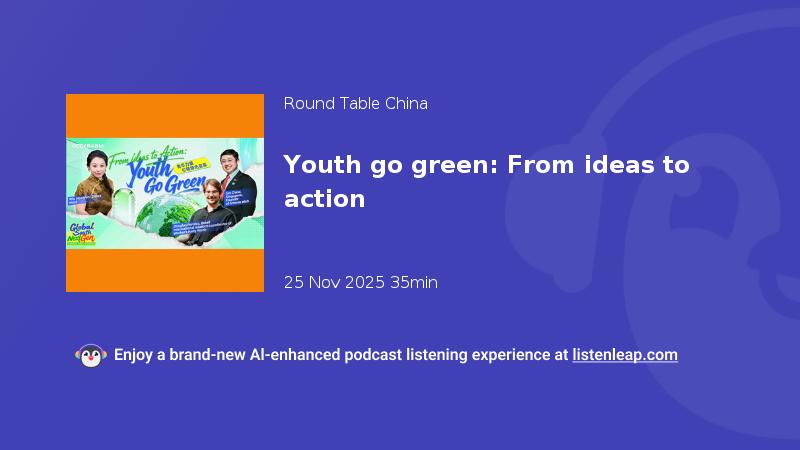
Welcome Ian Chu, founder and CEO of Greeny Web.
Hello, everyone.
And Douglas Ferreira, economic advisor of Federal Senate of Brazil.
Hey, how are you?
Welcome to the show.
Hi.
I have to admit, this is a very special experience for me, too, because we're in an outdoor area.
It is a traditional Chinese garden.
And the cicadas are so are crazy, they are shouting, they're making voices.
But I think this also represents a perfect picture of humans, nature coexist.
Yeah, I think they're rooting for us, you know?
They're rooting for us, definitely.
Because today?
Yes, because today we're talking about Green Development and both of you have great stories related to Green Development.
So how about we start from you, Ian.
Tell us your story, or more the story of you, as well as your company, Greeny Web, and the relationship between you and Green Development.
Wow, that's a long one.
So my story actually started in 2009, about 16 years ago, when I raised my hand in the classroom and I asked my teacher does going digital always mean going green?
He told me to prove it to him.
And so I was like, well, I'll try.
And what did I do?
I went back and I read up on this topic of green computing.
It was super new then and it still is right now.
And what I found out, lo and behold, is that I was right.
It doesn't always mean green or greener.
So going digital can sometimes be worse for the environment.
Right now, in the present day, we see how going digital is resulting in as much carbon emissions as every airplane, every airport and every airline combined.
And I think the cicadas agree.
They're shouting so loudly as well.
Yes, and...
Am I understanding it right?
When we use computers to go digital, when the computing power is so much, it would result in the heating or overheating of the machine and you need to cool down the machine, which means you use energy to cool down the machine.
Is that the major reason why going digital would sometimes lead to more carbon emissions?
I think you're spot on, Hong Lin.
So there are two aspects to it.
The first aspect really is that you need energy to execute things on your computer.
So every time you use your laptop it goes hot, because energy is very hot, especially with climate change.
And one of the things is that when this heating comes about, your computer starts to function a bit slower, slower and slower.
So you need longer time.
So you need to have fans in your computer or in a data center.
You need water to cool the entire system.
They use other sorts of liquid, but let's just call it water for today's podcast.
And what happens is that this consumes so much energy.
Fun fact, I'm from Singapore.
We've got this very nice flag, Singapore Chinese flag here.
And in Singapore, we've only banned two things since the start of our country's birth.
The first is chewing gum. pretty famously so.
And the second was a temporary ban on the building of new data centers.
Oh, really?
Yeah.
So even if you wanted to put in a billion dollars in Singapore to build a new data center, you couldn't in the last few years.
Okay.
Now the thing is.
I understand the data centers can be really energy consuming, which is why here in China, we have different ways to solve the problem.
For example, I've just visited a data center recently on another business trip.
And what they did, and a lot of data centers in China are doing, is that they use clean energy to cool down the system.
And of course, there are improvements on the process of cooling the machines down.
So instead of, let's say, spending around eight unit of energy to cool it down now, with advanced technology, they only spend, or they only.
It only costs around one unit of energy to cool it down.
And if you are using green energy, meaning that the energy is generated from solar power or hydrogen power, it's relatively better.
But your solution or your company is looking at another stage on the industrial lane.
Yes, it's mostly Hong Lin.
So what we do at GreenyWeb is we look at computer code and we change regular computer code into low carbon computer code.
What is that so?
Low carbon computer code is highly energy efficient computer code that basically does the exact same thing but with so much less data involved, so much less energy consumed and so much less carbon emission.
And that is the reason why we're so confident in what we do, because there are two, really two big aspects.
One is data centers and the green power and that supply side.
But we can't always focus on supply side because supply takes time to build.
We need times to build your solar farms and the securitas, they're agreeing with me right now.
And so what we need to do is we need to reduce demand.
Reduce demand without affecting performance, without affecting the TikTok videos that we watch.
I love my TikTok videos.
I have to watch them, but we'll go back to the magic codes we're talking about a bit later.
I actually learned a little, just a little, but tell me if I'm wrong when I explain the principle, the reasoning of green codes a bit later.
Now I want to talk about Douglas' great work in switching policies into greener ones in Brazil, because that's what you do.
Yes, exactly.
Thank you very much.
If we look at it for example, this great GreenyWeb company, what they are doing.
We also want companies to go to Brazil in this same situation.
Companies that are going green, companies that are developing their economic activity towards a less carbon impact, towards a more sustainable development.
So, for example, in this case of the computing process, we do have in Brazil some policies that we are developing to attract those companies, those data centers for our own system, for our own country.
In Brazil we do have a lot of water it is one of the biggest countries into water resources and we do have a lot of forest, and you could also develop a whole environment on the surroundings of those data centers.
So you could think about those heating systems that are being developed under the data, not only to improve the environment but also to cooperate with it.
So we do have some policies that are being developed for data centers in Brazil that could work with the forest, that could work with the environment.
So that is to say that we can have an idea of things merging, not only competing, not only damaging the environment, but also contributing for the world and for life.
Yes, I think that is a good example, but it's more than what you said, what you do, right?
You have some other policies you've been working on to promote the green development in Brazil.
Yes, we do have a lot of policies that are being developed in our country.
Another good example is the MOVER, is the Green Mobility Program.
It's a program that uses incentives, tax incentives, to bring companies to produce in Brazil, especially green development kind of companies.
One good one that you might know here in China very well is BYD.
It's a company... Ah, build your dream!
Yes, build your dreams, building our dreams also in Brazil.
They went...
Brazil to the northeast part of Brazil to produce cars that are electric cars, their cars with less impact on climate change.
So those companies, for example BYD, came to Brazil and are being implementing their, creating jobs.
They are helping our country also to move from the oil traditional cars to cars with less impact on climate change.
So that is a very good policy example as well that we are developing.
Another one, if I may, is our wind system in our coast.
We are doing wind offshore capture.
Clean energy.
Clean energy as well.
And we just approved the legislation needed for this kind of project.
So many companies are going to brazil to implement the wind capturing capturing devices into offshore, out of our coast.
So they're doing this on the sea, above the sea level, and it's very interesting that you can see that even the sea life actually attaches to those kind of structures and you can see that there are reefs, there are fish that is being generated with this kind of structure.
So yeah, it's very interesting.
Yes, you mentioned byd.
It is already the biggest new energy car companies here in china and, in fact, byd is also the biggest company when it comes to new energy cars and, if i remembered it correctly, byd sold around almost 43 million cars in 2024 globally.
So that's quite a lot of cars and quite a lot of energy saving.
Yes, we're talking about a good part of it being produced in Brazil as well.
And Brazil's unit actually is going to expand its sales to the whole Latin America.
So we are talking about a way of getting those fuel bad cars and switching them to electric cars.
And that's going to be much better for the consumption of Latin America and also for the world.
Of course.
And that is a significant number.
And if you think about how many energies can be saved, how many lives can be saved because of that shift, is quite impressive.
And there are so many different new energy cars here in China.
And one thing that we've talked about before, even before the show, is that in order for more people to choose new energy cars, on top of telling them the importance of going green, we also need to make the product better.
We need to make them more cost effective cheaper faster more, let's say sustainable, so that people can choose.
It is true, in Brazil still, electric cars are expensive, but they're getting cheap and they're getting cheaper.
So when people choose, they also choose with their pockets.
Brazil actually has a car automobile industry which is greener than others, because in the 70s we developed cars that are ethanol with propulsion.
So what makes the cars, the engine, go off, is actually sugar cane derivatives, so it's so products that are green actually.
So you take, you plant sugar cane and then you cut, you crop it, you industrialize it and then you put on your car so you could they are alcohol proposed as well as now build your dreams cars that are being made with electric propulsion.
So this is developing very fast in brazil.
Still, it's not many cars that are on the street with this kind of engine, but it's building, it's getting better and we hope that this continues.
That's really nice. deep diving into the new energy car industry.
Here in China some trends are not only are different companies inventing different cars and building cars in general, they're also making the industry a bit more, or let's say focusing on different sector of the industrial line.
For example Huawei, instead of building cars, they are building other structures as well as, let's say, different systems in the car.
So if I can have a new energy car that is using smart codes in the system, I would want to buy it even more.
So, Philip, tell us what exactly do the smarter codes do your company?
Or how do you help companies to have smarter codes?
Definitely.
So thank you, Honglin.
So I think it's very interesting because for EVs electric vehicles one of the biggest challenges would be range anxiety, where people are anxious that they just cannot go far enough before their next charge needs to come.
And this is really where low carbon computer code, green coding, comes into play.
Because, when we think about green code, it uses less data and, by extension, less energy.
So your same vehicle can therefore go so much further, even when it's using an advanced system to help in braking, to help in navigation, even when it is an autonomous vehicle.
That really shows the potential of green computer codes because it is cross industry.
It can be in evs, it can be in electric vessels tomorrow, it can be in spacecraft the next year.
It can be everywhere.
And here in China, we also have green colds and smarter colds happening in different ways.
And a general number here is that, in short, in China trimming 1 of cold bloat can literally turn off one server rack's worth of air conditioning.
It is quite significant.
And I did a little research about green code and tried to use layman's terms to explain to me.
I asked about some, let's say, experts.
And they say that there are so many different ways to make code greener.
And, if you think about it, it's like the computing unit is processing different clusters of data, of information.
And there are some information that needs to be processed very precisely.
There are some information that can be processed.
Not that precise.
Just, you know, the gist of it would work.
And also there are times where it's peaking hours.
You need a lot of energy.
You need a lot of energy to be used in processing.
For example, artificial intelligence training or generating graphics.
So things like this.
Yet there are also times like this during night times.
You do not really need the computers to be on all the time.
Or maybe you do not need the computing unit in the computers to be on all the time.
Yep, that's perfectly right.
I think it's a 50-50 split.
There's half of the energy that is used to.
Really, it's what we call compute power, whereby you have your computer doing whatever you want it to do, right.
The TikTok video.
And then the other part is at the data center, where these Well servers, which are basically mini computers, really overheat because they get so excited by the cat memes.
No, because they get so excited or they use so much energy to really process all of the information that we need.
And so these servers, when they overheat, they start to melt, just like us right now melting in the heat.
And when they start melting, they malfunction.
That's where you have an outage in the data center and you have an outage of internet in a given place.
So to prevent that, what data centers do is they have enhanced cooling.
They have air conditioning, they have water, liquid cooling and more types of cooling to ensure that this never happens.
But all of this is energy intensive, meaning you need to have energy well to reduce the heat.
Know, in Hainan in China, there is this data center that is built under sea water.
So instead of using liquid to cool off the machines, they use sea water to cool off the machines.
Very smart, and in Guizhou province, for example.
Guizhou is famous for being a relatively cool area, so that the environment is cooler, which means you need less power to cool down the machine.
So all of these things are happening in so many different areas.
We've only named a few examples, but in those examples and all the examples we didn't have a chance to mention just yet, you see young people's voices, young people's creativity, young people's great minds working in these areas, and both of you are quite young, so you work with the younger generation as well.
Do you see that they have a special perspective or They're driven their way of doing things?
Are they special in green development great cause?
If I may just continue a little bit.
So one of the things we do at GreenyWeb is we run the 30 by 30 programs.
And there's actually a Brazil link to that, because we're reaching 30 nonprofits and education institutions before COP30 in Brazil.
And we're doing that pro bono, completely free of charge.
We are teaching the next generation how to code low carbon.
And that's very important because coding has fundamentally not changed in the last 30 years.
They're still using the 15th or 16th edition of a 1980s textbook.
Really?
It's crazy because I can understand that for certain machines, they are designed not good enough.
So they would require more energy to cool it down.
You cannot really replace all of the machines to the newest edition.
But codes as well?
I think for codes, it's really the frameworks of how we think about coding.
And that's really why smart coding, in our case green coding, is so important.
Because if you don't want to shift out all of your old machines and throw them in a junkyard, you need to change the software part of it to make it more energy efficient.
And that's really how we ensure that machines have a longer lifespan, how they last longer, even beyond what would be considered the expiry date.
Look at that.
When we're thinking about the young people and their own processes.
We're talking about that.
We need to change the world.
When we need to change the world, we need new ideas.
We need new people.
We need people who are not used to those old-fashioned ways.
Exactly.
So this is a very good example.
And Brazil is developing space for social participation.
Our government is known by its democratic, open channels of dialogue with society, with social movements, with young people that are cheering and want to change the world.
And we just give them the right tools and we give them the right challenges channels to participate into policy, to participate into economic activities regulation and so on.
COP 30 is going to be a real good opportunity for the young people to participate.
So we are developing right now a big camp and eco camps in Belém, the north region of Brazil.
And the young people will be there will have the opportunity to participate into the policy making that's been shaping the new world actually.
Because when we're talking about COP 30, we're not talking about just one country together, but we're talking about the whole world being together to develop its future.
And we think it's very important for the young people to participate on it.
We hope to see many of you there.
You have talked about it already that collaboration among different countries is very important and for young people in general, we believe young people are more open-minded.
They are open to new ideas and they do not have that many biases.
I am not offending elder generation at all.
I love elder people.
They are wise.
They're with experience.
Yes, we love them.
At the same time, we also wanted to talk about the positive traits of the younger generation being open to different possibilities and different mentalities.
It's definitely one of them.
So how do you vision the cooperation needs or the necessity of having global cooperation among young people?
Do we think young people are better at cooperating with other young people from other countries?
Well, if I may jump in, because of what we do and our work globally, we currently run the program in Europe Africa, Asia Pacific and the Middle East.
So we've had a good vantage point of how young people work.
And we find that young people work very differently in the sense that they're very interconnected.
It's very easy to reach them and it's very easy for them to spread the good word of good programs that take place.
And that's not to say that old people can't do that.
Of course.
We love old people.
But it's really the case of how there's a different way of working.
And as you have a larger and larger population of people who work in this way, If we use the same methods, we can reach more people for greater positive impacts.
Yes, and I think that the young generation, they are very keen, they're very curious, they're very passionate about what they're doing.
They have their own mentality, they have their own ideology, they want to see things done.
So they are open-minded, they want to interact, they want to learn new process.
So, for example, they go on WeChat, they go on Facebook, they go on social media and start to speak with each other.
They want to see what others are doing on the rest of the world.
And I think that all generations should cooperate.
But the young people.
They have a special place in this new development way that we need to implement, in these new policies, in these new companies that are being founded, and and so on.
Yeah, I totally get what you're saying.
These days, I find young people being very expressive as well.
These days, we are taking part in the global youth development forum, and a lot of different young people from different places.
I've talked to them, I've talked to you, you too, included and all of you are very enthusiastic about telling me what you do, about the projects.
You're proud of the projects.
You want to find opportunities to cooperate with people from outside of the country, and i always always, find it a really good thing.
But at the same time, sometimes people would say that young people are creative, they are passionate, but they also lack the necessary experience in working in any industry and often they might be a bit even naive.
Do you find it true?
Well, I think that's a very difficult question.
And Chai, I feel that young people, well, the majority of them actually have great ideas.
And that's really why we need the elderly folks, folks who have been around in industry for 10 15 30, 40 years, to really be part of the solution.
We're not saying that climate change, sustainable development is a young people only kind of program.
We say it's for everyone, but it's driven by the young people who will be directly affected by climate change, because we are feeling the heat right now.
And for the young folks, 10 years, 20 years later, I cannot imagine how hot it's going to be.
But it's true.
It's going to be better.
I agree with you.
Sometimes the young, they are naive because they lack the experience.
They are not used to the processes that are being developed and they are already implemented.
So we need the young to cooperate and to deal together with the ones who are young people for longer, that is to say,
So those people can combine their ideas, they can combine their own work and implement the processes and be able to build, shape the future.
Definitely.
You're absolutely right.
And the reason that I said that in 20, 30 years we're not going to be still in this really hot environment is that every country, especially in the global south, are working on making things better, on cutting their carbon emission.
For example, here in China we have a dual carbon goal, which means that by 2030, China aims to have its carbon dioxide emissions reach their peak, meaning that from there, emissions will stop growing and start decline afterward.
And also in 2060, China plans to achieve carbon neutrality, meaning that balancing the carbon dioxide emitted with the carbon dioxide absorbed or offset, so that the net emissions are zero.
So if every country does this in 20 or 30 years, we'll be in a much better situation.
And I have to tell you, it's not only for big industries, not only for major manufacturing industries, it's also with each and every individual.
Just the other day, when I was back home from a business trip, I realized on my cell phone on a ticket selling platform that I can pay for a couple of dollars, or it's like a dozen of Chinese Yuan, to make my ticket green.
Meaning that by donating that money to the airline company they are using the money to I don't know trimming their coats, making them green or finding some other ways to invest in green energy.
So this is happening to each and every individual and I have to proudly say I made that donation.
Very good.
Thank you very much.
I want to also mention a very nice company that's being funded by a friend from india.
Thanks to her pinky, she is developing products that are capable of making this green transition, as well as in the way that you could buy a pencil and that pencil would have a little seed on top of it, so once you use it, you reach the end and you can just plant your own seed.
That's cute.
You could also do that with paper.
You could Put little pieces of seeds on your paper.
We can change the whole economy with little actions, just as you did with your ticket.
We could do that with plastic.
We could do that with many products that today make an impact in the environment but in the future can be even contributing for the new good environment.
That's not only a great example, great practice, but also a good social campaign.
I mean the kind of campaign that can happen in, for example, social media because, we mentioned, young people are open to new ideas.
They are very expressive.
They're expressive in reality. in real world.
And they're also, if not more expressive online.
Here in China, we have a lot of young people starting green hashtags on different social media platforms, inviting other people to join their greener lifestyles and also voicing and also providing different examples of how to make things greener in their own industries or in their daily lives.
So I think in this sense, social media is playing a positive role in green development.
Do you see these kind of phenomena in your countries as well?
Yeah, I think in Singapore we see that happening almost every day because there are a group and a growing group of youth who go about there showing how cool it is to be green, how cool it is to bring your own metal bottle instead of using plastic bottles, how cool it is to give out name cards with a seed planted in it, just like your example whereby, after I use the name card, if I were to discard it one day.
It will grow into a tree.
And these things start from young.
And that's why youth is so important because these are green habits that are built for life.
Yes, exactly.
There is also a movement in Brazil of people that call themselves climate refugees.
People that are moved from the cities to the countryside and started a new life, a life where there's less impact on nature, a life where they can coexist and they can plant their, their trees, they can plant their food, they can coexist with nature in a different perspective, a less industrialized life, so that there are many examples that we could give him here.
One of them is also putting hashtags, is also trying to make things better in the internet as well and building movement, building a mutual sense of understanding the environment and our part on it.
These are all very positive examples and statements, but going green is not that easy.
Definitely there is no one size fits all solutions.
And in your opinions, do you think young people can adapt and put forward some innovative ideas, localized ideas to help us fight against global warming and go for greener development?
Yeah, I think two examples from my side.
The first one is with regards to green code, which is what we do.
Computer code is a vast universe.
You know, there is Python, there's C++, there's Java, there's everything, right?
You name it, there is.
And what happened is that, after we taught low carbon computer coding to these students, we realized that they were bringing it back to their own projects, to even languages that we weren't prepared to teach on, and applying low carbon computer code principles to those projects.
So we see how that's very contextualized, even in the digital world.
And the second example, back to brazil, is really on agricultural gains.
We see lots of folks that i have friends with in africa, in south america.
All of them are moving towards organic pesticides, organic fertilizers, so they're going away from the chemicals.
And these are young people who are using their degrees in chemistry, their degrees in environmental science, to really help their local communities to go green.
And I think Douglas here will have more to add.
Yes, that is super interesting because if you look at it in Brazil, for example, we are the biggest producers of food in the world.
We produce food that could feed up to 2 billion people in this world, and Producing food is not always green.
There's always some impact in the environment.
We are changing those ways of producing food to agroforests.
Those are forests that can produce food.
Actually, the indigenous, the very original people from Latin America, they lived in the forest.
So the humans, they had a whole integration with the forests, and forests were the way that they provided their own living.
And we learned that if you mix some plants with others different types of plants, specific types of plants you would need less pesticide to deal with this.
We do that here in China too.
For example, if you have a monoculture, a big field with only one crop, you might need to put a lot of pesticide on it, because this is a very good environment for some bugs to develop.
And if you try to manage those crops, not only with other crops but with birds and different animals that could hunt those bugs and birds, they all mix and they make the environment sustainable.
So this is kind of agriculture that could help the future to have less impact when we are producing food.
Yes, it's happening here in China.
We're calling them new type farmers.
They are well equipped with great knowledge they learn about all the different logic and different ways of doing agricultural works in the field and many of the younger generation instead of flooding into major mega cities they go back to the countryside they would become digital nomads they start a business maybe a a coal tourism related business in countrysides or maybe they work with the lands with the new type of farming industry that is much friendly to the environment yes if you look at it Honglin sometimes we only look at life above the land but actually there's a lot of life underneath the land also so bacteria we have bugs we have all sorts of living condition underneath the land.
So this kind of agriculture also works with what is beneath, with what is below, not only with what is above.
If we look at it, this is the environment, this is the whole condition of the world.
We have to dig earth and play with it in a way to make the living conditions always the best for diversity and for everybody really.
Yes.
And there is also life in the digital world.
So we need to always bear in mind, as we balance the physical and digital world, that there has been so much talk about tech for sustainability, how we use technology to turn off the lights, how we use technology for agriculture.
But we also must make sure at the same time that tech is sustainable in and of itself.
And that's why we feel that young people, when they really adopt these practices, we have a bright future, a green one, ahead.
Through that, in the future we'll be talking about system and ability in the moon.
And that brings us to the end of today's show.
Thank you so much for your time.
If our stories give you something to think about, I think we've done our jobs.
We don't always need the right answers, just the willingness to continue asking the right questions.
Before next time we meet, let's stay bold, stay thoughtful and make sure that we want to create a future that is as green as bright.
I'm Niu Honglin, and thank you both of you very much, Ian and Douglas, for today's brilliant conversation.
You're listening to Roundtable.
That was me talking to Ian Chu, founder and CEO of GreenyWeb, and Douglas Ferreira, International Relations Coordinator of Workers' Party Youth of Brazil.