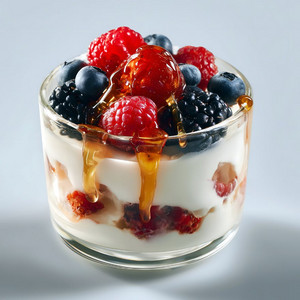
Yogurt is a miracle.
It's the creamy result of when you leave milk out for too long and zhuzh it up a little bit.
I think yogurt is like one of the dreamiest substances that we have to eat in existence.
I mean, I like yogurt fine, but we live in a world with chocolate.
Still, I'm definitely not here to diss it.
Yogurt is an extremely popular substance, and rightly so.
There's fruity yogurt, plain yogurt, Greek yogurt, drinkable yogurt, Icelandic yogurt, frozen yogurt.
The list goes on and on.
So who invented this dreamy, infinitely versatile food?
Where did it come from?
Fortunately Cynthia, you are in an episode of Gastropod, the podcast that loves to get to the bottom of exactly these kinds of questions.
So let's have a look at yogurt through the lens of science and history.
I am, of course, Nicola Twilley.
And I'm Cynthia Graber.
And if you happen to catch any ads for yogurt, it seems like it'll solve all of your health woes.
Where did that come from?
How did this idea start that it's like this elixir that will bestow immortality?
The other thing is, like you said, there's a million different kinds.
The yogurt aisle stretches half the length of the store.
But what's the difference between all the different yogurts like Greek or Australian or Icelandic, or even your basic Dannon or Yoplait?
All this plus yogurt made with the help of some friendly ants.
Yes, ants, the insect kind.
This episode was supported in part by the Alfred P Sloan Foundation for the Public Understanding of Science, Technology and Economics and by the Burroughs Wellcome Fund for our coverage of biomedical research.
Gastropod is part of the Vox Media Podcast Network in partnership with Eater.
Amazon has everything for everyone on your list.
Like your husband who hauls out the 40 pound canister vacuum to address a single dropped popcorn kernel.
He'll spend 12 minutes setting up, plugging in and maneuvering.
It's like using a fire hose to water a house plant.
Get him a cordless vacuum.
And with Amazon early holiday deals, you can save big on home electronics.
Now Dustin can skip the project planning phase and go straight to tactical crumb elimination, avoiding your unfinished home projects because you're not sure where to start.
Thumbtack knows homes, so you don't have to.
Don't know the difference between matte paint finish and satin, or what that clunking sound from your dryer is.
With Thumbtack, you don't have to be a home pro.
You just have to hire one.
You can hire top-rated pros, see price estimates, and read reviews all on the app.
Download today.
So my father...
Learned to make yogurt from my grandmother my maternal grandmother and he started making it in the 90s and he has perpetuated the same yogurt starter since then.
This is Priya Krishna, a cookbook author and food reporter at The New York Times and, of course, a mega yogurt fan.
Yogurt was a foundational part of Priya's childhood.
Every week, my dad would stand over the stove, stirring hot milk, pouring it into a container.
He made one large tub of it in a stainless steel container.
And then he invented what my sister called personals, which were like smaller individual size servings of yogurt.
And this was what we ate.
Not a day went by. that we didn't have yogurt.
Most of us buy our yogurt at the store these days, but it's not hard to make at home.
You just have to warm your milk and then add a little bit of your previous batch of yogurt, because that bit of yogurt has all the live microbes you need to make yogurt, and they'll get right to work and start turning the warmed milk into a new batch.
This is just what Priya's dad did week after week.
And I think like the biggest panics that would happen in our house were when we were low on yogurt or where all that was left was sort of the watery curds at the bottom of the pot.
But he would keep these sort of break glass in case of emergency containers of yogurt in the freezer, just in case one of us ate all of the yogurt and there was, like nary, a tidbit to start the next batch with.
And so he had all of these contingency plans if there was not starter to do the next batch.
This level of preparedness was essential because Priya's dad's yogurt was extremely delicious.
My dad's yogurt.
It's sort of an Indian style yogurt, which means it's creamy, but it's also very, very tart.
And just the way it came out in these really wonderful chunks that defined my dad's yogurt.
Like I said, delicious and also legendary.
My dad's will distribute his yogurt starter to friends.
So if someone asks him nicely, he will bring some, because there's this idea that My dad's yogurt starter can make like really pristine yogurt.
And all those families were so excited about this gift of a yogurt starter, because yogurt wasn't just a snack.
It was really an important everyday food.
My mom used it to make raita.
Raita is a yogurt sauce that's served almost every meal in Indian cuisine.
She would also strain it and use it to make shrikhand, which is like this very thick cardamom yogurt dessert.
It's like one of my favorite desserts of all time.
But among many South Asian families, I know yogurt is essential.
It is often not something you buy.
It is something you make.
It is sort of an underpinning to our meals.
You serve yogurt with an Indian meal, it like sort of cools you off.
It functions as sort of a refreshing counterbalance to this food that has, often has a lot of spice.
I don't mean heat spice, but just like a lot of spices in general.
Recently, Priya reported a story on the importance of homemade yogurt among South Asian families and how carefully each family's yogurt starter is preserved.
And the stories I heard were so endearing.
It was like people hiding yogurt starter in their suitcase when they were coming from India.
Or this one woman told the story about moving cross country and holding her family's turtle in her lap and having the yogurt starter next to her strapped with a seatbelt, like in a seat, like the yogurt got its own seat in the car.
And that's how important. it is to perpetuate the yogurt starter.
But South Asians aren't alone in their love for yogurt.
Today it's popular around the world and it's been popular for thousands of years.
Basically for as long as we've had milk and containers to put it in, which is something like nine or 10000 years.
So how long have we been eating yogurt? probably since we domesticated animals to produce milk.
Veronica Sanat is a professor of food science at the University of Copenhagen, and it seems like the discovery of yogurt was a perfect marriage of domesticated animals, the invention of pottery to hold liquid and, of course, place.
There's a popular story that the big yogurt breakthrough came when some nomadic tribesperson in Central Asia was carrying some milk in an animal skin pouch and by the end of a long, hot day on horseback, the milk had turned into sour curds, aka the very first yogurt.
That's a fun and picturesque story, but most researchers think that isn't how the discovery came about.
They think it's more likely that the milk was left in a ceramic container outside in the warm sun and microbes just started doing their thing.
No jiggling on a horse required.
Because all you really need in order to create yogurt is you need a milk source and you need bacteria and you need the right climate.
And so you now had those three things coming together in a very organic way.
This is June Hirsch.
She's a cookbook writer and the author of Yogurt, A Global History.
You had them take this milk product.
They put it outside.
They were in the area near Turkey, so it was hot.
And they left it out there.
And it curdled.
And it thickened.
And it coagulated.
The Turkish word yogurmark, which means to coagulate or to thicken, is really descriptive of what the product was that they got.
Typically, if you think of leaving milk out on a hot day, you think of it going bad and maybe even making you sick.
But this coagulated sourness was not only tasty, but also maybe made people feel better.
One theory about why people latched on to this new tangy, thickened milk that didn't make them sick has to do with my personal plague, lactose intolerance.
Most people at the time in those regions couldn't tolerate lactose, and something like 70 of all people around the world still can't today.
Lactose is a particular milk sugar that we humans can digest as babies.
It's why we can thrive on breast milk.
But most people lose that tolerance as they age.
Milk is super nutritious.
It seemed like it could have been a great food resource.
But drinking more than just a tiny bit was and is a fast track to digestive distress for most adults.
But these early people in what's now Turkey found that they could have a little bit more of this soured, thickened version of milk without wanting to puke.
And that's because there's about half the lactose in yogurt that there is in milk.
And that's because that lactose, that milk sugar, is a great food for, yes, microbes.
And now you can drink because the trick to turning milk into yogurt is really microbes.
And the microbes in it.
Often, bacteria produce acids and transform that milk through their microbial metabolism into a tangy yogurt.
These are not just any old microbes.
They are two very specific lactose-consuming microbes.
Yogurt, by definition, contains streptococcus thermophilus and lactobacillus delbronchii, And these microbes do one other important thing other than consuming lactose.
As Veronica said, they produce acids.
And those acids that acidic taste in the yogurt.
It keeps out other microbes that could be toxic to humans.
Those are the ones that would just turn milk bad.
Getting a hold of those particular acidic microbes was really helpful in the days long before refrigeration.
As you start to milk animals, or maybe have a herd of animals you might not be able to consume all the milk in one period of time, right?
So how are you going to preserve this lovely, nutritious resource?
Fermentation, that microbial transformation allows for you to preserve it.
So you could turn milk into something like yogurt and that prevents other microbial spoilage organisms from getting in there.
Essentially, preventing your food from rotting or going bad.
So that could be a major advantage.
This is truly a microbial blessing.
These two microbes made milk both longer lasting and more digestible.
No wonder people are protective of their starter cultures.
But so where did these incredibly useful microbes first come from?
This is the trillion dollar question.
No one really knows, because these two microbes can be found in all sorts of places in the wild, from human saliva to animal guts, to wildflowers and grasses.
Some people suggest that the microbes in our yogurt that we use today come from animals.
They like to live at really warm temperatures, more like mammalian body temperature.
The question becomes did it come from the cows or the animals themselves and it was part of their microbiome that kind of transitioned into our fermented foods?
Or is it part of our microbiome in these lovely warm environments like our mouth or Other places?
We may never know exactly where these two main yogurt bacteria originally came from.
But there's another twist in the yogurt origin story, and it's that yogurt wasn't one thing, it was plural yogurts, and each one might have had a slightly different microbial community that was fermenting it.
Traditional yogurt can have many different types of lactic acid bacteria, microbes that are eating those sugars in the yogurt and then producing lactic acid.
That could be...
These two traditional yogurt microbes, but it could be a variety of other species.
They also might contain some yeasts that might add a little bit of effervescence or different flavor profiles.
All those different microbes and fungi could really have come from anywhere.
It's kind of a tantalizing mystery.
Veronica studies the ecology and evolution of microbes in fermented foods, and she was curious about the origin of these microbial communities in yogurts.
What really intrigued her were stories from her colleague Sevgi Mutlo Serikova, who's originally from Bulgaria.
Sevgi told Veronika about yogurt that was created by putting ants in it, which made Veronika wonder could the microbes in this yogurt have come from ants?
Sevgi had collected stories of ant yogurt that came from Turkey.
It came from Bulgaria.
We've also collected other stories that come from other Balkan countries.
So she and her colleagues traveled to a town in Bulgaria where Sevgi's family is from, and they worked with the community to recreate that traditional ant yogurt so they could study it.
They hadn't actually been making ant yogurt.
It seemed like regularly, or potentially even for decades.
But many people had living memories of how it was made.
Ant yogurt turns out to be a seasonal treat.
This ant yogurt is made as part of a springtime tradition or a spring celebration religious celebration called the Hildrilles.
And as spring sets in, everything starts moving and growing.
And so do the ants.
Their colonies become alive again.
They start crawling all over their nests, but also all over the environment.
From the stories people told Veronica and her colleagues, it seems like people would drop whole ants into warm milk and then bury the container of that milk in the ant colony overnight.
Why?
Why ants?
Why the one particular kind of ants that they used?
So why these ones?
These ants produce acid.
They produce formic acid.
If you disturb them, they'll even start spraying it at you.
And you can smell it.
If you decide to lick your hand, you would certainly taste it, that it's a bit lemony.
Adding an acid to milk, something like lemon juice, is a known trick to kickstart the fermentation process, whether you're making yogurt or cheese.
You don't need it, but it helps create the nice acidic environment that the microbes like to work in.
And I think that might be one of the reasons why they started to think oh, these are a sign of spring.
These ants are acidic, maybe acidic like the yogurt.
Could that be important?
The ant colony is also warm.
So if you were to put your hand inside the ant colony, it's like this nice, cozy environment.
Much like that nice cozy, warm environment that you would wrap your yogurt in, wrap that blanket around it so it stays warm.
So it could be something like an incubator.
Those are maybe some of the reasons why they chose ants and particularly those ants, because certainly not all ants will work for this fermentation.
The story of ant yogurt is an interesting bit of cultural history, but Veronica is a scientist.
She wanted to understand exactly what was going on, what the ants were contributing to the yogurt making process.
And to do that, she had to make ant yogurt back at her lab in Denmark.
So the ants are in many different places, actually.
And luckily, they were in our own backyard here in Copenhagen.
They're a major fixture of the landscape in these pine forests.
So it was really easy.
We collected the ants from the Danish landscape, brought them back to the lab.
They actually crushed the ants so they could release anything and everything that was in the ants into the milk.
The milk itself was totally sterilized.
It.
Was this really controlled test of?
Can the microbes and the things in the ants get into the milk?
And how does that work in that yogurt making process?
So I'm really this food science level.
Veronica and her colleagues left the milk with the ants to incubate overnight.
And when they came back, it was definitely well on its way to yogurtification.
It had begun to coagulate.
It was a little acidic.
It wasn't fully yogurt, but it was getting there.
And so then they analyzed the ants themselves and the yogurt to find out what was in the yogurt that hadn't been in the sterilized milk.
Obviously, the ants had brought acid that lemony formic acid they're known for.
But they'd also brought the all-important microbes.
The ants bring in lactic acid bacteria.
They brought in this really cool bacteria called Fructilactobacillus sanfrancisiensis, which actually is normally found in sourdough bread.
The ants also brought in acetic acid bacteria that they seem to keep in their mouths and in their guts and have evolved with For millions of years likely.
Veronica was excited to find out that these ants contributed just what was necessary to make yogurt.
But it turns out that the ants had another trick up their sleeves, another contribution to the yogurt-making process.
They dropped off some enzymes, too.
These enzymes munch on the proteins, break down these proteins into smaller peptides or amino acids, and that's great because the food's more nutritious.
But also the other microbes in the microbial mix can use those amino acids for their own metabolism and growth.
Enzymes can also contribute to the texture of yogurt.
So enzymes can cause the casein, this major protein molecule in yogurt.
It causes the molecules to aggregate a certain way and then the milk coagulates.
In other words, ants are basically an all-star yogurt-making machine.
Of course, you don't need all those ingredients to make yogurt, and you don't need ants in particular.
In fact, as Veronica said, most people they spoke with in Bulgaria aren't even making ant yogurt anymore.
So when other researchers have gone out and sampled all household yogurts around Bulgaria, for example, they don't find any ant microbes in them.
So ants are probably not the origin of today's yogurt bacteria.
But Veronica does wonder whether the sourdough bacteria she found in her ant yogurt, whether that might have made its way from ant yogurt itself into the sourdough starters behind the bread we still enjoy today.
It's not unheard of to use yogurt in your sourdough starter.
But the moral of the story is that the yogurt could be used in different fermentation products.
Like sourdough.
It could be in the kitchen environment.
And this isn't the only story of insects helping create delicious foods by bringing along the necessary microbes.
There's been research in Italy, for instance, showing some of the microbes that can turn grape juice into wine came from wasps.
And so, while again no one is saying that ants are the forefathers of all yogurt, What's so cool about the fact that ant yogurt actually works is that it helps show how many different ways humans could have arrived at tangy fermented dairy products.
Today, we mostly just rely on two microbes, but imagine the variety in the past.
I still really want a time machine.
Anyone out there help me out?
But Veronica and June have some ideas about what that variety might have tasted like.
So there was no single yogurt with a specific flavor.
I think it was inevitably more complex than the yogurt you can buy at the grocery store today.
And its acidity, other different profiles, maybe it had some botanical notes to it.
It depends on who was making it and just how they did it and what microbes they carried with them and carried with their yogurt.
So depending on the strain of bacteria that you use, you get a very different taste.
Until someone comes through with Cynthia's time machine, that's as close as we'll get to an ancient yogurt flavor profile or profiles.
But what we do know is that ancient people loved it.
It was a hit and it caught on all over, throughout the Balkans, the Middle East, the Caucasus, and Central and South Asia.
Yogurt was mentioned in lots of ancient texts in lots of different languages.
And it was also almost always mentioned as something that was particularly healthy, almost medicinal.
The classic yogurt is the key to health story may or may not be true, but it is a good one.
It stars.
Yogurt obviously, but also King Francis I, who ruled the yogurt-free nation of France in the early 1500s.
From what the stories go, he had a sour stomach and an even more sour disposition, and all of the people in his court wanted somehow to get this man some relief, feeling that if they could relieve his indigestion perhaps he would not be such a disgruntled ruler.
And so he reached out to Suleyman the Magnificent in the Ottoman Empire and he said we hear you have a doctor who can cure sour stomach.
That doctor was a Jewish guy who apparently so the story goes he hiked all across continental Europe from the Ottoman Empire to France with a herd of sheep, got there and made some yogurt with that sheep's milk.
He supposedly cured the sour stomach and the chronic indigestion of the French king, forever stayed in their good graces, improved the health and the well-being apparently, of everyone in France.
Because now supposedly, he became this lovely benevolent ruler?
Because his stomach wasn't disagreeing with him.
At the time, Francis proclaimed yogurt the elixir of life, which you would think would help it catch on in France.
But it did not.
It took many more centuries and a bunch of starfish before yogurt would make it big in the West.
That story coming up after this word from our sponsors.
Fox Creative.
This is advertiser content brought to you by Vitamix.
Throughout human history, in homes and restaurants in every corner of the planet, Kitchens have always been full of noises.
Okay, so long before the buzz of the fridge and the whir of the Vitamix, the story of kitchen noise started with the sound of fire.
Its crackle has been part of the essential kitchen soundtrack for over 1.5 million years.
With the Stone Age came essential kitchen tools like the mortar and pestle, rolling pin, the knife and even the humble spoon.
Skip ahead a bit, and we have the modern kitchen.
Following the Industrial Revolution of the 1850s, electricity brought a whole concert of beeps and buzzes.
First there was a dishwasher in the late 1800s, the garbage disposal in the 1920s, the electric blender in the 1930s and the microwave shortly after that.
But all these sounds from across kitchen history the clank of the mortar and pestle, the buzz of the Vitamix, the click of the stove formed the course of experimentation, nourishment and love that fill the kitchen up.
Kitchen noise is nothing short of the sound of joy.
Dinner is served.
Vitamix knows your blender is one of your kitchen's essential noisemakers.
It's whirring is the sound of making your family's famous hummus, the creamiest strawberry smoothie or that perfect summer pesto to enjoy around a crowded, noisy table.
Add a little more joy to your kitchen and shop only the essential, like the new Vitamix Ascent X5 at Vitamixcom.
Welcome to gift wrapping.
Whoa, Zoe Saldana.
Hey, can you wrap these, please?
Wow, iPhone 17s.
You splurged.
At T-Mobile, you can get four iPhone 17s on them.
It's the perfect gift for everyone.
I'm the worst.
I only got my mama robe.
Well, it's better than socks.
So I have to trade in my old phone, right?
No, at T-Mobile, there's no trade-ins needed when you switch.
Keep your old phone or give it as a gift.
Incredible.
In fact, wrap up my old phone, too. for my Aunt Rosa.
Forget that.
Aunt Liz will be jealous.
Sounds like my family drama.
Oh, I got it.
I'll give it to my abuela.
I'll take reindeer paper with.
Hey, where are you going?
To T-Mobile.
Thanks, Zoe.
The holidays are better at T-Mobile.
Get four iPhone 17s on us.
No trade needed when you switch.
Plus four lines for just 25 bucks a line.
Welcome to Walgreens.
Looking for a holiday gift?
Sort of.
My cousin Freddie showed up to surprise us.
Oh, sounds like a real nice surprise.
Exactly.
So now I have to get him a gift, but I haven't gotten my bonus yet.
So if we could make it something really nice, but also not break the bank, that'd be perfect.
How about a Keurig for 50% off?
Bingo.
Savings all season.
The holiday road is long.
We're with you all the way.
Walgreens.
Offer valid November 26th through December 27th.
Exclusions apply.
We've said that yogurt got big in a pretty significant swath of the world, from the Middle East all the way through Central and South Asia.
But it wasn't particularly well known in most of Europe.
That's why King Francis didn't think of taking yogurt to cure his stomach without some outside intervention.
In some parts of the world, it makes sense that yogurt didn't get invented.
There weren't many milkable animals in North and South America, Australia, and the Far East.
But Northern and Western Europeans had milk up the wazoo.
And that milk would have spoiled without refrigeration, too.
Maybe a little bit more slowly than in the heat of Turkey, but still.
So why didn't they invent yogurt?
It turns out that the climate is key.
The particular microbes that make yogurt yogurt.
Yogurt isn't cheese.
It's not sour cream.
It's not buttermilk.
These yogurt microbes not only love heat, they can't live without it.
They just were never going to be happy in England or Sweden or even France.
So those places developed a completely different coagulated milk culture.
So you get butter and aged cheese.
They need cool temperatures, which meant they weren't great options in the Middle East or Central Asia.
Northern and Western Europe.
All also did have their own versions of soured milk milk that's been lightly fermented and curdled.
But these were made with different microbes that like the cooler temps in Northern Europe.
And the resulting soured milk is a lot less sour than yogurt is.
They have a kind of fresher, milder taste.
These are like British and Irish clabber, creme fraiche in France, German quark.
Those milder, lower temperature microbes also incidentally, eat a lot less of the lactose, the sugar in milk.
Which may have contributed to making it an evolutionary advantage for Western and Northern Europeans to pass on the mutation that makes them able to digest lactose as adults.
But the point is that for Western Europeans, yogurt just wasn't a food they were familiar with.
If they did get a taste, it would have been something super exotic, like the yogurt that the Jewish doctor from the Ottoman Empire had to make for the French king.
But even more importantly...
No one was familiar with what on earth was making any of these fermented foods.
Despite eating them by the boatload, no one had seen a microbe until microscopes were invented in the 1600s and no one knew what they did till Louis Pasteur came along in the 1800s.
Pasteur may have figured out microbes caused fermentation, but he didn't do research on yogurts.
He did end up creating the Pasteur Institute in France to study diseases and microbes.
And the first foreign scientist he invited to come work with him was named Elie Metchnikoff.
He was a Russian biologist who spent the second half of his time in France.
He worked in Paris at the Pasteur Institute.
And he was very famous, not just as a scientist, but he was at the beginning of the 20th century.
He was one of the most famous people in the world.
Luba Vekansky is a science writer and author of the book Immunity How Elie Metchnikoff Changed the Course of Modern Medicine.
Metchnikoff is a big deal in the story of yogurt.
He's sometimes known as the grandfather of yogurt.
But his scientific reputation was not built on dairy products.
He won a Nobel Prize for basically wholesale coming up with the idea of the immune system.
It wasn't called then at the time, but...
He developed the very first modern theory of immunity.
Until then, there was no notion of immunity in the way we know it exists today.
In the lab in the late 1800s, Metchnikoff was studying starfish larvae.
They're transparent, which makes them easier to study.
He noticed that there were cells that were basically digestion cells.
They eat food for nourishment.
And somehow he had the idea that maybe they don't just eat food, maybe they eat harmful things too, as a form of protection.
And he performed one of the most famous experiments in the history of science.
He introduced into this tiny larva little pieces of thorns from a rose bush.
And then he saw the next day that indeed the cells had ganged up on these thorns to protect the little animal.
They seemed to be a built-in defense system, an immune system.
Metchnikoff continued his experiments and eventually discovered that there's a similar, more sophisticated system in humans, made of white blood cells that surround and ingest harmful foreign particles.
This was an amazing breakthrough.
It was so ahead of its time, it was ridiculed at first.
But ultimately it made Metchnikoff famous, and so he got an invitation to come work at the center of the universe for science at the time, the Pasteur Institute in Paris.
This was an incredibly exciting time in science, and particularly for the Pasteur Institute.
Pasteur had just created a vaccine against rabies in 1885.
And that was like a miracle cure.
This was just something that totally captured people's minds and Everybody thought that this was like the beginning, which indeed it was a new era in medicine.
Metchnikoff carried on researching the immune system at the Institute but, as tends to happen, he was also aging.
He was in his 40s when he arrived in Paris, but by the time he got into his 50s he was beginning to feel like well, not a spring chicken anymore.
He started to worry about getting old.
It was then, I guess, you know, considered old.
And that's how he felt.
Metchnikoff had an idea at the time.
This wasn't just his theory.
It was kind of a popular theory in medicine.
It was even, I would say, verging on a medical obsession.
It was called auto-intoxication.
The idea was that germs, microbes in your intestines, were causing you to rot from the inside out.
And Metchnikoff figured that was probably what was causing aging.
So he came up with the idea that aging is a disease, that it's a disease that's caused by harmful infectious organisms in the gut.
And it should be cured like any other disease.
That was his starting point.
This belief, this theory, it made him a total germaphobe.
He tried every way possible to prevent what he saw as harmful microbes from getting into his intestines.
He had a burner in the lab and he sterilized everything.
He boiled even bananas because he thought that maybe somehow through the skin the germs can get in.
And when he went to restaurants where waiters would bring, they knew him, they would bring a burner.
And he sterilized utensils for himself and for his guests.
But just avoiding bad germs wasn't enough.
Metchnikoff wanted a cure.
And, just like the immune cells he discovered in starfish, he wondered if there might be good germs that could eat the bad ones.
And that is how yogurt entered the picture.
Because fermented milk from the beginning of history was known to preserve milk.
Like other products rot and spoil, and milk doesn't.
It becomes sour.
So what actually stabilizes it?
It wasn't known.
Metchnikoff began to speculate that maybe the microbes that fermented the milk to turn it into yogurt were eating the bad ones that would normally make it spoil keeping milk fresh longer.
We know today that isn't how it works.
As we said, they create an acidic environment that promotes the growth of beneficial bacteria at the expense of nastier ones.
But Metchnikoff didn't know that, and good microbes that could eat bad ones that made things rot was exactly what he was looking for.
Metchnikov was already familiar with yogurt.
As we said, he was from Russia, and people in Russia ate a lot of yogurt.
And it had been thought to be a particularly healthy food.
In fact, his first wife back in Russia, she had tuberculosis.
And one of the foods he and the doctors gave her to try to restore her health was yogurt.
It didn't work.
She did die.
But that didn't turn him off the food.
The real breakthrough came when a Bulgarian student called Stamin Grigorov brought back some yogurt from his home region to show his professor.
They found a bacteria in it, one of the two that's in all yogurt today.
And they made extraordinary amounts of lactic acid.
And they call these bacteria Bacillus bulgaricus.
The professor in Switzerland knew Metchnikoff, so he sent him a sample of the yogurt and of the lactic acid bacteria.
And he also passed along that in Bulgaria there were an unusual number of people who lived until they were over 100.
There were actually only so many centenarians because there were so few accurate records of their dates of birth.
But it made for a compelling story.
And for Metchnikoff, it all fitted in together perfectly. perfectly.
Like here was his theory that aging is caused by microbes in the large intestines and that you can fight it with good bacteria.
And the good bacteria, for example, there are in yogurt.
And here are these Bulgarians who are living proofs of that.
They eat so much yogurt and Look at them.
So Metchnikoff started giving lectures where he shared his new theory about auto-intoxication and the power of yogurt to cure aging.
He was a big popularizer of science.
And he was a very eloquent speaker.
And he was very passionate.
And journalists loved him.
He was sort of like a media person.
He was probably the equivalent of like Carl Sagan was for astronomy.
And he was the same for health and medicine.
So when he started talking about yogurt, you could imagine that people listened.
And then came the tipping point, a lecture that Metchnikoff gave on the subject of old age and its prevention in Paris in 1904.
Luba says that is when the yogurt frenzy really took off.
And he brought with him an old dog and an old parrot and the dog looked sort of shabby and this was sort of his way of showing.
This is what happens when you have a large intestine full of germs.
And birds have almost no large intestine.
And the parrot was 70, and it looked very young, sort of, and feisty.
These were visual props that, at least to Metchnikoff proved, so to speak, the ills of toxic gut microbes.
Today we know it's useful for humans and dogs to have a large intestine.
Birds don't have the same type of large intestine because they need to save space to stay aerodynamic.
They've evolved different digestive hacks to make up for that.
But in any case, that wasn't the only thing he lectured on that day.
He talked about many things, but the one thing that caught on was this maybe mention of yogurt and the Bulgarians who live these long and healthy lives.
He also said he personally ate yogurt three times a day.
And it was just picked up by the press without any caveats, without you know, any mention that it's a theory, that is just an idea basically, and journalists just ran with it.
The headlines were splashed across papers in europe and in america.
Sour milk is the elixir and quote.
Pretty ladies and brilliant gentlemen who don't want to age or die.
Here's the precious recipe eat yogurt.
I found, you know, clippings from chicago, from los angeles you, From the Pasteur Institute.
The great Professor Metchnikoff comes up with a cure for aging.
Eating yogurt was suddenly all the rage in Paris.
So first of all, there were cafes that sold it, like you could go for your five o'clock yogurt.
And there was this one cafe on one of the Parisian boulevards that said come and eat yogurt.
And, following the work of the great Professor Meshnikov, it will prevent the disastrous old age.
Yogurt was also sold in tablets, and there were chocolates that were spiked with yogurt and yogurt bacteria.
Doctors were recommending it to their patients in extremely generous quantities.
So the British Medical Journal, for example, wrote in the review that Yogurt can be used for an indefinite time without harmful results.
If the dose be not too large, one kilogram a day should not customarily be exceeded.
For American listeners, one kilo is 2.2 pounds of yogurt per day.
No thank you.
That is in fact what many Americans said about yogurt at the time.
There was one snippet from the newspaper in Elk Falls, Kansas that I found particularly lovely.
It says, quote Curdled milk of a peculiar kind, made after a Bulgarian recipe and called jagert, is now a Parisian fad and is believed to be a remedy against growing old.
A correspondent who has tried it says he would prefer to die young.
And speaking of dying young, Metchnikov did not, in fact, live forever.
He had not cured aging with yogurt.
Metchnikov died in 1916.
And he died at the age of 71.
And he thought that if you take all these preventive measures, he believed that people should and could and should live to 150.
And when he died halfway through to that mark, you know it was a huge disappointment for many people.
Michnikov had been afraid this might happen.
And he was very worried about harming his theories.
And he was talking about how his whole family didn't quite live long and that he started very late with his healthy regimen.
He made all kinds of explanations, provide all kinds of explanations for why he wasn't going to live till 150.
Meshnikov may have been a household name in his day, but his fame kind of died out in the decades after he died.
That said, the research he did was totally ahead of its time.
He conducted just absolutely modern and totally pioneering studies of the gut microbiome.
And he try to answer the question, for example, is it essential?
Can we live without it?
And which germs are good, which ones are bad?
He found that the microbiome changes throughout a person's life.
He found that it could be changed by diet.
He was a very firm believer in preventive medicine, which was he was like 100 years ahead of his time in everything.
But I think, in terms of his popular image in medicine, If he is remembered for anything, it's just for yogurt.
But even when it comes to yogurt, the Metchnikoff-inspired yogurt fad ran out of steam in most of the world pretty quickly.
In the U.S., yogurt fell back off the radar almost completely.
So how did we get from preferring death to eating yogurt to entire supermarket aisles devoted to it today?
That's coming up after this break.
This episode is brought to you by State Farm.
Black Friday savings are here at The Home Depot, which means it's time to add new cordless power to your collection.
Right now, when you buy a select battery kit from one of our top brands, like Ryobi or Milwaukee, you'll get a select tool from that same brand for free.
Click into one of our best deals of the season and stock up on tools for all your upcoming projects.
Get Black Friday savings happening now at The Home Depot.
Limit one per transaction.
Exclusions apply.
Full eligible tool list in-store and online.
This episode is brought to you by 20th Century Studios' upcoming comedy, Ella McKay.
From Academy Award-winning writer-director James L Brooks.
Emma Mackey plays Ella McKay, an idealistic young woman who juggles family and work in a story about the people you love and how to survive them.
Featuring an all-star cast including Jamie Lee Curtis, Jack Loudon, Kumail Nanjiani, Iowa Debris, Julie Kavner with Albert Brooks and Woody Harrelson.
Ella McKay, in theaters December 12th.
Adele Davis I have come to describe as the most popular cookbook writer you've never heard of, because she sold, by all accounts, millions of dollars worth of her cookbooks over the course of the 20th century and is not someone that I hear anybody talk about.
Matthew Wolfmeyer is a professor of science and technology studies at RPI and author of the book American Disgust Racism, Microbial Science and the Colony Within.
I got interested in her because...
She's one of those people who's like an early proponent of yogurt.
And you can see in the early cookbooks that she's trying to convince people that it's like an edible substance.
You know that like, maybe they've heard about it, but they've definitely never tried it.
Adele's books combine nutrition advice with recipes.
They were called upbeat, but also sort of patronizing things like let's eat right and let's have healthy children.
She got going in the late 1940s and hit her stride in the 1950s.
And by then most Americans had gratefully forgotten all about Elie Metchnikoff and wouldn't know yogurt if they bumped into it on the street.
Adele had very strong feelings about nutrition.
A lot of her nutrition advice was pretty sound.
She recommended eating whole grains and vegetables and that people cut down on meat.
She was also unfortunately, a big proponent of mega doses of supplements and had some not particularly science-based recommendations.
She recommended large doses of vitamins that could be, and sometimes were, harmful for her readers and their families.
She was a big yogurt fan, in part because she was a milk fan.
She thought milk was super healthy and a great alternative to meat.
But she also did recognize that yogurt had some unique microbial benefits too.
The thing that I often think about is like this recommendation that she has that if you're feeling ill, that you eat two cups or four cups of yogurt, right.
That it's like a significant amount of yogurt in order to deal with stomach upset.
But apart from spooning out cups when they were feeling crappy, Americans didn't know how to regularly incorporate yogurt into their diets.
And so, in order to kind of convince people that it's worth eating, she's thinking about like, ways that you can convey its palatability.
And part of that is including it in recipes, but some of it is just convincing people that it counts as food.
And she's there to kind of bridge the gap conceptually, to convince you it can be eaten and give you some ideas about how it can be eaten.
Adele not only provided a recipe for making yogurt at home, she also had a recipe for yogurt sauce with grated onion, mustard powder and Worcestershire sauce to serve with cold cuts, and another one to go with cheese cutlets.
Neither sound particularly pleasant, to be honest.
But Adele's story highlights two main points about most of America at the pretty terrible back then.
But also most Americans were one not familiar with yogurt and two didn't really have easy access to it.
Even Davis.
When she's talking about like where would you find yogurt, she's recommending people go to their you know nearby European grocery stores that it's not going to be something that you'll find at a mainstream grocery store.
At the time, yogurt was definitely something you'd only find at the quote-unquote ethnic food store.
It was something that Greek or Armenian or Eastern European immigrants would make and sell to their own community.
One of those immigrant families.
They were Armenians who came to the US in the early 1900s and they moved to Massachusetts.
It starts with Sarkis and Rose, who are the father and mother of this family.
And they start an intensely local family.
Yogurt distribution network.
Rose literally made the yogurt at home on the stove, the way she and her family always had.
In the beginning, it's just plain yogurt, right?
And they tell the story that Rose brought the basilisks to start the yogurt from Turkey when she emigrated.
Rose Ansarkis Kolombosian had a son named Bob, and Bob said his parents used to drive around to deliver yogurt to Armenians living in the area and to bring containers to ethnic stores in Boston.
He also remembered bringing yogurt to school with him in the very white town of Andover, where his family first lived.
And so he brings it to school to share with people, and his teacher uses it like as a moisturizer right.
Like, she puts it on her face in order to, like...
See if that's what you do with it.
Evidently, Bob's teacher was not an Adele Davis fan.
In any case, Bob eventually joined the family business and worked on expanding it.
One of the challenges that you can see is they're really trying to figure out how to make it palatable for mass consumption.
And so part of what they embark on is sweetening it up. putting fruit into it.
And when they did that, sales just took off.
Americans vastly preferred the fruit-based yogurt over the plain kind.
Colombo Yogurt even started making TV ads to promote their yogurt to a whole new audience.
Hi, I'm Bob Colombocian and this is my wife Alice.
This is my mom, Rose Colombocian.
She invented Colombo Yogurt in our kitchen in 1929.
The kitchen, it was right about here.
My mom cooked yogurt in a big bucket.
It was this big.
My brother fell in a bucket once.
We threw that batch away.
But Colombo Yogurt wasn't the only one on the market at this point.
One of the earliest yogurt entrepreneurs, a Sephardic Jew called Isaac Carasso, had started a business selling yogurt in Barcelona in the early 1900s.
He'd grown up in Greece, eating thick, strained Greek yogurt.
And when the Metchnikoff yogurt fad got going, he decided to make a business out of it.
At the time, he was living in Spain, and he decided to call his company Danone.
It was from a nickname for his son Daniel, Little Daniel.
Originally in the 20s, Isaac sold his yogurt in pharmacies as a health food.
He died in the 30s, and Daniel took over.
In the 1940s, Daniel decided to leave Europe for obvious reasons.
He settled in the Bronx and he renamed the American arm of his company Dannon to try to make it more appealing to Americans.
But even with the new name, the yogurt itself was not flying off the shelves.
Americans weren't taking to it.
So he figured he had to do something.
Now, he took on a partner, one Metzger, and together...
They came up with a number of innovations, but the first and most groundbreaking was they added fruit.
This was the same move Colombo made to appeal to Americans.
Both companies had realized they needed to make the yogurt sweeter and more deserty, less tangy, less kind of weird and ethnic, at least to American taste buds at the time.
But even with fruit and sugar added and with Adele Davis's enthusiastic backing, it wasn't until the 1970s that yogurt truly hit its stride in the US.
And that is really tied to the health food movement.
In that moment, it's tied to kind of national distribution networks.
But like the 1970s marks like a real shift in American consumption of yogurt.
America in the 1970s was going through a lot of changes.
As Matthew said, more brands were becoming kind of national brands.
Supermarkets were getting bigger and bigger.
Also, people were, as he said, obsessed with health.
A few hippie crunchy ideas were going mainstream.
And so Dannon took advantage of this by bringing back Metchnikoff's legacy.
It was their ad that appeared in the 1970s that showed a Soviet Georgian man who was certainly over 100 years old in appearance.
In Soviet Georgia, there are two curious things about the people.
A large part of their diet is yogurt, and a large number of them live past 100.
And they said, do you want to know why the people in this region live, many of them past 100?
They eat a lot of yogurt.
Of course, many things affect longevity and we're not saying Dannon, yogurt will help you live longer.
But Dannon is a natural, wholesome food that does supply many nutrients.
At this point, yogurt had essentially been made into dessert to suit American palates, but it was still being marketed as a health food.
And of course, healthy is often code for it will help you lose weight.
So yogurt really finds one of its early markets in...
Women who are dieting.
Over the decades, since the 70s, yogurt has continued to be marketed as a food that will make you healthy.
But the arguments change based on the latest health fads.
Dannon launched their Activia line in Europe in the 80s and in America in the 2000s.
And this one focused on yogurt's microbes and their relationship to gut health.
I remember my aunt used to buy Activia because of those Jamie Lee Curtis commercials saying it was good for your gut.
It's okay.
It's okay.
You were stressed, a lot of junk food on the go, and you were... A little irregular, sluggish.
My daughter needed Activia.
Help get your system back on track.
Activia with Bifidus Regularis helps regulate your digestive system.
When it comes to those microbes, of course fermented foods are good for your gut.
We talk about that all the time on Gastropod.
It doesn't have to be yogurt.
There are lots of great fermented foods out there.
Miso and sauerkraut and pickles and all sorts of things.
Yogurt's good too.
Activia was always a little... thin and drippy for my taste.
But if you, like me, prefer your yogurt on the other end of the texture spectrum, well, don't worry.
Greek yogurt is here for you.
Greek yogurt is strained after it's fermented to make it even thicker and more tart.
Why did it catch on?
Very simple.
Has much less sugar in it.
And so it became very popular for people who were on the keto diets and the paleo diets, because it was really much lower in carbohydrates.
So it was pretty much a simple reason for it.
It was perceived as healthier.
And today, the fad is not just to avoid carbs, but also to seek out protein.
And there's yet another yogurt for the protein obsessed these days.
Icelandic provisioned skit.
It's like yogurt, but packed with more protein and less sugar.
And that's why we've been eating skid since we were Vikings.
There's a yogurt to appeal to every single taste and style.
100%.
I'm still out here in grocery stores looking at the new brand of yogurt.
The obsession will never fade.
These days, yogurt is big business almost everywhere.
It's made it in America and it's still beloved in its traditional homelands.
It's proven adaptable to all sorts of palates and cuisines.
In America, we're used to like scooping our yogurt granola and berries on top of our yogurt.
In other countries, it's used as a sauce.
In India, we use it in all of these types of dishes.
I do feel like it's a cross-cultural food that speaks many languages.
Yogurt is compatible with a lot of different cuisines, and also it can be both sweet and savory.
I personally love to turn yogurt into a sauce for fish with dill and garlic, while my spouse prefers his with maple syrup.
Priya enjoys it both ways every single day.
I have it in the morning in my.
I make like a smoothie for myself and I always put that yogurt in there.
And then I have it as an afternoon snack either two ways either with chocolate chips or with a drizzle of olive oil and salt and pepper.
Thanks this episode to Priya Krishna, June Hirsch, Matthew Wolfmeyer, Luba Vikanski and Veronica Sanat.
And also to our favorite microbe expert, Ben Wolfe, for advice.
We have links to their work on our website, gastropod.com.
And in case you're having a meltdown because we didn't discuss Froyo, never fear.
Our dearly beloved supporters will get the full scoop in their newsletter.
Get yourself on that list by signing up at gastropod.com slash support.
Thanks as always to our fabulous producer, Claudia Geib.
We'll be back with a brand new episode in two weeks.
Till then.