Ted Audio Collective You're listening to Ted Talks Daily, where we bring you new ideas to spark your curiosity every day.
I'm your host, Elise Hu.
What if you could take something as tiny as a grain of sand, and as common as a glass bottle, to address something as big as the climate crisis?
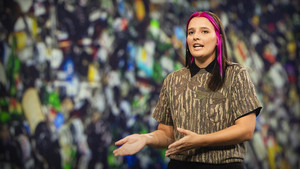
Francisca Troutman calls herself a waste alchemist because that's exactly what she's doing with her glass recycling company, Glass Half Full.
In a talk straight from this year's TEDNEXT conference, she shares how one small idea turned into a large -scale operation that's now helping restore the eroded shores of the Louisiana bayou.
After the talk, stick around to hear my interview with Francisca right off the TED stage.
But first, a quick break to hear from our sponsors.
And now, our Ted Talk of the Day.
As a kid growing up on a Louisiana bayou, the boogeyman was the existential threat of my state being washed away with the Mississippi River.
Louisiana loses a football field's worth of land every 100 minutes due to coastal erosion.
It's an unimaginably large amount to a kid.
But in my lifetime so far, we've lost over 600 square miles.
That's more area than New York City, San Francisco, D .C.
and Atlanta combined.
It's due to sea level rise, warming waters, increasingly severe storms, and exploration of the oil and gas industry.
Fast forward to 2020, in my last full semester as an engineering student and over a two -buck chuck, my boyfriend and I lamented over the lack of glass recycling in Louisiana.
My state was landfilling about 295 million pounds of glass annually.
The bottle we just finished would likely end up in a landfill.
It felt like a total waste.
We wanted to figure out how we could get all of this glass recycled.
The next day, it took a quick Google search to remember that glass comes from sand, and that sand is an increasingly finite resource.
We also learned about everything sand is needed for, including toothpaste, by the way.
And the last puzzle piece we found was this small human -sized machine that could crush one bottle at a time into sand, and we jumped into action, setting up a GoFundMe campaign and a pilot project in the backyard of a fraternity house.
Now, you might be thinking to yourself, how in the world would two college kids ever be able to make a dent in these problems?
And that would be valid.
Plenty of people told us the exact same thing, but we didn't listen, because we knew that no matter how small of an impact we made, it would be worth it.
It felt like we could alleviate two problems with one solution, convert the otherwise landfilled glass back into sand and use it in restoration projects across the state.
Easy, right? But we didn't listen to the haters, which is actually why we named our company Glass Half Full.
But that Glass Half Empty mindset might actually be one of the biggest threats we face today.
Because climate apathy might be the new climate denial, meaning that the biggest threat to our environment may no longer be people who deny our part in the changing climate, but people who deny that we can actually make a difference.
Now, climate change is happening right before our eyes.
It's terrifying. I've witnessed firsthand the severity of rapidly intensifying hurricanes like Ida.
But dread, doom, and gloom tend to get us nowhere, whereas hope combined with action can be one of the most powerful tools to enact change.
Since that late night wine -fueled idea over four years ago, we've been able to divert more than eight million pounds of glass from our landfills.
We quickly grew out of that small, tiny machine and upgraded a lot along the way.
We continued to work with over 50 scientists and engineers across the Gulf South, and they helped me learn if this is good -smelling mud or not.
But also understanding the interactions of our sand with the plants, animals, and even fungi of our region.
We've also answered difficult scientific questions, as well as questions like, can you actually walk on sand made from glass?
And I exposed my toes to the internet to answer that.
In a few short months, we'll be opening up our new facility, enabling us to recycle the 295 million pounds of glass entering our landfills annually.
And with a combination of biodegradable sandbags and native marsh grasses, we've already restored thousands of square meters along our coast, converting open water back into thriving wetlands.
But the key to our success so far isn't that we had all of the answers in the beginning or tons of money to try this thing out.
The key was that we simply started and we kept going.
Somewhere, the belief that we, as individuals, could enact change trumped our doubts.
And for us, finding a way to help with a problem much, much bigger than us meant taking that first step.
And in our case, it was a step in the sand in an eroding, but once magnificent, swamp.
Thank y 'all. And now, I'm so excited to share with you my conversation with Francisca onsite at TED Next 2024 in Atlanta, Georgia.
That was a lot to say that you packed into five minutes, it was very warmly received.
How do you feel now?
I feel like a million bucks.
The audience was so incredibly kind and supportive and welcoming, and I felt like it was all of us.
Like, it wasn't just me speaking.
It was kind of like an audience and me combined experience.
It was really incredible.
It feels like that about your project, too, that it's very community -driven.
Can you talk a little bit about how building community and nurturing that is really involved in the work that you're doing?
Oh, absolutely. I mean, if I had to thank everyone who had been involved in my project, right?
We would have been there all night.
We started Glass Half Full with community in mind and with community backing us from the get, right?
Like I mentioned, that we started with a GoFundMe campaign.
So the very first dollars that we used to start Glass Half Full was money from the community, right?
Like $5, $10 here and there.
Moving on from there, some of the most influential people in how I was able to grow and scale were like my initial advisory board that I formed, right?
From people in the community, some of my old professors, people who had started businesses before in New Orleans.
And so just ingrained in everything we do has been how the community can support and help us and continue to allow us to grow.
Is Louisiana and It's Close the Only Place a project like this?
Is applicable or are there more places that you would love to see Glass Half Full be?
There's definitely more places this could be applicable.
Obviously, we've been focusing on Louisiana wetlands.
But simultaneously, our team has been doing research on beach environments, which we see being able to work in coastal Alabama, coastal Florida.
So we already have research teams and projects in coastal Alabama.
But yeah, it's very different from like the wetlands of Louisiana, the marshes, right?
Like these are beach environments where people would actually walk on the sand.
But it's definitely in our eyes and something that we hope to be able to do.
What do you feel are the biggest challenges or what you need in order to scale?
I mean, this is a really capital intensive business and project.
We need a lot of machinery.
We use people for everything, right?
Like we're going around, we're collecting glass.
It's very physical.
And so for us, it's been being able to access capital, which we were able to do to build this new facility that we're building.
Now, it's what's that next step?
What's that next facility that we need to build?
Where does that need to be?
And how do we continue to grow and scale to collect more glass?
Fantastic. Well, thank you so much.
Thank you. That was Francisca Troutman at TEDnext 2024.
TEDnext is our brand new conference exploring what's next and propelling future you to drive change at every level, from personal to global.
Stay tuned for more talks from this year's event.
If you're curious about TED's curation, find out more at TED .com slash curation guidelines.
And that's it for today.
TED Talks Daily is part of the TED Audio Collective.
This episode was produced and edited by our team.
Martha Estefanos, Oliver Friedman, Brian Green, Autumn Thompson and Alejandra Salazar.
It was mixed by Christopher Faizi Bogan.
Additional support from Emma Tobner and Daniela Ballarezo.
I'm Elise Hugh. I'll be back tomorrow with a fresh idea for your feed.
Thanks for listening.