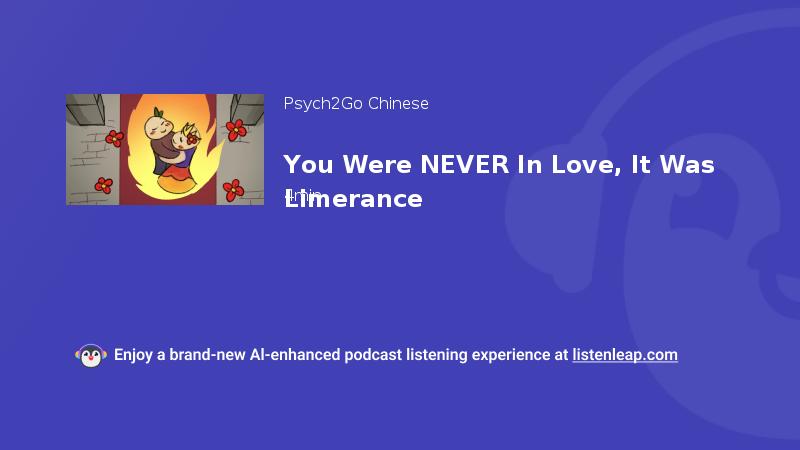
Have you ever been completely obsessed with someone?
You think about them all the time.
Every text from them gives you a rush of excitement.
And when they pull away even slightly, it feels devastating.
At first, it might feel like love, but sometimes what we think is love is actually something else.
Limerence.
Limerence is an intense emotional state where you become deeply infatuated with someone and crave their validation and attention.
It can feel powerful, passionate, and even magical.
But unlike healthy love, limerence is often driven by uncertainty, fantasy and emotional dependency.
So, how can you tell the difference?
Here are four signs you may have never been in love.
It might have just been limerence.
One, you were obsessed with their attention.
One of the biggest signs of limerence is how much your mood depends on the other person's attention.
Did a single text from them instantly brighten your entire day?
Did you constantly check your phone hoping they'd message you back?
And if they didn't respond quickly, did you feel anxious, rejected, or even panicked.
In limerence, your emotional state can become tied to how the other person behaves toward you.
Their approval feels like a reward while their distance feels like punishment.
Healthy love on the other hand, tends to feel more stable.
You may miss your partner when they're not around, but your sense of self doesn't completely depend on their attention.
If their validation felt like something you constantly needed to chase, it may have been limerence rather than love.
Two, you fell in love with the fantasy of them.
Another common sign of limerence is falling in love with the idea of someone rather than who they actually are.
Maybe you imagined a future together very, very early on.
Maybe you filled in the gaps of what you didn't know about them with idealized traits.
Or perhaps you ignored red flags because they didn't fit the story you created in your head.
When you're in limerence, your brain often builds a fantasy version of the person.
You focus heavily on the traits that excite you, while overlooking behaviors that might signal incompatibility.
Love however, grows when you see someone clearly strengths, flaws and all, and still choose to care about them.
If most of the relationship existed more in your imagination than in reality, it may have been limerence.
Three, the relationship felt like an emotional roller coaster.
Did the connection feel incredibly intense but also confusing and unstable?
Limerence often thrives on uncertainty.
When someone is hot and cold, emotionally unavailable or inconsistent, it can actually strengthen the obsession.
Each small moment of affection feels like a huge reward, making you chase those highs even more.
Psychologists sometimes compare this to a reward system in the brain.
Unpredictable reinforcement can make attachment feel even stronger.
But healthy love usually feels calmer and more secure.
While no relationship is perfect, Genuine love tends to involve emotional safety, consistency and mutual effort.
If the connection constantly left you feeling anxious, confused or desperate for reassurance, it might not have been love.
It may have been limerence.
Four, you were more focused on being chosen than on compatibility.
Finally, one of the clearest signs of limerence is that the main goal becomes being chosen by the other person.
Instead of asking yourself questions like, are we actually compatible or do they treat me well?
Your mind might focus more on whether they liked you back.
You might find yourself trying to impress them, win their approval or prove your worth.
When you're in love, the focus is usually mutual.
Both people are learning about each other, growing together and deciding whether the relationship works for both of them.
But in limerence the emotional energy often flows mostly in one direction toward earning the other person's attention.
Experiencing limerence doesn't mean your feelings were not real.
The emotions can feel incredibly powerful and many people go through it at some point in their lives.
But understanding the difference between limerence and love can help you build healthier, more fulfilling relationships in the future.
Because real love isn't about obsession, anxiety or chasing someone's approval.
It's about connection, mutual care and feeling safe enough to be your authentic self.
Did you relate to any of these signs?
Let us know in the comments below.
If you found this video helpful, don't forget to like, share and subscribe to Psych2Go for more videos about psychology and mental health.
And remember the healthiest relationships are the ones where you feel valued, respected and at peace.