NPR. Over the past several months, the American consumer has been on a rollercoaster ride.
Right before President Trump took office, consumer confidence was rising steadily.
Many voters and businesses felt optimistic that Trump would be good for the economy.
But then as Trump rolled out round after round of new tariffs on U .S. trading partners, things they took a turn.
By May, consumer sentiment had plunged to near record lows.
And then just in the past couple of weeks, it turned back up.
Even with this recent boost of consumer confidence, the fact remains that consumers today are feeling way less optimistic about the economy than they were at the start of the year.
And that is having a significant effect on the way consumers consume.
This is The Indicator from Planet Money.
I'm Waylon Wong. And I'm Adrian Ma.
Earlier this month, we did a little survey of our own.
Non -scientific, of course, but we asked listeners, how is this moment in the economy affecting your spending habits?
And you responded. So today on the show, we step off the roller coaster for a second and check in directly with the American consumer.
This message comes from Meta AI.
Meta AI is the personal AI to help you with whatever you need.
Not only is Meta AI now an app, but it's also on the apps you already love.
Facebook, Instagram, WhatsApp, and Messenger, plus the Ray -Ban Metaglasses.
It's easy to access wherever you are throughout the day.
Experience Meta's newest AI that's tailored to you by downloading the Meta AI app.
Try the Meta .ai app today on the Apple App Store and Google Play.
This message comes from Avid Reader Press.
Legendary investor Ray Dalio's new book, How Countries Go Broke, The Big Cycle, explains the mechanics behind big debt crises.
Larry Summers says Dalio's brilliant, iconoclastic approach is an invaluable resource, and Hank Paulson says it provides a solution to what is the biggest and most certain threat to our prosperity.
Read it to understand one of the greatest economic issues of our time.
Available now wherever books are sold.
Americans are big spenders.
Consumer spending makes up two -thirds of our economy.
And per person, we spend more on consumption than almost any other country in the world.
So we wanted to know if the past few months have affected that.
And one big takeaway from the responses we got was that a lot of you are worried.
Lately, I've noticed that I've been way more careful about making big purchases.
This is Nicole Patenza from Morristown, New Jersey.
And I think part of that's me being anxious about the economy and the possibility of a recession.
But then at the same time, I've been spending more on little things like coffee or takeout.
And I guess that's probably me trying to take care of myself when everything feels kind of uncertain.
What Nicole is describing here actually resembles this theory called the lipstick index. The idea is that in times of economic uncertainty, people often spend more on little indulgences.
Meanwhile, over in Orlando, Florida, Holly Boardman is also worried about a downturn.
Holly's in her 70s, and after seeing the stock market gyrations in recent months, she decided to cash in some of her investments.
I'm pretty sure the stock market's going to crash somehow.
somehow, in the next four years.
So I decided that I needed to do some things to invest money elsewhere than in the stock market.
I still have a good bit of money in stocks, but I needed to take profits.
Even more than the stock market, almost everyone who responded to our call out told us they are worried about tariffs.
Now, we know it's been hard to keep track of tariffs because they seem to change every week.
So here's a rough recap of where we are.
There's currently a 10 % tariff on all imports for many countries and a 25 % tariff on many cars and auto parts.
Then you've got a 30 % tariff on Chinese goods and a 50 % tariff on imported steel and aluminum, which also affects home appliances.
Oh, and then don't forget there are these so -called reciprocal tariffs on dozens of other countries that Trump announced in April and then postponed.
pwned. Those could go back into effect on July 9th.
Do you have all that straight, Adrian?
Not at all. But, you know, it is OK if you also didn't quite follow this because the main point is this.
Even though the tariffs have not yet produced the widespread inflation a lot of economists feared, all this tariff talk is affecting consumer behavior.
And a lot of people are making big purchases to try and get ahead of price increases.
People like Juan Castillo.
Juan is a high school teacher in Laredo, Texas.
Recently, he was looking to buy a car, a process he says he would normally spend a couple months on, you know, shopping for deals.
But back in March, all the tariff talk from President Trump made him nervous.
You know, you hear stories that they're going to raise the cars $2 ,000 or $3 ,000 extra, and we don't want to pay $2 ,000 or $3 ,000 extra.
So what do we do? We make a quick decision.
Juan and his family rushed to the Toyota dealership in San Antonio.
The place was packed and a lot of people are there because they were buying cars before tariffs were raised.
Funny thing, the dealership, it showed two prices, the tariff price and the sticker price.
And this is the price you're going to pay next week if you wait.
So it's like, all right, we fell for the trap.
Well played, car dealership.
But Juan, don't feel too bad because you're actually in good company.
A lot of listeners told us a similar story.
We used our emergency fund to buy a new car, which is breaking all of the personal finance rules I've ever believed in.
I bought a new car to replace my two old Camrys.
In years, we decided to buy a new car because it made more sense financially, and I hate that car payment.
Okay, I'm now feeling peer pressured, like I need to run out and buy a new car.
Let's put a pin in that, though.
Seems like everybody's doing it.
Even though these car buyers are gritting their teeth, they might turn out to be the lucky ones.
Industry analysts say price hikes could hit in the next couple of months as dealers sell down their inventory of pre -tariff cars.
And cars are not the only thing listeners told us they're rushing to buy.
Many of you are scooping up electronics and appliances.
It's called panic buying, but I'm not panicking, you know?
Jonathan Friedman from Laughlin, Nevada, not panicking yet.
Portable air conditioner for my room because it gets so hot out here.
I got that. Got a couple electronic stuff.
We think we have to buy the iPhone soon.
On top of these big ticket items, Jonathan, he is also stocking up on smaller ticket things.
We're just buying all kinds of stuff.
Fruit and whatever clothing the girls want at Walmart.
You know, we're spending $200 at Walmart every trip just to get stuff.
Mostly fruit. Fruit, because a lot of that stuff is imported.
Bananas, mangoes. Mandarins, oranges, kiwis, and just any fruit that kids want most. Jonathan actually sent us a picture of all the fruit, like, stacking up in his kitchen.
And he is not the only one stocking up on imported consumables.
One person told us they bought a 12 -pound bag of coffee.
Okay, easy there. I hope they were, like, parceling that out over the summer.
Another said they bought half a dozen bottles of French cognac.
Okay, party at their house.
And similar to fancy French booze, our final listener testimony may be more an example of a nice -to -have purchase than a necessity.
It comes from Phil Lazarus of Lincolnshire, Illinois.
Illinois and Phil plays guitar and sings in a dad rock band.
That is a rock band made up of dads, not to be mistaken for the genre dad rock.
Oh, look who's a music critic all of a sudden.
Just call me Lester Bangs, Adrian.
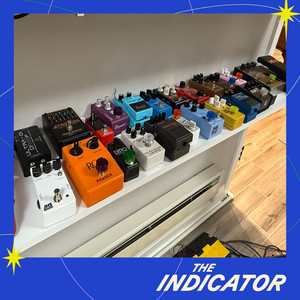
Yes. And maybe even more than playing music, Phil loves buying music gear.
On Reddit, they talk about being afflicted with GAS, G -A -S, Gear Acquisition Syndrome.
And I'm definitely a victim because the fact of the matter is it's much easier to buy guitars than it is to play them.
Now, Phil says he's been trying to cut down on his gas problem.
I made a New Year's resolution.
No more gear in 2025.
But then he thought about how a lot of music equipment is either manufactured overseas or assembled in the U .S. from imported components.
And I kind of saw the writing on the wall and I said, well, you know, New Year's resolutions are made to be broken.
The last three months I've bought three guitars, two amps, and 18 pedals.
The punchline is that I've bought more gear in the last three months than I had in the last three years.
This story is amazing and I feel like highly relatable.
From appliances to guitar pedals to produce.
This is just a snapshot of how consumers are changing their spending habits in this roller coaster economy of ours.
Thanks to everyone who sent in a story.
And even if we didn't get to feature it in the show, it really helped us understand what's going on out there.
So we really appreciate it.
And if you have a tariff related story to tell, please send us an email.
Indicator at NPR dot org.
This episode was produced by Cooper Katz -McKim and Ella Feldman.
It was engineered by Jimmy Keeley and fact -checked by Sierra Juarez.
Kaken Cannon is our editor and The Indicator's production of NPR.
This message comes from Capella University.
At Capella, you'll learn relevant in -demand skills you can apply in the workplace right away.
A different future is closer than you think with Capella University.
Learn more at capella .edu.
This message comes from BetterHelp.
June is Men's Mental Health Month, and every year, 6 million men in the U .S. suffer from depression.
If you're feeling overwhelmed, BetterHelp can make asking for help easy.
Visit BetterHelp .com slash NPR today.