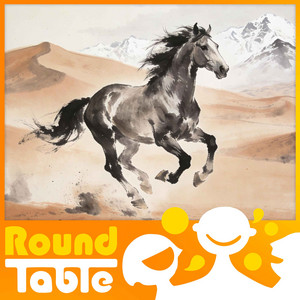
Are you familiar with the story of Emperor Wu of Han?
Well, if not, he had heard about some special heavenly horses that he thought could help him win a battle.
For our special Spring Festival episodes, we have prepared some special drama shows for you.
And Emperor Wu is our story today.
Coming to you from our studios in Beijing, this is Roundtable.
Thank you so much for sharing your time with us today.
I'm Steve, and for today's show, I'm with Yushan and Yuxin.
First up.
To all celebrating the Spring Festival, a time of renewal and hope.
Roundtable brings you a tale from the heart of China's Golden Age.
Over 2,000 years ago, the Han Dynasty was a realm of immense power and culture.
But to its north lay a constant threat, the nomadic confederation led by Xiong Mu.
Brilliant and brutal horsemen paraded the borders.
The Han needed strength, a symbol. a miracle to secure an upper hand.
This is the story of that miracle, the story of the heavenly horses.
In his vast court in Chang'an, the Emperor Wu of Han, a man of towering ambition, looked over his maps.
His heart was heavy with a single persistent problem.
My scouts bring the same report week after week.
The Xiongnu strike our villages and vanish back into the steppes.
Our cavalry pursues, but their horses, their horses are like the wind itself.
We're a giant swatting at gnats.
It's undignified.
Zhang Qian, step forward.
You've traveled further than any man.
Tell me, have you seen horses that can match the Xiongnu?
Your Majesty, beyond Yumen Pass and the Taklamakan, in Fergana, they breed a horse unlike any other.
Tell me more.
They are towering creatures, with necks arched like bows and muscles that ripple like flowing water.
They are born and raised in the high mountains, giving them boundless wind and strength.
And they are so fierce, so full of fiery spirit, that it is said they sweat blood.
As the court stood in stunned silence, upon hearing of the heavenly horses, the imperial astrologer stepped forward, calm and deliberate, to present her observations to the emperor.
The sweat of blood.
It is a powerful omen, your majesty.
My readings of the five stars rising in the east indicates good fortune for the Hun to win.
It is a sign.
These are not mere animals.
They are Tian Ma, heavenly horses.
A gift from the cosmos to the rightful son of heaven.
Heavenly horses, gift from the heavens to secure our destiny.
With such steeds beneath our riders, our enemies would not just be gnats, they would be dust.
Captain chen yes, your majesty, you will lead an envoy.
Take a hundred of our best guards, take chests of gold and a golden horse statue.
Go to Fergana.
Offer the king these tokens of our respect and bring me back the heavenly horses.
Seasons turned.
Hope in the court began to wane.
Until one day, the gates of the palace opened to a heartbreaking sight.
Captain...
Chen?
Is that you?
You're alone.
Where is the envoy?
Where are my horses?
Your Majesty, forgive me.
We...we failed.
The journey was a hell of sand and sun.
We lost half of our men just reaching for Ghana.
The city was a jewel, it's true.
The king.
He received us but he refused us.
He said you offer me pretty gifts for the very soul of my kingdom, for the children of the mountain gods.
You insult me, he.
He had our chief diplomat dragged away and executed as a lesson.
He said tell your emperor that the heavenly horses of fergana are not for sale.
He laughed.
He killed my ambassador.
He spits in the face of the Han.
He will learn that the son of heaven does not make requests.
He makes decrees.
General Li Guangli.
I am here, your majesty.
You will take 10,000 men and take 30,000 more to serve them.
You will cross those deserts and you will cross those mountains.
Be siege for Ghana and break it.
Do not return to Chang'an until those heavenly horses are mine.
Do you understand me, General?
You return with those horses or you do not return at all.
And so General Li's army marched west, faced the Sea of Death, the Taklamakan Desert, a vast ocean of shifting sands that swallowed men and spirits whole.
Veteran Wong, a seasoned soldier of the Han Army, hardened countless battles, surveyed the troops with practiced eye.
As he took in their condition, a quiet worry grew within him.
Just how many of these men would endure the long march to Fergana?
General, another 20 men fell behind today.
We left them in the dunes.
The vultures are our only scouts now.
The horse master Kai says the mountains are closed.
There will be streams, grass, or the horses.
General Li.
As General Li approached to investigate the army's slowing pace, Captain Chen and Veteran Wang straightened at once and offered her a crisp military salute.
Her voice, roughened by dust and exhaustion, yet still unmistakably commanding, rang out.
As she said, The Emperor's will is our stream.
His command is our sustenance.
We press on, Captain.
There is no alternative.
When they finally escaped the desert, the roof of the world, the Pamir Mountains, awaited them.
The cold.
It's a different kind of killer.
Steal the warmth from your bones while you still breathe.
General, we have less than half our men.
The rest are ghosts in the sand or ice.
Then we are an army of ghosts.
And we will hunt the king of Fergana until he yields.
We have come too far to falter now.
On your feet, soldiers of Han!
For your emperor!
For your brothers and sisters who feel!
Press on!
It was the year of 104 BCE.
The Han army marched west toward Fergana.
Their spirits were high, but the road was unforgiving.
The journey spanned deserts, mountains, and hostile lands.
Smaller kingdoms along the way barred their gates and offered no aid.
And by the time the Han forces reached for Ghana, only a few thousand remained hungry exhausted, but still determined.
Their first attempt to take the city failed.
With supplies dwindling and her soldiers worn to the bone, General Li Guangli had no choice but to withdraw.
She petitioned the Emperor to abandon the campaign altogether.
But Emperor Wu of Han believed otherwise.
To mobilize such a force and return without victory would damage the Han's reputation across the western regions.
The neighboring kingdoms would turn to the Xiongnu and the balance of power would tilt sharply against the Han.
So, the Emperor commanded a second expedition, 60,000 riders strong.
This time, they did not falter.
This time, General Li Guangli once again led her forces back across the unforgiving world.
And at last, They reached the walls of Fergana once more.
King of Fergana, honor the promise made to the Han.
Offer the heavenly horses and peace will stand between our nations.
Your plea sounds like command, General.
Fergana vows to no outsider, least of all the Han.
Inside the Fergana court, Hurry discussions, urgent pleas, and anxious murmurs filled the hall.
The kingdom's noblemen pressed the king relentlessly, urging him to answer the Han army's demands and spare their land and their people from the coming devastation.
Your Majesty, the Han endure where others would have fallen.
Their presence is not weakness, it's resolve.
Resolve?
A desperate army clawing at our gates is no threat to Fergana's throne.
No throne stands on pride alone.
We beg you, end this before the kingdom pays for your arrogance.
You fear them?
Look at you, trembling like weeds.
I will not yield because fear shakes your knees.
Oh, this is not fear.
This is an ultimatum, and we demand action.
Action?
Then act!
But know this.
Fergana does not yield while I draw breath.
Then it seems the kingdom and its king stand on different sides of the same gate.
Furthermore, for the sake of peace, this is the path we must take, and it is the only way forward.
Let history record this not as rebellion, but as preservation.
Pagana must survive its crown.
Open the gates before more lives are weighed against one man's pride.
As dawn slipped over the mountains, Fergana presented its decision and its horses to the waiting Hun.
No battle was fought, yet a kingdom was changed forever.
Your decision avoids a river of blood.
The Hun accepts this gesture in the name of peace.
Fergana seeks not humiliation, but survival.
Let diplomacy pave the road our former pride refused to walk.
Horsemaster, step forward.
Present to the Han army what they had come for.
General Li.
This.
This is the one.
It burns with the fire of the evening sky.
He's the king of the herd.
The heart of the heavenly horses.
Such a cost.
So many lives for this one moment.
He is more than I imagined.
He's not just a horse.
He is a promise.
A promise of a secure border.
A promise of peace for our children.
The return of General Li Guangli was a legend in the making.
She brought back the ultimate prize, the symbol of Heaven's favor.
General, you've done it.
You've brought Heaven's favor to the Middle Kingdom.
You have given us the future.
The cost was high, Your Majesty.
The desert and the mountains hold the spirits of thousands of brave Han soldiers.
But their sacrifice was not in vain.
With these horses, the future of the Han is secure.
Our children will know a world of strength and of peace.
And so, the heavenly horses became more than just a symbol of power.
They were a testament to the rise of the Han, a force in Central Asia that stood shoulder to shoulder with, and in some ways surpassed even, the Xiongnu.
The legend of the blood-sweating heavenly horse endured across the centuries.
It became immortalized in poetry and captured in paintings, celebrated as a symbol of strength and grace.
More than just a figure of the past.
It has come to represent the enduring bond of friendship between China and Central Asia, a bond that continues to thrive today.
As we gather with loved ones during this spring festival and as we welcome the hopeful year of the horse, we remember this tale, a tale of triumph sacrifice, connections that have endured through time.
In the year of the horse, we honor this legacy and look toward a future of continued unity and collaboration.
That was the first installment of our three drama series for Spring Festival you just listened to.
And the title that we went with was The Quest for the Heavenly Horse.
Yeah.
Did you enjoy it?
It's such a production.
I've listened to it before, but now, as I go through it again, I just feel like I am both in the story and in the studio as I recorded it.
You guys remember it?
Like how it felt?
Yeah, of course.
I feel like we should apologize to Yushun, though.
Yeah, and as the... script writer or part of the script writer, I kind of altered your fate.
From remaining to be the king who forgives and understands to someone whose arrogance led to his own end of life.
What do you read into that?
Since we are here, thank you for bringing that up.
Well, we should say if you noticed during the drama, Yushan had one, two lines and then died.
And that was Yushan's doing.
Partially, but yes.
And it's kind of me trying to bring that part of the story back in life.
And, of course Yuzhen, I got to give you the credit for really acting it out like the blood choking part.
Yeah, you died very well.
I really like that.
This story, Emperor Wu's story of sending out troops to hopefully bring back some horses that can help him achieve the goals that he has.
Is that a story that's familiar to you and to most Chinese people?
Is that a story that you're familiar with from when you're a kid?
Or is that kind of a new one?
It is absolutely a very well-known story.
And the horse that is mentioned in this story is very, very famous.
And in Chinese, it's called 汉雪宝马. blood-sweating horses so and but mostly they are in some also they appeared in other stories and we there are some other adaptations of this story ancient stories even games surrounding these kind of things and we always want to or kind of we know that it is one of the kind and the best type of horses and we whenever we're playing the game about this, we're trying to get that kind of blood-sweating horses.
My favorite line from Yushan was when I called.
I played Emperor Wu, if you didn't recognize that, and I called for Yushan, my general, to go back to Fergana.
And when I called for you, you said, Yes, General!
No, I said, yes, your majesty.
Yes, your majesty, right.
That was my favorite part.
And when we were recording that, I think you were standing next to me in the recording studio and I kind of jumped.
I was taking it back a little bit.
You are very, very good at this type of thing.
I remember going back home with a hoarse voice that day.
It was the outcome of being too much sinking into the role of General Lee.
And I'm really happy that you kind of switched the gender here, because historically these roles should all be male.
But we recharacterized a lot of the roles the astrologer and also the captain and the general to female characters.
And we see... the girl's doing a good job, too, and I'm really proud to be part of this as well.
Yeah, 100%.
Yeah, when we were going over the story the first time and how we wanted to present it, that's something that I wanted to do.
It's 2026.
Why not?
We don't need to stick to those...
Those gender roles from the past.
I want to say this too you know for me the reason I asked you if you were familiar with this story.
Obviously, this is a story that I'm not familiar with.
So being able to be a part of it and learn a little bit about.
One of the famous stories from Chinese history was really cool for me, too.
Again, that was the first of three dramas that we have for you during this spring festival holiday, and tune in tomorrow and the next day to hear the other two.
Now we have a little bit of a quiz where I feel I will be at a slight disadvantage, if not major disadvantage, because the quiz is fact or fiction.
Yes, tell us what we're going to do here, Yushan.
Yeah.
So I personally prepared five questions for both of you and it's going to be Is it fact or is it real, like just dramatic translation of the history, kind of questions for you guys to step up and say yes, that's real history or no, that's just drama.
Meaning it's based on the drama that we just heard.
Yes.
And, based on the story, that we just heard things that happened in the story.
Is that actually a fact that it happened, or did we fictionalize that for the purposes of our drama?
True, and as the dramaturg and the fact checker of the story, I think I'm going to just quickly start with the first one, if you two are ready.
Yeah, the reason I said I feel like I'm at a disadvantage is because of what we just talked about.
Yushin said, it's me versus Yushin here.
Yushin said, yes, this is a story that I've been familiar with since I was a child.
And for me, this is a story that I've been familiar with for about 14 days.
Not bad.
To be honest, it is a fair game because that is the only information that I know.
Oh, okay.
Good, good, good.
All right.
So here we go.
Question number one.
Question number one.
So we heard Feifei, the imperial astrologer, step forward and declares the five stars rise in the east.
Feifei did a great job with her character, too.
She did.
It's a powerful omen, your majesty.
Heaven favors the Han.
Mm-hmm.
Did we make that up?
Or was the five stars rising in the East actually a real Han Dynasty saying linked to good fortune?
So my first thought would be at that time in history, would the court have an astrologer to help make real, serious decisions?
My guess would be, Yes.
Now, whether this five star thing is true or not, I have no idea.
But because I'm assuming that the court would have an astrologer as kind of an advisor, I'm going to say yes, this is fact.
I think I will go with you.
I think it is also a fact because observing the stars has always been a thing for centuries.
So, yeah.
And like that.
There are different constellations and different ways or patterns.
They're forming up different understandings.
So I think it is true.
I find it comforting that you agree with that.
And the answer would be congratulations.
That is correct.
One point for both of us.
Yeah.
And yes, five stars rise in the east, benefiting China was a real saying back in the Han Dynasty.
And it actually came from astrologic auspice about China.
How Five Planets Rising in the Eastern Sky, Signaling Good Fortune for the Middle Kingdom and referring to China back then,
And actually that appeared from an unearthed real, existing historical fabric that was found in Hetian in northwest China's Xinjiang Uyghur Autonomous Region.
And I was so privileged to have visited Xinjiang sometime last year and I was in the museum and I saw that piece of fabric that has the eight characters Wu Xing, Chu Dong Fang, Li Zhong Guo, literally meaning five stars rising to the east benefiting China, woven to the fabric.
That's amazing.
Yeah, that's not only a symbol of how Han Dynasty...
Fortune telling, if you want to put it that way actually got to the western part of the western region, but also a fact that trade and commerce and, if not, cultural and language existing, already existed.
All the way back in the Han Dynasty, between Han and the Western regions.
Little did you know you were actually doing research for the next Spring Festival drama that we would do.
Yeah, I had no clue back then.
But they actually made a dance drama out of Wu Xing, Chu Dong Fang the five stars out on the eastern sky.
One point for each of us.
Question number two.
Question number two.
So your role, Steve?
The Emperor Wu of Han.
He sent his first envoy to the West and he orders take chests of goat and a golden horse statue as tokens of respect.
So is that true history or cinematic exaggeration?
It sounds like, uh, fictional because, uh, For no reasons, to be honest.
I'm just guessing.
Yeah, I know.
Why not coins or money or why gold, right?
It's so heavy.
Yeah, because, I mean, you would send something, right?
You wouldn't send them empty-handed.
What would you think they would send if it weren't that?
Food.
Since in a time of war, you know, food is a very, very important supply.
And people treat food as a very moon cakes.
You're thinking no basically, just some uh staple food that is uh important for soldiers to eat.
I think yeah, i'm gonna say no to food because of the trek.
It was very, very long and difficult to get across the deserts and the mountains, So that food would well.
I was going to say it might spoil, but still.
Yeah, I'm going to say it would have been like gold or some sort of valuable spices at the time.
A goat?
You said a goat?
No, I said gold.
Oh, gold.
Golden horse statue.
That sounds about right.
What are you saying, true or false?
False.
False.
Hmm.
True.
Awesome.
One point to Steve.
I do it.
Because, according to the widely believed version of what Emperor Wu Laofan actually sent, that was at least several chests of gold as a token, and also
This is the part.
I'm not sure if it's real history or it's just legend.
Has it that they actually made a golden horse?
So a horse in exchange for horse.
Oh, a golden one in exchange for real ones.
Golden, golden horse statue.
Two to one.
Question number three.
Now let's talk logistics.
So did Han troops and the envoys actually crossed the Taklamakan Desert and then pushed through the snow-covered mountains on their way to Fergana.
Or was it just us trying to level up the difficulty for the dramatic effect?
A geography question.
What stands between here and there?
Well, there is a desert for sure.
So that's 50% of it.
Are there mountains?
If you pass from Beijing and keep going west to the far western borders of China, you would find the autonomous Uyghur region.
Yes.
Beyond that, you would indeed find a mountain range.
The answer is yes.
I also think it is true.
One point for both of you.
No explanation.
I gave you a full detailed version.
Yeah, you explained it very well.
Next time, Yushun goes first.
So yes, they did go at the elder premiere of the Taklamakan Desert, actually not directly through it.
And, yes, on the snow-covered mountains, too, because we actually have that in Xinjiang.
Oh, see, I was a little bit wrong then because I said beyond that.
All right, very quickly, final question.
This one is for two points, so whoever gets this wins.
So in our story, Fergana's noblemen turned on their king which is a role Yushan played to sue for peace.
So did that really happen in history, or did your character die for the effect?
I will say it is just the dramatic fiction that we created for making the drama a little bit more interesting.
So you sacrificed yourself.
That's very noble of you.
For no reason whatsoever.
Yeah yeah, you were blaming yushan before.
You should have blamed yourself.
What about you, steve?
I will say that was also dramatized.
I will say uh, false.
Actually, that would be no point for both of you because, according to the widely believed version of the history, they actually turn against the king in order for a peaceful resolution in facing the han army because, For Ghana people, they were led by a court and those noblemen who made up the court wanted nothing else but protecting their own kingdom.
And there you have it.
And that's the conclusion of our first drama, The Quest for the Heavenly Horse.
We certainly hope that you enjoyed that.
We had fun making it.
And again, we have two more for you in the next couple of episodes of Roundtable, so make sure you join us for that as well.