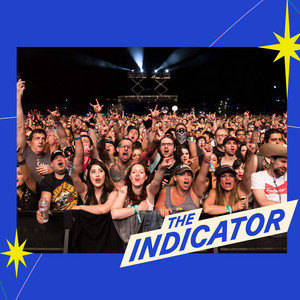
Is 2024 the year the music festival died?
Sierra Nevada World Music Festival in Northern California.
Kickoff Jam, a country music festival in Florida.
Blue Ridge Rock Festival in Virginia.
The list of recent cancellations just goes on and on.
Even big -name festivals that used to sell out in minutes struggled to sell tickets this year.
Burning Man fell to sell out for the first time in over a decade.
Coachella, the most attended annual music festival in North America, saw a decline of around 15 percent in ticket sales.
And it's not just America.
By one count, over 60 music festivals were cancelled in the UK this year alone.
In Australia, so many festivals were cancelled that one newspaper there recently asked, Are the nation's music festivals extinct?
This is the indicator for Planet Money.
I'm Greg Rizalski. And I'm Waylon Wong.
Today on the show, the music festival recession.
What's behind it? And is it temporary or a permanent cultural shift?
Wait, wait, don't tell me.
Fresh Air. Up first.
NPR News now. Planet Money.
Ted Radio Hour. Through Line.
The NPR Politics Podcast.
Code Switch. Embedded Books We Love Wild Card.
Are just some of the podcasts you can enjoy sponsor free with NPR+.
Get all sorts of perks across more than 20 podcasts with the bundle option.
Learn more at plus dot NPR dot org.
Read about the impact of women in music with NPR's new book, How Women Made Music, a revolutionary history from NPR Music.
This stunning anthology offers original writing and illustrations, interviews and photos.
And the audio book includes 52 years worth of interview excerpts with more than 60 legendary artists.
Visit NPR dot org slash How Women Made Music to order now.
Hey there, this is Felix Contreras, one of the co -hosts of Alt Latino.
The podcast for NPR Music, where we discuss Latinx culture, music and heritage with the artists that created.
Listen now to the Alt Latino podcast from NPR.
Phil Peroni is a longtime musician who plays in a psychedelic rock band called Juju.
He grew up going to music and art festivals, like Lightning in a Bottle and Burning Man, places where you camp in makeshift communities and immersed in art, culture and music.
There was something there that really inspired me, and I wanted to make a rock festival like that.
And so in 2012, when Phil was in his late 20s, he and his friends jumped at the chance to start a new music festival in the desert in Southern California.
They called it Desert Days.
We started the festival DIY with our family and friends.
You know, the first year we just kind of bootstrapped it.
Desert Days was part of this huge wave of new music festivals being created and expanded in the 2010s.
And like the broader festival market, Desert Days just got bigger and bigger, and they began attracting some big name acts.
We're talking like Tame Impala, Iggy Pop, Flaming Lips.
One year they even had Wu -Tang Clan playing their entire classic album Enter the 36 Chambers.
Desert Days Festival also really upped their game with their venue.
In 2018, Phil moved Desert Days to this sort of paradise for a music festival, the Lake Paris State Recreation Area in Southern California.
It's just so beautiful and vast and there's no sense of the outside world at all.
See the lake, the lake is huge, and you can swim in it.
And there's this beautiful sandy beach and grass lawns and mountains in every direction, and it really does feel like you're transported somewhere magical.
Obviously, the pandemic was hard on festivals.
That said, in 2022, consumers were flush with cash and pent up demand for social activities helped many festivals, including Desert Days, come roaring back.
Attendance was maybe better than ever.
But then in 2023, there began to be the rumblings of trouble.
I think it's because everything costs more, you know?
And as a touring artist, I understand this firsthand.
It's very hard to make ends meet on the road, you know?
The band's gas bill is double.
Their hotel bill is double.
Their personnel bill is double, you know?
Desert Days was scheduled to take place at Lake Paris this coming weekend.
It's an incredible lineup.
You had Jack White, you had Cigarettes After Sex, you had De La Soul, you had Danny Brown, Fleet Foxes.
I could keep going.
We were very proud of it.
But despite this incredible location and lineup, Desert Days pretty quickly discovered that something was really off in the festival market this year.
To be completely honest, a lot of festivals are struggling to move tickets.
And we experienced that right out the gate.
We're like, oh, okay, huh, what are we going to do?
Facing softer demand, Desert Days turned to the sort of classic economic playbook.
They lowered prices to try and convince more people to buy tickets.
It didn't go so smoothly.
In hindsight, if I could redo it, I probably wouldn't have done some of those things, like roll out discounts after the fact, which I think made some of the early buyers upset, and rightfully so.
We just wanted to make it more accessible to more people.
Ticket sales, however, remained disappointing, even with discounts.
The writing was on the wall.
It just didn't look like enough sales were going to be there.
So we made the hard decision to cancel.
Inflation hasn't just made it harder to book artists and put on a music festival due to cost of living increases and higher interest rates.
Many of the usual festival goers seem to be tightening their belts.
We're seeing similar downturns in other leisure and travel sectors.
But music festivals, especially smaller, independent ones, seem to be getting hit harder.
That said, there are some big name festivals and concerts that have actually been doing pretty well this year.
For example, the legendary Glastonbury Festival in the UK, that sold out pretty quickly.
It's the race to the top.
So in other words, it's become more of a winner -take -all market in this era of belt tightening.
120%. That's Will Page.
Will is the former chief economist of Spotify and the author of a book called Tarzan Economics, which delves deep into the music industry.
He believes that music streaming services like Spotify and Apple Music, with all their algorithmic recommendations, have stunted our discovery of new music.
All data comes from the past.
So if I know Greg likes Pearl Jam and Seattle Rock bands, I, the algorithm, will play Pearl Jam and Seattle Rock bands to Greg.
I do actually like Pearl Jam and Seattle Rock bands, but I don't know.
Maybe that's no surprise.
Anyways, historically, radio stations, MTV, and, you know, music magazines and blogs may have exposed music listeners to a wider, more diverse range of new music.
The algorithms of Spotify and Apple Music, though, Will argues, that could be changing that.
So if I look at a multi -genre festival poster, and I see all these different bands of all these different styles, my gut reaction is, that's a playlist that's been created for somebody else.
Therefore, I choose not to go.
But perhaps the most compelling argument that Will makes for the festival downturn is this.
Gen Z may have less enthusiasm for festivals than generations past.
Yeah, during the festival boom last decade, a leading explanation was that millennials preferred spending on experiences rather than things.
They liked going places, they liked socializing, they liked drinking booze and doing drugs.
They liked hooking up.
Who among us? Who among us, Greg?
Mom, if you're listening, that was not me.
You're like, I stayed home and I read books all day.
I was preparing for my career as a podcast host.
Anyway, research suggests that actually, though, Gen Z may be different.
It finds that they drink less alcohol.
Overall, they do fewer drugs.
They have less sex and fewer partners, and they're lonelier.
Will believes this generational change is reducing demand for music festivals.
And he points out it's not just smartphones and social media.
I do think there's something to this particular cohort where the winds of the lockdown, the pandemic, have yet to heal.
A bunch of kids missed out on bonding with peers during freshman year or other formative social outings.
And remember, going to a festival is an intensely social activity.
Will points to a survey in the UK, which looked at why so many young people were not going to festivals.
And one of the most popular responses we got from their audience was, I didn't think I had a friend I could go with.
Ouch! Ugh, that is brutal.
Meanwhile, many older millennials, that's me!
We're not going to festivals like we used to.
We've got little kids and work obligations.
We're just tired. My knees hurt all the time.
I can't be standing up.
All of these changes are forcing festival promoters like Phil Peroni to go back to the drawing board.
You know, I think the market has changed.
I think the festival landscape, also the economy, the culture, all festivals, goes where all festivals need to open our doors to the next generation.
And we probably need to pay attention to what, you know, would appeal to them.
This episode was produced by Angel Corradas with engineering by Gilly Moon.
It was fact -checked by Sierra Juarez.
Kicking Cannon edits the show and The Indicators, a production of NPR.
From poll numbers to talking points to all the drama, we get it.
Election season can be a lot.
That's why here at NPR's Pop Culture Happy Hour podcast, we're in the business of providing a little release from the squeeze of the political season.
Try out any of our shows on the latest in TV, movies, and music to keep you grounded and bring you back to Earth.
New episodes every week on Pop Culture Happy Hour, only from NPR.
Jim Ewing had to get his foot amputated after a climbing accident.
Thanks to a new procedure, his prosthetic feels like it's his real foot.
Your brain recognizes this piece of equipment as being part of you.
It just adopts it and starts using it as if it belongs there.
How technology is augmenting humans.
That's on the Ted Radio Hour podcast from NPR.
Do you feel like there's more on your to -do list than you can accomplish?
Or maybe the world's problems feel extra heavy these days.
We can't eliminate stress, but we can manage it.
It's almost like I have a new operating system now.
Like I tend to live more in this light.
Stressless, a quest to reclaim your calm.
A new series from NPR's Life Kit.