Welcome back to Chinese Folk Tales, everyone.
I'm He Yang.
So, you've made it through six episodes of six amazing stories from Xinjiang.
Today's episode is going to be a little different, but trust me, you'll love it.
You know, for me, these ancient tales are not just timeless, but are literally invincible.
They survived throughout the ages, And in the modern time, even TikTok algorithms.
How wild is that?
What keeps them pulling at our heartstrings generation after generation?
What's the secret sauce, that magic, that makes them stand up even against something like Marvel?
To help us dig into all this.
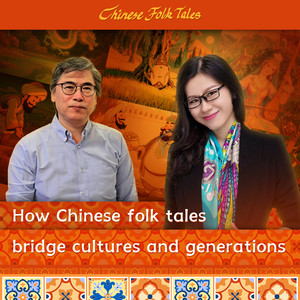
I'm absolutely thrilled to bring on Professor Zhang Juwen from Willamette University.
He has an MA and a PhD in Folklore and Folklife from the University of Pennsylvania.
Professor Zhang is not just an expert, but also acts as a real-life bridge between Chinese stories and listeners all over the world.
Professor Zhang, welcome!
Thank you.
Thank you for having me.
Professor Jung, every folklorist has an origin story.
Were you the kind of kid who loved stories or did this love for folktales came later?
I grew up in the 1960s.
As those days, there were no TV, Internet and so on.
So the best storytelling event was through folktales or picture books for those days, their early education.
And then in college in the early 80s, I began to notice the similarities between Chinese mythology or tales with the European, the Greek mythology.
So that, I think, led me to serious studies and eventually became a folklorist.
Well, by now it's 40 years ago.
That's very interesting.
And also it's fascinating to think that a childhood pastime of reading those comic books.
Well, they're like the Chinese version of comic books of the particular time period.
And that sort of opened doors for you in your mind for actually a long time path of storytelling and also cultural study.
That is quite the story.
And now here's a fun one.
If you could step into any chinese folklore tale as a character, who would you rather be?
Would you go for the full Monkey King Sun Wukong clever, powerful and delightfully disruptive.
Or maybe FNT, the witty wanderer from Xinjiang?
We actually shared one of his stories in a recent podcast episode.
Or it'd be somebody completely unexpected you see yourself in.
Well, actually...
If I were to play a role or to be one of the role, I think I might be Nezha, type of person that is born to be different rebellious exploratory, but deep in heart with humanity or humanism.
And especially in my past 30 years living and working in the United States, I think I'm being different by all means.
In China, I'm treated not really as an insider.
And here, the same thing.
So I'm between.
I'm different.
I'm rebellious.
I think I'm a nerja type of person.
Yeah, that's really interesting.
And also you jumping back and forth or among these two cultures.
That shows a certain aspect of you, I think, being very courageous in trying something new and imbue in a different culture and also working in it, working through it.
I think that says something about character.
And maybe that is echoed in the character that you picked as Nezha.
But also Professor for us in China.
We've maybe watched different versions of the Nezha story animation comics, and it shows up in different types of entertainment form.
And there are different parts of the story that the story creators tend to want to put on display.
And with the Nezha sequel, which you know is very strongly echoed by so many audiences in China and around the world.
It shows that aspect of Nezha.
But there's also the very dark, like the part when Nezha wants to repay his dad with the very ominous and drastic, in a drastic manner.
And that part wasn't really shown in the movie that's really popular right now.
So I wonder how you think about these different parts of one character that different storytellers decide to use and utilize at different moments in history.
Well, this is a fascinating question because we know traditional tales have many variations.
And it is this change, variation, that gives vitality to this tale.
In other words, if a tale has no change over time, that's a dead tale, okay?
There's no life in it.
So, simply because the tale can be adapted to different environments, different generations and bring new meaning, therefore they are constantly retold.
Of course, Folklore, folk tales, folk culture is a really double-blade sword.
In other words, people can use it for different ideological purposes, different educational purposes, entertainment purposes, and so on and so forth.
But in general these tales, as I said, the vitality is that they contain the essence of the culture.
That is, for example, in this case, the Chinese ethical relations, parents and children friendship community, and so on.
So, regardless of the variations for different purposes, the minor change we call the minor change, but the essence of the tale remains.
That is supporting the good cause.
And that, I think, is the reason these tales are retold again and again.
Yeah, so now let's talk about today.
We're living in an age where TikTok clips come faster than thoughts.
Netflix drops shows weekly.
And video games, $224 billion U.S. dollar industry, bigger than movies and music combined.
What is it about these old stories still cuts through all the noise?
Well, despite the political, economic aspect, which are meaningful as well, I think that retelling these tales or by viewing these tales listening, talking about these tales, it reveals the essence of storytelling, or tradition.
That is, through these tales, People get together face-to-face.
So it is the face-to-face communication that brings people together.
One aspect of this phenomenon as you mentioned Nezha, the scenes of the animation was not imagined.
It was based on the real site, natural geographical sites.
And, as a result, we know that many viewers players, including Black Myth Wukong either one.
They bring players, viewers together to talk about it.
And through this they share something common and build a new community and to continue that tradition.
So I think first, the process of communication face-to-face is essential because modern people, no matter how modern we are, we still need face-to-face communication, because that's the essence of a personal identity.
So the other aspect, I think, is the content of tale.
As we just mentioned, traditional tales contains the fundamental beliefs and the values in the culture.
Those, in Chinese case, are largely ethical.
And that is the beauty of Chinese culture, that people live Not just thinking about themselves.
They think about their friends, their parents, their community, their society in large.
So those things eventually shows that human needs face-to-face communication to make a life meaningful.
That really strikes a chord with me.
I think for anybody who's been following the news would have, especially gamers out there.
They would have all heard of Black Myth Wukong.
And it was really great seeing international gamers drawn to the origin story of where Wukong came from, which is the journey to the West, that big, fat book among the four classics from ancient times in China.
And they were posting theories about the Dragon Palace and Heavenly Court online.
And so many Chinese gamers and just casual observers were really excited at the time when they saw So many international people swarming in and showing interest in something that is so ancient, coming from China, where Chinese gamers have been doing a long time ago when they try to figure out oh, what's the Lord of the Rings backstory.
What are some of the other video games of, let's say, American Cowboys, that kind of backstory?
What was that about?
Right.
It's like a two way street, but it's happening online, professor.
So does that count as the face to face elements that you were talking about?
That's one part of that.
The other thing I want to add these games, as you mentioned, whether it's particular to one culture or has more universal elements, they actually show the other aspect of a traditional tale, that these traditional tales are really the weapons of the powerless people to fight against oppressing ruling class, as well as a way to build their own imagined world, to release the tension, to create their ideal world through games, through tales, so that eventually people can keep hope to live the rest of their lives, to live a meaningful life.
So, as we see, whether it's Lord of the Rings or Harry Potter well, people enjoy the entertaining part.
Lack of cultural background for Chinese.
So they enjoy that.
And vice versa for Westerners.
In general, they may not have enough cultural background to first understand Nezha and Black Myth of Wukong.
But it is the tension shown in the story fighting against the social injustice, seeking hope, fighting all the evil forces that bring them together.
So it's not just one thing.
It has so many elements in it. play it or read it and tell this for different purposes.
It's like eating a dish.
People eat the same dish, but for different people, they may absorb different nutrition.
Some may take more of vitamin A or vitamin D and so on and so forth.
So the story really is the source of energy, source of a new life, source of hope that bring people together.
And that cross-cultural curiosity is an action.
And that is so precious in today's world.
And when you spot it, you're like, yes, I'm holding on to that to give me some hope.
So we've mentioned some of these pretty prominent examples of how Chinese folklore has taken a new life and latching onto a new medium and finding global audience.
Do you see this as a possible new golden age for these Chinese stories going global?
Well, I think global or globalization has been the process throughout human history.
It's just a matter of a scope, matter of degree, and the matter of who is playing the dominant role.
China now needs to be known.
And through these tales, I think Westerners also wanted to know more about Chinese culture or other aspects beyond the political, economic aspects.
So I think there's a great commonality among different cultures.
That is, we all want to know something about others, learn something good from others.
It happens that Chinese stories unfortunately, were not known, or better known, to the West until about a century ago.
Because prior to that, in the 18th, 19th century, There were only tales translated by missionaries into European languages.
And those tales were very often not oral tales or traditional tales, but they were just excerpts from classical literature and edited with a missionary's mindset.
Agenda
So we see hope now in this new century, more and more true stories are translated.
I think China needs to do more work to let others know their good stories from the past, as well as those who are still told.
Yeah.
And that's also the wealth of An old civilization like China, because there's such a rich treasure trove of material you can work with.
Exactly.
I think people would agree that no culture in the world has richer resources of traditional tales than China's.
And you teach Chinese folk tales in the U.S.
I'm so curious what surprises your American students the most when they hear these stories the very first time?
Well, I use tales for language class, for culture classes.
Well, I think there are a couple of issues.
One is a cultural issue.
That is the cultural behavior, which may sound remote.
For example, the filial piety aspect, that is, the parents give orders and then children are supposed to obey everything.
That is not quite familiar to them.
That's content-wise.
But after knowing a little bit more about culture, Chinese ethics, they may understand why so.
Because many young people nowadays they have their Chinese Americans around in their childhood as friends.
So they more or less know about something about China.
The other aspect is the, perhaps through translation, is the concepts.
For example, Chinese concept of sky, 天, 上天, 天明, and so on and so forth.
Although it was translated very commonly as heaven, capitalized H, or even not capitalized.
So that has, just one example, that has very strong, deep religious influence.
Because people take it for granted.
Okay, we have the same notion of heaven.
But it is not, right?
The Chinese notion of Tian is not the same as heaven in Christian culture.
So similar examples bring difficulty for them to understand the stories.
Other minor issues would be translation issues, terms or metaphors, what we call the cultural translation, because there are terms that may not be a concept, may not be equivalent to any other culture, then some translations may cause problems.
Do you think that these stories change when it's told in English or in an American classroom, for example?
Does the soul of the tale stay intact or does it evolve in translation involuntarily?
Well, this is a key question.
Yes, tails are changing.
We say tails are breathing throughout history.
It's a living organism.
Okay.
Yes.
Therefore, as we just mentioned, tails should be adapted to new generations, new places, new people.
Yet, as you mentioned, the last part is whether this change adaptation, is loyal to the essence, the true cultural logic in the tale.
That is the problem.
And we see the biggest problems in the past decades or century is similar example, as I just mentioned.
Some adapter translator, let's say translator or re-translators They purposely or not, we don't know use certain twists to put their theological religious agenda in it.
That is the problem.
For example, my recent book is analysis of a picture book in English called The Five Chinese Brothers.
This tale is actually based on Chinese tales.
We call it Wu Xiongdi or Shi Xiongdi.
They have been circulated in China, all parts of China, different ethnic groups for centuries, at least five centuries in the past.
I even found dozens of newly told variants of this tale in China.
Yet, when this tale was first translated into English in the 1890s, by an American missionary.
She was more or less loyal to the Chinese text.
Okay, that's good.
I credit her for that.
But there is another person who rewrote or retranslated this into a picture book.
To create a picture book.
Her name is Claire Bishop.
This book was published in 1938.
A picture book.
It then was well received.
Well, think about the 1930s.
That was the peak of a Chinese Exclusion Act in the United States.
There was a massive media prejudice, stereotypes against the Chinese, by all means.
So this picture book was so welcome, so popular during that period.
Clearly, it aided that racism.
This is where we wrap up today's conversation.
A sincere thank you to Professor Jung for shedding light on why these ancient tales have survived and are still very much alive today.
Now let's get ready for what's coming next, because we'll dig even deeper.
We'll explore the hidden challenges of translating these tales for a global audience, like how one single mistranslation can twist the meaning of an entire story.
Oh, and speaking of twists, Ever wondered if there are Chinese folktale versions of Elsa, Cinderella or Iron Man?
I wonder what Professor Jung's answers would be.
Don't miss our next episode.
Until then, keep the stories alive.