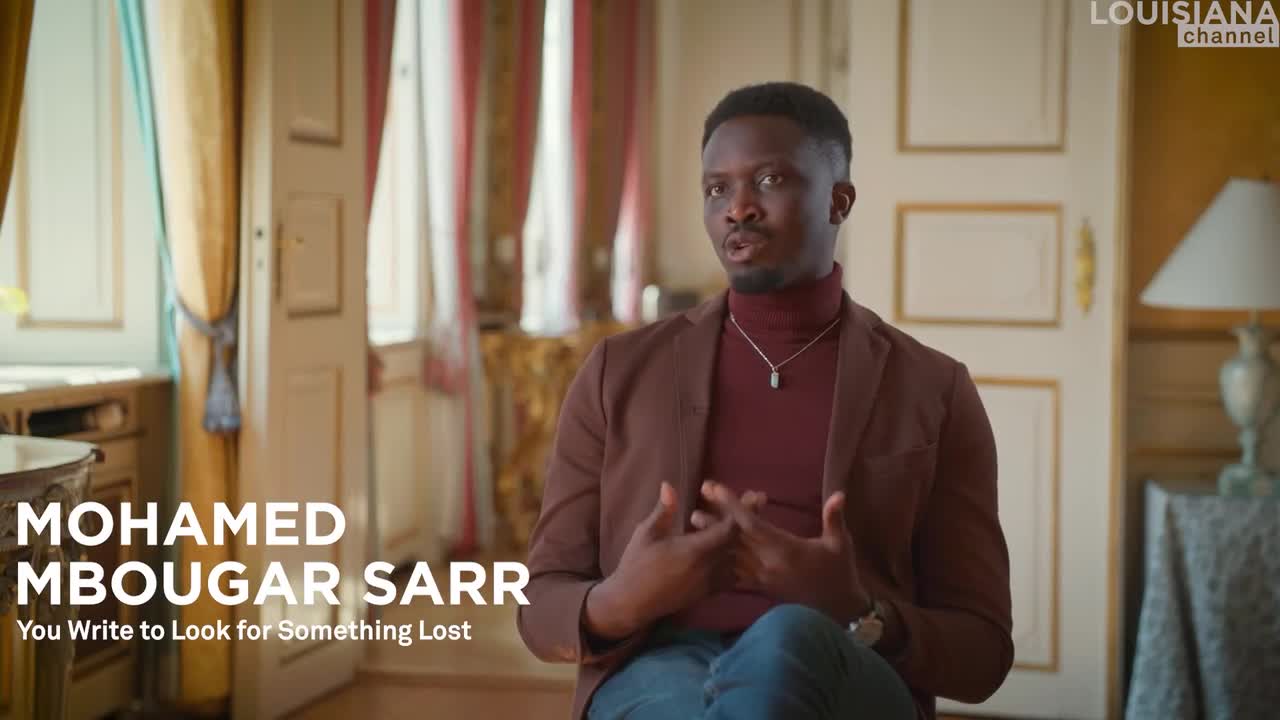
I started to write because I was alone, because I felt a deep solitude and I tried to find some voices, or I just tried to find sentences to express that solitude.
I think that I believe that literature starts with the feeling that you have lost something.
And you are alone.
I think both feelings are very important.
And you start to write because you want to take back something that you felt that you lost it.
But of course you can't take it back.
It lost forever.
And you have to seek for that thing, seek out for that thing, look for it.
And you have to do it alone.
But it's a very paradoxical solitude.
A book that I love very much from the Czech writer Bohumil Rabal is a book whose title is uh too, too loud.
A solitude, i mean, and i think we are all in that kind of situation in a solitude, but a solitude where you can find many voices, many people, many friends.
And it's, I think, our condition at the same time.
Solitude, but at the same time, the presence of our loved one, the presence of people who are dead.
I mean the invisible are here, I think and yes, of course, as a a migrant, i felt it maybe i don't know more more deeply, because even the presence of my loved ones wasn't there.
My family was in in senegal, my parents, my brothers, many friends.
So yeah, i had to Maybe dig further to find their voices.
I had to dig further to find out my way through that labyrinth.
But I understood years later that it's as well a very global situation.
It's our human condition at the same time.
Being lonely, looking for something lost.
And it's not always sad.
For me, it's the main point.
I'm saying all of this, it looks very gloomy, very sad, very... But no, it can be very joyful.
Looking for something lost can be joyful.
Being alone can be a joyful experience as well.
And that's also what I tried to express through through writing my books.
What I left in Senegal, what I left in my childhood, what I left in my family is lost.
Now, of course, there is something else that remains, but there is something else that I lost very clearly.
But, of course, the people, my family there in Senegal, lost something else, something from me, and they will never take it back.
They can't have it back and i miss something, they miss something.
It's at the same time, the tragedy of being a migrant going, i mean leaving.
It's the tragedy of living, because when you leave, at the same time you take with you something that you can't just Yeah, you can't give it back.
I mean
And by leaving there is something that you will never know something, even if I mean people tell you your family, tell you, your mother call you and tell you okay, this happened and that happened.
But you know that you missed the experience of being there.
That is lost forever.
And you have to accept it.
And I think that as a writer, it's a very powerful reason to write.
Just to say, okay, there is something lost.
But I'm not the only one who lost something.
And it's interesting to find the relation between the lost things, the lost experiences, from one side or another.
It creates the opportunity to have some discussions and, of course, to have very strong misunderstanding.
It creates something, of course.
Losing something creates something.
It's very, very simple.