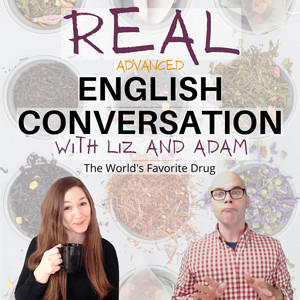
Hello and welcome to a real conversation between two native English speakers.
I'm Liz Waid and this is Adam Navis.
Hello!
I guess you're probably on this side, but I guess that doesn't matter.
But we are here today to discuss our Spotlight English program called The World's Favorite Drug.
What a provocative title.
I know.
And you will find out what that favorite drug is when you go to our website wwwspotlightenglishcom, and there you can hear our program and read along with the script on the website.
But what if you would like scripts delivered directly to your email?
You can also sign up on our website to get our scripts delivered to your email as a PDF for only 5 a month.
And that is just about a dollar a week for the easiest, cheapest English class that you can take.
So you can sign up with a little button on our website.
And if you would prefer to watch that as a video on YouTube, you can go to youtubecom slash spotlightenglish1 and visit our YouTube channel.
And if you would like extra perks there, click on the join button below this video and find out more about becoming a member.
And speaking of while you're there, if you would hit that like button and subscribe, we would really love that.
And hopefully, you'll really love it too because you won't miss any of our videos.
So Adam, we are here to talk about the world's favorite drug.
Now, when we say world's favorite drug, sometimes people are going to think about illegal drugs.
Yes, illegal drugs.
Which, as a hint, if you haven't seen this, it's actually a legal, not illegal.
Yes.
Right.
It is legal.
Yes, it is legal.
People all around the world have access to this drug.
They can get it.
They take it every day.
It's not prescribed by a doctor.
No.
It's caffeine.
In fact, doctors would probably say, have less of this.
Yes.
Well, depending on what your ailment, what your sickness is.
Let's be clear.
We are not medical professionals.
No, no, we are not.
No, this is a long list of things that I am not.
A medical professional, a statistics analyst.
Those are all sorts of things.
NBA basketball player.
Yeah, basketball player.
Yeah, not that either.
I'm about two feet too short for that.
Yeah, yeah.
So if you think you know what it is, before we say what it is, put the... Oh, I did say what it was.
Oh, did we?
Oops, I did, yes.
Anyway, whatever.
So tell us about the world's favorite drug.
Well, I'll give you a hint.
It could be found in this mug.
Bourbon.
Bourbon.
No, that would be alcohol.
That's not the world's favorite drug.
It is caffeine.
Caffeine.
Caffeine is found in tons of different places.
We think of it mostly in coffee and tea.
Those are the big ones.
What did you say?
Those are the big places, the first place a lot of people will think of.
Right.
And caffeine, it comes from a plant.
So from coffee it comes.
From, what is it?
Coffee cherries, and then they're dried into coffee beans.
And then, yeah, there's caffeine in there.
Tea is dried plant leaves.
So it's in there.
But it's also in things like guarana and um, yerba mate, which i i believe are also plants somewhere.
Uh, not by us.
Those aren't common things um where we live um, although i have certainly heard of them.
So we get these caffeine from plants and um yeah, often it's in a drink.
Did you say chocolate?
I consume it.
Did you say chocolate?
I did not say chocolate.
Okay yeah, good catch.
Yes,
So there is there is a small amount of caffeine in chocolate as well.
Certain chocolates, I think.
Maybe the darker the chocolate.
That would be my guess.
I don't know.
And of course, there is caffeine added to a lot of foods.
So like.
There's naturally occurring caffeine, which I would think coffee or tea would fall into that category.
But of course there are also energy drinks or things like.
It seems that they have even certain.
I've seen certain beers that they make alcoholic drinks where they add caffeine to it for like a.
I don't know.
I think it would drive me crazy because I can't.
Yeah, no kidding.
So that you have the depressive effects of alcohol, but also the stimulating effects of coffee.
Right.
Your body might not know what to do.
Maybe I'm just too old and my body wouldn't know what to do.
Yeah.
So do we want to talk about anything in this program?
Yes.
Okay.
I have something that I learned from this program because I actually wrote this program.
So I learned a lot from this program.
But one thing that really stuck out to me is that caffeine in a plant is actually an insecticide.
Oh.
It kills insects.
Interesting.
So it's for the plant or you harvest it and then use it on other plants?
No, no, for the plant, I believe.
So, you know, an insect is starting to eat the plant and it has caffeine in it and it dies.
And then, you know, eventually insects learn not to eat this plant.
Right.
Oh, that's fascinating.
But so I just think, you know, these people or whatever are looking around.
They find this plant and they're like, oh, all these bugs, they die eating it.
I'm going to try it.
Yeah, that's logical.
Let's eat that thing.
Is this how coffee began?
Yeah.
No.
But of course, in humans, it does a completely different thing.
Right.
Which is sort of stimulates uh the body, like makes your heart beat faster, it can focus your thinking um yeah, just makes everything in your body a little faster.
And for some people, it also makes them jittery.
Yeah.
So we have to explain what the word jittery means.
So when I feel jittery, like if I eat or if I have too much coffee without any food, shaky.
So this is my hands are jittery.
You can see they shake a little bit.
Right.
Or you actually can't focus.
You're trying to focus on too many things.
You just feel unsettled.
I think that's a pretty good definition, don't you?
Right.
So normally I have a cup of coffee every morning.
And I put a little sugar and a little cream in it.
But sometimes it just gives me a little boost for the day.
And sometimes other times It makes me anxious and nervous and it makes my body feel like it's doing this, like shaking.
I don't know.
I still drink it.
It's not like I'm not drinking the coffee anymore.
How do you manage that?
Do you drink coffee at night?
No.
Or are you just a morning coffee drinker?
I'm too old for that.
No, I probably would not have any caffeine after noon or 2 p.m.
Okay.
Because I wouldn't want it to affect my sleep.
Because that is one of the things that caffeine does, right?
It can affect your sleep in a really bad way.
Right.
Well, and I know people who drink coffee all the time.
They just drink coffee throughout the day.
Even at 10 o'clock at night, they drink coffee.
And they say it doesn't affect their sleep.
But then do they have a ton of sleep problems?
I won't judge, but I don't know how that would work.
Yeah.
But yeah, I think when you drink a lot of caffeine or consume a lot of caffeine, your body can adjust.
You got a little friend there.
I have a visitor.
It's not your tale.
So you have a lot of caffeine.
Your body can adjust to it, but...
As you get older, I think you become more sensitive to the power of caffeine.
I don't usually drink coffee after about 10 o'clock in the morning.
Oh, wow.
Yeah.
That's really early.
Yeah, because I know I'll stay awake.
It will affect me even more.
This is another thing that I learned is that caffeine affects you very quickly.
So it can start working in your body in about five minutes.
Yeah.
I learned you can actually start absorbing it under your tongue.
Oh, yikes.
Yeah.
Yeah, I guess that makes sense.
I mean, that's how you do a lot of herbal remedies and things, like under your tongue.
Yeah.
So in 30 minutes, the caffeine affects the person most strongly.
So that's when it's at its peak.
But then, after about four and a half hours, your body has used about half of the amount of caffeine that you consumed.
And then by the next day, it's gone.
So this is a lot to do with if you're drinking coffee at like 2 p.m., right?
Yeah, it's still in your body four and a half hours later, when it's getting dark and it's starting to be the time for you to go to bed, which can affect all of your.
What are those?
There's a term for that.
Your like biorhythms, your circadian?
Yeah, your inner clock.
Yeah, yeah, yeah.
Yeah, so it starts affecting how your body's signals to sleep. are affected by caffeine.
Yeah.
Well, this is a great point, a great time to ask if you're watching this, tell us if you drink coffee or tea and specifically what time you stop drinking.
Do you drink all the time?
Yeah.
Because I know in a lot of places around the world people drink tea, and late into the evening, but I don't know if it's always caffeinated tea.
Some teas do not have caffeine in them.
Yeah.
So we touched also on like how caffeine can affect your sleep, but we didn't talk about how much coffee is good for you or bad for you.
Oh, that's an interesting.
Or caffeine, right?
So this is always the question.
How much caffeine is too much caffeine?
Right.
Is there a standard for that or what do you think?
I think, well, the program says I think that's really about one cup of coffee a day.
So that's about 300 milligrams of caffeine a day.
One cup?
No way.
Yeah, I think so.
No, I believe you.
I believe you.
For a normal person?
I'm just saying I drink more than one cup or more than eight ounces if that's one cup.
Oh, well, I think... I've seen your iced coffee.
It's like...
A foot tall.
Well, that's mostly ice, Adam.
So you could say coffee is mostly water.
Yeah, that's true.
But I mean I know that Okay.
So when I was pregnant, I know they said like one cup of coffee a day, which should be your maximum.
But I mean, sometimes they... This is the other complicated thing, right?
Because um, coffee or caffeine i keep saying coffee, but i do mean caffeine caffeine can be good for you in small amounts, like it helps you remember things, it can help you focus.
Um, it has a good effect on your heart, i think right, i think that there are there's some things that it can for some people right and for your memory, and it helps that um, but it also has some really bad effects, like it can make you feel really fantastically bad.
Yeah well, and i think we need to inject here the conversation about children having caffeine and how they're affected, because that's what this program goes into a little bit.
Yeah, they're a big.
They're a big market for energy drinks and even kind of coffee.
Food with caffeine in it.
Food with caffeine.
So they're big sodas.
We haven't talked about caffeine being in different sodas.
And kids can really kind of be affected by caffeine in significant ways.
Right.
Yeah, so probably kids shouldn't have caffeine.
I know my kids, we try to avoid it.
Yeah, we do too, honestly.
Occasionally they'll have like a little bit of, I say pop, not soda, but a soft drink.
And sometimes they'll have a little bit of coffee, but really they don't drink a lot of caffeine.
They're just better people without it.
Yeah, exactly.
Aren't we all?
Maybe we're not.
No.
But the part that also you know after doing all of this research and writing this program.
The end is basically like you know your own body best.
And so you know how much caffeine is good for you.
And you should follow that.
Yeah.
Not helpful.
Not helpful.
But I mean.
No.
Affirming.
It's not.
Yeah, it would be nice.
I mean... Yeah.
As someone who appreciates rule following, I would appreciate.
You would like to know.
Yes, if doctors just say
You are this old and I don't know, you weigh this much.
You should only have this amount of caffeine.
But then again, as the program even points out, like it's hard to know how much caffeine is in a lot of things.
Right.
How much caffeine is in this cup of coffee that I drank this morning?
You could make it very strong or you could make it very weak, and that would change the amount of caffeine in it.
You could have a stronger coffee bean.
You could have, maybe one that was grown in a different place, or you could have one that was roasted to a different temperature or time, or you could have different teas, right.
Green tea has a little bit of caffeine, I think, but black tea has a lot, and herbal tea has none.
That's technically a tisane, but i yeah well, i don't know.
I think as long as you, i would like to live a life of enjoy, intentional enjoyment, so i don't want to just oh, i drink coffee all day and then just don't think about it because you were meant to um, you know, the things we eat and drink we're supposed to really enjoy.
So if you enjoy coffee and it doesn't um negatively affect your life, Go to town.
Go crazy, as they say.
I agree.
And see, that is a little bit like the end of this program anyway.
You know your body best.
You know your life best.
You have to make that decision about what you can handle in an honest way.
And so with that.
Again, I want to invite you, if you're listening, leave a comment below or write us at contact at spotlightenglishcom, to let us know if you have caffeine every day.
Have you made a decision about how much caffeine should be in your life or not?
I mean, I know people who have decided I'm not going to have any caffeine ever.
Yeah.
There are some whole religions that forbid it.
Yeah, that's true.
That's true, too.
So let us know what you think.
Check us out on YouTube, Facebook, Instagram, Twitter, wherever you listen to your podcasts.
Visit our website at spotlightenglish.com.
And yeah, let us know what you think.
Until next time, listen, watch, practice and learn.
Spotlight out.