Takeaway Chinese, where you can take some Chinese away, and experience progress day by day.
Takeaway Chinese, we will promise you a difference.
Ni hao huán shòu ting so yi xin há yi.
Welcome to Takeaway Chinese.
I'm Yeo Hong Lin with Steve Hatherly in the studio as I promised.
Hello Steve! Ni hao, how's it going today?
It's really well, really cold these days.
It's winter time and I can...
I expect coldness every winter days, but it's just...
I don't like cold. I like summer days.
We're spring. We're autumn.
When it is winter time, it feels like I can hardly enjoy the nature during winter days unless I go to certain ski resorts or certain winter or snow ice themed parks, which is somewhere I really want to go these days.
It took you two seconds to start complaining on the show.
Question. How do you say when a parent talks to their kid like, oh, it's okay.
It's okay. How do you say that?
That is a really good question because in Chinese we do not have their kind of expression.
Oh, really? We don't have that.
We have very specific comforting words.
You know, when we comfort people, we are very genuine and we want to accommodate to the exact situation instead of just saying they're there, you know, just saying, that's why.
In Chinese, we don't have that, but I understand what you're saying.
You can either say, for example, for me, when I try to comfort my two -year -old, I would say, mama baba, come here, hug hug.
Right? So, I'm not gonna say that to you though, if you're complaining about it.
No, you can. Yeah, right.
I'll skip that one.
And also, measure, measure, measure.
Measure, measure, measure.
Making sure it's like no problem.
No worries. It's like trying to tell you the situation you experiencing I know I understand it bothers you but try to you know, move on try to regard it as something insignificant Okay, so go and complain about the cold again.
Just quickly. It's really cold and I hate it one is That's because it wasn't genuine It all I'm saying is when it's perfectly cold winter days and it's snowing and it's annoying to travel, for example, from home to work.
It's actually perfect if you're staying in a ski resort.
If you do not really have to go outside, but you can, you can enjoy the beautiful outside, the beautiful snow, but you can also stay indoor.
You can have some hot pot or cheese fondue or whatever inside the perfectly warm room that you're in, hotel room, or you can wear your long jacket and go outside and enjoy the beautiful snow, knowing that a hot cup of tea is waiting for you in the room whenever you go, perfect food, perfect view, perfect winter days.
Everything you just said sounds amazing.
Right, and these things can definitely be achieved, to be, you know, enjoyed here in China in different ski resorts.
I think for a lot of people, even though we have already mentioned in our previous episodes that China is not a country with a really long history of enjoying winter sports or winter activities as a tradition or even a family tradition for a lot of families.
I feel like these years, we see this kind of winter day trips, family trips surging and more and more people are embracing the culture or the habit of doing so.
It's just such a fun family day, right?
To go to a ski resort.
Because they have so many things to do, and they also have facilities for every level of skiing and snowboarding, it's just such a hassle -free, stress -free environment to let kids play.
And if the kids are too young to ski and snowboard, then often times a ski resort will have a location where they can just slide down the hill on a sled or something like that or snow fight.
Yeah. So it's just, it's such a good, clean, wholesome family fun.
Definitely. And you know, what's even better?
A lot of places with many snow and ice resorts and resources have snow and ice festivals.
And we call it Bing Shui Jie.
Bing Shui Jie. Bing Xuejie Jie Jie Zhi festival.
Bing Xue, we talked about when is ice and snow so nice, it's always Bing first then Xue later.
So Bing Xuejie. And there are so many fun activities to do.
And that is the theme of today's Takeaway Chinese.
If you're interested in Chinese culture and you wanna get a grip on the Chinese language, then this is the show for you.
Stick with us for 30 minutes and you soon see the rewards.
And for more fun Chinese learning, follow our Facebook page, Learn Chinese, Chinese to watch many fun videos and live streams.
But now, let's provide you with some free Chinese for Takeaway.
The first Chinese I want you to take away is a snowball fight.
I think it's a really fun one and it's like stress -free like you said.
It's something you do not have.
It's stress -full. You don't have to have any technique.
I mean, you have to be quick.
Yes. You have to have good reflexes.
Yes. And you have to be okay with being hit by a snowball.
And have good aim for when you're throwing the ball as well.
But what I'm saying here is that, for example, if you want to build a snowman, I'm not singing, I'm just saying this event, then you have to know how to do that.
You kind of have to have certain aesthetics.
And if you want to do huāxie, that's skiing or snowboarding, either it'd be danbanhuaaxie or xuangbanhuaaxie, you have to know how to do that.
But for a snowball fight, you just fight!
You just need to know how to move your arm, I guess.
And also make the snowball, too, I guess.
So here, have a snowball fight.
In Chinese, it's dāxiechā.
Dāxiechā. So 다 means to hit and 다정 is actually a fight.
It's a proper, not very written language kind of way, more of a colloquial or at least oral language kind of way of saying a fight.
Actually, we're talking about real fights, like wars can also be used with this word 다정, actual words.
But, you know, we have juan juang, that's a more official and proper written language kind of way of saying it Whereas das jang is like you have two armies and each army might only have 200 Soldiers and they're fighting against each other that's still a das jang fight Okay, so a war in a way really small one.
So das jang is a fight whereas das shu jang So a fight with snow being the key element, Dā shi zhā.
That's a snowball fight.
Dā shi zhāng. Yay! Did you have snowball fights when you were a kid?
All the time! Oh, yeah?
And, you know, the thing is when I was a little girl, at least in kindergarten and primary school, I was kind of the, you know, very aggressive and a started kind in terms of one is boys vs. girls.
I mean, I guess it's also because the boys in my classes are all gentle and nice.
They would not attack too hard.
They would always avoid and try to you know, be the one who's being hit more.
But it was really fun.
Yeah I had snowball fights when I was a kid, although I did not have the luxury of someone taking it easy.
Okay, so let's make a question out of this.
How do you say, do you want to?
So you want, whether or not.
We remember. Yes, because the idea is that when you want to ask a question in the Chinese language you have a sentence, a narration kind of sentence and put mà at the end yeah so nǐ xià dà xu chàng that would be you want you wish to have a snowball fight and you put mà at the end of it nǐ xiàng dà xu chàng do you want to have a snowball fight mà, mà is very important.
Mà suggests this is a question which is why how to I want to have a snowball fight.
Wǒ xiǎng alright I forgot the xiǎng that is why I said mě is very important okay so nǐ xiǎng mě or wǒ xiǎng and then the things you want to do.
So if you go outside with your co -worker or your classmate or your family member.
You just get a snowball and hit them.
Don't ask at all. Got it, perfect.
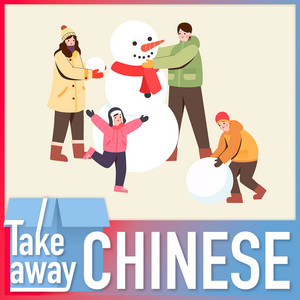
And then another thing that we've already mentioned is build a snowman, okay?
So build a snowman.
You're not actually building.
It's not that technical.
Even it requires certain skills.
So you're basically piling up the snow and forming a huge snowball.
that's the base of the snowman, which is why instead of using for example jianzhu or jianzhu.
That is the more proper and official way of saying Bude.
We say piling up. Dui.
Dui cares the meaning of putting things together without a very exact order.
It's like just piling them up.
Okay. Yeah. So... For example, if you're talking about a pile of clothes you kinda just throw the clothes together.
So it's 一紏紏. So 为紏 can also be used as a measure word.
Okay. It's a pile of clothes.
为紏. And 为 is the word being used to here for building a snowman, and the snowman is 为紏, precisely snowman.
为紏. Yes. So 为紏紏. Perfect.
Okay. 为紏紏 is to build...
or not just snowman, but to build a snowman.
To build a snowman.
Now how to say, do you want to build a snowman?
Yǐ xiāng zhí shí zhín mà ?
Perfect. Ni xiàng dì xiàng mà ?
Remember we talked about using want to or not want to to form a question.
That is, we know xiàng is want to.
Bu xiàng, don't want to.
So instead of using the Nǐ xiàng mà format, They used nǐ xiāng bù xiāng format.
Do you want to or not?
Yes. So precisely, it's nǐ xiāng bù xiāng dùy qù shōe gēn.
So it's pretty close though?
It's pretty close. Try that.
nǐ xiāng bù xiāng nǐ xiāng bù xiāng dùy qù dùy qù shōe gēn shōe gēn?
Yes. nǐ xiāng bù xiāng dùy qù shōe gēn.
And do you think you can sing that song now?
Nǐ xāngbú xángduǐ geǐ shuì jiàn!
Yes. It works! Nǐ xāngbú xāngduǐ geǐ shiàn!
Oh my gosh. You are never going to invite me back.
Everyone who loves this show is like, yep, that's it.
Last episode. No, it's just we will avoid inviting you to, you know, Chinese musical theme to take away Chinese names.
I would give up my dream of appearing in a Chinese musical.
Just again, I would say, give it a year or two.
Yeah. Right. Oh, that's fun.
Yes so which you want to build a snowman.
That is the other activity we mentioned.
I think very interesting, very fun and you can definitely enjoy as a family activity, yet they're just you know too active.
You know what I mean?
To build a snowman.
Yeah you have to. It was not?
You have to build a huge, not build pile up a huge bowl.
Huge snow ball. But don't look at it like a construction project.
Look at it as having a bit of fun in the snow.
It is fun. Wow, it's fun to build this snow.
It is fun but I have to admit these are not my favorite winter day activity.
Hmm. What is? My absolute winter day favorite activity would be soak in hot spring while it's snowing.
Outdoor hot spring.
Yeah. Yes. Which is why I must share this.
Yes. Choose the meaning of being soaked.
You know, in Chinese meaning make tea.
So you soak the tea bag into the water, right?
So basically means you're entirely in the water.
Well, by saying you, I don't mean you.
Any object actually.
So the teabag in the teapot or in the teacup.
How do you say feet?
Ziaoz. So, 没没. Perfect.
Put bath. Yes. So here, 没.
Normally, we talk about, for example, 没我 is soaking the teabag.
没我 is soaking your feet.
However, when it comes to soak in a hot spring, even though you are the object being soaked, we here use 尢絋 that's hot spring precisely 尢 means hot and warm that's warm 尢絋 is warm and 尢絋 is a spring 尢絋 that's spring 尢絋 that's spring water 氢絋 would be a hot spring So here you kind of get what I'm saying, instead of soaking the object, we're talking about where you're soaking yourself.
Yeah, no I get it 100%.
Are there places in China that have outdoor natural hot springs?
Actually many places in China have that especially for those, for example China's Snowtown, we call it It is a beautiful village, especially covered with snow.
It's located in the Xiong Feng wood farm in Hylin City, you know, under the jurisdiction of the Mu Danjiang city.
The village is about 280 kilometers away from Harbin and it is a place you can definitely enjoy a really local and authentic snow culture with a lot of different activities.
Yeah that sounds great.
In many different places in China, you can find hot spring and winter days, especially the one that I enjoy, outdoor ones.
Because when it's outdoor, and especially when it's snowing, you're in the hot spring, which is warm and nice and cozy and your tip of your nose, your hair, you can still enjoy a little bit of the snowflake lending on them.
It's romantic, isn't it?
it's very romantic if you're there with your partner but even if not it's romantic in a poetic sense yes and it's pāo wen chuan yes so wen chuan that's the hot spring pāo wen chuan so kind of hot spring and if you want to specify you want an outdoor area outdoor is hu wè hu wè yes hu is the door and wè is outside of the door outside of the house holds.
Who? Why? outside so Paul W the chat, another really cool activity and another one that I have never tried personally yet to looking forward to is admire eye sculpture.
Have you ever seen an eye sculpture?
I think I have. I don't remember where but it like a huge festival where you would go from ice sculpture to ice sculpture.
I've seen indoor ice sculptures before.
Yeah, me too, actually I have.
Yeah, those are kind of cool.
But yeah, the outdoor ones usually at some sort of ice or snow festival, I think that's what you're asking about?
Yeah, those are very, very impressive.
Those people who do that, those are artists.
Yeah. And sometimes they'll use a chainsaw to do the carving.
Right? They are incredibly incredibly talented.
Exactly. And a eye sculptor would be bingdiao in Chinese.
So bing we know as ice, sculpture.
And admire the ice sculpture you can say khanbingdiao.
Look at. Or shang, Xinsiang, admire, bingdao xiang, bingdao xiang, bingdao...
Yes, that's admiring the ice sculptures.
All these activities, I love them very much.
It feels like, you know, soothing and the kind of activity that can take away all the pressure you have.
Have you ever gone ice fishing before?
No, I have never...
Well, I have gone fishing, but only several times.
No ice fishing. How's ice fishing?
I mean what's it...
Really? Just sit there, and it's cold.
But you drill a hole on ice?
Yes, and then you sit there.
Hopefully you'll catch something, but oftentimes you won't.
My friend... this is quite a Canadian thing, I think.
My friend lives in the northern part of Canada, and he has an ice fishing shack, And a shack is like a small wooden hut and inside that, and that's located on the ice, and he sleeps in there.
It's like a little tiny cabin, and then just outside is where he drills a hole in the ice and then just ice fishes.
So he sits there and then he goes back inside and he goes to sleep, and he loves it.
So the people who are really really really into fishing I mean really really into fishing then they enjoy ice fishing as well It wouldn't be for me, but some people do enjoy it.
Okay, let's try to form ice fishing here Let's learn about fishing first in Chinese fishing is Yes, okay, so you is fish, okay.
You know is the verb it's it's kind of like the action of getting the fish out of the water.
Okay. That's the action of 下.
So it's the verb of fishing.
It's the verb for to fish.
Yes. Yep. And, um, now I'm telling you, the word for ice fishing is also two characters.
You have to choose which character to use.
And, uh, we already know ice is bing.
So can you guess what is ice fishing?
Bing jiao yu. If it's a two -character word well now I have a choice.
Yes. Because ice and then yu is fish so ice fish but fish that's the noun form so that wouldn't make sense so it must be Bing jiao.
Perfect. Bing jiao.
Cause you need the verb.
Yes you need the verb and also if it's ice fish then people would assume it's a certain kind of fish.
Yeah it's like a dish.
Yeah so Bing jiao would be ice -fishing.
Yes so these are the activities let's do a quick recap.
How to say have a snowball fight?
It's perfect. You can say and how to say build a snowman.
Perfect perfect. 你們你喜不喜喜喜喜喜?
Do you want to be a snowman?
Be careful. They don't want you to come back to this show either.
Okay. And the other one would be, admire ice sculpture.
Okay. So, 你见 is ice sculpture.
And to admire is 然, perfect.
The only thing you should be careful about is that Bing Dia first tone is eyesculpture.
Whereas Bing Dia, fourth tone is eyesfishing.
Oh, right. They're quite close.
Oh, okay. Oh, that's interesting.
I didn't notice that.
Bing Dia that's eyesculpture.
Yes, and Bing Dia is ice fishing.
Yes. And the last one, my favorite one, hot spraying.
Soak in a hot spray.
How to say that. Po is to soak and Pyu nxuan is a hot spring, so pua wu nxuan is to soak in a hot spring and hu y pao wu nxuan is to soak in an outdoor hot spring.
Exactly. The ultimate pleasure in the winter, especially a snow day.
I really very much love to see!
I always forget the ma.
There's like this dramatic pause between the end of my...
But I know you were asking, so I was waiting for that important, vital, but kind of little tale of that syndrome.
Yes, which is essential to the sentence by the way.
Essential to the sentence.
Which is what makes it a question, yes.
And I enjoy Huai, Pao, Wenche, and very, very much.
You're listening to Takeaway Chinese with myself, Neil Honglin, and Steve.
We would love to hear from you.
Send us your thoughts via email to learnchineseatcri .com .cn Coming up next, let's talk about some certain activities you can attend and you can enjoy all the above fun things to do in winter days here in China.
don't go away so you will take some Chinese away.
Welcome back to Take away Chinese.
I'm Yuho Lin joined by Steve Hatherly.
So we talked about China having many different types small and grand Ice and Snow Festivals.
And do you still remember how to say Ice and Snow Festival?
Okay, ice is bing. And snow is shue.
Yes. And festival is jie.
Jie. Jie. So, oh and you taught me this.
One has to come first.
You cannot change the order.
So I'll say bing, shue, jie.
Perfect. Bing, shie, jie.
Bing has always have to go first.
Ice and Snow Festival.
Actually China's northmost metropolite, Harbin, is the capital of Heilongjiang province, also known as the Ice City.
And it experiences long cold and snowy winters with short cool summers.
The annual Harbin Ice and Snow Festival began in 1999 and is held every year.
Now it is the largest ice and snow festival in the world.
At first, the participants in the festival were mainly Chinese, however it has since become an international festival and even competition, with the festival attracting millions of visitors and generating billions of revenues.
Which makes a lot of sense when you attend an Eyes in Snow festival, you'd want to Doui Shui and Da Shue Zhang or maybe Qi Ma on Snow that's horseback riding and also engage in local activities, traditional ones, and also have the kind of very meaty, heavy but really delicious food in winter days.
Artie, hearty food.
Yes. Like a stew, like with carrots, and potatoes, and some perhaps beef if you're a meat eater.
That sounds delicious.
And all these would definitely give a huge impetus to local economic development.
Have you ever gone on a sleigh ride before?
I haven't. Behind a horse?
Like where the horse pulls the sleigh.
I understand. No, I have not tried that.
I did enjoy a little bit of horseback riding on snow land, on snow field.
How was that? it. It's cold.
Yeah. A little bit scary but definitely fun.
Hmm. You know going on a sleigh behind a horse is it almost feels like you're in the inside a novel.
Aw. Yeah, but you're also behind a horse.
And how do I say this politely?
Depending on what the horse had for lunch that day, it can be a very unpleasant experience for you the horse doesn't care that you are there it's romantic in picture yes when it's taking the picture at the right time is essential though and when it's a chance in shooting yeah immersive experience it's not necessarily pleasant all the time not necessarily which is why I also would recommend to you some other activities you can enjoy during ice and snow festivals.
For instance, there are winter swimming competition, that would be Dong Yong winter swimming, ice hockey match, your favorite.
One of your favorites.
Snow football game.
Alpie skiing competitions, international ice sculpture competition or admiring ice sculptures, and also poetry gathering on Snow using snow and ice as a theme of the poetry.
You can recite, you can come up with your own.
You can talk about literature with snow and ice as the theme.
Very romantic and beautiful.
That sounds like a lot of fun.
Yes. And in Harbin, there's the Shaolin Park being the venue of the world's well -known Harbin Ice Lantern art fair.
So we call it Binyong Youyang Hui.
So Binyong would be Ice Lantern.
Donk? Donglong is Lantern, Bing is Ice, we know.
Binyong. So having, you know, an Ice lantern.
That sounds beautiful.
It is beautiful. Yeah especially at night time obviously.
Yes. Really pretty I've never seen that before.
Well when night comes the multi -color of the ice lanterns would fill the entire park.
You can enjoy it. You can also have a Bing Tang Hulu in your hand.
You know what is a Bing Tang Hulu?
Bing Tang Hulu? Yes.
No. It is whole -thorn on a stick with sugar sugar coat.
Oh the little snacks!
Yes, yes, yes, yes, yes.
Oh I finally tried that by the way.
Oh yeah. How'd you like it?
It's quite sour in the middle isn't it?
Yeah but you have sugar coat.
That is quite sweet.
Yeah so it's it's like two treats in one you get the sugary outside and then you get a little bit of sour on the inside so here's my pro tip, don't consume all the sugar before you bite No, don't lick Yeah, exactly Chew, chew the entire thing Chew the entire thing Do it together Yeah, no, it was tasty, it was good It is tasty and it's really nice and I feel like it's one of the best treats in winter days because you do not have to worry about the sugar coat mouth That's right While you're eating Yeah Those are the things that you can do during a really cold cold winter day and let me know for those
of you who have visited many of these ice and snow festivals or have spent time in a ski resort, how'd you like it?
And you can leave us a comment in the comment area or send us an email.
All of those response, all of your comments, questions are definitely valued.
And that brings us to the end of today's Takeaway Chinese.
I'm Yong Hong -In with Steve Hatherly here in the studio.
For more episodes of the show, you can visit our website radio .cjudian .com and go to the Column Podcast.
You can also listen to the show and read the script there.
Find us wherever you listen to your favorite podcasts.
Just search for Take Away Chinese.
Don't forget to leave your questions, comments, and ratings.
Thank you. See you next time.