Hey, I'm Tracey Mumford. There is a lot happening right now.
The Headlines podcast from The New York Times will catch you up on the latest in 10 minutes or less.
We'll take you inside breaking news and big investigations from the Times newsroom.
Plus bring you the stories that make you go, huh?
I didn't know that.
Listen to our show, The Headlines every weekday morning wherever you get your podcasts.
From The New York Times, I'm Rachel Abrams, and this is The Daily.
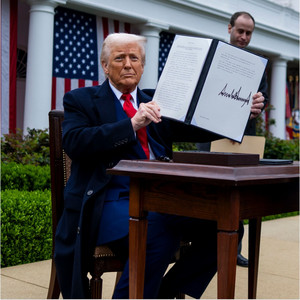
In a blow that has threatened to derail President Trump's trade agenda, a federal court ruled on Wednesday that many of the president's tariffs are in fact illegal.
That decision makes the future of Trump's trade war even more uncertain.
Today, I talk to Victor Schwartz, the wine importer at the center of the case, about why he decided to take on the president.
And to my colleague Gina Smilek on Trump's options as he scrambles to keep his trade war alive.
It's Friday, May 30th.
Victor? Yes, hello?
Hi, it's Rachel Abrams from The Daily.
How are you? Um, I'm just crazy.
You're having quite the day.
It has just been non -stop.
I got a call from ABC News in the middle of dinner.
... They wanted to come over to my place, which kind of got me nervous because I thought they were some weirdo's.
I grilled them a bit and I hoped they're real.
I said, okay, well, meet me outside my building.
No, I'm not letting you in my house.
So that was fine. They were very nice people.
And then I got a call from the CNN in Hong Kong.
That was crazy. And then the phone's been ringing and everybody wants to get my comment.
Obviously the reason that you're getting hounded is that you were the lead plaintiff on a case that got ruled on Wednesday afternoon.
Yeah, yeah, that's right.
So the ruling basically said, you know, much of Trump's tariffs are illegal.
Correct. Can you just bring us to the moment where you found out about the court ruling?
How did you find out?
And how did you feel?
Well, I was literally preparing dinner.
I was looking for a recipe for linguini and clams. And I walked over to the computer.
You know, I'd looked at one before.
And then I got an email from Sarah Olbrecht, who is the head of the Liberty Justice Center are the wonderful people who have taken our case pro bono. And they're they're the ones doing the heavy lifting.
Not me. I'm just the legal spokesmodel.
So I read that and of course I'm completely confused because I don't know the legal leads or the summary judgment.
Is that good? Bad? I don't know.
I immediately got in touch with a friend of mine who is a lawyer.
He explained it, that it was very good.
So I've just kind of been off to the races.
How did you become the spokesmodel for this lawsuit?
Because, because I'll tell you, I'll tell you, it is also strange and backdoor.
It's like unintentional.
This is in March and we're talking right brunch. We're talking about the tariffs because that was on everyone's mind.
We have to having a conversation with a cousin of my wife, and he brought up the fact that his former law professor was bringing a case against the tariffs.
And I said, wow, this is great because I wanted to give my two cents about what was going on in my business, in the wine business.
You know, I got in touch with him right away.
And he got right back to me, got right back to me.
And we had a wonderful conversation.
I told my tales as well about being in the wine business and an importer in the world of threatened tariffs.
And he said, okay, fine, that sounds good.
And then three days later, they asked if I would be the lead plaintiff.
And that's when I got nervous, and I said, well, what does that entail?
Let me talk to my wife and kids.
And of course they were all kind of nervous because the administration is known for being vengeful and, you know, we're a heavily regulated business.
We have a lot of business in front of the government.
Whether it's importation, the FDA rules, et cetera, et cetera, et cetera, leaks, label requirements.
So it's like, well, should I do this?
Should I not? You know, I don't really want to stick my neck out.
And then I thought about all the billionaires that I'm just so pissed off about doing nothing.
And I'm going, well, sitting around, we're all complaining.
We're all saying, Hey, what can we do about this?
You know, what can I do?
Everyone's feeling powerless.
And I said, this just landed on my plate.
If I don't step up, then how can I expect anybody else to?
And I just felt it was incumbent upon me to do it and let the chips fall where they may.
You describe this as a tale of woe for a wine importer.
I want to understand that.
A tale of woe, yes.
Tell us the tale of woe.
Well, first of all, understand, you know, number one, we're a very heavily regulated business.
So for instance, we have to post our prices, our discounts, fixed with the state over a month in advance before we start selling.
And we can't change them.
So if like, I've got a five case price, $120 a case or something like that, I can't say, oh, it's a tariff.
I'm going to change that to $150.
It's done. It's fixed.
So the tariff liberation quote unquote liberation day, I call it strangulation day.
money. So we had to really jump on this right away and try to make some decisions in a very unclear situation.
So there's that. Plus, where is this tariff money going to come from?
Just tariffs have to be paid up front.
This is, as I put it, it's worse than a tax because a tax usually happens after the event.
This happens before anything before we sold a bottle.
So even if our commander in chief says, it's not a big deal to raise your prices, if I raise the price on a container, I don't see the revenue from that container for months down the road.
We have to sell it all.
We have to collect it all.
So where is that capital going to come from?
It's a real cash flow killer.
That's the real challenge.
And when you're a small business, cash flow is always a challenge.
So bottom line is, you import wine, that costs money, it's already cost you money, you decided to fight this.
I decided I had to step up, yes.
I mean it came to me in a sense, you know what I mean?
I wasn't like I was looking for a law case.
I want to be very clear about that.
How did you feel when you won yesterday?
Because I got to point out here, you're literally going up against the President of the United States, you presumably know how much this what policy means to him, and you just threw a gigantic wrench into his whole plan.
I mean, when I first read the complaint, VOS Elections Inc.
versus Trump et al, I laughed like a lunatic.
I mean, in a sense, like, this is so crazy.
This is not what I signed up for when I created my company 39 years ago, you know.
I just wanted to find interesting wine that are really delicious, find a community of like minded people on this side of the of the pond, and sell them these delicious wines and have a happy life, you know, that's all I wanted to do.
And not say high tariffs for it.
I am sure there are definitely some trade issues.
I'm not like, completely anti -tariff in some way.
But the fact is, it was not necessary for our industry and certainly not across the board. Do you feel any certainty now about what to do with your business?
Like, will this actually help you plant?
Like, don't count your chickens yet.
I mean, I do think we're going to eventually win?
I, we can't. We'll probably go to the appellate court in D .C., right.
That's the next step.
We don't know how they will rule.
Will the Supreme Court say, no, we're not going to touch it, or will they take it on?
So many ifs... You can't plan on that.
You can't plan on this.
No, we're planning on the tariffs being with us for a while.
That's the sad truth of it.
But we'll still enjoy the wind for the time being.
What bottle of wine did you pop open when you found out that you won?
Well, I was already in the middle of drinking it, but I had no problem finishing the bottle.
And that was a beautiful Vermentino from Château d 'Arukfort, which is inserle provence.
You know, delicious wine, went with my vongole and linguini very nicely.
my wife and I toasted, and you know, there you go.
— Victor, thank you so much. Enjoy whatever bottle of wine you pop open tonight.
— Thank you. — Thank you so much for your time.
— Thanks, bye -bye. — After the break, I talked to my colleague, Janus Milek, about how this case could impact the president's tariff negotiations moving forward. — We'll be right back.
to do with immigration?
My name is Carlos Prieto, and I'm one of the people that helped make the Daily.
As part of our reporting on immigration, we heard from this woman crossing one of the most dangerous stretches of land on the whole planet to get to the United States.
I knew that she was from Venezuela, which is where I'm also from.
But what I found out is that not only was she from the same city that I grew up in, but she was also from the same neighborhood.
She was describing parks and plazas and streets where I spent a lot of my childhood.
She was a woman that I might have encountered at some point in my life.
It made me feel an extra responsibility to find a way for our listeners to feel like they understood her and her story.
What makes The Daily special is that we try to understand every story with that level of closeness so that our listeners can really connect with the humans in the middle of a news event.
If this is the kind of journalism that you like and that you care about, the best way to support it is by subscribing to the New York Times.
Gena, welcome to the daily thank you for joining us.
Thank you for having me.
We heard from this wine importer just now who was elated by this trade ruling that came out on Wednesday night and I'd like to take a step back here and just understand what was this case about?
Right, so this case was fundamentally about whether president Trump has the authority to an act across the board tariffs on US trading partners without approval from Congress.
It was about this 10 percent tariff that has been applied to a range of trading partners including the European Union, which is what I cover, and which have obviously made it a lot more expensive to import products from overseas into the United States.
We saw the one company you talked to, a women's cycling apparel company, an online fishing tackle company, band together and take this to a court.
And say that this was an over -interpretation of a pretty obscure law that had allowed these to go into effect in the first place and that it should be overturned.
And remind us, Gina, what is that law?
Yeah. So it is this 1977 law called the International Emergency Economic Powers Act, which is what we in trade circles all call AIPA.
It is basically the cudgel that President Trump has been using to wage his trade war on global trading partners.
It's not the only thing he uses, but this is the law that he uses to apply tariffs of varying sizes across the board on products from a range of trading partners.
So, it's been really important to his strategy of surprising people with big, varying, shocking tariff packages.
This law is an unusual tool to use for something like this because it primarily concerns trade embargoes and economic sanctions.
It was originally conceptualized to be in reaction to national emergencies, and the administration has basically been arguing that the trade situation is a national emergency.
So this is this really unusual interpretation of this 50 -year -old piece of legislation and this wine importer and these other companies basically take it before the court and say, This is too broad.
And the court that ruled late Wednesday agreed with that assessment.
Can you just walk me through their decision?
So the decision essentially said two things.
It first said that a set of tariffs that the Trump administration has put on Mexico, Canada, and China in response to the fentanyl trade is not a good use of this law.
And it also, importantly, said that across the board tariffs, these tariffs that apply to everyone at 10 percent currently, is too broad of a use of the law and that the law was not meant to give the president unbound authority to just put tariffs on whoever he wants at whatever rate he wants.
And as a result, they are basically blocking these tariffs.
You know, this latest news, it only feels like it's adding to this kind of whirlwind of trade news.
It's really, I think, been hard for a lot of people to keep all of these different tariffs straight.
So I wonder if you could just kind of help us understand the current state of play on tariffs, like what is in place, where, what's on hold?
Right, it is a law to keep track of.
I think it's important to emphasize what's not affected, and that is sector -specific tariffs.
So you may remember that there are 25 % tariffs on steel and aluminum and on cars.
Those tariffs are under a different law entirely and are not subject to this ruling.
The tariffs that are subject to this ruling are across -the -board tariffs that have applied to a bunch of American trading partners, and which were announced early in April on what President Trump called Liberation Day.
Those are currently at 10%, but they were set to bounce back to higher rates that were specific by country after a 90 -day pause, so in mid -July, and they've really been sort of the center of negotiations.
This is the thing that Trump is negotiating with countries across the world about.
Okay, so then the Wednesday night ruling, how does that ruling affect, if it affects, the negotiations that are active right now between the administration and these foreign trading partners?
Well, this really damages President Trump's ability to do the kind of negotiating that he tends to prefer to do and which he has very much been doing throughout this trade war.
So, what we've seen him do repeatedly is kind of art of the deal, unpredictable style of negotiation where he announces really big tariffs on trading partners and then rapidly takes them off and then threatens them again.
And so, it's been this sort of, you get a tariff, you get a tariff approach of trying to keep everybody on their back foot.
And he's been doing that unilaterally, sort of King Trump style, not passing it through Congress not taking the time to do some big investigation?
He's been able to do it very quickly and very nimbly because of this creative use of this law, and now suddenly it seems like that might be off the table.
Although I think it would be premature to say that this is the end of the trade war.
I've been talking to a lot of people today who are very nervous about what happens next.
I think the word of the day is probably chaos.
I think there are a lot of questions about whether where there's actually potentially a risk that this actually provokes the Trump Administration to do something even more drastic.
And Gina, what would that look like?
Like, what options does the administration have in front of it?
So the most obvious option that they have is try to get the ruling overturned.
And we've already seen some action there.
They've applied for and then been granted a stay pretty quickly after the ruling.
So legally we're now in this sort of wait and see moment where it's clear that the tariff block is not going to take effect, at least immediately, and it's very clear that the Trump administration is going to really try and get this overturned in court and it could even end up being escalated to the Supreme Court potentially.
So clearly there are some legal options here.
And then I think the second bucket of options is what they can do on the trade front.
And one option there is that they could use another provision in trade law to apply some tariffs, up to 15 percent, on trading partners for 150 days.
And after that they'd have to take it to Congress, but there is a period here where the Trump administration could do that without congressional approval.
And how likely is it that the president would enact that 150 -day, 15 -percent tariff, and then go to Congress to seek the authority to, I guess, extend it permanently?
I think people think it's possible that he'll do the 150 -day version of this.
I think people think it's a little less likely that he's going to try to get something through Congress because while that would put this on very solid legal footing, it also means you have to get it through Congress.
But I think that there are other tools that Trump has at his disposal that he could reach for maybe a little bit more readily that he's used before and which are really legally solid and those are the ones that people are really worried about.
Can you explain that a little bit?
What are these more legally solid options?
So there are two provisions in trade law that allow you to slap tariffs on trading partners after investigations.
One is a national security investigation, and it allows you to apply tariffs to specific sectors.
The other is an investigation into unfair trading practices and it allows you to apply tariffs to a specific trading partner, so an individual country but across the board. These are the provisions they're currently using to hit steel and aluminum and to hit cars.
And so this isn't a totally novel idea, which would put tariffs on slightly stronger legal footing.
So if those options could theoretically put the administration on more solid legal footing, why not use those to begin with?
Like why even rely on this 1977 law that seems to have been relatively easily struck down, at least by this first court.
So the 1977 law gives you a lot more unilateral, immediate authority.
It allows you to just kind of throw out a number and threaten another country with it.
Whereas these investigations take time.
You know, they take weeks, maybe months, to complete.
But what we've seen so far is that the Trump administration is really used to a combination of the two.
And so they have a bunch of investigations, open, pending, not completed, that would potentially allow them to hit additional sectors with tariffs.
And so it's entirely possible that we see more of these sector -specific tariffs and fewer across -the -board tariffs, and those could still be very painful for America's trading partners.
It feels as though there has been this pattern since President Trump took office of him levying these huge threats that end up, in one way or another, going away, either because a court strikes something down or a deal is negotiated or he walks something back.
And I just wonder if this ruling on Wednesday, if in any way it puts even more pressure on President Trump to show that he means business with these trade negotiations.
Yeah, you know, this comes at this really crucial moment for the Trump administration because they had been trying to make 90 deals in 90 days.
And they are well short of that target.
And so I think this is sort of entering the ferment at this moment where we're in this really intense period of negotiation and there's a lot of pressure on the Trump administration.
But I don't think it's a foregone conclusion that things are going to get worse from here.
I think we saw stocks rise on this decision because at least people in financial markets think that this could potentially deescalate the trade war.
But I definitely heard some people voice the concern today that the Trump administration is going to feel like they need to reassert their bargaining position and that that feeling of being backed into a corner could force them to take more drastic action or could force them to speed up some of the sector -specific tariffs in a way that would really hurt trading partners or in a way that would really hurt companies in some specific countries.
And so I think there is this concern that you could end up with a deepening of the trade war out of this.
Which is a little ironic because on its face it seems like this ruling would bring relief but it sounds like it could actually prompt even more aggressive action potentially.
I think that's right.
And I think actually a good example of what that might look like takes place here in the European Union.
So where I'm sitting, the EU has been facing a pretty hefty tariff threat from the US.
President Trump said last week that he was going to slap 50 % tariffs on the EU to essentially force it to come to the negotiating table.
With this court case, it's now unclear whether he'll ultimately be able to use those across the board tariffs to try and sort of wrestle the E .U. into a negotiating position.
But even if it turns out that the original decision stands and that he cannot use the 50 percent tariffs, the E .U. is not totally out of the woods.
There's still some serious risks that the Trump administration could use other tariffs to kind of force it to bow to the administration's will, including sectoral tariffs on things like pharmaceuticals, which are a major export for the EU.
So essentially, the Trump administration might not be able to use this sort of preferred tool of just ratcheting up tariffs, but it might have other options in its back pocket that could be, if not equally bad, at least very bad for somewhere like the European Union.
And so I think the upshot here is that this is a new chapter in the trade war, But the trade war is definitely not over.
Gina, thank you so much. Thank you.
A federal appeals court on Thursday signaled it would move quickly to address the legal uncertainty surrounding the president's tariffs, and asked the parties in the case to file legal briefs by early June.
Lawyers for the administration said that they're prepared to take the case to the Supreme Court if the appeals court rules against the president, saying the move would be necessary to, quote, avoid the irreparable national security and economic harms at stake.
We'll be right back.
Here's what else you need to know today.
On Thursday a federal judge blocked the Trump administration's attempt to bar international students from enrolling at Harvard. Over objections from the White House the judge extended a restraining order that ensures such students can attend the University.
Welcome! The ruling came on the same day as Harvard's annual commencement during which its president Alan Garber celebrated international students in a pointed jab at President Trump.
Members of the class of 2025, from down the street, across the country, and around the world, around the world just as it should be.
And the Trump administration cancelled a nearly $600 million contract with the drugmaker Moderna to develop a vaccine for bird flu.
The move was a win for Health and Human Services head Robert F.
Kennedy, Jr., who has repeatedly questioned the safety of vaccine technology.
Thursday's cancellation also forfeits the U .S. government's right to purchase doses of a vaccine ahead of a pandemic.
Today's episode was produced by Olivia Knatt, Alex Stern, and Jessica Chung.
It was edited by Marc George and Paige Cowitt, contains original music by Roan Niimisto, and was engineered by Alyssa Moxley.
Our theme music is by Jim Brunberg and Ben Landsberg of Wonderly.
Special thanks to Susan Beechey.
That's it for The Daily.
I'm Rachel Abrams. See you Monday.