Keeps the world.
Hello, welcome to Roundtable where we serve up piping hot debates on the issues that sizzle in China and beyond.
I'm Niu Honglin.
They call it the most fake business in China, and yet it's never been more authentic.
From the quiet city of Xucheng to the flashing screens of TikTok, strands of hair weave, stories of labor, reinvention and pride.
In today's show we take a look at the wig industry in China and see how some people change their lives starting from the top.
For this episode, I'm joined by Yu Shen and Steve Hatherly.
Now grab your virtual compass and follow us to the heart of the discussion.
Before electric vehicles went global, China's wigs have already been in the world spotlight.
And behind this boom stands a city few outside China have heard of.
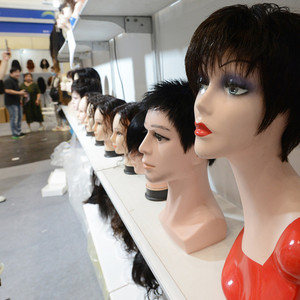
Xucheng in Henan Province in middle China, home to over 4000 WIG-related enterprises and 300000 workers and 80 of the world's WIG exports.
Now, Whigs aren't just going overseas.
They're also returning home in full force onto the heads of many young Chinese.
So how did the Whig economy take root?
What's driving young consumers in China and around the world?
We are talking about Whig today.
So to start with, Wig is fake hair, right?
Yeah, I guess you can say that.
It's also made from genuine real human hair, but...
Depending on which style or which look you're pursuing.
Sometimes a wig can be a full wig, a full set of hairstyles.
Sometimes it can be only a lock of hair or a colorful piece of hair.
Or it could be a bang, like something in front of your forehead to make her face looking cuter.
It can be extensions as well.
That's a popular thing to do.
It can be real human hair.
It can be made from real human hair.
It can be made from synthetic fibers too.
Moment of truth.
Have you ever tried a new wig?
I was going to ask you this because I've never tried it.
And I don't have the personal feeling of how it would be like wearing one.
But I've seen my mom wearing like a piece of something on top of her head to cover the gray hair at the center of her scalp, which works magically fine.
And sometimes I steal that to put it on the head of my cat, and it works.
I've only worn it for, like, performance purposes.
Purposes like being on a stage, playing a character or something like that.
Is it hot to wear one?
Yes.
It can be.
Yeah, because they're very tight on your head.
They're very snug.
They're supposed to fit perfectly.
They're not supposed to be loose at all.
If they're loose, they move around a little bit.
Other than that, I've never worn one.
But when I was in middle school and high school, my mom suddenly one day came home with this bright red wig.
It was kind of like shining red, like a stoplight, and I wondered what's this for?
And She just bought it because she thought it was pretty.
She thought it looked good and then when she and dad would go out, they used to go out dancing all the time when I was young and she would wear it sometimes.
And the only reason she wore it was just to give herself a different look and to kind of spice up her outfit a little bit, which I thought was kind of cool.
I have a long and complicated relationship with wigs.
To start with, I have long hair, which means for me to wear.
The reason I said yes when Yushan asked is it hot?
Is because I have my authentic hair and there are a lot of them.
So I have to press them really tight to my scalp for the wig to fit, so that I do not look twice the size of my head.
So that is one thing.
And that was the first batch of wig I tried, different hairstyle, different color of the hair.
And later on I realized that there are so many different types, like Yusheng described, the band ones and also the braids.
Some of the hair or the wig even comes with a hat, which means I can have the hat and have a perfect, perfectly beautiful ponytail if I want.
Yeah, because the ponytail or the wig itself will be stitched into the hat, and then all you have to do is put on the hat.
And now I'm really curious to know what are young people doing with wig?
Because many of the reasons that I bought wig was that, like Yuchen said, to cover my unwashed hair, to cover some of the gray hair jumping.
Really standing out on my head and aging was one thing, and finding a different style but a really extreme style for performance on stage was another thing.
But it's never an everyday thing for me.
Nowadays, I think for young people.
If you go on to social media and search wig-related topics, many titles will show up appearing to be how to use wigs to instantly enhance your look, or how to boost hair volume instantly, or just how to make your hair look instantly brighter by adding a layer of lighter color of wig on top of your original hair.
So it's all about making wig more everyday fashion accessory rather than to hide... boldness or hide your original hair color or stuff like that, like how it was in the old days.
Nowadays, for young people, it's all about fashion.
It's all about expressing the self and also the market is proving the popularity here as well, here in China, especially since recent years.
So from 2023 to 2030, the market size here is projected to expand from 1443 billion yuan that's roughly over 20 billion us dollars in 2023, to 168 billion yuan that's roughly over 23 billion us dollars in 2024, and that's reaching 300 billion yuan roughly 42 billion by 2030 just within the next few years, with a compound annual growth rate of.
I was reading some blog posts about, because you know, if you search wig related news, you're not going to see a lot of things happening on a daily basis.
So I wanted to know what people were saying and how people were feeling.
And there was one blogger that wrote this kind of story.
She said that one event she had to go, she had two big events in a couple of weeks.
And one was a friend's wedding where she wanted to look a little bit more formal.
So she chose one wig for that party.
Then the following weekend she had a friend's big birthday bash and she chose a longer kind of hot pink thing.
Wow.
Yeah.
And she said the way that she felt.
At both events, it made her feel more confident and it made her feel differently.
And the great point that she made was honestly, I would have had to gone out and get two different hairstyles done at the salon if I wanted to achieve both of those looks in two different weeks.
That's time, that's effort, that's money spent.
Whereas this is something that you could just put on your head when you're done with it.
Put it in your closet until you have the next event that you want to use it.
And I thought, yeah, I mean, in that case, it's just an accessory.
If that's the reason that you're wearing the wig, it's just like wearing a hat or getting your hair dyed.
And at the same time, I find people's attitude towards wig wearing is also changing.
Previously in, I think, last generations TV shows.
For example, if you see in a public scenario once wig got removed by a blow of wind or any kind of accident, it can be a funny and a little bit sad moment and people would laugh about it or awkwardly silent about it.
Yet in today's day and age, we see people are being more and more confident about who they are.
And they are kind of open about the fact that they're wearing a wig.
I have even personally experienced a scenario where everyone's having a meeting and people are commenting and praising once even a girl young girl's hairstyle, and she just took her wig off and said oh, it's a wig and i bought it from which platform?
I can give you the link if you like it, and it's the kind of wig that you put on your real hair And it's very natural at the same time.
So it's good product.
So I'm very glad to see that when the next well, previous generations wig accident happened, instead of laughing about it, people are being very tolerant and finding it to be quite natural.
I think there was, and this is true in the West as well.
There's a stigma attached with wearing a wig.
And maybe for men I'm not sure if it's fair to say, but maybe even more serious of a stigma, because we call those toupees for men the hairpiece that sits on top of your head.
And I think part of the reason for that stigma is because of what you just said.
In the media or in movies or TV shows, it would often be used for comedic effect.
You know, the wig would, or the toupee would suddenly slip out of place and then look odd, or the wind would catch it and blow it away.
And it kind of created this attitude towards hair pieces or wigs that they were somehow...
For people who I don't know.
I don't even know what the right word is, but it wasn't looked at positively, or even from a neutral point of view.
But I think that's changing now.
We're going to talk about it maybe a little bit later, but social media, I think.
Has a lot to do with that.
And I think celebrities have a lot to do with that as well.
Yeah.
And it was just a few weeks ago when I saw a live stream of a guy.
I'm not sure which country he was at it was definitely not in china, but that was a chinese live streamer and he's got that two piece to pay to pay.
Um, all different styles, colors of all shapes of toupee behind him and he's trying One, taking that one off, trying another one while dancing.
He's performing and just presenting himself his figure and also what he's trying to sell, which are the toupees in front of camera doing live stream.
Of course, that's been proven to be a good way.
The online e-commerce channels via different platforms.
Social media platforms like TikTok or Tmall.
Nowadays they're proving to be a very profitable but also popular way for people to gain access to.
Oh, Here are the new styles.
Oh, this guy is looking really good in these toupees or wigs or whatever.
So maybe I can give it a try too.
So if you're in China and you hear people saying to each other wow, you're just one wig away from being a really super hot, handsome man.
Is that like a thing?
It's okay to say that.
Oh, really?
It's not negative.
It's not mocking.
It's just saying you got really good facial eyes and nose and figure and everything.
And maybe you can fix your hair a bit.
It's definitely not accusing or attacking the other person, and that's the situation here in china, but we know that in overseas markets, in different continents, in different cultural backgrounds, wig has been something that has been important in the culture for a really long time.
And yes, i'm talking about africa.
Yeah, in a lot of african countries, like South Africa or Nigeria, a lot of people just think wig is an everyday essential for them and also fashion statements, especially for women who loves the long braided hair of various different colors.
And many of those wigs also come were exported from China as well.
And nowadays this global success is kind of increasingly influencing China's domestic market in some way.
But it's worth mentioning.
It's totally the truth nowadays that among African ladies, I'm not so sure about men.
And also black people all around.
Yeah, black people in general.
I think, Chinese wigs.
They have this potential of becoming their daily necessity in so many ways because of the affordability and good quality in so many aspects.
Yes.
In 2024, China's WIG exports exceeded 37.5 billion yuan.
That is about 5.2 billion US dollar.
And that is 80% of the global market.
It's amazing, isn't it?
In the United States, a lot of the wigs in that market come from one particular area in China.
There was a wig seller in America.
There was a quote that if those wigs stop coming from China, if they ever stop production, the next day you're going to see a lot of bald heads in New York City.
Is that serious?
You're talking about Xuchang, the city of Xuchang in Henan province, the wig capital of the world.
Can we call it that?
Definitely, because Globally, six out of every 10 wigs come from Xuchang.
That is a huge percentage.
And you can imagine people in that city.
You don't have to imagine, I'm telling you.
People in that city.
They have a heritage, a talent and technology and, most importantly, passion to work with magical wigs.
There are so many different types.
There's a long history of wigs in that city too, right?
Yeah, it's amazing.
I just discovered about it this morning that Xu Chang started producing wigs ever since around 500 years ago.
500 years ago?
During the Ming Dynasty, yeah, around the year 1500 to 1566 AD, but...
Back then it was mainly for theatrical costume production and rarely for personal use or trade by any sense.
But with...
I think it was until early to mid 20th century when a German businessman appeared in Xuchang.
That's when they start to deal with international business.
And then looking at today.
In 2022 alone, cross-border e-commerce transactions for hair products in Xuchang exceeded one billion US dollars.
And that's how big of an impact is creating, locally and also globally as well, from shu chang.
Like yushan said, there are different types of wig there.
There are ones that are made with real hair, real human hair.
There are also the ones that are mainly made by the kind of fabric that can mimic the texture and the feeling of hair.
And in Xuchang they started with the first one, because In China for those of you who don't know in ancient times, for a really long time, people believed that you cannot cut your hair from the time you were born.
Let me take a guess before you say.
Your hair does not belong to you.
Your hair comes from your parents.
Yes, look at you knowing Chinese culture.
Yes, somebody's recording enough Chinese content.
Yeah right, And that's the idea.
Yeah.
So at that time, people in Xuchang started to look into the texture and what can make their wig to stay longer, to be more endurant and can look more familiar or look similar to real hair, so that on stage when people wear the wig and play and they do not come off too fake and at the same time, of course, the way to wear it, to put on your real hair and to put on the head.
And all these things have been in research in Xuchang for a really long time.
Now culturally, I have a question.
So would that mean?
And, by the way, for our listeners who might not know, I don't think that culture, that aspect of Chinese culture, exists anymore.
People dye their hair and cut their hair to whatever length.
A bit too much.
Yeah, right.
But historically, would that mean that you could never cut your hair?
You should never cut your hair.
You should never cut your hair.
If it's for a really drastic situation and you want to make a huge statement, perhaps you cut your hair.
Hmm.
So when we watch Chinese historical drama, sorry, I'm going down a rabbit hole here.
But when we watch Chinese historical dramas, a lot of the men, for example, will have really long hair right.
That's part of the reason.
Yes.
Uh-huh.
And hairstyle, I'm going with him.
And hairstyle means a lot of things.
And also facial hair.
See the beard?
Oh, yes, yes, yes.
And when you tie them up, it's for official occasions.
And when you let them loose, it shows that it's a bit unofficial.
You're not standing in, I don't know.
Court a judge, court in on, not that official scenario.
So yeah, hair has been important in chinese culture as well, not both men and women exactly, yeah.
And then jumping back to the city that we were talking about, shu zhang.
Um, they sell a hair, a wig related product on cross border e-commerce platforms every two seconds.
So this is just proof of how important the market is there to that particular city.
It's their largest export item.
It's a pillar of their foreign trade.
Their market spans 120 different countries and regions.
You talked about Africa 70 market share in Africa but 40 in Europe and the United States as well.
And in the city this is from 2024 they have 4100 WIG companies, product companies or wig-related product companies.
That's a lot of people come and go, bringing in a lot of revenue for that one city alone.
Yeah, so if you've got 4100 related companies, now imagine how many people work at those 4100 different companies, meaning it's an essential industry for the city itself.
This is the thing that happens in China and we can use this as a good example to do a case study, because here in China we see little city, little town, even concentrating on one industry, and they can be so good at it.
They bring the entire industrial link.
They have the upper stream, lower stream.
They figure out how to do the product, how to do the byproduct, how to ship all these products into different places and how to be the supplier of the lower stream product of their product.
So this is quite so interesting.
If we take a look at the example In Xuchang, you can see that they are doing a lot of experiment.
They are being very innovative when it comes to the making of the wig but, at the same time, the selling, the promoting the marketing of their wigs.
I've also seen reports on just how some international wig business person ladies, for example, they go to Xuchang or other Chinese cities who also has a pillar industry of making wigs or with related products.
They'll just visit those small village or counties, walk into those factories and try things on themselves to see which texture feels the best, which might their targeted audience prefer the most.
Because I think Xu Qiang also is working on some materials, such as the synthetic wick, materials that can offer both a good value for money, of course, and also easy maintenance for the wig to have it last for a longer period of time.
Because we know if the wig is produced by real human hair, then it requires a lot of, let's say, manpower after you buy it.
You need to groom it very often, clean it with a certain type of detergent or cleanser and put it in dry place and perhaps put it onto a wooden model's head.
Like a stand.
Yeah, to keep it in certain shape.
And it's scary during nighttime, by the way.
No way.
Oh, if it casts a shadow?
Yeah, like someone standing there.
But if the quality is made in a better way from the start, such as replacing some part of the human hair with synthetic materials, perhaps all of these labors can be saved.
Yeah, that's definitely very important.
You mentioned the maintenance of it.
The shipping is also a huge problem.
If you do not ship it properly, then it's hard to maintain the same quality every wig.
It's hard to maintain the same quality for every wig, which might damage the brand, because now, instead of being the supplier and the factory that are manufacturing different major brands of wigs, Xucheng has been a hub, an incubator for different local brands, and the local brands are gaining popularity and reputation in the global market.
I think that is the kind of story again you will see in a lot of Chinese counties and cities and places.
That is, on top of being really good as the craftsmen, they are also started to know what they are selling, not only the product, but also the ideas, the stories, and also knowing what is their best selling point so they can make their name heard and known on the map.
Yeah, it's weird we're talking about, but just a quick note here.
You said certain counties famous for certain industries.
It reminds me of a certain town.
I don't remember which one particular, but that one is...
Most famously known for its production of falsies, as in fake eyelashes.
Also related.
Also kind of... Tiny but major.
Even more detailed piece of craftsmanship in the making.
But talking about wig, you're right honlin, in many cases wig, it could take one a very skillful um expert, a production expert a whole day to make only one piece.
So Yeah, a lot of times they're thinking about how to become more innovative, as in how to save labor costs in the making processes as well.
That's the making process.
How about the selling process?
Yeah, they're getting innovative there too, because when you have your product, then the next issue is how to get your product to people and how to get your message out to people.
And e-commerce is the way that everybody's doing it successfully these days.
And yes, the wig makers are using, of course, the e-commerce sites like AliExpress and Amazon, but they're also now experimenting with new platforms like TikTok and Shine, which is a cross-border e-commerce site.
And they're working directly with overseas influencers to reach customers.
More precisely, and there was one company that earns about 10000 a day, that's American dollars a day, just from TikTok sales.
And this is the point that I wanted to come to about social media, because it's such a smart thing to do to talk to influencers and celebrities.
If they're the ones who are buying and using the products, because it breaks down a barrier that may or may not.
It definitely existed before, but may not exist as much now.
There was a quote from.
I found this from Reese Walker, who is a celebrity hairstylist and colorist and does extensions in New York City.
Now, nobody's going to know who that is, but the quote I thought was kind of interesting.
90% of people you look at in Hollywood wear extensions.
But now with TikTok, celebrities are a part of the process and are willing to be filmed.
Have you heard of the get ready with me trend?
Hashtag GRWM.
It's all over YouTube.
161 billion views on TikTok and 6 billion on YouTube.
And part of that process is when they have their wig.
You know they'll show how they put it on and the whole process, because that's what people want.
The point is that's what people want to see these days.
That's what they want to know.
So when you have...
These influencers and celebrities willing to share that information, breaking down that stigma, eliminating the stigma with people like you and I.
It just makes people like you and I all the more willing to make a purchase ourselves.
Yes, and we're seeing positive results.
Remember the days when people say, I'm a natural blonde.
That's not true in a lot of cases.
But these days, on social media around the world, people are willing to be their authentic self instead of putting on full makeup and everything and getting really, really ready on social media for different performances or different shows.
They started to show you, or they at the same time show you the process from being who they are to being a beautiful, more beautiful version of who they are.
They show you how to do makeup.
They tell you oh, I encounter the same problem that you encounter.
Sometimes the foundation on my face just not fit that well.
And these are some tricks that I use.
And instead of making people or thinking that huh, that celebrity is not as beautiful as I thought, people are thinking oh, she's so real.
And she is sharing her tips.
And I love it about her.
So Nowadays, on social media, people are being more tolerant and the people are enjoying authentic personality and authentically who they are better.
And I think that also leads to the possibility of the wig industry using celebrity, using social media to market their product.
Because people, as long as the final product being the one who's Wearing full makeup and wearing the wig they want, is good.
People are okay with the fact that they are decorating themselves with accessories, with makeup, with wigs.
And it doesn't have to be for decoration.
It doesn't have to be for aesthetics.
It could be for health related reasons or it could be for hair loss reasons as well.
But I'm reminded now of when we talked about the gym and we said you know, for people who aren't familiar with the gym, even going into the gym can be a really intimidating experience.
And I think the kind of influencers that you were talking about before Yushan, for example, Andoian influencers are not only breaking down the barrier of saying it's kind of cool, don't worry about it, it's kind of hip and trendy, but also the how-to.
And I think if someone's interested in getting a wig for themselves, for whatever reason, Knowing how to put it on, knowing how to fit it, how to shape it, can be a really intimidating thing.
So when you break down that barrier, when these influencers are eliminating that emotional strain, if you will then it makes it easier for people.
Then there's basically no barrier at all.
Any anticipation for the future wig industry in China or around the world?
Anything that you want the wig experts to work on, specific product or any trend or anything?
Wow, definitely on the personalization of Wix.
I've already seen such a leap of faith of progress made in that area, but let me tell you a real story that I personally witnessed a few years ago.
So You guys know, I used to do an internship in a theater, and in a theater wearing a wig is like a very common thing.
We've got a diva who herself, for perhaps health reasons, perhaps aesthetics reasons she wears a wig every single day already, and she refused to take it off, even though she needs to put on a different wig on top of that.
And back then it was such a difficulty for the costume team to design a bigger wig, to hold a wig inside on top of her head without making her head looking so much bigger on the sides.
So back then it was I remember it was such a discussion because I was the translator helping to facilitate that communication.
And nowadays I see there are improvements, but It can still be pricey sometimes if you want to personalize or customize a wig for yourself or your own condition.
So let's see in the future if that can be further adjusted.
Yeah, I was looking at a New York City.
I think it's a relatively new startup, a New York City wig making company.
They're using a robot now.
And from start to finish, they can make a wig in 45, the robot can make a wig in 45 minutes.
That's probably the direction that the industry is going.
But I was looking at the prices, $900.
Right. you know, $650, depending on the style of wig.
And it's not to say that it's not worth it.
It's just that's out of reach for a lot of people.
And I think for today's conversation.
We proved that even the fake can become the foundation of something very real pride, creativity and self-definition.