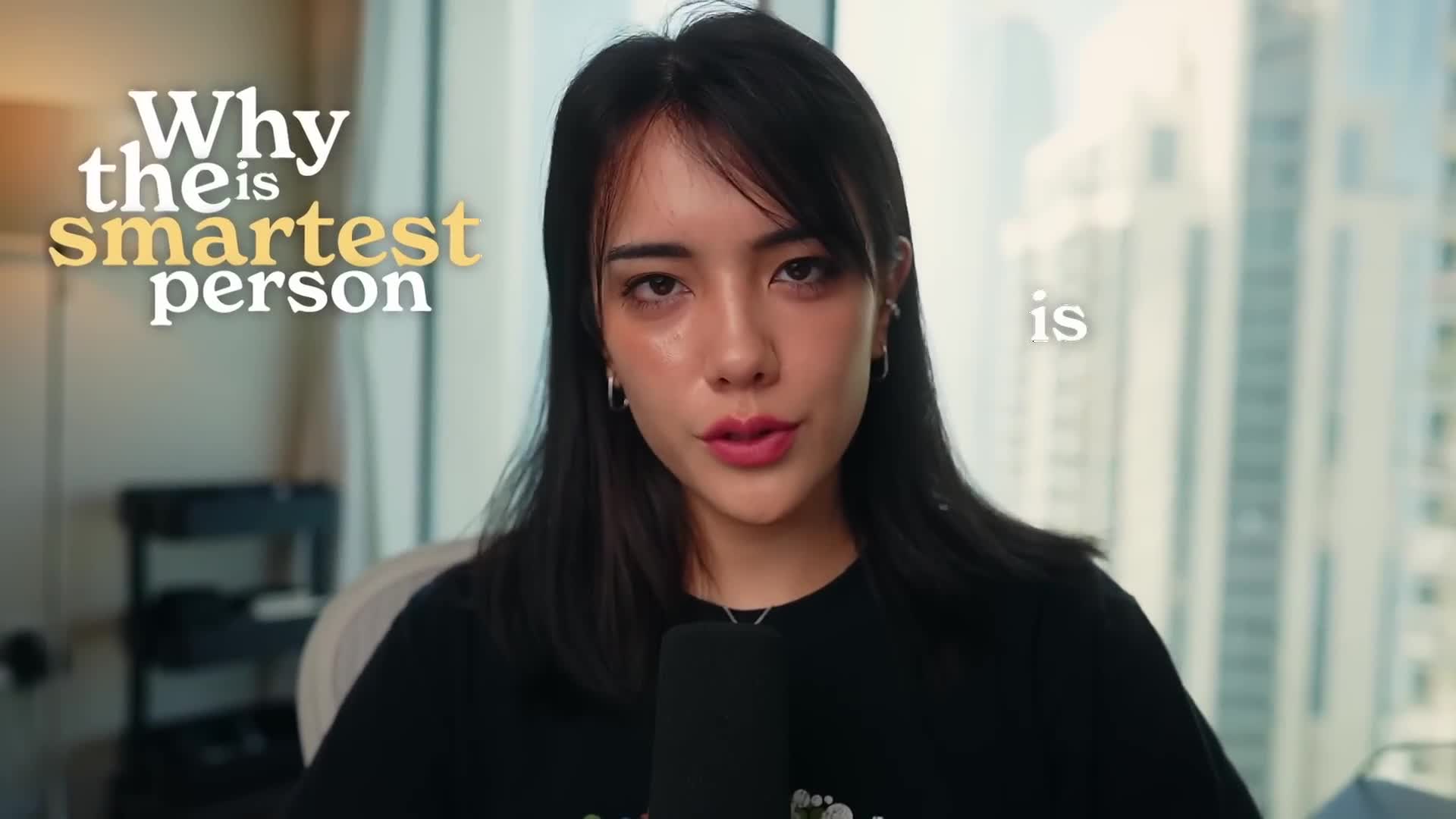
Why is that the smartest person in the room is usually not the richest?
You know what you should be doing, you researched it, you planned it, but when it comes to execution, your brain won't just let you do it.
Meanwhile, people who are less intelligent, less qualified than you, they're out there succeeding, making money and achieving their goals.
And you call this a procrastination, but it's actually not a procrastination.
It is something else.
Turns out that your intelligence, the thing that you thought that was your advantage, might be the exact thing that is holding you back.
I know that sounds backwards and maybe a little bit delusional, but how can being smart can actually keep you stuck?
Let me explain why and how to overcome this dilemma.
There's this thing called Dunning-Kruger effect, where people with low competence in a given domain tend to overestimate their abilities, and people with high competence in a given domain tend to underestimate their own abilities.
So when you have high intelligence, you usually have high awareness.
You realize all the areas that you don't know.
As my guy Socrates said, the only thing I know is that I know nothing.
But when it comes to less intelligent people, they usually don't see those gaps.
Even if they do, they have more of like not backed confidence or delusion.
That lets them start.
You know, they think they know enough, they think they got it, and they just do the thing, whereas you, you look at all the options and you start to analyze, strategize and prevent all the possible problems that you can encounter, and that creates an all analysis paralysis where you're like paralyzed by your own mind.
So what do you do when you have this fear of failure and analysis paralysis?
You get into the constant learning mode.
You think maybe if I learn more, I'll find the perfect path.
If I read one more book, then I'll start.
If I take one more online course, then I'll be ready.
And then you keep doing this again and again and again.
And the more you learn, the more you realize you know nothing.
When I started my YouTube channel at the age of 15, where I was posting makeup videos and diet videos which I have absolutely zero skills at, I was delusional.
I didn't even strategize.
I didn't look into ways that I can succeed.
I just had the vision of, I want to be a YouTuber and I can do it.
And usually people say confidence comes from competence.
But my confidence came from delusion, because I had low awareness towards how hard it is and how high the competition is.
I just believed that I can do and I just started posting.
And by constantly executing I learned way more than I could ever do by just consuming content about it.
And the thing is that if you're watching this video, you probably already do know what you need to do or want to do.
Your problem is probably not the knowledge gap.
You already have the enough knowledge to start.
But there's this disconnect between doing and knowing.
And that disconnect is basically your brain stepping in to protect you.
Because, when we think from the evolutionary standpoint, our ancestors, who were cautious about all the possible dangers, like maybe a lion or something, survived.
So they passed their genes to us.
Therefore, we are more careful towards all the potential things that can go wrong.
But in our current world, the world doesn't reward learning.
Like outside of school, Nobody cares about how much you know.
The only thing that people care is what you build, what you ship and what you create, because people pay for what you do and what you can offer to them.
And to achieve success in any realm, you need to do something different than the rest of people.
That's literally how success works, right?
Differentiation.
If the majority of people are stuck and keep learning and also not taking action, then wouldn't taking action already put you one step ahead?
You don't need to be perfect or you don't need to know everything that you possibly can.
You just need to be doing while everyone else is preparing.
And for this, you don't need to be smarter.
You don't need to have a better plan, because executing on a mediocre plan is always better than never executing on a perfect plan.
And I am literally the victim of my own mind.
When I just started YouTube because I was delusional and I did not know I thought, if only I post more videos, I'll just succeed.
That was the only thing that I was thinking.
So I posted and posted and posted.
And yes, people around me were making fun of me but I was like yeah, but like it's gonna work, because i was not aware, i was delusional.
But now, because i have 14 million subscribers and i made so many videos and i know how youtube works, now i'm in this analysis paralysis mode, where i'm analyzing every single strategy that i do, whereas i could probably figure out that answer if i would just post the video, look at the analytics and then decide what to do next.
But because Now I know a lot of things.
I'm like, I can do that.
If I do that, this will happen.
But what if that happens?
And that keeps me stuck.
And that's probably thing with you as well.
But we have to get back into that.
I'll just figure out how things go.
I will learn by doing.
I don't need to be ready to start mindset.
And this actually does not only apply to me.
And I'm not the only one that achieved and got the things that they want.
There are so many examples of of people who executed on messy, sometimes silly, imperfect plans in one.
And if you've been stuck on searching the perfect business plan to execute instead of just starting and testing it, I have a perfect, free guide that I found for you.
It's basically called How to Get Your First 100 Customers and it shares seven real stories from Sam and Sean from My First Million podcast People who did simple, sometimes stupid and imperfect things that actually made money.
Like one of the ideas was literally wearing a costume to festivals just to test their idea.
Another like story that they have is that they hosted a party just to see whether people will like or be interested in what they're building.
They didn't do like market research, just now read so many books about it.
They just hosted a party and then got their data from actual people.
Are they the best strategies?
Probably not. but they worked.
And in the guide you'll see the actual numbers, the tactical takeaways from each story, plus a three phase action plan that takes you to execute, so that you can go from zero to 100 customers, which is usually the hardest part in business.
And they also give you a specific moves for each stage.
My favorite part is where they talk about how like, successful people aren't planning everything perfectly.
They're just moving faster than you.
And they're saying that they didn't know everything from the start.
They just got started sooner.
This free guide comes from The Hustle, who is currently sponsoring this video.
Thank you so much.
And if you're interested, the link is in the description.
Grab it.
It's free and it's really helpful.
Okay, so now you understand the trap.
But how do you actually execute on it, right?
Because it's easier said than done.
The first step is actually the mindset shift.
And literally, this is the thing that I'm struggling the most still.
Because at the beginning, you think it's a knowledge gap.
And that might be true, right?
Like, you know nothing.
Therefore, you need to do a little bit of learning.
That's true.
But once you get to this never-ending loop of, I actually need to learn more.
If I just learn a little bit more, I'll be ready.
And then I'll start.
I'll finish this and then I'll start.
But then you never start.
Like that end never comes.
And that is the loop that we need to get out of.
Because I realized that actually the correct mindset if you want to achieve success in any realm is not learning and then doing.
It's learning by doing.
And I think the reason why we avoid doing so much by learning is, first of all, I think there are a few reasons, but one of them is learning feels productive and you never fail by learning right.
Because you never try.
So there's no failure.
So you feel productive and you keep yourself away from failure.
So it feels safe.
The second reason I realized is that we almost treat the success stories or the lessons or strategies that successful people use as just the one truth.
And this is one of my weakest points.
I tend to see the world black and white, but it is not like that.
There is no one way to success.
So I actually realized that everything we know is just an assumption. until it's tested in reality.
Because I think about it.
You know the courses, the books, the research, everything in the world that worked for other people in other scenarios, that have other tendencies in different timeframes.
So sure they are helpful to guide us and give an inspiration towards the direction that we want to go.
But the only way to figure out what works for us is by trying it and then figuring it out.
There's no one way to succeed.
I also realized this when I was growing my YouTube channel.
I disagree with so many advice that the people that I looked up to.
I did the exact opposite thing and we still got similar results.
So actually the question is not really about how do I learn more, but how do I execute more?
And how do I use information to help me execute more?
Because the whole reason why you're learning something is so that you can use that knowledge.
If you can't use it or put it in practice, then it's actually useless in real life, unless it's a hobby.
Okay, so what is the exact system to learn by doing?
Because I'm an overthinker.
I also analyze why I am not able to execute, even though I know I should be executing and learning by doing.
Because I'm such an overthinker that I even thought about it and I... learn about it okay so let me share it so that i won't be wasting my time i realize that biggest reason why many of you including also myself don't take action is even when we have enough knowledge is because we're treating everything like a goal and goal activates our fear of failure because goals are binary it's either win or fail either you hit that goal or you don't there's no in between and also a lot of goals include metrics that we cannot control like for example i want to make this this much a month That's literally me every single night.
Even though I can do things that can help me make money, I cannot really directly control how much money I will make this specific month, right?
I cannot control you to give me money.
So when that happens, when you realize that you either win or fail, you start to freeze and try to logic your way out so that you won't fail.
And you strategize more and more, you analyze more and more and You get this all or nothing attitude.
But if you don't specifically have a goal, how do you even motivate yourself or find the direction that you want to move right?
And there's this like book called Tiny Experiments by a neuroscientist called Anne-Laure LeCunf.
I don't know how to read it.
And it gives you basically a framework to how to achieve things that you want to do without setting any goals.
It basically all starts with an observation, actually.
You just take notes on what you're curious about.
Like, what keeps coming up?
What do you keep thinking but not doing?
You just take notes.
And then the second step is forming a hypothesis.
Based on the notes, you form a hypothesis, not a fact.
You just guess.
You know, you tell yourself, maybe if I would do this, this thing, I would enjoy it more.
Therefore, I'll do it more.
Maybe doing this in this particular way maybe helped me to get the results I want.
You're not declaring like this is the answer.
You're just curious and you're just trying to form a hypothesis.
Then the step three, design your pact.
Then you basically design what's called a pact.
It's like a commitment to your curiosity.
It basically stands for purposeful, actionable, continuous, and trackable.
In a simple format.
You can design your own tiny experiment by following this pact.
Formula is basically this
I will action for duration.
So an example could be i will write a weekly newsletter for the next six weeks, or i will go on a daily walk for the next two weeks, or i will post one youtube video per week for the next eight weeks.
Then you just do it.
You don't analyze it midway, you don't judge yourself, you just conduct the experiment.
And once you're done, you look back and see how you felt.
What did you learn?
And based on that, you can either design the next experiment or keep continue doing the thing if it was working.
This actually changed, like everything that I see and every single goal that I set for myself actually.
The reason is because you can actually run these experiments tiny experiments without quitting your job or without making a significant change in your life.
Like you don't have to change everything in your life to conduct a tiny experiment.
And you can also experiment in different areas.
Like it could be in business, it could be in health, it could be in relationships, or it could be even maybe in hobbies.
And when you treat life as an experiment and develop this experimental mindset and not a goal experiment, goal-focused mindset failure actually doesn't exist, because any result that you get is actually a data, a feedback, an answer to the question that you were looking for.
And when you have this tiny experiment, I think mindset, you switch to the learning by doing mindset instead of just I got to learn so that I'll succeed and I'll never fail, kind of a mindset.
So I'm taking my own advice, okay?
Because the whole reason I was researching on this video was to solve my own problem of constantly learning and never executing.
So basically what I'm experimenting with is that the biggest issue that I have in my life for like the last one and a half years is that I am not consistent on making videos.
When I am consistent, when I'm on the flow, I go all into that, like content creation.
I do nothing else in my life that I burn out, and then my mental health suffers a lot and then I cannot recover and then I disappear months and months.
You guys already know my pattern if you've been following me for a while, right?
So to solve this issue, I was like keen to read a bunch of books and also listen to podcasts about other YouTubers, how they are being so consistent about it.
And I literally had a playlist of 20 videos that I was about to watch.
But then I reminded myself about this tiny experiment and I was like, okay.
Let's apply it in my life and let's see how this goes.
So basically, my hypothesis is that I struggle with consistent effort or consistent, sustained periods of work.
For example, think about a traditional 9 to 5.
From Monday to Friday, you'll work from 9 to 5.
It's like fixed and you do keep doing it.
But it My brain does not work that way.
I'm in a creative field.
I'm not in a linear field.
Therefore, some days my energy is like 120.
My focus is over the roof.
And some days it's in the minus.
Some days it takes me like five hours just to sit down and reply to an email.
So instead of forcing myself to perform the same every single day, I thought to myself...
What if I actually work in three-day intense work sprints and then four-day complete off cycle and work at the library or something for 12 to 14 hours during those intense sprints?
And my hypothesis is that I will enjoy it more because when I'm in the flow, nobody can stop me, but it takes time for me to get in that flow.
And I can not get every day into that flow.
If I do this, I'll have a better work-life balance.
Therefore, I will be less likely to burn out, post more and be more consistent, because it actually matches the kind of a brain that I have.
So you might be thinking like, oh, but this is not balanced.
This is not healthy.
We don't know.
We have not tried it yet.
Old me would be saying like, oh, I'll burn out if I do that.
But you have not tested it yet.
So it's just an assumption.
You got to test it in real life.
So I actually started to run this experiment.
And so far, it's actually going so well.
I started to go to the library and I just go there and lock in.
And I feel less alone compared to working from home alone.
And because there are other people around me working as well, it motivates me to keep pushing.
And I'm able to sustain my focus focus for way longer than I thought I could.
The only reason why I'm able to do this and started to find a rhythm that actually works for me is because I did not analyze it and I started taking an action and running this tiny experiment.
And right now I'm not judging it.
I'm not trying to optimize it.
I'm not trying to analyze it or improve it.
I'm just going to conduct the experiment and see how it goes.
And I want you to apply the same mindset to your life, whether that's business, whether that's fitness, or whether that's a relationship goal that you have.
I also want you to apply this tiny experiment mindset, okay?
Learn by doing mindset.
I know it's so hard.
I know because I am you.
It's very uncomfortable.
But when you think in terms of tiny experiments, actually, it becomes really fun.
You're like, oh, okay, it didn't work.
And then you just take it as a data point.
And then you learn more.
So what I want you to try is I want you to pick one thing that you've been overthinking.
Okay?
Just one.
And then turn it into a small experiment.
Remember the formula.
I will bracket action for duration.
And keep it small.
Maybe one week or maybe two weeks if you're feeling fancy to just start.
Make it something that you can do maybe daily or weekly and make it trackable.
Okay?
You're going to track whether you did it or not.
If yes, how did it go?
If no, why didn't you do it? because it's data.
And to make things easier for you, I actually made a tiny experiment tracker to help you find your own tiny experiment, track it and find your answer.
Links below is free.
You can download it and use it.
And I also want you to share in the comments what you decided your tiny experiment will be and what you've been overthinking.
Because I really want to know you what you've been overthinking, because I'll overthink it, every single thing.
Don't judge whether that's right or that is the correct way to do it or the best way to do it, okay?
Just run the experiment and see what you learn.
And just by doing this, you'll learn more than three months of doing than three years of planning.
And because you're intelligent, you'll also iterate faster.
You'll see what's working, what's not working, and then improve from there.
You just need to start.
Just need to start inputting it in my brain as well.
Let's go.
Don't forget to subscribe.
Okay.
I worked on this video for such a long time.
Please subscribe.