This message comes from Progressive Insurance and the Name Your Price tool.
It helps you find car insurance options in your budget.
Try it today at progressive .com.
Progressive Casualty Insurance Company and Affiliates.
Price and coverage match limited by state law.
Not available in all states.
You're listening to LifeKit from NPR.
Hey, everybody. It's Mariel.
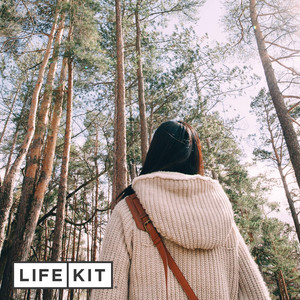
Isn't the forest a magical place?
Like when you really venture into the woods, and you see these century -old trees towering over you, sunlight twinkling through them, and spiders weaving their elaborate webs.
The smell of pine needles is in the air.
Birds are tweeting.
You hear a mysterious sound that you're not going to pay too much attention to but you really hope is not a bear.
There is a moment of awe that happens when you step into a forest. And I think a lot us can sense that forest bathing or taking in the forest through your senses makes us feel better and calmer.
I was surprised to learn that there are decades of scientific evidence backing that up.
A lot of the evidence comes from Japan where the term forest bathing originated in the 1980s.
Over many years researchers have shown in peer -reviewed studies that time in the forest is a kind of medicine.
Forest bathing helps your immune system by increasing your levels of anti -cancer proteins and immune cells that kill tumors.
It's been shown to lower blood pressure and stabilize blood sugar.
It can help with depression.
It can lower adrenaline and turn down the dial on your body's fight -or -flight response.
What we could see in the data was that as soon as somebody came into proximity of a tree and they were just present and mindful, paying attention and appreciating the tree, that they're basically the parasympathetic activity, which is the relaxation response in the body, was increased.
I know, all of that from spending time with trees.
On this episode of Life Kit, we will talk about how to forest bathe, using the research as our guide to what works, and we'll share some exercises to get you started.
Feel free to head outside to listen to this one.
If, like me, you're wondering why forests are so good for our health, there's an evolutionary hypothesis for this.
Simply put, for much of human history we lived in nature.
So the thinking is, because we evolved in nature… We have a biological need to connect with nature.
So we love nature because we learn to love the things that have helped us survive.
That's a professor at Nippon Medical School in Tokyo, and the president of the Japanese Society of Forest Medicine.
He's designed and carried out a lot of Japan's research on forest bathing.
Another expert you'll hear from in this episode is Gary Evans, director of the Forest Bathing Institute in the UK, which was heavily inspired by Dr. Lee's work.
Gary says at this point we can survive without exposure to nature and forests specifically.
But there's a difference between surviving and thriving.
All right, let's get thriving.
We're going to start with some forest bathing basics.
Gary says a lot of the time when we head to the woods or a hiking trail, nature is a backdrop.
You know, it's secondary.
So we might be walking and talking with a friend, running, cycling, horse riding.
But he says if you want to get all the benefits of forest bathing, your primary focus should be connecting with nature.
So takeaway one, really let yourself bathe in the forest. It's It's kind of like bathing in your tub.
You're there to relax and dwell on the experience.
You say, OK, I'm going to go to the park, I'm going to go to the forest, I'm going to appreciate the natural beauty.
So that's the first thing, set the intention.
Ideally, you can also set aside an entire morning or afternoon for this because...
The important thing for people listening to remember is that relaxation is not like an on -off switch. As for how much time, Dr. Lee suggests two to six hours.
The longer the better.
The longer is more effect.
His research shows that the health benefits can last for as long as 30 days.
So aim to do this once a month or maybe more often if your sessions are short.
So you can build up the dose?
Now let's talk for a minute about location.
A nice patch of forest or woods is best, but if you don't have one nearby, you could get some of the same benefits from a city park if it has a lot of trees and quiet spaces.
So, if you travel one day to visit the city park, you also can get beneficial effect.
But, he says, the effects will be smaller.
Lastly, before you enter the forest, do some basic wilderness prep.
This is not an exhaustive list, but that can include sunscreen, which you should be wearing every day anyway, also bug spray and long pants to protect you from ticks and plants that'll give you a rash, and check the weather ahead of time.
Make sure it's safe to venture out.
Also remember to stay on the marked trails and check yourself for ticks after too if those are a problem in your area.
Alright so we're into the woods.
Next up, takeaway 2, slow down and disconnect.
Your forest bathing session is a good time to sit or to walk or to do some gentle yoga or tai chi.
It's not the time to squeeze in your hardcore cardio for week.
So the next difference between normal activities and forest bathing is we're going to move very slowly in forest bathing and we want to reduce the heart rate.
Also, Dr. Lee says if you tire yourself out physically, your tiniest will reduce the effect of forbidding.
So when you get to the forest or the park, maybe you walk a little bit and then find a spot that speaks to you.
It could be a clearing in the woods surrounded by a bunch of tall trees or a spot where a tree has grown into a curved sheet that looks suspiciously like a seat.
If it feels beautiful and resonant to you, that's what matters.
Now, sit down. And then just be present with the environment.
And leave the phone alone.
All right. You're settled in.
Your phone is turned off or at least put away.
It's time to engage your senses.
The sight, hear, taste, smell, and touch. We're going to start with smell and inhalation because Dr. Lee says, based on his research, many of the benefits of forest bathing come when we inhale the chemicals that trees release into the air.
They're called phytoncides.
And when we breathe them in, they, on their own, can do things like reduce our stress hormones and increase our levels of anti -cancer proteins.
Dr. Lee has done experiments on this.
His team ordered these special concentrated essential oils made from Japanese cypress trees and then pumped them into the hotel rooms of test subjects using a diffuser.
The people staying in those rooms saw many of same health benefits as the ones who did a forest bathing session, just to a lesser extent.
So as a side note, if you can't make it to a forest, Dr. Lee says you could get some of the benefits by diffusing tree -based essential oils at home.
But yeah, takeaway three is to breathe it all in and ask yourself, what do I smell?
Behind each smell in the forest is an exquisite, wondrous fact.
For instance, the flowers on trees emit a fragrance so they attract bees with the promise of food that's packed with energy.
According to researchers at the University of Tel Aviv, a plant called the evening primrose will actually pump up the concentration of sugar in its nectar when bees are buzzing nearby.
I learned that from a book called, Forest Walking, Discovering the Trees and Woodlands of North America written by Peter Wohlbein and translated by Jean Billinghurst. I also learned that the earthy smell underfoot in comes from insects, bacteria, and fungi breaking down leaves and rotten wood, and that process will enrich the soil with nutrients.
So the advice here?
Notice what you smell.
And maybe later, follow your curiosity to learn more.
You can also try some breathing exercises because there's a big mindfulness component to forest bathing.
In addition to being a forest bathing researcher, Gary is a yoga and mindfulness teacher.
And he says the practice of meditation started outdoors.
Buddha had his awakening underneath a tree.
No coincidence that the trees were there right at the start of this.
So here's an exercise to try as you're sitting among the trees.
So if you inhale for a count of one, two, and then you exhale for double the length of time.
So it's one, two, three, four.
more. And so you keep that going inhaling for two, exhaling for four.
When the exhale is slower than the inhale, it sends a physiological message to your body, I'm safe.
I can relax. It's okay.
This breathing exercise has been shown to have benefits on its own outside of the forest environment.
The reason to do it in the forest is to allow yourself to relax.
What happens on the physiological level is When our parasympathetic fires up and we slow down, nature comes into sharper focus, so there's a change of perception.
And it gets easier to notice things—sounds, colors, textures.
And that's takeaway four.
Engage your other senses.
Listen for the rustling of chipmunks, the gurgling of a creek, the groan of branches in the wind.
And notice the colors—bright red leaves exploding from trees, light green ferns creating a canopy cover for the ground.
When you observe nature, that can slow down your fight -or -flight response and lower the levels of stress hormones in your body.
You can also take this moment to touch some stuff.
No, no, no, not the poison ivy.
You know what? Why don't we start with the tree?
Go ahead and feel its bark.
Is it rough or smooth?
Does it have any scars from old branches?
Another sense you can use in the forest is taste.
I mean, you have to be careful.
Don't just pick up a mushroom and start eating it.
But, if you learn about plants and foraging, you can add that to your forest bathing practice.
You can also buy teas and tinctures from trained herbalists in your community and then bring them to the forest with you.
Lucretia Van Dyke is an herbalist, a ceremonialist, and author of the book African American Herbalism, a Practical Guide to Healing Plants and Folk Traditions.
I always laugh. I'm like at this point of my life I'm so into herbalism that if you can't talk about plants, I don't really know what to talk about anymore.
One of her favorite trees is the mimosa tree.
It has these Dr. Seuss like pink flowers on it.
Also, herbalists use the flowers to help people work through grief.
So sometimes she'll take a couple drops of a mimosa tincture in her mouth.
And then I go sit with the plant and I hold the flowers and I'm laying there with the plant and staring at it and it becomes like this full circle thing.
That brings us to takeaway five.
Go deeper. here. Work with the forest to process what you're going through.
Gary says you can see nature as a mirror.
So, depending on what's happening in your emotional world, quite often when we look at nature or the forest, it sends something back to us to help us make sense of what's going on in our life.
The Forest Bathing Institute, which he runs, leads group trips to forests in the UK and around the world, and people have told him that forest bathing helped them work through grief.
Actually, a number of them that have come on our sessions have found that it's been very helpful to go into the forest and see the natural cycle of life.
Somehow it's enabled them to reconcile what's happened.
In the forest, dead trees provide homes for woodpeckers and owls, and when they fall down they become hiding spots for frogs and other creatures, and they provide a space for mushrooms and moss to grow.
In death, they support life.
Another metaphor. Think about how trees communicate with each other through their network of roots underground.
It's a stark contrast with how isolated many of us feel these days.
Lucretia shared this exercise.
So a beautiful practice I feel like is imagine how all these roots are touching and watering each other.
And if we need to, to like imagine, you know, even energetically, like my family lives in North Carolina and I'm in Louisiana.
So energetically like, you know, when I imagine that tree and touching that tree I can imagine myself and my spirit being at home with them.
And if you want to try something a little more spiritual while you sit in the forest ask a tree or a plant to tell you about what medicine it holds.
You know, let me feel, you know, your medicine.
Let me to understand your medicine, because it's a lot how the original people did it.
It's not like they had a book way, way, way back in the day that told them, this plant does this, this plant does that.
And then you can always compare what you imagine to a book.
When you spend time in nature and around trees, that can also be an opportunity to think about the folks who came before you, whether that's deep in the forest or even in your neighborhood.
Lucretia told me about the Tremé district of New Orleans, known for being among the oldest African American neighborhoods in the country.
And it has been, you know, cut in half by a highway.
And it's also been, you know, very gentrified.
She likes to look at the neighborhoods' oak trees draped with Spanish moss, and imagine what have they seen?
I try to imagine like the old Creole neighborhoods and how, you know, people of color came together and watched each other's children and built what is now revered today as the birthplace of jazz.
Like those trees have heard some of the original jazz greats ever.
She thinks of generations of kids playing and families sprawled out under the trees.
It puts me in old New Orleans and in those old community moments that don't exist, or they exist in a new way.
I'm sensing a parallel here, right?
Trees bring people together.
We sit under them in the shade and picnic, we gather around them and harvest their fruit.
But they're in community with each other, too — the young and the old propping each other up and sending each other nutrients through their networks of roots.
There's just so much wisdom that trees and plants hold for us when we pay attention.
All right, time for a recap.
If you want a forest bathe, go to a place that has a lot of trees with the intention of appreciating and focusing on nature.
The trees shouldn't just be a backdrop to some other activity.
Go slowly, take it easy.
This isn't about doing heavy cardio.
It's about slowing down your heart rate and getting to a calm place where you can start to see the wisdom that nature offers.
You can also try some simple breathing exercises, slow yoga, or Tai Chi, or do meditation exercises that use the metaphors the forest provides.
On that note, Lucretia is going to walk us through one more forest meditation.
Settle down next to a tree and take some deep belly breaths.
I like for people to imagine your legs being like old tree trunk roots that roots you deep in the ground like the tree.
So when I take a deep breath, I imagine the energy and love from our ancestors, or from Mother Nature, coming up those large roots into your legs, into your abdomen, belly expanding.
And then as you exhale, sometimes I do a practice of shedding the things that no longer serve me, shaking off the day.
And then she exhales and says a prayer of gratitude to Mother Nature.
This episode of It was produced by Claire Marie Schneider.
Our visuals editor is Beck Harlin and our digital editor is Malika Gureeb.
Meghan Kane is our supervising editor and Beth Donovan is our executive producer.
Our production team also includes Andy Tagle, Margaret Sereno, Sam Yellow Horse Kessler and Sylvie Douglas.
Engineering support comes from David Greenberg.
I'm Marielle Segara.
Thanks for listening.
This message comes from Amazon Business.
How can you grow your business from idea to industry leader?
Bring your vision to life with smart business buying tools and technology from Amazon Business.
From fast free shipping to in depth buying insights and automated purchase approvals, they deliver everything you need to achieve your goals.
It's not easy to stand out from the crowd.
Simplify how you stock up to get ahead.
Go to AmazonBusiness .com for support.