NPR.
This is The Indicator from Planet Money.
I'm Darian Woods.
I'm Waylon Wong.
And I'm Adrian Ma.
And we're here today to discuss rotisserie chickens.
Oh, finally!
I love a rotisserie chicken, but we're actually here to tackle your listener questions.
So today we're looking at what the heck the M2 money supply is, how AI chatbots affect blind or low vision people, and whether rotisserie chickens are actually more difficult to buy.
Oh, so we are talking about rotisserie chickens.
This message comes from BetterHelp.
February is full of flowers, candy and lots of relationship talk.
It can feel like everyone has it all together in their love lives, but the truth is they're still figuring it out.
And whether you're married, dating or prioritizing being single, just remember you're right on time.
Therapy can take the pressure off and help you feel lighter.
Just a little outside perspective from a professional can lead to new understanding and a lot of progress.
Visit BetterHelp.com slash NPR for 10% off.
This message comes from Capella University.
You know that feeling when there's a spark building inside you that you were meant for more?
That's your own drive pushing you towards what's next.
Capella University gets that.
With their FlexPath learning format, you can set the pace and earn your degree without putting life on pause.
You've built experience and know what you're capable of.
Now, this is your time to turn that momentum into more.
The only real question is, what can't you do?
Learn more at capella.edu.
Our first listener question comes from Chaya Simkin.
And I am from Haifa, Israel.
I just listened to your episode on getting interviewed with a chatbot.
I've heard repeatedly that 70 of blind people worldwide who are capable of working don't get hired because of the stigma.
Would a chatbot help to eliminate this bias?
OK, when we did our episode on these chatbot interviews, I remember the takeaway being surprisingly positive that AI job interviews led to better hiring outcomes.
People felt less discriminated against, although we did not talk explicitly about blind candidates.
That's right.
So we took this question to our original source for that episode, Brian Jabarian.
As a reminder, Brian is a fellow at the University of Chicago School of Business.
And he says he hasn't specifically researched how blind candidates do in AI interviews.
But it is possible that a blind candidate might face less discrimination if the AI interview is voice only.
They remove visual cues.
So on that front we could say that there is some potential for AI to reduce some form of like visual discrimination.
Now, that's if the interview is audio only.
But then what about if the candidate has a certain accent or a really high voice or something that the AI might be trained to dislike?
Here again, he says there's a lack of research so it's hard to predict how a job candidate's vocal characteristics might be judged by an AI interviewer.
Though interestingly, there is some research suggesting AI has a harder time understanding certain kinds of accents and non-native English speakers.
So, Haya, I hope that partially answers your question.
I wish we could give you a more definite answer, but thank you for raising this, because I definitely think it points to an issue that's worth paying attention to, as more companies use AI in their hiring processes.
For sure.
Okay, thank you for that, Adrian and Haya.
Now on to Darian.
It's time for your question.
Okay, my question is from DJ Starfox.
This is an alias, like an internet kind of thing from Mike.
And here's Mike's question.
Hey guys at The Indicator.
I heard the Fed is buying treasuries again.
And I heard in an article it mentioned something about the M2 money supply.
Can you tell me what that is?
And should I be concerned about my retirement account?
Thanks a lot, guys.
Ah, yes, good old M2 money supply.
Dare I say my favorite money supply.
Is it actually?
It's either that or it's Scrooge McDuck's giant vault of gold.
That gold is appreciating rapidly.
Scrooge McDuck was onto something.
Leaving aside the McDuck vault, there are three often discussed ways of defining money supply.
These are ways of measuring how much money we have in the economy, which is an important question because there's often a connection between the amount of money we have and inflation.
Macroeconomics 101.
Lay it out, Darian.
So the smallest definition of the money supply is what's known as the monetary base.
And that includes all the coins and bills in circulation plus the balances within Federal Reserve Banks.
Next up is the M1 money supply.
That also includes all the coins and bills.
Plus it includes money in your checking account or other very accessible accounts.
All right.
So you've got two slightly different ways of counting up coins and bills.
And then M1 also includes the money we see in a lot of our bank accounts.
Exactly.
And the M2 money supply definition expands on this even further.
It holds everything in M1, plus some CDs or certificates of deposit.
You know, when you lock up your money for a set period, until it matures.
It also includes the money in these special accounts that everyday investors might have with investment brokers money market funds.
So Mike slash DJ Starfox asked if he should be worried about his retirement accounts because of how M2 might be affected by the Fed buying treasury bonds.
Right.
So for some background to this question, in December of last year the Fed went from letting its treasuries leave the balance sheet to buying treasuries again.
When the Fed purchases treasuries, it increases the money supply.
Anna Kovner is the director of research at the Federal Reserve Bank of Richmond and she says that was mostly a technical measure.
To make sure that we maintain ample reserves in the banking system so we can have smooth functioning in short-term funding markets.
And to avoid market stress.
As the economy grows, after all, the reserves in the system needs to grow naturally too.
So the Fed buying Treasury bonds wouldn't necessarily affect DJ Starfox's retirement account.
Like, they wouldn't make his investments worth less or something.
Not materially.
Anna says we can leave that to interest rates.
Because that's the main mechanism through which we are trying to stimulate or restrict demand in the US economy.
So your retirement's going to move with depending on the nature of the assets that you hold in your retirement.
So Mike, Mr Starfox, if you're worried about your retirement account, watch the Fed's interest rate decisions.
And thank you for your question.
On to yours.
My question comes from Anne Crowley.
She's a 95-year-old listener in Rotterdam, New York.
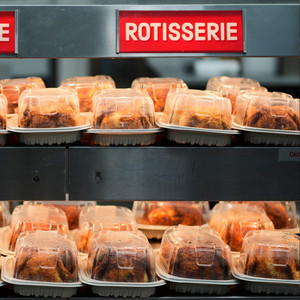
And her story was so good, we had to interview her because her question is about rotisserie chicken.
Well, as a professional dancer, we are always very, very into nutritious food.
But now, since I'm on a fixed income, it's even more important than before.
Every week her son takes her to the local BJ's to go grocery shopping, and she always picks up a rotisserie chicken, no problem.
Now, the last few months, there have been no chickens.
The hot plate is cold and there's an angry mob standing around waiting.
Angry mob?
That sounds a little scary.
I noticed the crowd, the angry crowd, standing there again by the table.
So I asked one of the women, I said, what's going on?
She said, rotisserie chickens are coming out in 15 minutes.
So I waited on the line like on a bread line in Russia.
And sure enough, out came the chickens and the mob pounced.
And I, of course, pounced with them since I was part of the mob.
And lucky to get one.
But my thought is, what is going on with these chickens?
The mystery of the rotisserie chicken has been haunting me.
This reminds me of like a Soviet aphorism, which is, if you see a line, just get in line.
Don't wait to ask what it's for.
Just get in that line.
I love this.
And also I have noticed long lines at my Costco for rotisserie chickens, like people waiting for the chickens to come out.
And then it's also like this hungry mob descending on the employee.
So, of course, we had to answer Anne's question.
So we went to Michael Baker.
He's an equity research analyst covering retail stocks like Costco, Walmart and BJ's.
He says there is something going on with rotisserie chicken.
There is more demand than usual.
It's a great bargain.
People really like it.
There's a lot of inflation in the economy.
This is one area, one product that hasn't seen inflation.
Now to be clear, chicken has seen some inflation, but not so much that it's put it out of reach for a lot of people.
So if it seems like rotisserie chickens are harder to get in the grocery store, there is some validity to that.
The weather in the country right now.
The storms that we've seen has caused some disruption in terms of supply chains for a number of products including potentially, rotisserie chicken.
But I think the bigger issue is demand has been really strong for that product.
Yeah, demand is strong from Anne.
It's strong from me and all the other angry mobs out there at their grocery store.
Just picturing Waylon at her local Costco just throwing elbows.
Oh, yeah.
They've got my picture up on the wall in front.
They're like, do not admit.
So those are our listener questions.
And if you have a question for us, you can always email us at indicator at NPR.org.
Or if it's more just compliments that you want to share with the world well, leave us a review on your podcast app.
Thanks so much.
This episode was produced by Cooper Katz-McKim and engineered by Sina Lafredo.
It was fact-checked by Sierra Juarez.
Cake and Cannon is our editor, and The Indicator is a production of NPR.
On River to River, we talk to people impacted by change.
Unless they hear our stories, it's not going to have the same effect.
And how to accept change.
A little bit of humility and a little bit of genuine human interaction really matter.
Understand our changing state on River to River, an Iowa Public Radio podcast.
Part of the NPR Network.