at New Balance we believe if you run you're a renter however you choose to do it because when you're not worried about doing things the right way you're free to discover your way and that's what running is all about run your way at newbalance .com running At the UPS Store, we want to make this summer the summer of shipping.
Summer shippalooza!
So you can start crossing items off your must -ship list. Like the vintage film camera your college kid needs for class.
Or the vase you told your mom you would send her ages ago.
And with our pack -and -ship guarantee, your items arrive safe or we reimburse you.
So stop by your local store today for everything you need to be unstoppable.
Visit theupsstore .com slash guarantee for full details.
Available at participating locations.
Most locations are independently owned.
Product, services, pricing, and hours of operation may vary.
See center for details.
The UPS Store. Be unstoppable.
The White Mountains in New Hampshire are known for their rugged beauty and unpredictable weather.
The highest wind speed ever recorded in the U .S. was atop Mount Washington, the tallest peak in the Whites, 231 miles per hour on April 12, 1934.
Yeah, it's often windy up there.
But the White Mountains are also known for gourmet meals served at eight remote huts that house weary visitors spending a night off the trail.
Crews of hikers who love to cook, or maybe cooks who love to hike, prepare legendary four - and five -course meals in these huts.
Our reporter Otis Gray hiked with one of these crews last July.
He wanted to understand why food prepared at the top of the mountain was so incredibly delicious.
Today on Proof from America's Test Kitchen, how does physical exertion and extreme environments change the way we taste our food?
I'm Jack Bishop. Load up your backpacks.
We're going hiking.
Hey, it's Ryan Reynolds here from Mint Mobile.
Now, I was looking for fun ways to tell you that Mint's offer of unlimited premium wireless for $15 a month is back.
So I thought it would be fun if we made $15 bills.
But it turns out that's very illegal.
So there goes my big idea for the commercial.
Give it a try at mintmobile .com slash switch. Upfront payment of $45 for three month plan equivalent to $15 per month required.
New customer offer for first three months only.
Speed slow after 35 gigabytes if network's busy.
Taxes and fees extra.
See MintMobile .com.
Hey, business owners.
We know you know the importance of maximizing every dollar.
With the Delta SkyMiles Reserve Business American Express card, you can make your expenses work just as hard as you.
From afternoon coffee runs to stocking office supplies and even team dinners, you can earn miles on all your business expenses.
Plus, you can earn 110 ,000 bonus miles for a limited time through July 16th.
The Delta SkyMiles Reserve Business card. If you travel, you know.
Minimum spending requirements and terms apply.
Offer in 71625. This episode is brought to you by LifeLock.
Between two -factor authentication, strong passwords, and a VPN, you try to be in control of how your info is protected.
But many other places also have it, and they might not be as careful.
That's why LifeLock monitors hundreds of millions of data points a second for threats.
If your identity is stolen, they'll fix it.
guaranteed or your money back save up to 40 % your first year visit lifelock .com slash podcast for 40 % off terms apply reporter Otis Gray has the story when I think about hiking I think about food like some of my favorite food memories if someone asked me what's the best meal I've ever had some of the ones that would make the short list are just simple meals that I've had at the end of hikes like this one time when I was hiking in the Alps.
I was with some really close friends and I was overlooking a glacier.
We made this little fire and we boiled water and we made standard instant ramen from a bag with a little seasoning packet.
We added some peanut butter because we had it and to this day, that is one of the best things I have tasted in my entire life.
But this same exact ramen recipe would taste whatever.
If I cooked it in my Brooklyn apartment.
So I was curious, what is that really?
What is happening in the body and the brain to make food sometimes just taste special?
Well, on a hot muggy July day, I decided to dive deeper into this question with some people who might really know.
What are you packing right now?
Um, bacon, some frozen veggies, and some fresh veggies.
I'm with a handful of 20 -somethings at the base of Mount Pierce in the White Mountains of New Hampshire.
Maddie, I'm from Amesbury, Massachusetts.
Cooper Young. My name's Natan.
I'm Noah. The leader of the pack, the hunt manager, Bethany.
Oh, yeah! There were six crew members that hiked up here today.
I talked to five of them.
They are part of a crew, spelled C -R -O -O, that does this climb twice a week.
They're all paid seasonal staff, mostly college kids who just like hiking and love the challenge of working in the mountains.
A truck just dropped off a bunch of fresh food here.
And now, they're hiking it up the mountain so that they can cook a four -course meal for a lot of hungry hikers.
Uh, what do I have?
That's Natan, a crew member in his early 20s.
He's from Brooklyn.
Looks like frozen vegetable, kale, and some Parmesan cheese.
Oh, okay. I'm not sure what I've got here.
Probably a combination of veg, and that's obviously a turkey.
And again, we can't explain on tape why we're bringing a French horn?
No. It's three pretty steep miles up Mount Pierce to the Mitzvah, which is an old school lodge that can house 60 hikers.
Each hiker packs about 50 pounds of food onto these archaic wooden pack boards.
It's about as primitive as you can get.
They kind of look like if you were to strap a small ladder on your back and then strap boxes and gear onto that, and then you kind of load it up high above your head.
So it's very practical.
They take a beating too.
They really loaded these things up.
If you want, you're welcome to try this on.
They strapped one to my back and had me stand up with it.
Oh, my God. That is deceiving.
Oh, but once it's up, it's not bad.
Crews like this have been hiking food up into the White Mountains to these huts for over a century.
They weren't always as organized though.
They also weren't hiking up Cale.
The huts were originally built here up in the mountains because despite the idyllic New England surroundings, the White Mountains can be brutal, and these huts provided refuge.
Back in the 1920s, two of the most well known hikers of the time died up in these mountains during a snowstorm in late June.
So these mountains are famously unpredictable.
They said it might hail, beautiful day out.
Hot, like 85 degrees probably.
It's really humid. feeling strong feeling good I'm a strong hiker so is my girlfriend grace who I'm hiking up with how you feeling grace stronger and better than you okay the pack boards full of fresh food the chance of a random hailstorm and dinner to prep for potentially 60 hikers we took off up the trail to see what's so special about dinner at 4 ,000 feet into the woods The woods here are lush, dense green forests, rivers and brooks running alongside the now well -worn trail.
Right at the beginning of the path, there's a plaque embedded into this big boulder.
Crawford Path National Recreation Trail, built by Abel and Ethan Crawford in 1819.
The oldest continuously used mountain trail in America, in the White Mountains National Forest. episode.
The first shelter was built in these mountains by the Appalachian Mountain Club, or AMC, in 1888.
It was a golden age of mountaineering.
People were hiking for recreation and for research. That first hut was the nearby Madison Hut.
It was a shack, basically.
Could fit about 10 people.
The mountains started getting a lot of traffic.
In 1906, an AMC guy named Austin Brooks asked, hey, can we start cooking for these hungry people?
The AMC said, yeah, sure.
So Austin and Brooks served the first soups, and became the first of a long line of high -altitude hospitality here.
Now there are eight huts.
The Mitzvah hut, which was the last one that was built, and the one we're going to, was built in 1964.
That same year, US Supreme Court Justice William O.
Douglas went on a Hut2Hut trip, and he loved the experience so much that he wrote a story about it for National Geographic.
Suddenly, this niche regional attraction went national, and the huts got very busy.
Since Since then, the AMC crews and the food that they've made have grown kind of a cult following.
There's even an AMC cookbook published by a couple who met on one of these crews a couple of decades ago.
Even if it's just their fresh bread or lasagna or pancakes, hikers have said it just tastes special up here.
And again, I get that.
I've experienced it.
But what is it? Why does our environment and state of being and maybe who we're with actually change the way that we taste things?
Smell and taste historically have been unsexy things to study.
This is Arielle Johnson.
There's, you know, been a few passionate weirdos throughout the years that have sort of maintained this field of study.
Arielle is the weirdo food scientist I've always wanted to talk to.
She founded the fermentation lab at the restaurant Noma and thinks a lot about how we taste and the huge amount of factors at play when we do.
She wrote an incredible science cookbook called Flavorama, which dives deep into where taste begins.
And that is flavor.
Very broadly speaking, flavor is a combined sensation involving mostly taste and smell.
Arielle is going to be kind of our omniscient Ms. Frizzle scientist throughout this whole expedition, breaking down how things affect the way that we taste.
So first off is understanding What flavor is?
Molecules. Basically, when we eat, we're ingesting molecules.
Through our mouth, through our nose, and through a term we call retronasally, which is like smelling through your mouth.
We have receptors made of neurons that catch those molecules and determine what they are.
Sweet, salty, sour, which senses acids, umami, and bitter, which senses many different potentially poisonous molecules.
Our receptors read those molecules and send a kind of flavor image to the brain.
Basically like a two -dimensional picture.
So like you could kind of think of it like a QR code.
And it turns out that QR code, that image in your brain, once that initial image is established, because it is just our mental perception, it can be heavily influenced by so many things around it.
At this point, Grace and I are about a mile up the mountain.
The hike to the Mitzvah is three miles, but it is completely uphill.
And it's not one of those easy, winding paths.
It's essentially a rock staircase the whole way up.
And when it rains, which it often does, you're basically climbing up or down a slippery riverbed.
And slipping is no joke, especially for the crew members here that are hiking over 50 pounds on their backs each time.
So even though Grace and I are strong hikers, it is an uphill climb, And we're beginning to sweat and we're starting to get hungry.
Hunger as an ingredient is this physiological state of like depleted nutrients in the body.
Hunger is the best sauce, I think it's also been put that way.
Didn't eat much this morning, so already kind of hungry.
Hunger is basically low blood sugar.
Your body telling you, hey, we need more fuel.
What are you hungry for?
Chicken was like, like the crispy skin.
Ooh. Wouldn't that be phenomenal?
Like salty crispy skin.
If you've like sweat a lot, then you can get a salt craving when your body is like low sodium.
Sodium, another kind of fuel we need to operate.
So when we're losing stuff like sugar and sodium, that can activate those cravings.
Which is why sugary or salty foods taste so much better when you finally get them.
Not fried chicken, like roasted chicken with crispy skin.
Yeah, yeah, that's the one.
And I also want to eat it with my hands.
Screw cutlery. If you are having intense emotions.
Two miles from the top, starting to get that, like, hiking high.
You know, hiking for a long time and being in pain.
Definitely starting to feel it in the legs.
Your brain is going to pay a lot more attention to, like, what is happening around you and within you that might be associated with those emotions.
We're close. Yeah. There's also, like, the anticipation of eating.
You hear that? It's a heartbeat.
That anticipation. On any hike, for me, but especially this one, when we know a big amazing regenerative meal is waiting for us at the top, my mind is already cultivating that expectation of food, of relief and sustenance.
I can taste salt, I can taste sugar, I can taste that cold sip of water that's going to quench my thirst. That's all going to like, come together to impact both flavor on a perceptual level, but also the emotional coloring of those flavor experiences and how intense they seem.
We did a peak of Mount Pierce.
It's amazing up here.
Basically, in our circumstances, the exhaustion we're experiencing, the environment, and the emotional state we're in, have already influenced how we're going to taste something before we even taste it.
You've primed this kind of like canvas to paint this picture.
Our senses are heightened, and once we do put something in our mouths, and we do start taking in those flavors and those molecules...
Those are going to be like painted in particularly intense colors.
That anticipation and desire and need for food, our taste buds are going to satiate that psychological need.
We are getting something we really want and worked for.
Looking down the ridge line, it just looks like this big snake that just goes up and up and disappears at this peak in the clouds.
We're at the peak and the mitzvah is still a mile back downhill.
Dinner's in a couple hours and we're ready for it.
I haven't really got to see just green stretching this far for a very long time.
You can see hundreds of miles in every direction, just like mountains behind mountains behind mountains.
After the break, a high -altitude gourmet experience.
And now back to our story.
We had pretty good weather coming up but on the final mile to the Mitzvah hut from the peak some light gray clouds turned into a torrential downpour oh it is absolutely boring looks like a big barn when we finally stumbled into the hut going inside soak to the bone we were greeted by Noah the cook of the day he was the crew member down at the bottom packing up a French horn he'd been at the hut for a couple hours already and was and starting to prep dinner.
Hello. Noah. Oh, you're Noah.
That's me, hey. I'm Otis.
Nice to meet you. Nice to meet you.
The crew takes turns being cook of the day.
Grace and I went upstairs to put our bags away and change out of our drenched clothes, feeling this strange mix of exhaustion and anticipation.
The Mitzvah is a big impressive cabin.
Rustic design, but a pretty dominating presence on the mountain.
Bunch of bunk rooms, running water, big dining hall with long tables.
On a given night, the mitzvah hut can house and cook for 60 guests, not including the 5 to 10 staff that are usually there.
We're serving 39 tonight, I think?
Everything here feels designed to offer comfort after a long, grueling hike.
Cold, sweet lemonade.
Lemonade after a hike.
God, that hits different.
Hot coffee, little baked treats the crew made that day.
We got maple, rosemary cornbread, lemon cake.
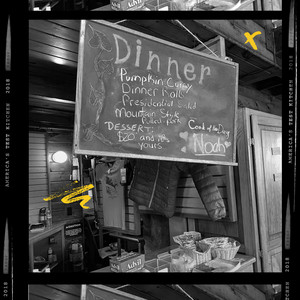
The promise of a hearty dinner, which is beautifully written on a chalkboard when you first come in.
We have pumpkin curry, dinner rolls, presidential salad, mountain -style pulled pork, and dessert.
What is it? Dessert's always secret.
Dessert is secret. Dessert's always secret.
Okay, so you can't say dessert.
Okay. Before dinner, I got to hang out in the kitchen where the five crew members we hiked up with are prepping in this commercial kitchen up in the mountains.
This is the kale I brought up today.
we're going to do a little goat cheese, walnut, cranberry.
They're all following recipes in this binder that lives in the kitchen.
All eight huts along the mountain range followed this master recipe book.
Yeah, so every Monday, every hut makes the same meal.
This is Maddie. And every Tuesday, every hut makes the same meal.
So if you're going hut to hut, you're not eating the same thing every day.
a lot of hikers that come here will do a stretch where they stay at all eight huts in eight days these meals being a kind of daily reward and the trail that these huts are on it's also part of the Appalachian Trail which starts in Georgia so some of these hikers started about five months ago five months and these huts are a massive reward for what's usually a seven -month hike right before before the trail ends in Maine.
And to be clear, there's nothing else like this along the Appalachian Trail, making this extra special.
In the kitchen, everyone's tasting everything to make sure it is, in fact, just that.
Currently, they're figuring out what the pumpkin curry needs.
Probably some lemon juice.
Lemon juice. Yeah, I'm thinking lemon juice.
Lemon juice would be good.
Yeah. Black pepper?
Yes. The crowd of the hut is a mixed bag.
There's a mom and her son.
She's been coming to the huts since she was a kid.
And now they go together.
Four women from Connecticut who met in college.
They'd stayed at a couple of the other huts in previous nights.
And then there was Fred.
This is Fred Woods.
I'm from Bushnell, Florida.
Fred's in his late 50s.
Kids recently went off to college, so he took himself out hiking for the first time ever.
When we met him, he was hiking southbound for about a month already, and he'd been foraging along the way.
So I fish, I eat chanterelle mushrooms, black trumpets, any berries I find.
But if you get to a place like this...
This is five -star dining.
It's ambrosia, you know, yeah, it's super good.
There was a big rowdy group of pre -teen girls from a nearby summer camp.
How was your day? It's pretty good.
It's been a hard hike.
I'm glad to be here.
There was an anticipation in the air that mirrored how I was feeling.
It wasn't just hunger.
It was that kind of craving your body creates when it's low on nutrients.
And that was setting in with everyone, desiring warmth and a little respite.
And everyone had their own things that they want to taste at the end of a day like this.
Usually like a big, juicy cheeseburger.
This is an easy question for me.
Just like a big old steak, mashed potatoes, and a Diet Coke.
I would hike for tacos.
For sure. Fatty pasta.
It would be like a bolognese.
Probably some mac and cheese.
Why mac and cheese?
Because it's my favorite.
Cheese is the best. Notably, not a nice light salad or something like that.
All the cravings were for food that were going to give back what you lose during a hike.
Salt, sugar, protein to regain strength and keep going.
The summer camp girls were particularly freaking out about seemingly unglamorous foods like I do about instant ramen with peanut butter.
I crave Gorp. Really?
I love Gorp. Gorp is so good!
Gorp and granola. For those not raised by a crunchy New England mom, gorp is good old raisins and peanuts.
It's homemade trail mix.
Does it taste better because you know that you've worked for it and you've hiked for it?
I feel like if I were to have just a tortilla with cheese and hummus at home, I'd be like, what am I eating?
But at the summit of a mountain, it just tastes so good.
We do know that when you are hungry, this is our omniscient food scientist, Ariel Johnson again, food tastes like statistically significantly better than when you are not hungry.
Your emotional state, like the sense of accomplishment, you know, the kind of like endorphins that come with physically taxing experiences.
Dinner is about to be served, and we are all hungry and ready for it.
feeling like we worked pretty hard and earned what we're about to taste.
At 6 sharp, everyone sat down at the long tables, and dinner was served.
Dinner! At 3 ,777 feet!
It's worth noting that altitude also affects the way that we taste.
the lower air pressure and drier atmosphere dull our ability to detect flavors, making foods taste blander than they would at sea level.
That's why airline chefs often add extra salt and seasoning to meals up in the clouds, and why tomato juice might taste so good on planes.
It's because our taste buds need a little bit more oomph to be satisfied at all.
Well this high -altitude dinner did not lack flavor.
Everything was served communally, passing everything down, it It was just a highly indulgent amount of delicious food.
Oh wow, they did not undersell these.
These are fluffy rolls.
I do think people maybe sometimes come in here with low expectations, but I think it's fun to surpass those expectations.
The food they make today in the huts isn't like what it used to be.
An AMC archivist sent me scans of some stained recipes from the thirties and they were pretty crude.
There were meals of meats cured with borax, now considered pretty toxic to eat, recipes for anything you could whip together with canned foods, very wartime ration vibes.
People aren't expecting a multi -course meal with fresh bread.
We definitely cater to what hikers want in food.
The pumpkin curry soup, that might have been the star of the show.
As soon as I took the first spoonful, the warmth and the spice of the curry spread through me, instantly comforting me.
Oh, my God. This definitely tastes better because we caught rain.
It warms you deep to your soul.
I say flavor is taste and smell, but texture is another important, smaller component of it.
There's a reason that soup hit differently after the hike.
When we're exposed to cold and wet weather, our bodies crave warmth to regulate our internal temperature.
So hot food doesn't just warm our stomachs.
It actually signals to our brains that we are regulating balance.
So really, when I eat this soup, I'm satisfying my survival instinct.
Yeah, sort of returning your body to equilibrium.
They serve the kale salad, just fresh and nice.
Have you ever had a salad on a hike?
No. This is disorienting.
It's a salad with goat cheese, dude.
What? I put less effort into most of my meals in Brooklyn, where like food gets delivered to me.
Pulled pork, mashed potatoes, so hearty, so good, just indulgent I really love that we are a place where people feel like, for whatever reason, they deserve the food that they're eating This is Beth, the hut manager that we mentioned earlier She pretty much oversees everything at the Eight Huts And like they deserve the experience that they're having The secret dessert ended up being these dense baked cookie squares with a good hint of salt Which I always appreciate on sweets Oh my god And it's like moist and gooey On the very bottom This is like really greasy In a good way Your physiological
state That's going to play a role There's also the novelty Of the situation Like if you are in A novel environment That you haven't experienced as much Your brain is going to Basically turn up the Recording level on everything to make sure that it collects enough data and is paying attention enough in this situation that it's not so familiar with I grew up in New Hampshire but we lived just outside of Philadelphia so we'll make a trip out here once during the summer This is Tricia, the mom with her son that Grace and I spotted when we first arrived at the hut She's been coming up to these huts
since she was a kid and she always had a good time eating here and now she does it with her son, who also loves the food 100 % They do this together every year They were actually staying at one of the other huts the night before and had dinner there too.
I mean, all day on the trail, we're eating just like peanuts and raisins and M &Ms and Clif bars and water, and that's it.
So, I mean, I think that we know that we're going to get something really good here.
One of the meals the huts are known for is their lentil soups.
Patricia says at home, she makes lentil soup all the time, and her son, he won't eat it.
But the night before, the hut they were at made lentil soup.
And they asked who wanted a full bowl, half bowl.
he said, oh, lentil soup?
Absolutely, full bowl.
And I was like, come on, I make lentil soup at home and you don't eat it.
But here, he eats it.
It's super good. He talks about the soup all the time.
Yeah. So why would the same lentil soup taste so much better up here than at home?
Well, I'd like to think that mom is a great cook.
So what it really comes down to is this change in context and environment.
New surroundings and novel experiences prime our brains to pay extra special attention to what's happening around us.
So that same lentil soup that his mom makes at home, it might feel ordinary, tied to everyday life.
But up here, after a long hike in the rain, in this cool, weird place he gets to come to each summer, it becomes extraordinary.
A comfort that feels like an earned reward. The familiar becomes special.
This is deeply satisfying.
I'm so happy right now.
Upstairs, there's a little library in the hut next to the bunk rooms. It's got these shells filled with log books that go all the way back to the 60s.
Hikers who stay here have been writing entries in these books forever about the weather, how they're feeling, who they're with, and the food.
Always the food. How tired they are and how happy they are for a bed and a hot meal.
Not only are the people I'm with today experiencing the same thing, these are also all the big factors that affect the way we taste.
Weather, physical state, mood, anticipation, the company you're with, and relief.
You can tell reading these that these places have been more than a physical refuge for a long time.
People come here for a reason.
You know, I hiked with my dad and he just died so it's really important that I come up here.
We get people who are like 50 coming up here talking about the time they were 9 when their parents brought them up.
When we reopened the huts in 2021, after the pandemic, there were guests that were like, this is wonderful.
The 48 hours that I was hiking to and staying at a hut are the only time in the last year and a half that I haven't thought about COVID and haven't been terrified.
And it's moments like that where you realize what we're doing is actually pretty special.
Yeah, he's having like a three -stripe dinner.
getting into bed very very full everyone's about to go to sleep and breakfast at 7 a .m. signing off for the night If dinner was about reward, breakfast was like waking up to a cozy nostalgia bomb.
They served hot oatmeal, dried fruits, bacon, coffee, and pancakes.
Endless stacks of pancakes with real maple syrup.
And growing up in Vermont, that maple syrup has a direct line to my lizard brain.
Oh, the pancake smell.
So specific. So memory and flavor, specifically memory and smell, are like very, very, very tightly intertwined together.
There's some serious science behind this nostalgia trip, too.
So you have this signal for a smell, for a flavor.
One of the first places it gets sent is to your emotional and unconscious memory centers.
Oh, my God. This is just like so homey.
I feel like a kid. So you will frequently have an emotional response and a memory associated with a flavor before you consciously perceive what that flavor is.
So for me, these pancakes up in the woods, I take one whiff and I'm back at a high top table on weekend mornings as a kid, watching my mom flip pancakes for my brother and me.
Extra butter. God, that is good.
The point of these memories?
Well, in this way, your brain is kind of a con artist. There's like an evolutionary reason for why it immediately goes to memory before… A few, well, yes, there's a few theories about that.
You know, one kind of harkens back to this idea that we are using flavor to figure out what to eat, that we use smell signals.
So like learned associations and memories of smells that we experience while we were eating certain foods to help guide us in making food choices to have a good time eating, to not kill ourselves.
So nostalgia for food is protection.
Injection. It's your brain's way of helping you avoid poisonous stuff and to remind you what's safe to eat and what's not.
That's all well and good when it's keeping me away from something like an underripe apple or raw meat or whatever, but it also means that when I desire comfort, I may immediately tie that to a massive stack of pancakes, which is why maybe we indulge in comfort foods a little past the point of comfort.
for it. Say you're hiking.
You're hungry and you find an unripe apple on a tree.
You eat it. It upsets your stomach. Not good.
So your brain takes all the information around that experience.
What the apple smells like, your surroundings when you ate it, the sounds that might have been associated with it.
And it stores all that for when you see or smell an underripe apple again.
And when you see it you have this immediate flood of memories and input that might help you decide not to eat it conversely if you're you know hiking a long way and find a like beautiful ripe apple on a tree and then you know you can smell the kind of like floral fruity perfume of it and then you take a bite and it feels amazing you're gonna then store that that feeling of a feeling amazing with with the sort of encoded memory of the smells of that apple.
So that nostalgia is about protecting us, sure.
But it's also there to help us enjoy our next meal.
It's building up this bank of positive memories so that in the future, we can recognize what makes us happy and go after it again.
After breakfast, we all packed up.
Fred, the empty nest dad, he kept going on his solo journey.
Mother and son were going back down to their car so they could head back to Philly.
The Connecticut ladies looked extra tired, trudging out to get to their next hut.
The two counselors from the summer camp rounded up all the preteen girls, which took a while.
Bye all. Thank you very, very much. Thank you.
Super appreciated. And we all headed out into the foggy, humid morning.
It's so cool. It's cloudy.
We are in the cloud right now.
I feel like I just came from a slumber party.
You kind of did. If you are, like, hiking with anyone else, that sort of, like, social camaraderie has a big effect on, like, emotional state and perception.
I had too many pancakes.
Before your hike. Yeah.
Yeah. It all kind of comes down to flavor being a part of feeding ourselves, you know, not just feeding ourselves well right now, but also like building up a bank of memories and experiences so that we can do the same thing in the future.
Taste and smell are going to be a big part of that, but so are, you know, your feelings and the people that you're with and the, you know, even the colors and sounds of the environment.
As we made our way down the mountain, the memories of that meal already started to process.
Those flavors that we had starting to etch their way into the tablet of all the other tastes and memories that have made me happy in the past. The hut, the food, and the people.
I could kind of feel it all wrapping itself up into this neat little mental package.
Your brain is going to take in all of that and use it to create a very holistic and detailed sense of flavor and of eating so that you can remember how to have a good time later.
It's funny because in the months after this hike, while making this episode, I've already told the story of this hike dozens of times.
And what I talk about is the food, the nostalgic bunks, the ragtag crew, the summer camp girls singing.
swinging, and each time I can truly reconjure all the tastes that I had there again.
The warm curry after a downpour, the sweet hit of cold lemonade when we were sweaty and wanted to cool down.
Those things are already burned in my brain, filed away as one of those meals that just matters.
Just like that, we're almost at the bottom.
They say memory is there to protect you, to teach you what's good and what's not, but it's more than that, right?
It's there to help you survive.
But after that, maybe it's just there to help you thrive.
You're investing in figuring out how to make yourself happy again in the future.
So like training your body, training your brain to continue your emotional health and also like your physical ability to carry on living.
That's why this food will always taste different up here.
Because all these factors come together together to build a special image around certain tastes.
The scenery, the exhaustion, the uniqueness of the huts, the people you get to meet in novelty surroundings.
It's a mental recipe that gets saved in the good pile.
This is something that helped you survive.
We're done. No, no, you don't want to be done.
No, no. So sure, the magical night in the Mitzvah is over, but we know that we can now go look for that good time again.
And, in the end, that's what we're all looking for, right?
Just the next thing that tastes good.
The next story to embed in our minds, to fill in those gaps our memories create.
Our minds are a roadmap of places we've been and things we've experienced.
And the things we've tasted along the way are guides to help us get back to the good ones and keep us looking for more.
Thanks to Otis Gray for bringing us today's story.
Next time on Proof.
It wasn't until 1657, as far as we have recorded events, was when the first tea was brought into London on a Dutch ship.
It was not the British East India Company which brought tea in.
It was the Dutch. We learn about the history of tea and what elements make up the perfect cup.
If you like Proof, be sure to subscribe wherever you listen so you can get new episodes as soon as they drop.
And while you're there, why not leave us a rating or write us a review?
It really helps other people find the show.
This episode was hosted by me, Jack Bishop, and the podcast is made by the following cast of characters.
I'm Yumi Araki, the managing producer.
I'm executive producer Caitlin Kelleher.
I'm producer Alex Kern -Cardarelli.
I'm associate producer Angelica Quintanilla.
And I'm associate producer Louise Kern -Kensler.
Audio services are provided by Ultraviolet Audio with scoring, mixing, and sound design by Matt Boynton, Brian Campbell of Signal Sounds composed our theme music, additional music by Kyle Forrester and Jordan Pearson, San Margolis is our director of post -production and our director of production is Diane Knox.
Fact -checking and additional research by Sarah D.
Collins. Special thanks to Avery Thompson, Grace McNally, Ethan and Sarah Hippel, and everyone at the Appalachian Mountain Club.
Nina Gianelli is the Senior Vice President of Television, Video, and Podcasts.
Dan Souza is the Chief Content Officer, and Dan Surratt is America's Test Kitchen's CEO. Proof is a production of America's Test Kitchen.
This podcast is part of the Airwave Media Podcast Network.
Visit airwavemedia .com to listen and subscribe to their other fine shows.
An Airwave Media Podcast.