This message comes from MetaAI.
The new MetaAI app is built to get to know you, basing its responses on your preferences and interests.
Get help anytime with MetaAI, your personal AI.
Download the MetaAI app today.
Now available on the Apple App Store and Google Play.
This is Planet Money from NPR.
There's this story that seems to have repeated itself over and over the last five months.
In some federal agency, long time employees notice that somebody is inside the computer system, requesting access to data, trying to publish new computer code, possibly breaking a government website.
What the employees learn is that someone from the Trump administration's secretive cost cutting effort, known as the Department of Government Efficiency, has arrived.
I think there's so few details, right?
It's a big story, you know, Trump, Elon, Doge, but you don't really know exactly like what are they doing?
And that's kinda scary, right?
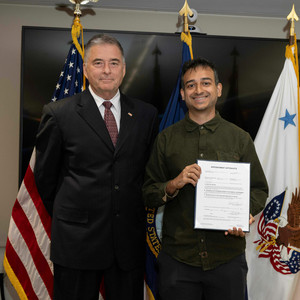
Sahil Lavingia is able to fill in some of those details because he was one of those people requesting access trying to push code and terrifying federal employees as a member of Doge.
We've all been watching this from afar, the dramatic headlines, the lawsuits, the concerned members of Congress.
And today we are going to get to see Doge from the inside, from the software engineer who made the decision to join that group?
I was like, yeah, I think obviously like a lot of my family would not be excited about it.
Most of my friends would be like, what the hell are you doing?
But hopefully I could go back and be like, well, this is what the hell I did.
I shipped this code and made people's lives better.
And hopefully they wouldn't, you know, stop talking to me.
Hello and welcome to Planet Money.
I'm Kenny Malone. And today I am joined by NPR correspondent, Bobby Allen, who has been part of the NPR team covering doge.
And Bobby we're delighted to have you here with us today.
What's up, Kenny? It's my pleasure.
Today on the show, Bobbie is gonna bring us access to the inner workings of Doge, frankly, in a way that we have never heard before.
Yeah, and look, I've been trying for months to get anyone from Doge to talk to me on the record. So this is a huge deal for me.
I mean, Sahil here is the first person willing to do that.
And I have to say, what Sahil shared with us and what Bobbie has brought to us is somehow both exactly like, and nothing like, what I expected.
This message comes from Meta AI.
Meta AI is the personal AI that's tailored to you.
Now, with its very own app, it's built to get to know you, offering helpful answers and inspiration.
Looking for something to add to your bucket list?
Meta AI goes beyond traveling the world.
It remembers you're a basketball fanatic, and suggests you attend one of the playoff games.
Just start typing or speaking to get the answers you need wherever and whenever because meta AI is your personal AI Download and try the app today now available on the Apple App Store and Google Play Why did saw hill Lavinia join doge is a question with like lots of answers, frankly It was not about politics in 2024.
He voted for nobody He didn't like the politics of either Kamala Harris or Donald Trump.
It was a little bit about Elon Musk, you know, a chance to learn from the leader of six major tech companies, that was appealing to Sawhill.
But it's also true that joining Doge was informed by what Sawhill had gone through as a startup founder.
Back in the 2010s, Sawhill raised millions of dollars for a company that was sort of like Etsy for digital stuff.
It let people sell their ebooks, their music, their online courses.
It grew to about 23 full time employees.
This was happening in the era of easy money 0 % interest rates when investors were looking for almost any investment with a chance of big return and Sahil says when he was in the middle of that getting investment.
He could not see that context What you're telling me that my investors didn't really believe in my ability to generate profits They just basically had too much money and startups were like this thing that like existed that they could sort of put money into because they couldn't get three percent from their bank and all you Know it was kind of an almost like an identity crisis the takeaway for saw hill was when money was flowing easily Businesses tended to bloat because that's what happened to his business Yeah, eventually his company wasn't growing fast enough So investors lost interest he wound
up laying off all of his full -time employees Which is not to say his company was a failure it still exists.
It earned about $9 million in profit last year.
It's just that Sawhill had to find the right size for that company.
And if his company got bloated from easy money, well, where else might that be happening, he thought.
And I felt like the same sort of thing had happened with the federal government, that effectively there was this massive amount of free money that was being generated that would allow for a lot of this waste and buildup to happen.
So that's what I expected.
So, from Sahil's perspective, he felt like his experience slimming down his own company could make him particularly useful for Doge's effort to slim down the federal government.
And if this all sounds a bit like a self -enggrandizing tech start -up person thinking they could swoop in to save the federal government, well yes.
And to some degree, Sahil admits that.
And the context here is that back when he was thinking about joining Doge in 2024, it's hard to even remember that now, but at the time, Doge was going to be who knew exactly.
It was vague. It was maybe about cutting government.
It was maybe about cutting contracts.
It was definitely about efficiency.
I mean, that's right in the name.
And what Sahil hoped was that it was also about, or maybe mainly about, modernizing the outdated software running the US government.
He thought he would be especially good at at, and he, you know, thought all Trump's rhetoric around slashing and cutting and firing was perhaps just rhetoric.
And this was the only way that Trump would allow Doge to exist, right?
Trump is not going to say, we're going to ship a bunch of software unless he can say that it's going to cut the deficit or it's going to, you know, save taxpayers a lot of money.
Are you sure you're not just hearing what you want to hear in that scenario?
I mean, I am hearing what I want to hear.
I mean, I think, unfortunately, that's kind like who I am.
Like I'm just like a naively optimistic.
So weeks before President Trump took office Sahil went to his wife and said he wanted to join Doge.
She was not happy about it at all.
She's like you know we have a kid coming right?
They were expecting their first kid, she'd be like five six months pregnant when Trump took office.
Admittedly not not the best timing.
And it was tough honestly I mean it was sort of this I can't think of other places where someone with my skillset, you know, building iPhone apps and mobile apps for, since I was 13 years old, like where else in the world I could go to have that level of impact that quickly and we negotiated it to basically two weeks in DC where I would go to DC.
I would really learn if it was all that was cracked up to be and she was like, look, I do not like that you are doing this, you know?
Was the Doge of it all part of it?
Yeah, for sure. I mean, I think the biggest thing about it that made it hard was I was going to go work for Trump.
Yeah. Unlike Sahil, his wife did have strong political feelings.
And again, Trump hadn't taken office yet.
Sahil argued, in his words, he could separate the art from the artist. If he gets to play a part in modernizing the federal government, it doesn't matter who's in charge.
His wife did not buy that, but the two agreed that Sohill would sign up for a very short doge stint.
He signed up for just a few months.
Then he was contacted by the Trump transition team, where he got an inkling that that it might matter who is in charge.
The team told Sohill they wanted to conduct a political alignment interview.
Washington speak for a loyalty test. Basically, yes, like, we're not going to hire anyone who doesn't agree with like the mission of the administration.
and so I had this interview with them, where they asked me a lot of questions.
What kind of stuff?
Like, what is your opinion on tariffs, for example.
What is your opinion on tariffs?
I think there are...
I mean, now I can tell you, I think they don't seem like a great idea.
At the time... At the time I said, I don't know!
Sahil remembers sort of politically shrugging his way through that interview and questions about Trump's platform.
They asked him if he'd voted for Kamala Harris, he told them he had not.
We reached out to the Trump administration They did not respond to our questions about Doge or anything else in this episode.
Now, the hundred or so people who have joined Doge got there from many different paths.
Some were already in Elon Musk's orbit, former employees of X, Tesla and SpaceX. Others were aligned with Trump and MAGA.
Sahil though, he's part of this third group.
He's good at writing code.
And to him, Doge was a once in a lifetime chance to make the software that powers the federal government more spiffy.
Sahil never heard back after his political alignment interview, but a few months later he assumed he must have passed when he got called in to start as a Doge member deployed to the Department of Veterans Affairs.
And by this point, it's March. Doge has made lots of headlines, taking a wrecking ball to USAID and other agencies.
This was celebrated in some political corners and it also led to confusion, lawsuits, and very angry town hall meetings.
Now, this was not the version of Doge that Sahil naively, optimistically had anticipated.
It's not what he'd told us he'd imagined, but Sahil decided he was still going to join.
And it might be hard to understand that, but talking to Sahil, you get the sense he is good at compartmentalizing and perhaps hearing what he wants to hear.
And when we asked him directly, he said at the time he was thinking that the media tends to blow things out of proportion in his opinion.
However, you want to make sense of all of that, on March 17th, Saul Hill heads to DC for the first official today at Doge.
What did you expect day one?
Did you think Elon Musk would be there with his dark MAGA hat and shake your hand and give you a Doge badge?
Honestly, that's about what I expected.
But no. There was no central Doge office, no greeting from Elon Musk.
It wasn't clear, in fact, who he reported to at all.
Seem to be the only Doge person at the VA actually.
And so day one was a lot of mundane tasks.
Get your ID card. Stop by the VA's fingerprinting room.
They're like, Hey, you're on this list of three people that is getting fingerprinted today.
And I was like, yep.
That's me. Saho, this is it's fascinating to hear all this because like, as you're being like onboarded, as a Doge staffer, me as a reporter covering Doge, I'm hearing about the Doge people entering agencies like over text message, but like you saw it first -hand, so what did that look like?
Also, you were it, to be clear.
I was, yeah, exactly.
I did not have any dogehoodies.
Did you dress like a federal government employer?
Did you dress more casually?
I dressed… I wore a t -shirt and a shacket, and khakis.
Did you say shacket?
It's like a shirt meets jacket.
Were you the only one wearing a shacket?
I was. Almost everybody wore a suit.
So did you get any looks that were like, oh, this is a doge guy?
Oh yeah, for sure. the reputation of doge had become the reputation of doge and so sahil avoided mentioning it when he met people and at the end of his first day he got out his phone and started a voice memo i'm going to sleep soon so just recording a quick little diary entry of my first day working for the va sahil's day one impressions doge seems smaller than he thought.
Not exactly the grind to the bone startup vibe he was expecting from an Elon Musk production.
I was hoping to learn more about how you long rise and or how you can work super hardcore.
You can have like an insane superhuman impact by just running through wall it does feel a little bit more like a 60 hours a week thing not 120 hours a week thing.
Case you're curious, 120 hour week works out to sleeping about seven hours a night and then working every other minute of the week.
Sal would have to settle for 60 hour work weeks and he keeps up with his audio diaries.
At the end of each day, he goes back to his DC hotel room, gets under the covers, and starts recording about his day.
Day four at Doge. He talks about the people he's meeting.
The CIO, Roy was awesome.
What he's learning about how the VA runs.
Came up with a new cool fun logo idea for the VA.
He's assessing the VA's software situation.
You know, the conversation yesterday was about moving from like 80s era software to like 2000 era software.
I don't know, I feel like it's Doge's job to try to pull us into the 2010s at least. 2020s would be cool.
Otherwise you just, I don't know, it seems like a waste opportunity, potentially.
In those first few days Sahil texts a friend about Doge about how he's feeling confident in his ability to have an impact.
Sahil reads the text to us!
I say, I think I'm at 80 % confidence of $10 million order of magnitude impact, 40 % of 100 million, 20 % of a billion, but 5 to 10 % of 10 billion.
Some big numbers and big confidence.
But his argument is that the VA's budget is hundreds of billions of dollars.
Sahil's seeing old, outdated software, IT work that's outsourced and really expensive.
And Sahil thought that if he could write software, cut expensive IT contracts, and do more things in -house, then his impact could be heroic.
he could have a five to 10 percent chance of saving the government 10 billion dollars.
Contributing to the modernization of the US federal government in like a marginal but impactful way that I wouldn't have been able to do as a private citizen, right?
Like a large amount of impact.
And so, Sohail went looking for billions in efficiencies.
Contracts to cut, fraud to root out and other general Doge goals.
After the break, what he actually finds.
of what's happening together, like how we were never really told when Doge is about to start working in a specific agency.
What tends to happen is government employees will start sending us photos of Doge staffers trying to get into buildings, or a group of guys who look like coders all of a sudden bossing longtime employees around.
And in that vein, Doge has never shared a playbook exactly for cutting the federal government, but reporters like Bobby Allen here have pieced together that there seem to be roughly three phases to Doge's work.
Yeah. Phase one. Doge workers fanning out across the government in hoodies and jackets, and getting into place.
Phase two. There tends be a kind of audit.
They compile data, they knit together different data sets, they try to get a complete picture of the money in and the money out of each agency.
And phase three of course, the cuts, mass layoffs, contracts cancelled, grants suspended.
Now, is Doge literally making those cuts?
Are they identifying them and someone else decides?
Is what they're doing even legal at all?
That is all being debated right now.
But generally speaking, those three phases do seem to be the phases and it's a kind of Silicon Valley Elon Musk takeover playbook.
And I think a lot of what we've seen of Doge is how that Silicon Valley ideology is butted up against the realities of how the federal government works.
And you could really see this through Sahil's story.
Now he didn't really have a specific boss.
He was getting requests from multiple people.
He was to some degree left on his own to figure out how everything worked at the VA.
So, one day, he was poking around the VA's computer code to learn the software and learn what he could do.
I was updating Twitter to X in the footer of the VA .gov.
Like the place on the VA website where it might say, follow us on Twitter.
He changed Twitter to X.
The reason I was doing that wasn't because I cared.
I still say Twitter colloquially.
It's just I wanted to learn how the website was deployed.
Harmless enough, Sahil thought.
But people at the VA said, you can't just go messing around with a live website.
This is the federal government.
Even small changes to a website have lots of rules.
Like, just writing X makes the word too small and potentially violates laws and rules about making the site accessible to people with visual impairments.
VA staffers were like, what is going on here?
They told reporters at the magazine Wired, which reported on Sawhill how some doge guy was trying to push his code, possibly messing up important websites, and how even something small, like changing the word Twitter to X, has ramifications that he does not understand.
Another example. Sahil was asked to help look at the tens of thousands of existing contracts that the VA has for possible cuts.
And he's like, oh, yeah, that's a super easy software problem.
He talks about it in one of his audio diaries.
And then we have the contract muncher.
We go through the 42 ,000 contracts that we have and then hopefully we can cut a bunch of waste.
Sahl built an AI tool.
He named it the contract muncher, that could read the PDFs of VA contracts and flag ones his bosses might want to consider cutting.
That took me, whatever, 15 minutes.
So tomorrow should be a really good day where we actually get to utilize the contract muncher.
Maybe sounds good in theory, but this really freaked people out.
This became the subject of a ProPublica story.
Doge developed error -prone AI tool to munch Veterans Affairs contracts.
Yeah, they checked his code, felt like it was sloppy, would misinterpret contracts, use a shoddy AI model.
And people at the VA were very concerned about someone who knew nothing about the VA creating something that would help inform huge decisions about cuts.
He'd built a tech company solution, moved fast, built quick, and to him it might not have been perfect, but a human was still going to decide if a contract would get cut or not.
It didn't matter why Sahil had joined Doge in the first place, he was a disruptive force in the VA and it seemed Everyone could see that.
Like I remember one software engineer at VA, you know, career employee He slack messaged me and was like everyone is terrified of you Like every time you really like everyone is terrified I don't know if he was being a little facetious but like he was like, you know people know who you are They talk behind your back not in any like this guy's a evil person but he's representing this evil force or whatnot.
Could you blame them, though?
If you're reading the headlines, it's like these Doge staffers are just laying off people left and right, I'd be terrified, too.
Yeah, I saw that we had no authority to riff anybody, and so I was like, we don't - What is riff, as Riff used to say?
Reduction in force.
So to - And what is reduction in force?
Basically, to fire people.
I see, so that's two levels of abstraction from saying fire people.
Yeah, basically. do you understand why to the other people in the department it felt and looked like a person coming in breaking things now Yeah, I get it.
Yeah. Yeah 100 % I Do think there's some confirmation bias at play too, you know, and maybe I should have worn a suit But yeah, I understand why we looked the way we did and hopefully we didn't break anything, you know, hopefully like Hopefully we didn't actually break.
It looked like we were breaking stuff but hopefully, hopefully we didn't.
Sahil sees lots of this stuff differently now.
And one of the big turning points came the one time he got called into an e -meeting.
Apparently that's what they call meetings with Elon Musk.
Sahil was excited. This e -meeting went from about 8 p .m. to midnight.
I'm gonna be like 60 people around this like big table, mostly standing.
For four hours? Yeah, I was leaning on a wall for sure.
Sahil had joined DOGE in part to learn how Elon Musk works and sees the world.
And during this meeting, there was an EQ &A session.
Time to ask Elon questions.
So I asked him, I said, like, what have you learned last week?
Like, what - you know, what are you learning about how the federal government works, basically.
And he basically just sort of said, like, it's just - it's just like a fractal of terribleness.
And you just can't believe how terrible it is until you peel back the next layer and it's even more terrible.
And I just - I just was kind of like, That's cool, I guess, but that doesn't help me do my job.
I was expecting a little more of a concrete answer.
Sahil was unimpressed.
He'd gone into the meeting looking for a clear mission, hoping to get energized.
And I was like, honestly, I was super disappointed.
I was expecting a lot more of a plan of attack, of a sort of a war room, where this is what we're trying to get done, this is where we've failed, this is where we've succeeded, you know, a little bit more of like a team effort.
Sahil says it wasn't that at all.
He left the meeting feeling like, what are we even doing here?
And then there's this one last story we're gonna tell about Sahil's time inside Doge, about a fraud investigation.
Yeah, another big goal of Doge is to save money by finding fraud and waste.
Sahil says one day a call comes down from like a boss's boss saying, drop everything.
He asked us to look into this person who may be receiving disability payments even though they're 137, I'm like, awesome.
Like that's, you know, that would be cool to find fraud.
Like that's a good, you know, I think everyone would agree that we should not participate in that.
So Sahil starts calling around, finds a VA employee who says, give me a second.
Let me go cross check this possible case of fraud in a different database.
He comes back to us and says, hey, you know, this guy's in our database, he's 75.
That's that's a that is a more reasonable age to be yeah and when he said that I was like okay I know what happened right like as a software engineer who's worked on software and seen data like you know some some software languages like there was a null value that then got set to 1900 or something.
Soghil says that was the one case of fraud that the doge team investigated at the VA during his limited time there I mean I really believe that like we hoped there would be more fraud that like I think we underrated how many checks there exist when you pay somebody.
I think actually there is a check somewhere in the system and that check proves, you know, make sure that they're alive, make sure that they're, you know, they've gone to a doctor's appointment in the last three months, you know, that sort of thing.
Like, these checks exist. This is actually what makes the government sometimes, like, expensive to run is that you have to check all these things before you give people money.
Yeah, I think it was just a feeling of like, You know, like it would have been really nice to like come in and save a bunch of money And he was realizing the same kinds of things about his big dream of going there and modernizing outdated systems the more he dug around and talked to people suggested ideas the more he would learn that like Oh federal employees are already working on some of these things and it's not that they don't know they need to be fixed It just like takes a long time There's this pretty amazing moment in Sawhill's audio journal where he seems to realize all of this in the moment
Not just about the software and the fraud but about maybe all of his assumptions here He is talking into his phone late one night.
So another thing I learned it's not like the good.
There's no easy wins The government is not corrupt The government is really not wasteful The government commits to doing a lot of things for its citizens, but generally it executes on them decently well, full of amazing, smart, hardworking, educated people.
Is it too nice for those people?
Maybe is it too nice for those citizens?
Maybe is it, could it be run more efficiently?
Probably. But is efficiency always the goal?
No, I don't know. Sahil joined Doge running these calculations about his own personal impact.
Could he save hundreds of millions, 10 billion maybe?
And he told us that baked into those numbers is the assumption that the federal government wasn't going to fix things without someone like Sahil swinging in from the outside.
But when you join and you realize, oh, they're actually trying to do the thing that I already wanted them to do.
That is sort of like, it's good in a sense, right?
It's great that they're already focused on modernization a hundred percent, but but also it means that like, you're no longer the hero, you know, like you're just an employee of this big organization.
And when you talk to Sawhill, admittedly, about a very small amount of time at one department, it sounds like his lesson isn't that the federal government has run perfectly or that it is the exact right size, but that it is much better than he had imagined.
And there just are not easy ways for someone like him to come in and save $10 billion.
And I think that's a lot of, you know, a lot of like the sort of Doge sentiment.
I think it's probably what got Elon in over his head potentially was like, you know, like Trump, I think, is also good at this like convincing other people that they're the hero of their story and that this is like the unique singular opportunity.
Like only you can fix this, right?
It's sort of like even better than only I can fix this.
One day in May, after almost two months at Doge, Sallejua opened his work computer, tried log onto a worksite and his credentials didn't work anymore.
No one even confirmed this to him, but it seemed like he'd been let go.
He suspects it's because he lives his life like an open book, and had talked to a reporter about Doge, which obviously he's still doing today.
In the end, Sahil did not end up saving the government billions of dollars.
He says he landed closer to the low end of his projections, somewhere around ten million.
And a lot of that actually came from a thing Sahil did, that the official Doge X account about, bragged about.
Do you remember the tweet?
Yeah, the tweet was something like the VA was spending $380 ,000 a month on basic website modifications.
The VA will do this internally with a software engineer spending 10 hours a week.
And is all of that true to the best of your knowledge?
Well, the problem is I was that software engineer and I'm no longer there.
Meaning, he has no idea if that is true anymore.
Elon Musk, of course, has left Doge, rather dramatically.
And the Trump administration recently announced that it intends to try to make Doge a permanent U .S. tried to shrink the federal workforce during the Clinton administration.
We'll include a link for that in our show notes.
And if you have any tips about Doge, you can contact Bobby on signal at b -a -l -l -y -n dot 77.
That is b -a -l -l -y -n dot 77.
This episode was produced by Sam Yellowhorse Kesler and Emma Peasley.
It was edited by Jess Jang.
It was fact checked by Sierra Juarez.
It was engineered by Neal Rauch. Alex Goldmark is our executive producer.
I'm Kenny Malone and I'm Bobby Allen.
This is NPR. Thanks for listening.