Hello and welcome back to the Easy English Podcast.
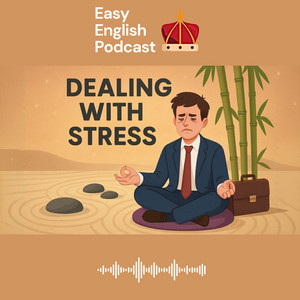
I'm your host Oliver, and today we are talking about a topic that is very relevant in January and particularly at the beginning of the year, and that is dealing with stress.
January can be quite a stressful time, particularly in the fast-paced world that we live in today.
Lots of information, lots of internet, digital information.
We can't escape it.
And of course, things can become a little bit stressful for us.
And perhaps you might be feeling anxious, burnt out or already a little bit stressed in the new year.
So today we're going to talk a bit about that in English and we are going to grow your vocabulary.
So we're going to get some new words to talk about this topic.
And, as always, I like to remind at this stage if you're new, make sure you're following and subscribed to the Easy English Podcast for more.
And if you would like bonus episodes, including flip cards for every episode, as well as full transcript PDFs with exercises, make sure to follow and support on the Easy English Patreon.
Let's take a look at our key vocabulary for today.
Okay, so to manage stress, we first need the words to describe it.
And here are seven essential terms.
So a little bit more today.
I'm not going to explain as long each word, but I want to teach you seven words and phrases in this episode.
So more than the usual five.
So get ready.
The first word is resilience.
Resilience.
And this is the ability to recover quickly from difficulties.
So if you are resilient, you recover quickly from difficulties or mistakes.
Our second word is overwhelmed.
Overwhelmed is a great adjective.
And it means feeling completely overcome by an intense emotion or task.
Our third word is burnout.
Burnout.
Perhaps you've heard this word before, maybe a previous episode.
And burnout is physical or mental collapse.
Usually, so it's something that's caused by stress for a long period of time.
Our fourth word is reframing.
When we reframe something or reframe something, we look at the situation in a different way to change its impact.
Our next one.
This is a phrase you will hear later, so I want to explain it early so you can listen for it.
It's a complicated science term and it is amygdala.
Amygdala hijack is the phrase.
And an amygdala hijack is an immediate overwhelming emotional response.
So when we have very intense emotional response immediately.
Our sixth word, phrase, word and phrase, I believe, is imposter syndrome.
Imposter syndrome.
And imposter syndrome is when you doubt your abilities and you feel like you're maybe not enough for what you're doing.
Or you're not.
Maybe like you're a fake or you're not the real.
Let's say you have a high profile job.
You feel like you're not good enough for that job that you're pretending.
And our final one, our final word is eustress.
Eustress.
That's E-U-S-T-R-E-S-S.
And this is a positive stress that motivates you.
Like a deadline, for example.
Okay.
So...
Let's get to our topic today.
It's a very deep topic.
Don't worry if you didn't understand every word there or every phrase.
Some of them are quite complicated, but you'll hear them in today's episode.
You might notice that I am a little bit higher up in today's episode because I'm actually standing.
I got a standing desk just to help with my back.
I spend a lot of time sitting with my job, with making these podcasts.
So I thought hey, I can get a standing desk and hopefully try to stand a little bit more when I'm working.
Okay, so why does your English disappear when you're nervous?
So when you feel stressed, nervous.
So we're going to talk a little bit specifically today as well about stress and language learning stress in relation to learning.
So when, this really comes down to your brain and how your brain works.
When you feel threatened, either by something physical or social.
Maybe you have a social fear of looking stupid or silly.
Your body releases chemicals.
These chemicals are called cortisol and adrenaline.
So they are stress hormones.
And the amygdala.
So that's your brain's alarm system.
When it detects a threat, it makes you choose one of three main responses.
Fight, flight, or freeze.
So basically, are you going to face the fear and fight it?
Are you going to flight, so are you going to run from it?
Or are you going to just stop and try to figure out what you're going to do, or just have a total freeze?
So we also have the prefrontal cortex of the brain.
So just this overall picture of how our brain interacts with the stress.
The prefrontal cortex is like the CEO of your brain, basically.
It handles the logic, the complex grammar that you're using for your speech and it helps find the vocabulary that you want to use too.
But during an amygdala hijack that we mentioned this alarm system in your brain, the amygdala.
It takes all of the energy.
All of the emotions, all of the chemicals, it's pulled into this stress response.
And the CEO of your brain that makes those useful decisions and it finds the words and the grammar that you use.
It basically goes home and takes a day off.
This is why you can understand a Netflix show at home, for example, but when you are I don't know in a coffee shop in London and someone talks to you, you can't understand because you are more stressed.
You have a stress response as well as the attempt to understand in English.
It's not always a language problem.
It is also a nervous system and brain stress response problem too.
This, of course, isn't for everyone.
Not everyone gets stressed when they speak English, but I can understand this, because I have it with foreign languages too.
Although you can practice you can rehearse ahead of time whenever you start speaking in a real life situation, it can become quite easy to have this stress response.
We don't even realize it sometimes.
And we suddenly perform a lot worse than we do in our private space or in our comfortable environment.
In language learning, we use a concept that we call the affective filter.
Affective filter.
Think of this like a psychological gate or a gatekeeper between you and English language.
When you're stressed, self-conscious or bored, the filter of this gate is very high.
So you might hear the words, but they're not reaching you.
This filter is stopping them from reaching you whenever you're very stressed, let's say.
They aren't getting to your long-term better memory.
It's kind of like trying to listen to music through a very thick wall.
You can't hear very much through it.
And that's what it's like when you're stressed while practicing English.
But when you're relaxed or you're laughing or you're deeply interested in what you're doing, the filter, the effective filter, is very low.
So it's not very high.
And this is when you pick up phrases and you understand a lot more and you might even feel like you're not really trying.
You're not trying so hard.
I often hear this from students, where they say that when they are drinking let's say alcohol they feel like their English is a lot better.
And it pretty much in most cases is simply because they're feeling more relaxed and they're not thinking so much about you know what their English is like or how well they are speaking.
They're just talking.
It's the same even in your own native language.
You might find that you're a lot more confident after a few drinks, which is totally normal.
But in our 2026 reality, we have like an always on culture.
So stress is particularly high even around this time of year, which means our filters are often naturally very high too.
We have a lot going on in our lives, a lot of information in our jobs, from our phones, from online.
And as a result, this filter is very high.
So we need to learn, not necessarily to just open a textbook, but to relax when we speak English, when we're learning, particularly in public, when we're using the language.
We need to learn to relax.
This might seem like a very simple tip, but I wanted to make this entire episode about this stress and relaxation and language learning, because it's very, very important.
And it's a very, very much an overlooked aspect of English language learning.
Everyone talks about the grammar, about the vocabulary, the reading, the methods, but no one really talks about that actual, real life practice.
More so the stress of it.
It is stressful.
I understand that.
It's a very scary thing to do.
To speak a foreign language in the country or to someone that you don't know.
So how do we practice lowering the filter?
We have a few different strategies that we can use to lower this filter and manage those overwhelming situations, those feelings where you feel a little bit stressed, maybe self-conscious about your English.
And here are my tips for you.
My first tip is something called the safety phrase.
When someone asks you a question and your brain freezes or you have that panic mode, you need to use a safety phrase.
Give yourself time to answer questions.
And this goes for anyone, not just English language learners.
It's a really great tip.
So when someone asks you a question, use a phrase that gives you time to sort of restart that part of your brain and answer, to think and answer the question clearly.
So you might say something like, that's a great question.
Let me think for a second.
And in the time that you're saying that, you're giving yourself some time to refocus and to start thinking about your reply.
Or simply call out the stress.
Say, oh, like I'm having a little bit of a brain freeze.
Let me think for one moment.
And even just acknowledging that you need a minute to take that time, it reduces the stress.
You're not thinking about it.
And from your brain's perspective, it says, hey, it's okay.
The threat is managed.
It's under control.
I think a lot of people can really benefit from just pausing.
So not trying to answer or speak too quickly, just taking that deep breath and that moment and then replying and answering.
Now the next two tips are more for if you get very anxious or stressed when you're trying to speak English.
This is more for those of you who feel maybe physically anxious as well.
You might get very nervous.
And the first, sorry, the second tip I guess today here would be about breathing.
So a big part absolutely of speaking and speech in general is breathing.
I struggle with it sometimes too, even recording these podcasts.
You need to give yourself time to breathe, especially when you're speaking and you're trying to think about what you're saying.
Next,
Take those pauses and breathe.
Take a deep breath in, take some time.
You need to physically force yourself to relax.
And as a result, the English and the language will come a lot easier.
Very simple tip.
I know a lot of people don't like to hear it, but it's true.
Simply breathe more.
And actually, a little side effect of that is you'll sound more natural.
If you're breathing and you're relaxed, you're going to sound more like a natural speaker of English too.
If you get very stressed, very anxious, a good tip here as well is the 5-5-5 rule.
Essentially what you do is, let's say, you're during a social event, you can sort of stop in your head and you can try to think of five things that you can see, five things that you can hear and five things that you can feel.
For example, your feet on the floor, the clothes on your skin, the air on your face, that type of thing.
And this will take your brain out of that stress.
It will focus on something else and give you that moment to get back in.
Of course, we always don't have the time to do this, but let's just say you're very stressed or conscious about your English.
It can be something you can do to take a moment and just take yourself back from that stress.
It's just something I like to do when I feel a little bit stressed, so I thought I would share it with you.
Okay, let's take a minute to go to our listener spotlight.
It's my favorite part of the show because I get to read your comments and answers to my questions.
And many of you practice your wonderful English skills every week in the comments.
It's amazing to see the answers that you guys write, and sometimes they're really touching messages very, very nice, beautiful messages that you write, and I'm always very impressed.
So last week I asked about your dreams, about what your dream is.
It was quite of a general question and I got so many great answers.
The first one I want to read out is we got a comment from Rumeza, who is from Turkey, and she said Firstly, I really love to listen to your Easy English podcasts.
I dreamed two days ago that I was speaking English, and this episode made me want to tell the story.
In my dream, my friend and I went on a trip to Spain.
We rented a car and something went wrong.
The police gave us a fine because we hadn't completed a required procedure related to the car.
To pay the fine, we had to go to the police station.
And since we didn't know the address, we asked people for help.
It was a bit of a strange dream, but throughout the dream, I was speaking English.
When I woke up, I repeated the sentences that stayed in my mind.
That is excellent, Rumeza.
That is a very impressive dream, especially if it was in English, and a great sign that you are using the language in your subconscious.
Thank you so much for sharing.
What a lovely comment and very interesting dream story there.
Okay, we had another comment as well.
And this was from Neeti.
And Neeti said yes.
What I dream of is that one day I would be able to speak English fluently and without stagnation.
I've always dreamed of that in my mother tongue, whereas nowadays my mind goes automatically thinking English.
Do you think that's a good sign that I'm near of realizing my dream that I have had for more than six years now?
Thank you for the wonderful podcast.
You're very welcome.
I think, Neeti, that this is a very good sign.
I would also say that, you know, being fluent in English, it is a gradual process.
You'll never wake up one day and say, wow, I am fluent.
It's something that happens very slowly and you improve slowly over time.
So it will take you a lot of time to improve and it will take you a lot of time to develop fluency.
I think of fluency more like a skill.
It's something that we can even improve.
You can be fluent, but still have a lot to improve.
For me, being fluent is more about speaking freely.
So understanding people and them understanding you.
But you can have a fluent B2 speaker and a fluent C2 speaker.
Do you see what I mean?
So the fluent C2 speaker is speaking freely, but they're using much more complex vocabulary.
The fluent B2 speaker is maybe speaking.
They could be speaking even more fluently, but using a lot less complex vocabulary and maybe understanding not academic or professional sphere English words.
So it really depends on your goals and it depends on what your aims are with being fluent.
Okay.
One final comment for today.
We had a comment from Douglas and Douglas said, Hi Oliver, how are you doing?
I'm great.
Before I answer the question of today's episode.
For me it's awesome you bring different topics in each episode.
I'm glad you think that.
I try to do that with each episode.
There's a long time I didn't hear about the sleep cycle.
Thank you for answering the question.
I don't remember dreaming in English at any time, but if it happens with me, I probably reach another stage of English.
Yeah, absolutely.
It can be a great sign to show that you're starting to use it in your subconscious.
But if not, don't worry.
It takes so much time.
And even people who speak English fluently don't always dream in English.
So it's not guaranteed.
Absolutely not.
And a good exercise actually is to try and think in English sometimes.
I know it's hard, but just whenever you're doing something or you're distracted, try to make thoughts in English.
It's a free exercise that you can do anytime, anywhere.
Okay, back to our episode.
When we talk about stress and we talk about all these situations, it builds resilience.
Every time you have a stressful time in English, every time you practice using the language, every time you speak, you are building your resilience with the language and you will build your confidence.
And naturally then, with time you will be less stressed and you won't be as stressed working with the language, using the language and engaging with English in different situations.
And you'll become a better speaker overall.
So although stress is an inevitable, you see my English is not even perfect.
Although stress is an inevitable part of 2026 of present day life, it is something that we can learn to get better with with our language learning.
It's something that we can become more comfortable with and it's something that we can understand does affect our language ability, whether we like it or not.
So, no matter how good we get it with English, unless we practice it, unless we use it, we aren't going to overcome this stress element.
You could spend every hour of every day learning English on your own at home and still struggle to speak it in person because you feel stressed, maybe anxious, and it affects your brain's ability to use that language.
So it's really important that we practice and we get more confident and stronger each day.
And I'm sure each and every one of you listening will do so.
Thank you very much for listening today.
Remember to check out the Patreon for bonus episodes every single week, as well as flip cards for vocabulary for each episode.
And of course, it supports the show.
It's really the number one way that you can support the show, support me and these episodes, which I make for free every single week.
I think we have over 160 episodes now of the Easy English Podcast, which is crazy, and there's over 50 000 of you guys listening now, which is amazing.
So from all over the world, and i appreciate each and every one of your comments and really just for listening to the show.
It's amazing.
Thank you so much and have a wonderful rest of your week goodbye.