NPR. Hello there, Weyland.
Hi, Darien. And listeners, dear.
I have a story. One you should hear.
Ooh. I am intrigued, Darien.
You're rhyming. You're rhyming today.
Today's show for the Indicator.
A financial fables for kids progenitor.
I already talked about kids books about money.
That was kind of a tortured rhyme, but you know what, I respect it.
You must be thinking, who could it be?
She was a member of the FDIC.
To be quite specific, the 19th chair.
Her name, the singular...
Sheila Bear. Sheila Bear, yes, the towering figure who was working to keep the financial system running during the great financial crisis around 2008.
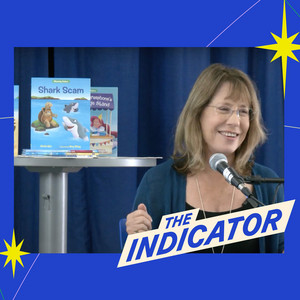
And what I learnt is that this whole time, she actually had this side quest, which is writing kids books to help them avoid scammers and predatory lenders.
I mean, financial literacy and financial savviness is a really big issue, and like kids and adults actually could stand to know more about it.
Today on the show, what Sheila Bear has learned about American capitalism as one of its top regulators and how she's trying, one book at a time, to help new generations from falling into its traps.
Through rhyme? Violin, if you insist, one more time.
Aww. Yay! Best story time ever.
Sheila Bear learnt her first financial lesson pretty early on when she visited the bank with her dad.
I was always fascinated by the bank vault, the door was usually closed.
And so I went in with him, he was making his deposit.
I noticed that the bank vault door was actually open, so I snuck away and peeked in.
And I came running back and said, there's no money in the bank.
There's no money in the bank.
Oh my goodness. So I mean, we all have to learn at some point that banks aren't physically holding onto most of our deposits.
And, you know, she learned it in a very visceral way.
Yeah. When Sheila Bear grew up and served at the treasury, she began to notice that not every child was getting the same concrete financial education.
And one thing that concerned me, well, a couple of things became apparent.
One is there isn't that much information for elementary school children.
There was really, to the extent there was information, it was more for the older kids.
And also a big problem was the adults didn't understand it.
Well, I mean, that seems to be the biggest problem, right?
Like how are you expecting children to learn about loans or saving for retirement if parents are themselves in the dark about this?
Teachers, too. At the same time, I had young children on my own and my husband and I every night would read picture books to them.
And I thought, what a wonderful medium to impart financial information to the children.
But the parents as well, because the parents read those books with the kids.
And that's what drove Sheila Bear to publish her first kids book.
It was called Rock, Brock and the Savings Shark.
It's about these two twins, Rock and Brock, and their grandpa offers each of them a kind of savings matching program for the summer.
One ends up spending the money and the other one saves and ends up with $512.
That's like compound interest at work.
Yes, it's a wonderful force when you're saving.
Not so much when you're borrowing, though.
It can be brutal. And that's the kind of lesson Sheila was trying to teach people both through these kids books, but also in her day job.
In 2006, Sheila was appointed chair of the Federal Deposit Insurance Corporation, FDIC.
Yeah, that's the government entity that ensures people who save their money in the bank.
Indeed. And Sheila was starting to notice that more and more adults were getting seriously stung by not understanding the interest on their loans.
During that time, a lot of homeowners were being sold a particular type of loan.
Already then, we could see they were being push marketed into low income minority neighborhoods.
It was really despicable.
People would go in.
They would troll for people who already owned a home and had a nice, safe 30 year fixed rate mortgage with equity.
They come knocking on the door, hey, would you like to get some cash out of your house?
You know, vacation, new roof, whatever.
These salespeople would offer loans with a nice, slow interest rates to begin with, but that wouldn't last.
They were just designed to force people to keep refinancing every couple of years with a steep payment increases.
And it was shocking.
It was frightening.
Sheila Bear raised the alarm in Washington, trying to force higher standards onto these lenders.
But she had arrived at the FDIC in 2006.
It was too late for many households in what would become known as the subprime mortgage crisis.
We helped a lot of people keep their homes.
We did. So I don't want to say it was all for not, but there are millions more who lost their homes, who I think with a more concerted effort could have been saved.
This is really bringing me back to all of those awful stories we heard during the great financial crisis.
And a lot of those stories had this thing in common where there were predatory loans that were sold to people who couldn't afford them.
And the people doing the lending knew that.
So Sheila was trying to clean up the damage and enforce stronger rules around deceptive lending.
But the other side of that deal is also the borrowers.
And that's where financial literacy comes in.
Maybe it's kids books, or maybe it's a course added to a high school curriculum.
I will say though that financial literacy as a genre also doesn't have the best reputation.
There's also a ton of scams in those courses that you see advertised on the internet or whatever.
And academics have studied financial literacy programs for a long time, and they haven't found them as a whole to be particularly effective.
Right, like people don't retain the information, right?
Do you have any concerns that maybe the lessons may be fun, but they won't have that stickability?
But don't stick, yeah.
Yeah, no, it's a real issue.
I think one of the reasons I like picture books is because my experience with my own children, and I think there's a lot of literature that backs this up, is that a good story, a good picture book, a child when they're young will read it over and over and over again.
I'm an uncle of six, so I got a lot of this experience.
You know what I'm talking about.
Sheila herself says that a lot of financial literacy programs aren't teaching particularly useful concepts.
Sheila says they might be teaching the ins and outs of the stock market and different types of exotic trades you can do, but they don't necessarily underscore those financial basics.
Students should be learning about how just saving $10 a month, even at their age, is going to turn into a lot of money if they just leave it there until they retire.
Those are the kinds of lessons they should be learning.
And, you know, don't click on that Buy Now, Pay Later link.
When you see some fancy gadget that you think you want you haven't really thought about, those are the kinds of things we need to be emphasizing with kids about money when they're teenagers, not active stock market trading.
So I do think we need to have a more careful assessment of what kind of content we're giving children to make sure they're learning to be skeptical, ask questions, be worried, know how to protect yourself.
That's really what's important.
Knowing when to have a healthy sense of skepticism is the theme of another one of Sheila's kids books, Princess Persephone Loses the Castle.
And a few weeks ago I went to Bryant Park in New York and I sat at a table next to the carousel and I asked some kids if they wanted to learn about protecting themselves from unscrupulous lenders.
Very enticing. This one is about a princess who loses her castle.
I read it out to three kids, Grayson, Sloan and Freya.
Princess Persephone glued to the phone, talking all day to her friend Mary Joan.
Basically it's about a princess who is taken in by a door -to -door salesman called Aluminum Jim.
Aluminum Jim lends her money at this exorbitant rate and she ends up losing her castle.
Spoiler alert though, she does get it back at the end.
Protecting the meek and the law abiding from crooks like Jim in his cheap tin siding.
I really liked it. What lesson did you learn?
That you have to read the papers.
And what do you think of Aluminum Jim?
I think he's a crook.
Amazing. Well the kids were really listening.
To be fair, Aluminum Jim is quoted as saying, I am NOT a crook.
Do the kids know that reference?
We'll see if it sticks when they grow up and are sold their first credit cards or loans.
This episode was produced by Angel Carreras with Engineering by Kelly Moon, was fact checked by Sarah Juarez.
Patty Hirsch edited this episode and Kate Kincaiden edits the show.
The indicator is a production of NPR.