This BBC podcast is supported by ads outside the UK.
If journalism is the first draft of history, what happens if that draft is flawed?
In 1999, four Russian apartment buildings were bombed.
Hundreds killed, but even now we still don't know for sure who did it.
It's a mystery that sparked chilling theories.
I'm Helena Merriman and in a new BBC series I'm talking to the reporters who first covered this story.
What did they miss the first time?
The History Bureau, Putin and the apartment bombs.
Listen on BBCcom or wherever you get your podcasts.
You've been served.
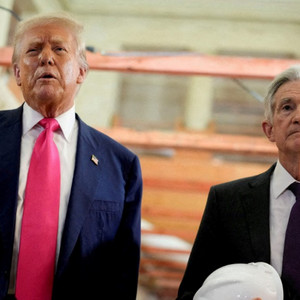
The war between the White House and the Fed is heating up.
He's going to continue to focus on making sure that the Fed is making its policy decisions on behalf of the public.
They were very slow to see the inflation build up during the pandemic and we are still paying the price for some of that.
Welcome to World Business Report from the BBC World Service.
I'm Sam Fenwick.
As prosecutors issue subpoenas for Fed Chair Jerome Powell, we'll be looking at what it means for the independence of the world's most important central bank.
And what happens when the oil flow stops?
Cuba may soon find out Venezuela is its main supplier.
But since Maduro was captured, shipments have stopped.
So let's start with the Federal Reserve and take you back to 2017.
It is my pleasure and my honor to announce my nomination of Jerome Powell to be the next chairman of the Federal Reserve.
Congratulations, James.
In November of that year, Donald Trump backed Jerome Powell as chair of the United States Federal Reserve, and three months later he was sworn in.
At the time, Mr Powell was seen as a safe, centrist choice a lawyer and former investment banker expected to keep the world's most powerful central bank steady.
But since returning to the White House, President Trump has made no secret of his frustration with the Federal Reserve, and with Jerome Powell in particular, over interest rates.
Now we have a man that just refuses to lower the Fed rate, just refuses to do it.
And he's not a smart person.
We would be helped if interest rates would come down, but we're going to see how the board rules on that soon.
I'd love to see them come down a lot, but...
We have a country that's thriving.
I think he's doing a bad job, but he's going to be out pretty soon anyway.
In eight months, he'll be out.
But I call him too late.
He's too late all the time.
He should have lowered interest rates many times.
People aren't able to buy a house because this guy is a numbskull.
He keeps the rates too high.
Now Mr Powell is at the centre of a political storm.
Federal prosecutors have opened a criminal investigation into the Federal Reserve related to the 25 billion renovation of the central bank's headquarters in Washington.
And that prompted this unusually forceful statement from the Fed chair.
The threat of criminal charges is a consequence of the Federal Reserve setting interest rates based on our best assessment of what will serve the public, rather than following the preferences of the president.
This is about whether the Fed will be able to continue to set interest rates based on evidence and economic conditions, or whether instead, monetary policy will be directed by political pressure or intimidation.
Loretta Mester is a former president of the Federal Reserve Bank of Cleveland and spent a decade inside the Fed, including years sitting alongside Jerome Powell when the interest rates decisions have been made.
Oh, I thought it was very short.
And pointed.
And I think I agree with him that this is not to do with the actual spending on the buildings.
This is really about trying to undermine the ability of the Fed to make monetary policy independent of political influence.
We don't often hear the Fed chair speak in such strong terms, do we?
Have you ever seen Jerome Powell this angry, this openly defiant?
Well, I think he's been trying and being successful at trying not to respond, right?
So because the president has been going after the Fed, and even the chair in particular, for quite a number of times.
But what is unprecedented is what happened on Sunday night was Jerome Powell telling us, and making it clear and open, that The Justice Department has served him with subpoenas, threatening a criminal indictment.
Chair Powell has tried to not engage.
But when this line has been crossed, I think it was appropriate for him to explain to the American people and be open about what's going on.
As someone who's been within the Fed for 35 plus years, how difficult is it to remain independent?
You did mention that there's always some pressures, although not maybe so overtly.
So how difficult is it to stick with the facts, I suppose, and not be pushed in a certain way?
Honestly, because it's so embedded in the culture of the institution over my time there.
And so in my time it was just really accepted that when you enter that FOMC room and you're sitting around making policy, the only thing you're concerned with is what is the economic evidence and financial market developments telling you about how the economy, where the economy is today, where you expect it to go and what are the risks?
Always focus on setting policy on behalf of the American public to get price stability and maximum employment.
And so I am very confident that, even with the president doing these kind of you know, trying to put pressure on the Fed, that politics has never entered that room and it hasn't entered in any of the meetings that we've had.
The unfortunate thing though is, by doing what he's doing, the president's actions have raised the possibility that the Fed might be influenced by political considerations.
And that undermines credibility of the policymaking process in a way that's detrimental.
There are some Republicans that argue that the Fed has kept interest rates too high for too long and that has hurt growth and the financial markets and that actually this kind of scrutiny is justified.
Everyone can have a policy view.
I don't think anyone's disputing that and everyone can sort of read the economy.
In fact, you know when you're at the FOMC table, there's a number of policymakers that would have different views than I would have.
But that's what's great about the policymaking process.
You go into that room and you share your views on what you're seeing in the economy and how you're interpreting it.
Other people around the table do the same thing.
And I've learned from them.
And hopefully in my time there, they learned something from me.
And then you come together and make policy.
That's OK.
Right.
What's different about this is that the president is undermining the institution.
Right.
By trying to make the institution bend to his will. will on policy.
And frankly, that's not a good way of making policy.
But I suppose there might be some that would say, you would say that, wouldn't you?
You've been at the Fed for 35 years.
Yeah, but there's a lot of research on this.
This is not just me talking.
Look at other countries, you know.
Look at countries where, for example Turkey, where they haven't had an independent institution, they have not had a good economy.
You know Jerome Powell.
His actions over the weekend have been surprising, you think.
What's his next move?
Jay has known that the president has been unhappy with him and wanted to fire him.
So that's not news.
I'm not trying to undermine or underestimate or underplay how difficult the situation is.
I think it's very difficult.
But I know Jay is going to do what's right.
And I think that's what his statement was.
His statement was wanting to share with the public something that he thought was very important for them to know and for everyone in the financial markets to know, before the markets opened.
Right.
That this was this is what happened.
And this is his approach going forward, which he said is to make policy right on behalf of the public, public focused on price stability and maximum employment.
And I know he will continue to do that.
And he'll lead the Fed to continue to do that.
That was Loretta Mester, former president of the Cleveland Fed for 10 years and various other Feds across the United States for 35 years.
But many Republicans see this very differently.
They argue that the Federal Reserve has become too powerful.
Too insulated from democratic control and that Jerome Powell's interest rate decisions have hurt growth markets and American households.
Paul Winfrey served as deputy assistant to President Trump for economic policy and as director of budget policy at the White House.
He now runs the Economic Policy Innovation Center in Washington.
I think it's certainly about more than just a building renovation project.
I think that the president has been pretty clear about that, even if it is not clear within the context of this investigation that he is not thrilled about the job that Jerome Powell has been doing as chairman of the Fed and that he'd like the Federal Reserve to lower interest rates and that he'd like to make some personnel changes there over at the Fed.
And so it seems to me like this is a backdoor way for the administration to try to kind of get what it wants over at the Federal Reserve.
But I do think that that opens them up to many many, many challenges that we should be concerned about.
Do you believe that Jerome Powell is being unfairly targeted here?
Or is this sort of the scrutiny that he should expect?
Presidents over the years have provided a tremendous amount of pressure from the outside on the Fed.
I think that ultimately, we talk about Fed independence as being an important institutional structure for not just the central bank, but for one of the One of the things that is happening right now is that the Fed is now no longer able to take that for granted.
Right.
So they're they're being forced to come out and say, no, no, no, no.
We actually are an independent entity and and we're going to stick up for ourselves, even under the pressure from the from the president of the United States.
You've called for reform of the Federal Reserve.
In plain terms, how do you see it changing or how would you want it to change?
In the United States, there has been a massive skepticism towards a central bank, going all the way back to the founding.
I mean, people forget this, but this is our third try at a central bank.
The first two tries in the first and second National Bank failed.
And one of the biggest issues that that they tried to resolve with the Federal Reserve System was a decentralization of power away from New York City and Washington DC.
And I think that that's worked in some ways and it hasn't worked in other ways.
I think that there's a lot to be critical of the current Federal Reserve for, including the fact that they were very slow to see the inflation build up during the pandemic.
And then they were slow to respond to it.
And we are still paying the price for some of that.
There are lots of ways to start thinking about different ways to reform the way that monetary policy functions, or to think about how the Federal Reserve regulates banks, banks and who should be regulating banks.
Should it be Treasury?
Should it be the Fed?
But ultimately I don't think that those kinds of policy debates, which are really really important to the economic prosperity of the country, are going to be resolved if the Federal Reserve continues to be politicized in the way that it is.
Would your reforms give more input or influence from the White House or Congress?
No, I think that maintaining independence at the Fed is critically important, especially for setting monetary policy.
I do think that there is an open question about whether or not the Fed should be so involved with banking regulation or whether or not that's inherently a political decision that needs to be handled by Treasury.
Ultimately, I think that there are some guardrails that should be put in place.
That can be put in place by the Federal Reserve or by lawmakers who set the terms for the Federal Reserve or for the central bank.
What happens now between the Fed and the White House?
Jerome Powell will be there at the moment, at least until May.
Yeah, well, so a couple of things are going on, right?
So in President Trump's first term, he had the ability to fill several seats on the Fed.
Today, he does not have the ability to fill several seats.
Right now, there's one vacant seat that he can fill.
And what he will do is likely fill that with Jerome Powell's replacement.
So I think that one of the things that we're going to see is we will likely see a new chairman, probably within the next six months to a year.
But ultimately we're going to see more disagreement than I think that we're used to around monetary policy decisions.
And I think that, you know, we may have this.
It's not necessarily an unprecedented time, but we but it will be a little bit strange to see a situation where the chair is voting for deeper rate cuts along with maybe one other member, where everybody else is going against the chair.
That was Paul Winfrey there who served as deputy assistant to President Trump for economic policy.
All this political pressure on the Fed has rattled the market.
So let's bring in Peter Jankowski, vice president of research and analysis Arbor Financial Services in Chicago, to tell us what's going on.
What traders are seeing.
Peter, it's been reported that the Treasury Secretary, Scott Besson, told Donald Trump that the investigation quote made a mess and could be bad for the financial markets.
How is it playing out?
Well, I think you are seeing evidence that it has hurt the market somewhat.
It started the day down more than half a percent.
It did recover, but the recovery was in sectors that are viewed more as safe havens.
So I think there still is some concern.
And bond yields actually rose about a basis point across the board.
Gold prices went up as well, I think, didn't they?
Yes, that's correct.
Yeah, they're the ones to look out for, aren't they?
Gold when people are feeling a little bit concerned.
Another story which is developing at the moment President Donald Trump has announced on his social media site, Truth Social, that any country doing business with Iran will face a 25 tariff on trade with the US.
Now, this is a move that could hit some large economies like China, Russia and India.
What's your reaction to this?
Well, it'll be interesting to see how much they stick with that policy.
I saw the statement.
It said there would be no exceptions.
But pretty much every one of these tariffs that's been announced has had pretty broad exceptions.
And I find it hard to believe that they'll stick with that tariff, particularly against China.
What sort of businesses might be affected by this?
What sort of business would, say, China be doing with Iran?
Well, certainly they do trade energy.
They trade oil.
That's the biggest area.
But the bottom line is, because they're trading there, all of the Chinese goods being imported to the US will be subject to tariff, additional tariffs.
And I think that's the real sticking point in all of this.
And presumably that's the same impact that it will have on India, but less so on Russia, because of sanctions which have been put on them since the war with Ukraine.
Yes, that's correct.
That's correct.
Yeah, there really isn't much trade with Russia at all.
So I don't see this as impacting Russia.
OK, Peter Jankowskis, we will leave it there for just the time being, but we will come and talk to you again in just a few moments.
If journalism is the first draft of history, what happens if that draft is flawed?
In 1999, four Russian apartment buildings were bombed, hundreds killed.
But even now, we still don't know for sure who did it.
It's a mystery that sparked chilling theories.
I'm Helena Merriman and in a new BBC series I'm talking to the reporters who first covered this story.
What did they miss the first time?
The History Bureau, Putin and the apartment bombs.
Listen on bbc.com or wherever you get your podcasts.
Well, the United States is also tightening its grip on Venezuelan oil exports, and that's putting pressure on Cuba, which has relied on that fuel for years.
President Trump says there will be no more oil or money going to Cuba.
Zero.
I strongly suggest they make a deal before it's too late.
So what's the deal that he's referring to?
Let's talk to Mariana Paraga.
She's the Latin America energy correspondent at Reuters, and she joins us now from Houston.
So, Mariana, thanks for joining us.
What's the deal that Donald Trump is referring to?
It seems to be referring to a political deal.
We know Trump is going against Cuba after capturing Venezuelan President Maduro at the beginning of January.
He has been very against the Cuban island for very long and looks like he's trying to craft a deal with them right now.
We don't know exactly what because he hasn't elaborated.
But we do know they are putting more pressure on Cuba for everything from political negotiations to the oil supply Venezuela used to send there.
And what's Cuba's leadership?
How have they responded to this?
What have they said?
They have criticized the move very much.
They say they will defend the country and they were not taking any advice from any outside country on who to buy the oil the country needs from.
Venezuela has been a very long supplier of to Cuba for very long, more than 20 years.
And it is the main, the largest oil supplier to the island.
So they're relying on Venezuela very much.
So this could be quite a problem for them.
I think half of their energy needs have come from Venezuelan oil, and that could now lead them to fuel shortages and presumably, a bit of economic uncertainty.
They are in very bad condition already.
So this announcement is cutting them in a very bad moment, because lights are pretty much down for most of the day in Cuba.
They're struggling to distribute fuel to gas stations for vehicles.
So this is going to be on top of all of the conditions and the situation they have been seeing for months.
Is Cuba able to get oil supplies from anywhere else?
And how reliable might those alternatives be?
The problem is not to source the supplies.
The problem is to afford the supplies.
Cuba doesn't have the money typically for paying in cash.
So typically they try to make exchanges and barter for getting the soil.
From an energy markets perspective, could this crisis then shift how countries like maybe China or Russia engage with Cuba?
It might.
China has been very vocal on criticizing Trump's move from the beginning, because they are a big investor in Venezuela and one of the largest creditors as well.
And they're now going against Cuba, which is also has been also an ally of China.
So, yes.
So, in general, all of the situation is hitting the countries that have been only fine together against US sanctions for long.
They kind of have to find some common ground then with the United States, do you think?
I think so, yes.
We've got to pay attention to the officials.
They typically try to elaborate and provide nuances to what Trump is saying.
But in general, they have been very harsh on these topics.
How do you think it might resolve itself, this situation?
Well, for now, the Cubans are very worried over fuel supplies.
Of course, they already have no maneuver capacity and the power cuts are affecting everybody in a very individual way.
Household don't have power for most of the day.
So it looks like they don't have a plan B.
OK, Mariana Pagara, thank you very much.
There she is, the Latin America Energy Correspondent for Reuters.
She was joining us today from Houston.
We're going to move on to some tech news now, because Meta has a new president and she's a former presidential advisor.
Dina Powell McCormick served as a senior advisor under President Donald Trump and also held senior roles in George W Bush's administration.
Donald Trump has welcomed the appointment.
He said on Truth Social that she is a very talented person.
Well, we wanted to find out a little bit more about her.
So we asked Bloomberg's tech reporter, Kurt Wagner.
She did work in the first Trump administration in the national security space.
And she's someone who still has a lot of political ties.
You know, not only was she obviously in the administration, but her husband is a US senator and she's someone who continues to defend, show up in DC circles and things like that that are relevant to US politics.
But she's also a former Goldman Sachs executive.
And so she has a lot of ties to the finance sector and the world of banking and Wall Street as well.
And so the combination of both politics and finance is kind of key for this role, because Meta is trying to build these massive multi-billion dollar data center projects, which require relationships with people both in politics and finance.
And so I think they see Powell McCormick as someone who can kind of bridge those various worlds together.
And Donald Trump even took to his own social media platform to praise the appointment, saying that she was a very talented person.
Does it demonstrate though, that the tech world is becoming ever more aligned with the Trump administration?
I think for sure broadly, but specifically, Meta is really moved toward the Trump administration since the beginning of last year.
We've seen this happen for about a year now.
In addition, before Dina Powell McCormick took this role that we're talking about today, she was actually on Meta's board of directors.
They appointed her last April to be a board member in part because of those relationships.
They've appointed other sort of Trump loyalists and Trump fans to the board.
They've kind of changed a lot of the company policies around speech, around DEI to align with the administration's view on those topics.
Fact checking is another one where they made decisions, dramatic changes to their fact checking program to sort of align with the way that President Trump would prefer social networks to be run.
So this is a company and a CEO and Mark Zuckerberg that I think has really made aligning with the administration a key priority over the last year.
And I think that you know, bringing Paul McCormick in to the president role is just yet another example of them sort of strategically placing themselves to be in the best position with the administration.
And would you say that Meta are doing it more than any other tech company?
I don't know, because we've seen others.
You know OpenAI, for example, work with the administration and show up at events.
We've seen, obviously, Oracle is probably the other very, very notable tech company.
They're in position to perhaps... acquire TikTok or partially acquire TikTok.
I think there's been a general pivot by a lot of these companies to make sure that they're in President Trump's good graces.
I think what maybe makes the meta situation feel a little bit different is that even just 18 months ago there was a very negative relationship.
It wasn't neutral.
You know, President Trump was talking about throwing Mark Zuckerberg in jail, you may recall.
And so the pivot from meta feels perhaps more stark than some of the other tech players, simply because it went from very, very bad to all of the examples I gave earlier of them trying to get in the administration's good graces.
That was Kurt Wagner there from Bloomberg on Meta's new president.
Now, we're just coming to the end of this edition of World Business Report.
And to end the programme, I have got a question for you.
What does Alphabet now have in common with NVIDIA, Apple and Microsoft?
Well, Peter Jankowskis is still with us.
Vice President of Research and Analysis at Arbor Financial Services.
And he can give us the answer.
Do you feel we need a drumroll, Peter?
A little bit.
They definitely have hit a milestone with passing $4 trillion in market capitalization.
So they've all four of them, haven't they, got now this market cap valuation of $4 trillion.
How have Alphabet managed to get there?
Well, I think some success in the AI field has definitely helped them.
They released a new model late last year that really rose in the rankings and they had a very strong finish to the year as well.
They were up more than 30% during 2025 because of that.
Do you think these tech firms can continue to grow above this $4 trillion club?
Well, certainly over time.
I think obviously there will be some reckoning when it comes to AI as to whether all these projects really pay off, and that will cause some of them to dip, no doubt.
But we've seen it in the past with the rise of the internet.
Some of those companies that were very strong went on to greater heights and others some of them fell by the wayside.
Yeah, now i know just around the corner from you in chicago, amazon is opening a 300 000 square foot store selling groceries and general merchandise.
I just wondered if would you be shopping in there?
I'd certainly give it a try see, see what prices are like.
Um, You know, I think it's only about 20 miles from my home, so I'll definitely go give it a look.
Not bad.
It could take you days and days and days, though, to do your supermarket shop.
Thank you, as ever, Peter Jankowskis, for joining us on the programme today.
Thank you to you for listening.
Don't forget to sign up to our podcast and join me again same time tomorrow.
If journalism is the first draft of history, what happens if that draft is flawed?
In 1999, four Russian apartment buildings were bombed, hundreds killed.
But even now, we still don't know for sure who did it.
It's a mystery that sparked chilling theories.
I'm Helena Merriman and in a new BBC series I'm talking to the reporters who first covered this story.
What did they miss the first time?
Listen on bbc.com or wherever you get your podcasts.