This is The Indicator from Planet Money.
I'm Stephen Massaha.
And I'm Waylon Wong.
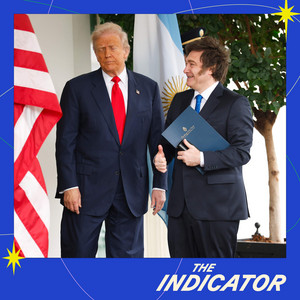
Last month, a reporter on Air Force One asked President Donald Trump about his administration's recent deal with Argentina.
The country's currency, the peso, is volatile and had plummeted in September.
And the US government had agreed to extend Argentina 20 billion in what's called a swap line, which is essentially a loan.
They're fighting for their life.
You understand what that means?
They have no money.
They have no anything.
They're fighting so hard to survive.
Democratic lawmakers blasted a decision to prop up the Argentine peso during a US government shutdown.
They said the administration was being reckless with American taxpayer money.
Money it might not even get back.
So where did the U.S. get the money from and will it get it back?
Today on the show, a peek at the 90-year-old emergency fund that the administration used for the Argentine lifeline.
We look at how the government has tapped this money before and why it's doing it this time.
This message comes from AT&T.
America's first network is also its fastest and most reliable.
Based on RootMetrics, United States Root Score Report 1H2025, tested with best commercially available smartphones on three national mobile networks across all available network types.
Your experiences may vary.
RootMetrics rankings are not an endorsement of AT&T.
When you compare, there's no comparison.
AT&T.
This message comes from Fisher Investments.
Senior Vice President, Michael Hosmar, explains the importance of providing a comprehensive approach for clients.
From investment management to tax minimization, to estate planning, you name it.
We have a sizable deep team with a diverse skill set, decades of knowledge and experience in the financial markets, and that team is who actually develops and deploys the plan for each of our clients.
Learn more at FisherInvestments.com.
Investing in securities involves the risk of loss.
The government piggy bank we're talking about today is called the Exchange Stabilization Fund.
It's been around since 1934.
That's when President Franklin D Roosevelt signed a law that, among other things, set aside 2 billion for this special fund.
The fund will be controlled by the Treasury Department.
And the government can use the money to buy or sell gold or foreign currencies.
The idea was to control the value of the U.S. dollar.
Monica DeBull is a senior fellow at the Peterson Institute for International Economics.
It's a research group focused on international trade and macroeconomics.
Monica says it's hard to picture today, but back then, the value of the U.S. dollar was volatile.
Remember, 1934 was the midst of the Great Depression.
When your currency is fluctuating a lot, that can become a huge problem for investors.
Companies that are dependent on.
You know flows of exports or imports, because of course, all of that is determined by the exchange rate.
It can have a very big effect on consumers.
It can even have a very big effect on the government.
The U.S. economy did, in fact, face those dangers in the 1930s.
So the Treasury tried to contain this volatility and did this by selling and buying currencies.
Here's how this market intervention works.
Let's say the U.S. dollar was falling in value against the Swiss franc.
The treasury could sell Swiss francs and buy U.S. dollars in foreign exchange markets.
That would make the Swiss currency weaker and the dollar stronger.
The need for this kind of market intervention went away as the U.S. economy became dominant.
The dollar is now the world's reserve currency.
It's used around the globe for trade and commerce.
Its value has historically been very stable.
Monica says the exchange stabilization fund kind of outgrew its name.
There is really no need to stabilize the dollar, as it were.
So the ESF isn't really being used to do that anymore.
In fact, the language around stabilizing the dollar was removed from the fund's mandate in the 1970s and the Treasury Department found other ways to use this fund.
One purpose is related to the International Monetary Fund.
That's a group that lends money to countries in trouble.
The IMF actually has its own kind of pseudo-currency, something called special drawing rights, and the US uses the Exchange Stabilization Fund to hold this IMF currency.
I'm picturing like a big cookie jar that has U.S. dollars and euros and Japanese yen inside.
And then there's also this special IMF monopoly money.
Yeah.
Do you think the cookie jar is in the shape of a giant bald eagle or is it?
Uncle Sam's head?
Can you do a dollar-shaped cookie jar?
Okay, I see it.
I see it.
To the pottery wheel, Stephen.
Anyway, the fund does earn some income from interest and selling investments.
Those profits go right back into the jar.
As of September, the fund had a net balance of $43.5 billion.
The $20 billion for Argentina represents a hefty chunk of this amount.
The Treasury has done dipped into this cookie jar for emergencies.
For example, it guaranteed deposits in certain kinds of investment funds during the subprime mortgage crisis in 2008.
It also backstopped certain loans to banks in the early part of the pandemic.
And the government also uses this money to tackle economic emergencies in other countries.
One of the most famous uses of the Exchange Stabilization Fund came in 1995.
Mexico had borrowed a lot of money and dollars that it could not pay back, and the Mexican peso was in free fall.
President Bill Clinton announced that the U.S. would come to Mexico's aid.
I have worked with other countries to prepare a new package.
As proposed now, it will consist of a 20 billion share from the United States' Exchange Stabilization Fund, which we can authorize by executive action without a new act of Congress.
Monica says the Clinton administration had strong economic and political rationales to extend Mexico that 20 billion.
Mexico was certainly systemic in the sense that a crisis in Mexico would have had implications for the United States.
But we should also remember that at the time, NAFTA had just come into being.
And so you know there was great political interest on all sides not to see NAFTA sink because of a crisis in Mexico.
And therefore, that was the other reason why the ESF was deployed in this way.
And at first glance, the Mexico and Argentina situations look similar.
Country with debt problems and a weak currency, check.
Political ally, check.
Even the nominal amount of money, $20 billion, is the same.
But Monica says the Argentina package is unprecedented in a few different ways.
For starters, the U.S. is going it alone on this aid package.
That's different from the Mexico bailout, which was done in concert with other countries.
It's also different from previous cases where the U.S. had coordinated with the IMF on aid.
Monica says another way.
The Argentina example is unique is that there's no risk of other countries getting dragged down, even its neighbors.
Argentina is a notorious economic basket case.
Whoa, Whelan, forget the cookie jar.
I feel like that's almost like swear jar territory.
It is justified, though.
Argentina has defaulted on its government debt nine times during its history.
And it's this crummy track record that's largely isolated the country, so that its problems tend to stay within its borders.
A problem in Argentina does not spill over into the U.S.
So there's that, you know, additional element of, let's say, something that's being done that is not exactly like what has been done in the past.
It's an unprecedented use of the ESF.
It may be unprecedented, but there are many reasons for the administration to support Argentina.
President Trump considers his Argentine counterpart, Javier Millay, to be a friend.
The country has natural gas, lithium and other resources that interest the US, And there's a desire to curb China's influence in Latin America.
And there's this.
The New York Times and other media outlets have reported that former colleagues of Treasury Secretary Scott Besant stand to gain from an Argentine bailout.
Some of his associates from his Wall Street days are heavily invested in Argentina.
We did contact the White House and the Treasury Department for comment.
We did not hear back.
But CNBC talked to Scott Besant last month.
He said...
This trope that we're helping out wealthy Americans with interest down there couldn't be more false.
No matter the rationale, economist Monica DeBoll has concerns about the bailout structure.
The US hasn't publicly released any conditions for the 20 billion it's essentially loaning Argentina.
She worries this lifeline has drawn the U.S. into a political and financial quagmire.
And Argentina has done a lot on the reform front, but there are still gaps.
So the possibility that Argentina has another crisis in a few months exists.
And then the question becomes well, now that the US has put money into Argentina so that it doesn't lose money in Argentina, will it have to help Argentina again if it falls into a problem?
The answer to that is probably yes.
The Trump administration, however, seems undeterred.
Scott Besson has said he's pulling together another 20 billion package for Argentina, but this time from private banks and sovereign wealth funds.
Monica says that would be another unusual move.
By the way, if you want to hear more about how the exchange stabilization fund was used in Mexico back in the 90s, you can listen to an episode from our Planet Money colleagues.
It will be publishing tomorrow.
This episode was produced by Julia Ritchie with engineering by Robert Rodriguez.
It was fact-checked by Sierra Juarez.
Kicking Cannon is our editor, and The Indicator is a production of NPR.
This message comes from BetterHelp.
Most FSA dollars expire at the end of the year, so it's time to use them or lose them.
With BetterHelp, you can invest those funds in taking care of your mind with online therapy.
Join today and you can be matched with a licensed therapist in as little as 24 hours.
Visit BetterHelp.com to get 10% off your first month.