Ted Audio Collective You're listening to Ted Talks Daily, where we bring you new ideas to spark your curiosity every day.
I'm your host, Elise Hugh.
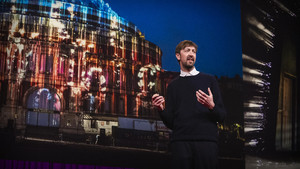
I met today's speaker, production designer Mark Grimmer, in line for Coffee, or something like it, at TED 2024 in Vancouver.
He was so understated and humble that I had no idea he's the man behind ambitious art and multimedia experiences like a David Bowie retrospective and an immersive David Hockney exhibit.
In his talk, he goes behind the scenes on these productions and shares all the things he didn't share when we met in line at the TED conference after the break.
AI is shaking things up, and it's fascinating, confusing, and sometimes scary.
Our new podcast, The TED AI Show, helps you understand what you need to know about AI and how it's changing our world.
I'm your host, Belaval Sedoux, a creative technologist and AI innovator.
And I ask experts, artists, journalists, and beyond to guide us through the thrilling world of tech and how it's going to affect the future of our health, art, everyday lives, and so much more.
Each episode will leave you more informed and with tools to help you understand how AI will change your future.
Check out The TED AI Show, wherever you get your podcasts.
And now our TED Talk of the Day.
A few years before his death in 2016, our small and at the time slightly scrappy design studio was charged with taking the world -changing body of work created by David Bowie and turning it into a museum exhibition that would speak to newcomers and die -hard fans alike.
We'd never designed an exhibition before.
We'd made stage shows, we'd worked in live music, we'd made films.
But lacking any direct experience, we wondered what might happen if we took those genres that we did know and mashed them together into a single, immersive audience experience in a museum.
What might happen if forms and ideas were allowed to collide?
Well, today we are living in the age of immersion.
But what does that really mean?
Well, technological advances have always led to new forms of storytelling.
You think about the amphitheater or the printing press or celluloid or the internet.
But now, new possibilities for storytelling are emerging faster than at any other time in history, and as they do, they provoke us as storytellers to experiment with new kinds of narrative experience.
Experiences that touch all the senses, that play with dramatic scale or heightened intimacy, to help audiences feel more.
Now, many of these experiences are supercharged by technology, but the very best of them aren't defined by it.
The power of the story, rather than the novelty of the hardware, remains the key.
Throughout his career, David Bowie resisted calls to stick to one genre or even one art form.
He was the very embodiment of the collision of ideas.
So when thinking about how to tell his story, it seemed fitting to look at his work through a kaleidoscopic lens, constantly shifting, fractured, but always luminous.
The first thing we did was to abandon any sense of a traditional linear narrative.
And instead, we collage together a whirlwind of objects, costume, props, music and image to create a form that felt true to Bowie's magpie -like mentality, that celebrated the collision of ideas.
Now, the exhibition was a kind of promenade through a cubist portrait of the artist, leading to a finale of live performance that we hoped might somehow capture some of that intangible magic that truly great performers can cast on their audiences.
Now, we couldn't literally recreate a Bowie gig.
And we didn't really want to either.
So instead we sat out to conjure the energy and emotion of one.
Oh no love, you're not alone, Bowie sang in this, his last ever performance as Ziggy Stardust.
And 40 years later, for a few brief moments, we weren't alone.
It felt like he'd returned to Earth.
From a star man of one kind to star men of another, in 2019 we were asked to help mark the 50th anniversary of one of humankind's greatest achievements, the Apollo 11 moon landings.
But what format might allow us to evoke the scale and the spectacle of the Apollo 11 mission, but also to immerse audiences in the barely believable story of the 400 ,000 women and men who'd helped put humans on the moon?
And how, at a time of real division and pain, how might we bring people together in much the same way that the crowds had gathered to watch the rocket launch back in that red hot summer of 1969?
It had to be big. It had to be audacious, bordering on the impossible as the mission itself was.
In conversation with our colleagues at the Smithsonian Museum, an outrageous idea emerged.
The Washington Monument, the world's tallest obelisk, which stands at the foot of the mall in D .C., is, it turns out, almost the exact height of the Saturn V rocket.
An act of Congress was required for the project to go ahead, and permission from the White House didn't arrive until the day before rehearsals were due to start.
But against all the odds, over two sweltering nights, 500 ,000 people gathered to watch as 100 ,000 tons of marble appeared to blast off into the night sky, captivated not only by the spectacle, but also by the story of how, through the collision of science, technology, curiosity and courage, humankind
had achieved the impossible, sending three men a quarter of a million miles to the moon and bringing them safely home again.
The collision of ideas behind shows like David Bowie is and Go for the Moon allowed us to tell other people's stories in novel ways.
But what might happen if one created a new kind of hybrid storytelling experience that had, at its heart, a true collaboration with a living, working artist?
Might that kind of collision lead to a new art form?
And now, back to the episode.
Well, the artist we dreamed of working with was David Hockney.
So in 2019, I wrote him an email and within a few weeks, we were together in this farmhouse in Normandy.
And for a few days, we chatted, and he smoked.
Boy, did he smoke. You know someone's a keen smoke when they've got at least two cigarettes on the go at any one time.
Sitting in the studio, we spent several hours leafing through the Sumo -sized book of his paintings.
And as we did, David talked about his work with the undimmed pride of a child showing their parents a crayon drawing.
And he agreed that maybe there was something in this new form we were discussing, part exhibition, part theater show, part documentary, that might lead him to something interesting, something new.
In 2020, in February, just before the pandemic locked down, David joined us in a freezing cold warehouse on the outskirts of East London to look at some of his work projected at scale.
And he was thrilled by the size, but also by the color, the brightness, the vivid hues.
And as we flashed through a selection of his work projected 50 feet tall on the bare brick walls, David talked about his process, about the decisions he'd made in composing the paintings, about how hard it is to make memorable pictures.
And that was when the idea for the show emerged.
What if we could recreate this moment, David Hockney, sitting next to you, talking in his warm, mischievous Yorkshire lilt about a life of making art as his work unfolds before your eyes?
When I arrived here, I couldn't drive at all.
And within a week, I'd got a driving license, I bought a car, I'd got a studio.
I thought, Oh, this is the place for me.
The only voice that you hear in the hour long immersive show is David's.
But that might be about the challenge of painting his giant Yorkshire landscapes, the young David in conversation with his older self.
You're invited to listen as well as to watch as images appear all around you.
And we worked closely with David for almost three years, during which time he came to think of the show as a work of art in its own right by him.
It was a Hockney. Together, we'd found an approach that allowed him to reach new audiences, to share his process in new ways and to give people unparalleled access to his creative process.
In the show, 30 projectors and a cutting edge sound system fill the space with image and sound and hundreds of David's paintings, drawings, sketches, operatic set designs and photographic works are woven together with voiceover, music and sound design to create a guided tour led by the artist himself
through six decades spent looking closely at the world and enjoying every moment of it.
Oh wow, I've painted for 60 years now.
I'm still painting and I'm still enjoying it enormously.
Yes. So what does the future of immersive entertainment look like?
VR, AR, XR, AI? The truth is that none of us know, but those technologies that might otherwise threaten to isolate us can actually be harnessed to bring us together and not just as audience members, but also as creators, because making immersive work calls for a richly multidisciplinary approach, one
that creates the conditions necessary for the collision of ideas to take place.
An approach in which architects and animators, directors and designers, writers and technologists are brought together as if in a kind of cultural large hadron collider, a machine in which multiple disciplines can be accelerated towards one another in the hope that the resulting collision might release
something new, something energetic, something that has the power to change the direction of the bodies involved.
Thank you. That was Mark Grimmer at TED 2024.
If you're curious about TED's curation, find out more at ted .com slash curation guidelines.
And that's it for today.
TED Talks Daily is part of the TED audio collective.
This episode was produced and edited by our team, Martha Estefanos, Oliver Friedman, Brian Green, Autumn Thompson and Alejandra Salazar.
It was mixed by Christopher Faizi Bogan, additional support from Emma Tobner and Daniela Ballarezo.
I'm Elise Hugh. I'll be back tomorrow with a fresh idea for your feed.
Thanks for listening.