This message comes from U.S.
Bank.
Simplify how you do business with business.
Essentials a powerful combination of no monthly maintenance fee checking and card payment processing.
Deposit products are offered by U.S.
Bank National Association, member FDIC.
You're listening to Shortwave from NPR.
Hey, short wavers.
Regina Barber here.
And Emily Kwong.
With our biweekly science news roundup featuring the hosts of All Things Considered.
And today we are back with space case Scott Detrow.
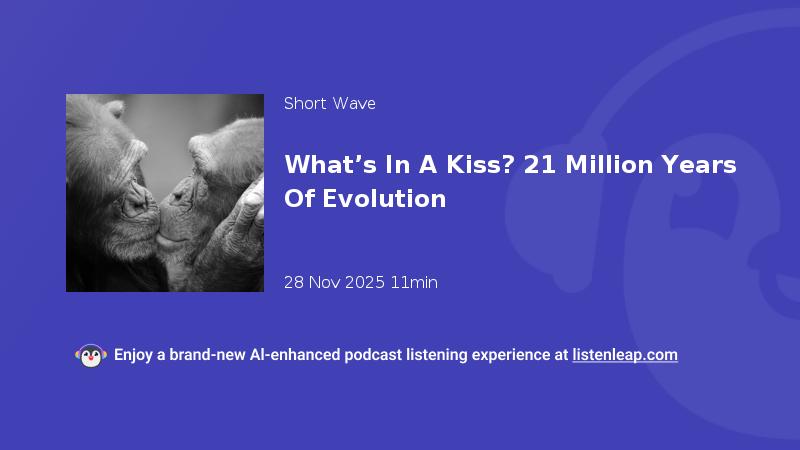
Listen, I like space, as you know, but I'm also a fan of apes making out.
And that's.
And that's why I'm here today.
Heard that's a topic?
Yes, we're going to pucker up to some weird research.
We're also going to talk about space moths.
Yes, and we are going to talk about another moon story, Scott.
But this time it's ours and how it was made.
You know, I think last time we talked about one of Jupiter's moons.
So I'm glad we're closer to home this week.
Yeah, moon, moon.
You know, buy local.
Get excited for all of that on this episode of Shortwave, the science podcast from NPR.
This message comes from NPR sponsor NetSuite.
Get their free business guide, Demystifying AI, at netsuite.com slash shortwave.
This message comes from NPR sponsor, Rosetta Stone, an expert in language learning for 30 years.
Right now, NPR listeners can get Rosetta Stone's lifetime membership to 25 different languages for 50 off.
Learn more at rosettastone.com slash NPR.
All right, we are back.
And to start off, tell me about our ancestors making out with Neanderthals.
It happened under some prehistoric mistletoe.
How did science address this question?
Like, I don't even know where to start with that.
Yeah, so many animals kiss.
So birds, fish, insects, especially primates.
And by kissing.
Scientists define that as non-aggressive mouth-to-mouth contact that does not involve passing food.
That's an important aspect.
And Matilda Brindle at the University of Oxford wanted to know how far back in evolutionary history does this go?
If you think about the fact that humans and our closest living relatives, chimpanzees and bonobos, all kiss, it makes sense that the common ancestor of those three species kisses as well.
So, tracking back through evolutionary time, Matilda's team found that kissing was present in the ancestor of all large apes 21 million years ago.
And they published these results in the journal Evolution and Human Behavior.
How do you even begin to see if somebody was kissing somebody 21 million years ago?
Like was there a fossilized mid-kiss?
I don't know.
That would be really cool, but no.
This was all done through what's called phylogenetic analysis.
Matilda and her colleagues basically treated kissing as a trait and mapped it Onto like a tree of primates.
Which they did by determining which primates kiss and which do not.
So Matilda had to watch a lot of video footage of primates locking lips.
And she compiled evidence of which of our primate cousins canoodle.
She built her family tree, and she discovered something else, which is that Neanderthals probably kissed too.
And that is a big deal.
Why did that matter?
Well, most humans of non-African descent have a very small amount of Neanderthal DNA.
And we know that Neanderthals and humans interbred after the two species split.
And this kissing study gives us a little bit more insight into those relationships.
Humans and Neanderthals were probably kissing each other, which is a way more romantic take on human-Neanderthal relationships than I think we might have thought of before.
What a romantic take.
I know.
Equally romantic in my mind is moss spores in space.
Right.
Yeah.
How did this experiment come about?
So, as humans contemplate long term space travel, scientists want to know which plants may survive the extremes of space, because space is cold.
There is a lot of radiation.
It's a vacuum.
Scientists can simulate some of that on Earth.
But to know how a plant will do in space, you got to put it there.
And I assume that if you're going on a really long space travel at some point you probably want some plants with you.
Yeah, you want them for things like oxygen production, maybe to help terraform a planet, once that becomes possible.
And for many people, aesthetics.
Right.
Right.
That's true.
But why moss in particular?
Well, because moss has some incredible survival strategies.
Bryophytes, the group of plants that includes mosses, were the first plants to move from water to land.
We believe moss colonized on land about 500 million years ago.
So they can survive for a long such period.
Even dinosaurs may be extinct, but still moss can survive.
This is plant biologist Tomomichi Fujita at Hokkaido University, who led the work.
And he says land is a lot harsher than the ocean, with larger temperature fluctuations, higher risk of drying out and more UV.
In ground studies before the team sent moss to space, they found that moss spores, which were enclosed in this protective coating called a sporangium, did much better with exposure to extreme heat and cold and importantly, to UV.
So the moss spores passed the UV test on Earth.
How did they do in space?
They did shockingly well, says Magdalena Bezania, a cell biologist at Dartmouth who is not involved in this work.
Her lab just happens to study the same moss.
I was really surprised.
I mean, the spores just went out.
They were just phenomenal.
After nine months in space, more than 80% of these spores germinated once they were back on Earth.
From this, scientists calculate the spores could go about 15 years in space conditions and still germinate.
The team published their results in the journal iScience.
So are we going to terraform with them?
Well, the paper points out that moss and other bryophytes can survive low light.
They're great at making oxygen and fixing carbon, and they could be good at transforming other planets' surfaces into fertile soil.
But the scientists have only shown that the spores can survive, you know?
They haven't shown that the moss, the green fuzzy stuff that you see on Earth, can grow in space under this extreme radiation.
Finally, we're going to talk about a moon.
This week it's our moon, a close-to-home moon.
Yes.
Gina, I'm always pro-moon stories.
Tell me about this week's.
Yes, Scott.
Okay, right now, in the sky, there's a moon.
True.
Okay.
And then in the beginning, when the solar system was forming, there was a proto-Earth and no moon.
No moon.
Then something maybe the size of Mars came and smashed into proto-Earth, and that debris from that giant crash made the moon.
And the name of this like planet smashing object was Theia.
Now a new paper in the journal Science is attempting to figure out what this object Theia, was made out of and where in the solar system it came from.
Here's how Kelsey Preisel put it.
She's a geochemist from Purdue University who didn't work on this study.
For me this paper reads kind of like a planetary whodunit where we're trying to figure out how do we form the Earth-Moon system together.
All right, so where did Theia the Earth Smasher... Yeah.
It's like a mythological phrase.
Yeah, it's like a Marvel villain.
Yeah.
Well, they looked at lunar samples brought back from NASA's Apollo missions and other meteorites from our solar system and, comparing those samples to rock samples from Earth, they found that Theia, the Earth Smasher, could have been born even closer to the sun than Earth.
So Theo was born in the inner solar system.
Scott, the call is coming from inside the house, okay?
And this also gives us a clue about maybe the origins of water on Earth.
Water, how's that?
If Theia had formed in the outer solar system, so past Jupiter.
Where it's colder, there's ice.
Some scientists thought that Theia could have delivered water to Earth during that collision.
But with this study, we now know that Theia came from the inner solar system, which is drier.
And that means that Theia was probably not the source of water on Earth.
But now I'm curious, where did Earth's water come from?
So I asked that to the lead author of the study.
His name is Timo Hopp, and he's from the Max Planck Institute in Germany.
Theia could not have brought a lot of water to the Earth.
That means the water must have come from another type of material or process later or earlier, likely earlier.
Now, water could have come from comets.
It could have formed when the Earth did.
Though to truly solve the debate, we're just going to need to gather more space rocks.
Because if Theia did indeed come from closer to the sun, we would need samples from Venus or Mercury to prove it.
But sadly technology to withstand the harsh surfaces of Mercury and Venus and actually travel there efficiently and back our technology is just not totally there.
It just seems like it's too hot.
Yes, it is too hot.
It's my scientific analysis.
Right now.
Scott, it is always super fun to have you.
It's true.
We love talking about space with you.
Yep.
Thanks.
As long as you keep upping the weirdness of the stories each week, I'll keep coming back.
I try every time.
We'll try.
Yeah.
Thank you both.
Thank you.
You can hear more of Scott Detrow on Consider This NPR's afternoon podcast about what the news means for you.
This episode was produced by Barilla McCoy and Kai McNamee.
It was edited by Rebecca Ramirez and Christopher Intagliata.
Tyler Jones checked the facts.
Zimon Laszlo Janssen and Damian Herring were the audio engineers.
I'm Emily Kwong.
And I'm Regina Barber.
Thank you for listening to Shortwave, the science podcast from NPR.
We have too much fun.
This message comes from Solidime.
Yesterday's approach to storage can't meet the demands of today's AI ambitions.
Bigger, faster, and more energy efficient.
Solidime solid state storage solutions are optimized for AI.
Learn more at storageforai.com.
This message comes from Mint Mobile.
Starting at $15 a month, make the switch at mintmobile.com slash switch.
$45 upfront payment for three months.
5GB plan equivalent to $15 a month.
Taxes and fees extra.
First three months only.
See terms.
This message comes from PACA.
Everyone's got that one hoodie they practically live in.
But the PACA hoodie?
It's on another level.
Softer than cashmere, warmer than wool, and still breathable.
This alpaca fiber hoodie goes from airport to mountain trail to couch without missing a beat.
And right now, for a limited time.
You'll get 30 off when you purchase three or more items during their Black Friday Cyber Monday sale.
Now's the perfect time to level up your hoodie game at go.pacaapparel.com slash NPR.