What makes someone Native American?
There's a misconception that to be truly Native, you have to have darker skin and long hair, dress only in traditional clothing and be actively riding a horse.
But Native Americans are also modern people.
We wear suits and jingle dresses, write code and teach traditional languages, rock buzzcuts and braids.
We could have an Ojibwe mom and a British dad who pass on his blonde hair, pale skin or love of beans on toast.
Basically, you can't tell if someone's Native just by looking.
So today, I'm going to give you the scoop on what it really means to be... Native!
Hi.
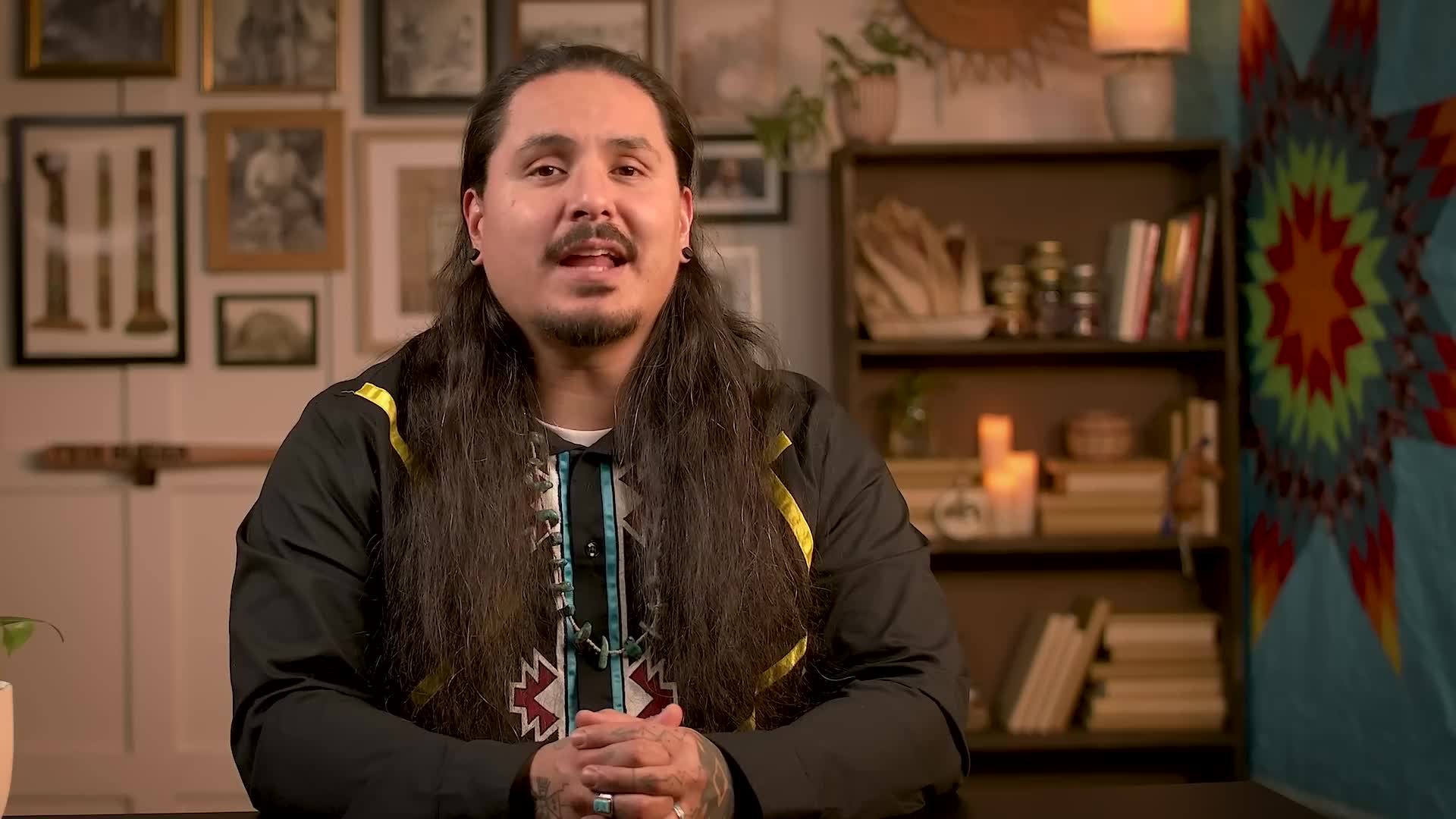
I'm Che Jim, and welcome to Crash Course Native American History.
So, first of all, there's no single native identity.
And no single native culture.
Before the land that we call the United States was a twinkle in Thomas Jefferson's eye, some native nations knew this land as Turtle Island.
And it was, and is, a land of hundreds of tribes.
Each tribe had its own cultural practices and unique identities, with different spiritual beliefs languages customs landscapes rituals food, dress and traditions.
You wouldn't get a Kwakiutl potluck confused with a Muscogee green corn ceremony.
That'd be like rolling up to Cinco de Mayo in Lederhosen.
People look at you funny.
Trust me, I know.
We'll begin in 1492 when Columbus sailed the ocean blue.
Whoa, no, no we won't.
Plus, the Vikings made it here way before that dweeb anyway.
Yes, to make an extremely long story short, European settlers colonized North America, interrupting native life.
Something we'll talk more about in episode 10.
And like we'll see over and over throughout this series, native people are still dealing with the consequences of colonization, including when it comes to identity.
Take spirituality.
Before colonization, the hundreds of tribes scattered throughout what is now the US had diverse spiritual practices and many communities shared the notion that all living things are related, a part of a family, rather than resources to be used up.
What we native folks call mitakwe oyasi, a Lakota phrase meaning all my relations.
But when the colonists imported Christianity and those weird hats to North America, they tended to see Native Americans as souls in need of saving.
Spiritual practices that had stretched back for generations were suddenly disrupted.
For instance, the Puritan John Eliot of the Massachusetts Bay Colony tried to convert American Indians to Christianity.
He even learned the Algonquin language to do so.
And it worked.
One quarter of Native people in New England converted to Christianity.
Elliott isolated those who converted into praying towns, forcing them to cut their hair, dress like Puritans and give up their families and cultural practices.
This created tribal and cultural tensions between those who converted and those who didn't, even within families.
When your community faces a crisis of faith, what does that do to your cultural identity?
Fast forward to the 21st century and two-thirds of Native Americans today identify as Christian.
But plenty of Native people still follow their traditional beliefs, and some mix the two.
My own grandma wore her traditional dress every day.
She spoke fluent Navajo and with the Catholic Mass every week.
Or like at Minnesota's All Saints Episcopal Indian Mission, where the pasture burns sweetgrass instead of incense, the organ is swapped for traditional drum and the congregation holds annual buffalo roast.
And when it comes to cultural identity, language is one of the most powerful ways to share and preserve it.
But hundreds of native languages have been lost since European contact, in part thanks to American Indian boarding schools.
Starting in the 1870s, thousands of Native children were forced to attend these government schools and, among many other deeply horrifying things, were forbidden from using their given names and speaking their languages.
We'll talk a lot more about these boarding schools later on in the series.
But let's jump forward to the here and now.
If you can't speak your ancestral language, how might that affect your connection to your culture?
These are complicated questions, and the answers can be different for every native person and tribe.
But some languages are being revived in some pretty unexpected ways.
Come here, tell your story.
In the 1990s, Jesse Little Doe Bayard, a member of the Mashpee tribe of Wampanoag Nation, started having dreams.
In them, familiar-looking people spoke to her in a language that she didn't understand.
Then one day, when driving in Massachusetts, she noticed similarities in the street signs that she was passing, and it hit her.
The people in her dream were speaking Wampanoag, the traditional language of her people.
See, there is this prophecy from back when her tribe had first met the pilgrims at Plymouth Plantation.
It predicted that the Wampanoag language would disappear and eventually return, and the children of the people who played a role in its loss would help resurrect it.
True to the prophecy, Wampanoag hadn't been spoken since the late 1800s.
Bayer took her dreams as a sign.
She worked with the Mashpee and Aquinnah tribes to launch a language reclamation project and while getting her master's in linguistics from MIT, she was advised by an expert in indigenous languages who just so happened to be a direct descendant of the white founder of Rhode Island.
Much like the prophecy foretold,
To bring the language back to life.
Shikras referenced a Bible that John Eliot Ascot guy had translated into a language similar to Wampanoag, plus dozens of other archival documents from languages in the same family.
From those scraps, Baird constructed a 10000-word Wampanoag dictionary, began teaching Wampanoag classes and even raised her daughter to speak the language, making her the first native speaker in seven generations.
And that is the story of Jesse Little Dove Baird.
As diverse as native identity can be varying from person to person and tribe to tribe, what's shared is a common experience of splintered connections to places practices, languages and more.
In fact, colonization changed how lots of Native people determined what's known as tribal membership.
Like, I'm an enrolled member of the Navajo Nation.
But not all Native Americans are enrolled tribal members.
Before colonization, tribes often used descent to figure out membership.
If you were descended from someone in the tribe, or were adopted or married in, you were welcomed.
We kept it chill.
But thanks to standards imposed by the US government over the years, things have shifted for many tribes.
Today, each tribe determines their own enrollment criteria.
For instance, the Cherokee rely on something called the Dawes Rolls lists, prepared by the US government in the late 19th and early 20th centuries, to document who was a member of five specific tribes, including the Cherokee.
But they weren't perfect.
Many people from those tribes didn't sign up out of fear of persecution.
Also, the Dawes Rolls limited enrollment to one tribe, even though many Native people claimed multiple tribal identities.
Regardless today, the only way to become an enrolled member of the Cherokee Nation is if at least one of your direct ancestors signed up for that list.
Elsewhere.
The most widely used way to figure out enrollment eligibility is to require a particular blood quantum or fraction of tribal blood.
Quantum blood fractions?
Man, this sounds like a sci-fi thriller.
But the amount required varies between tribes.
For example, someone looking to enroll in the Turtle Mountain Band of Chippewa only needs one-quarter Indian blood, regardless of tribe.
But a person seeking to enroll in the Navajo Nation needs to have at least one-quarter Navajo blood to be accepted.
Thanks, Dad.
About 70 of federally recognized tribes today require a blood quantum, but it's a controversial way of determining tribal enrollment.
It's a practice born out of those early Dolls Rolls days back when the US government was also sorting Native Americans into mixed or full blood.
AKA those with European ancestry and those without.
The hope in measuring Indian-ness was that eventually, after generations of intermarriage, there wouldn't be many people who qualified as Native anymore and the US would not be held to the treaties that they signed.
That's one messed up loophole.
Many natives today argue that tribes should lead blood quantum in the past, reasoning that it's a colonial invention that treats native identity like a math problem.
Considering younger generations not native enough,
If a child of two enrolled parents doesn't lead blood quantum, they miss out on the benefits of tribal citizenship, like access to scholarships, religious protections and healthcare.
Not to mention a sense of belonging.
And a cool ID card.
And as fewer people qualify as members, what will that mean for the tribe's continued existence?
But on the other side, some native people think blood quantum requirements are their best shot at proving a lineage and preserving already close-knit communities.
So it's up to each tribe as a sovereign nation to decide how they want to handle membership.
And some tribes are taking action, returning to enrollment based on descendancy.
In other words, if your parent is in the tribe, you can be in it too.
Like the St.
Croix Chippewa tribe, which voted in 2023 to eliminate blood quantum requirements.
And in case you were wondering, can a DNA test prove tribal membership?
No.
At most a DNA test might show someone is related to a tribal member, but there's no tribe-specific genetic marker that says congratulations, you're Navajo.
And although there are some DNA markers more likely to be found in people with Native ancestry, not all Native Americans have them.
So next time your white neighbor tells you they're Mohawk because 23andMe said so, kindly direct them to this video.
So Native American identity can involve being an enrolled tribal member, but not always.
Also, to make things even more nuanced, not all tribes are federally recognized.
The US government chooses which tribes get federal benefits currently 574 of them, though there are some occasional updates.
Most benefits and many laws relating to American Indian identity only apply to members of those federally recognized tribes.
Additionally, the government issues Certificates of Degree of Indian or Alaskan Native American Blood or CDIB cards.
So many cards. which entitle holders to those benefits like access to Indian health services.
All of this has a huge impact on the cultural identity of a tribe and its people.
If a tribe isn't federally recognized, some people don't see it as legitimate, even if that tribe has been around since time immemorial.
And without recognition.
Tribes like the Winnemem Wintu face an even steeper climb in preserving their cultural traditions because they lack legal protections for their religious practices or the clout to stop development on their sacred sites.
As for how the federal government decides who gets recognition, that's complicated.
And we'll get there in a later episode.
When it comes to culture, native identity might involve speaking traditional languages and dressing in traditional clothing, or it might not.
When it comes to legal status.
Identity might mean being an enrolled member of a federally recognized tribe or an unrecognized one, or not an enrolled member at all.
Really, it's not a one-size-fits-all kind of deal.
But if there's one word I could use to describe native identity, it's this.
Perseverance.
Ever since the first colonizers set foot on the shores of North America, they've worked to dilute, restrain and destroy Native culture.
From creating categories to define us, to separating us from our beliefs, lands, and languages.
But through it all, Natives have persevered.
And in that perseverance, we've begun to reclaim what's been taken from us.
In our next episode we'll look at some of the many ways Native Americans are connected to the land and to each other.
And I will see you then.
Thanks for watching this episode of Crash Course Native American History, which was filmed at our studio in Indianapolis Indiana, and was made with the help of these nice people.
If you want to help keep Crash Course free for everyone forever, you can join our community on Patreon.