You're listening to LifeKit from NPR.
To tip or not to tip, that is the question.
Also though, how much am I supposed to tip?
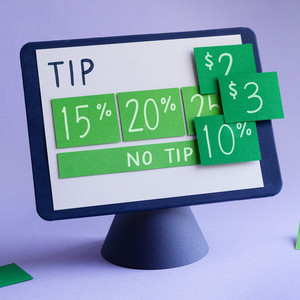
Is this 24% minimum tip I'm seeing on the screen?
Is that really the new minimum?
Is it OK to leave less?
Can I tip on my card or am I supposed to tip in cash?
Also, I didn't even know I was supposed to leave a tip
at this kind of a business.
And where is my tip even going?
Is it go to the person who's actually helping me
or is it go somewhere else?
Tipping.
It is complicated.
I'm Stacey Vanick Smith, Informeriel Sigerra.
And today on LifeKit, we take a look at tipping.
The last couple of years have seen a whole lot of talk
and back and forth and emotion about tipping.
One of our wonderful producers, Audrey Wynn,
said at her local coffee shop, the tipping situation
is especially intense.
I have a 12 hour course, shoes, and eight outspotato.
It's called retrospect coffee bar in Houston, Texas.
And because of the way the coffee bar is physically set up,
they can't turn the screen around and have
a customer punch in a tip.
So they have to ask.
$9.20, please.
Pretty good.
All right.
Now, computers are going to ask me if you care to leave a tip
today.
You don't have to feel obligated.
Chris Davis is one of the owners of the shop.
And he says, when they bought the shop,
this was just the way it was set up.
And he doesn't love it.
But he has tried to find ways of making things less awkward
when he works the register.
You heard one of them back there.
The computer is going to ask me if you want to leave a tip.
That's one trick.
But he has others.
Heavy on the self-deprecation.
Hey, I know this is awkward.
You don't have to feel obligated.
And if they say no, and they look sheepish.
And I love to go to, we can handle no.
It gets very awkward.
Chris has gotten all kinds of responses from customers.
Some very kind, very understanding and generous.
Others, not so much.
And I asked, do you want to leave a tip?
And his answer was, all you did was pull a lever for my coffee.
And it really hurt another time.
I think somebody asked me, is this even legal?
For the record, it is legal to ask for a tip.
But truly, I kind of feel this customer's pain.
Tipping has become very fraught.
And a lot of this has happened because tipping
is a pretty intense social interaction, not always
as intense as it is in a retrospect,
but still often quite intense.
And ever since the pandemic, tipping expectations
have changed a lot.
And now there's just a lot that customers don't know.
And the answers are not always so obvious.
So today on LifeKit, tips for tipping.
We lay out the facts and answer some of the big questions
so that you can feel good about where
you're putting your money and where your money is going
in our brave new world of tipping.
So pretty much everyone we talked with for this tipping story
said, yeah, the tipping situation in the US, it is not great.
It's not ideal.
However, it is the system we have.
So it's worth figuring out how to navigate it.
But tipping in the US, it's just very fraught.
And it seems like everyone has developed
their own new system in the last couple of years.
In fact, we asked some of our LifeKit listeners
what their system is, how they navigate this wide world
of tipping.
Here's what they said.
My personal philosophy is if there's a tip option, always tip.
I think there should be a minimum of $5 for the pizza
man, for Obar, Buck of Beer, or pre-made mixed drink,
$3 to $5 for a fresh mixed drink.
That was Kent Tong and Andrew Lewis.
Listener Daniel Hoffman had a bit of a different perspective
on tipping.
I remember all too well making a whopping $2.83 an hour
as a server.
So I tip everyone.
20% no matter what, to all table service,
even if the server is a jerk.
Actually, when I go to a diner, I tip way more than 20%
because I know what a difference it makes.
Someone else who knows firsthand
what a difference a tip makes.
Sylvia Elogredo, I'm senior economist at the Center
for Economic and Policy Research.
Sylvia has done a lot of work around wages, pay, and tipping.
But before that, she lived on tips.
For over seven years as wait staff and or bartender,
far before I became an economist.
But it certainly is one of the reasons why I write so much
about it, because it's confusing.
People don't really get it.
And it's really quite important.
Sylvia says the most important thing
to know when deciding how much you want a tip, location,
location, location.
Where you are the state you're in,
makes an enormous difference.
And that is our first takeaway.
Know what the tipping and wage situation is in your area.
For one thing, every state has its own minimum wage.
There is the federal minimum wage of 7.25 an hour.
But some states have minimum wages that are more than twice
that.
What gets even more confusing is that there is also
a sub-minimum wage.
That is a wage that some service workers get paid
and it is below minimum wage,
like our listener Danielle and her whopping $2.83 an hour.
The idea is that the workers earn a sub-minimum wage
and then customer tips make up the difference.
Get those workers up to a minimum wage.
People don't understand this two-tier wage system
that we have in the United States.
We have minimum wages.
And then we have sub-minimum or cash wages
paid to workers who are tipped.
And at the federal level, the sub-minimum wage
is $2.13 an hour.
That is the federal sub-minimum wage.
And that amount has not changed since the 90s.
Now, some states do have a higher sub-minimum wage
and other states do not allow businesses to pay
a sub-minimum wage ever.
So the tip that you decide to leave for your coffee and pie
means something really different for a server
in Washington state, where the minimum wage is more than $16
an hour and there is no sub-minimum wage
versus a server in Tennessee.
Where that person might be earning $2.13 an hour
and really counting on the extra change you leave
for your pie and coffee.
And I think this is one of the reasons
why there is so much emotion around tipping from customers.
Because tipping is presented like an option or a courtesy.
Like, oh, if the service was great, leave a tip.
But in some cases, that money your tip is vital
to the income of that worker.
Like the Tennessee server is really counting on your tip
to be able to pay their gas bill.
Economist Sylvia Allegretto says, yeah, this system is confusing
and it is complicated and it puts way too much on the customer
as far as knowing what people are getting paid
in different jobs in different states.
So here in California, we're one of seven states
that do not allow for a sub-minimum wage.
So we don't have tip workers making less than the regular minimum wage.
So tips in California are actual bretuity.
On top of the minimum wage, if you're not tipping
in a state like Maryland, for instance,
Maryland has a $3.63 sent sub-minimum wage.
So if you're not tipping somebody in Maryland,
they're likely not getting up to the regular minimum wage.
So that's the case that where tips are not necessarily
gratuity, they are in part a very large share of the minimum wage.
Sylvia says, one great place to get this information
is the Economic Policy Institute's wage tracker.
That is at epi.org slash minimum dash wage dash tracker.
The information is totally free and updated all the time.
But there are also a lot of other sites where you can get this information.
But even when you know what the minimum and sub-minimum wages
are in your state, it can still be hard to know who is earning a minimum
or a sub-minimum wage.
It's not always so clear.
Often a sub-minimum wage will get paid to bar tenders,
servers, but also people who work in car washes.
It can just be really hard to know.
So when and out?
Asking is never a bad idea.
Shubanju's saying is a professor of marketing
at Johns Hopkins Business School.
And that is our takeaway number two.
When and out, just ask the person who is serving you.
Shubanju has a lot of practice doing this
because tipping in the US has always seemed kind of mysterious to him.
Because where he grew up, tipping was not a thing.
I lived in Singapore before I moved to US.
But when I moved to US, then tipping is a thing that I had to learn
and went to tip and went not to tip.
So Shubanju taught himself to ask questions.
Not just about minimum versus sub-minimum wage,
but also asking people, hey, do you get to keep your whole tip?
For instance, the business might not be tipping the person
that you are interacting with, the person who is serving you
and who you might think your money is going to.
So ask.
And if you just really don't feel comfortable asking,
Shubanju says you can always go old school and just tip and cash.
Giving a cash is always the preferred option
because then you know that you are giving that person that money right there.
And takeaway number three, as much as you can,
ignore social pressure when tipping.
There is a lot of social pressure around tipping,
especially when you are looking at the person who is asking for the tip.
But Shubanju says your decision to tip should not be completely based on who is looking at you.
In fact, he says right now, most people do not tip their Uber or Lyft drivers
or leave a tip for housekeeping at their hotel.
So I will suggest that please add a tip that will help the person.
Right now, less than half of individuals are tipping in this situation.
Right.
And often those workers really count on tips,
but they are not looking at you when you are making the tipping decision.
Now for businesses where you are not even sure if you should be leaving a tip,
and this has happened a lot since the pandemic,
some business you don't even expect to ask you for a tip is suddenly asking you for a tip,
Shubanju suggests leaving a 10% tip.
He says even asking for a tip is often an indication that the workers there
are not really getting paid a minimum wage.
So it is good to err on the side of leaving something.
And one thing to watch out for, screen pressure.
Shubanju says in a lot of businesses they have loaded a minimum tip of more than 20%,
some 22%, sometimes 24%, so there can be a lot of pressure to leave more than you want
just so you don't hold up the line.
But Shubanju recommends rejecting that pressure and feeling totally empowered
to press that custom tip button.
You know, push back a little bit on businesses who might be asking for too much.
In fact, I will suggest that everyone should hit that custom tip all the time,
instead of paying 24% or 28% default tip.
Why should you, if you want to pay 20% tip, just hit that custom tip button.
So there they are, our tips for tipping.
Just to recap, take away number one, know the tipping and wage situation in the place where you're paying,
because that makes a huge difference, probably the biggest difference of anything.
There are a bunch of free resources online around this.
One is at the Economic Policy Institute.
Take away number two, when in doubt, ask questions.
Ask workers how much of a tip they will receive, or if their job pays a minimum wage,
or a sub minimum wage, just ask.
Take away number three, try to ignore the social pressure around tipping.
Think about who you want to tip outside of who is looking at you.
Don't be afraid to hit that custom tip button.
And you should feel fine about taking a minute or two to decide how much you want to tip.
How can I help you?
I'll just get a vanilla latte with an extra shot.
Alright, one vanilla latte, extra shot.
Whole milk is fine?
Yes.
And we're over 16 ounces.
Look at those 16 ounces.
And I hope that's the hardest decision you have to make today.
For more life kit, check out our other episodes. There's one about how to do a budget refresh
and another on how to save for a big purchase.
You can find those at npr.org slash life kit.
And if you love life kit and want more, subscribe to our newsletter at npr.org slash life kit newsletter.
Also, we would love to hear from you.
If you have episode ideas or feedback you want to share, email us at life kit at npr.org.
This episode of life kit was produced by Audrey Wynn. It was edited by Sylvie Douglas.
Our visuals editor is back Harlan. Our digital editor is Malika Garib.
Megan Cain is the supervising editor.
Beth Donovan is the executive producer.
Our production team also includes Andy Tagle and Claire Marie Schneider.
Engineering support comes from Becky Brown.
I'm Stacy Vanicksmith in for Maryl Seguera. Thanks for listening.