This episode is brought to you by Rumchata, a delicious, creamy blend of horchata with rum.
It's best enjoyed over ice or in your coffee.
Rumchata, delivering vacation vibes any way or anywhere you drink it.
Find out more at rumchata.com.
Drink responsibly.
Caribbean rum with real dairy cream, natural and artificial flavors.
Alcohol 13.75% by volume, 27.5 proof.
Copyright 2025.
Agave Loco Brands, Milwaukee, Wisconsin.
All rights reserved.
A message from McAfee.
Wondering why the post office is texting you or why you owe thousands of dollars in toll fees?
Because someone's trying to scam you.
The good news?
McAfee can help.
With McAfee's award-winning scam detection, it's easy to tell what's real and what's fake over text in your inbox and online.
If they're faking it, they're not making it past us.
Get award-winning scam detection today.
McAfee.com slash keep it real.
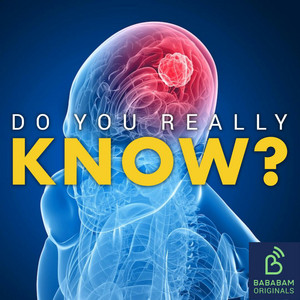
What is a tumour?
Thanks for asking.
The word tumour comes directly from the Latin for swelling.
A tumour appears when a group of cells multiply and form a mass.
Even though some tumours are malignant or cancerous, most are actually benign.
When normal cells multiply and remain localised, there's nothing to worry about.
These can be for example moles or warts.
Can benign tumours develop anywhere in the body?
Yes.
They can be found on a person's chest, face, or even in the brain.
A meningioma, for example, is a benign tumor of the brain.
Benign tumors do not spread.
They tend to grow slowly and have distinct borders.
They are not usually a problem.
What about malignant ones?
A tumor is malignant when cells grow uncontrollably and spread locally or to other parts of the body via the bloodstream or the lymphatic system.
This process is known as metastasis.
Genetic changes in the cells that form malignant tumors are the initial stages of cancer.
For example, if a person has a cancerous tumor in the liver, it may spread locally and become liver cancer.
Over time, it can also migrate to other organs, such as the lungs or brain.
When that happens, we refer to metastatic cancer.
According to Cancer Research UK, there are around 375,000 new cancer cases every year.
That's around 1,000 per day.
To tell whether a tumour is cancerous or benign, doctors need to see if it spreads quickly or remains localised.
The most non-invasive diagnosis method is through ultrasound.
These scans can show whether the edges of a tumour are well defined.
If the mass has irregular edges, the doctor will need to perform a biopsy, which involves the extraction of sample cells or tissues for examination.
The kind of medical professional who performs the biopsy often depends on the type required and the part of the body being examined.
The procedure may be performed by a surgeon, an oncologist or a gastroenterologist for example.
The tissue samples removed during a biopsy are usually analysed by a pathologist.
They specialise in interpreting lab tests and evaluating cells, tissues and organs to diagnose disease.
Is it possible to treat and prevent tumours and by consequence cancer?
A proper diet and a healthy lifestyle are two key elements.
Post diagnosis, there are several options depending on the stage of the disease.
In some cases, surgically removing the tumour is enough, especially if it's benign.
With malignant tumours, the patient may need chemotherapy, a combination of drugs that kills cancer cells.
Some other options include radiation therapy, bone marrow transplants and immunotherapy.
Many new treatment methods are also being tested through clinical trials.
There you have it now.
You know what a tumor is.
In under three minutes we answer your questions.
What would you like to know about?
Use the comments section to send us your questions.
Hey, ryan reynolds here, wishing you a very happy half off holiday, because right now mint mobile is offering you the gift of 50 off unlimited.
To be clear, that's half price, not Half the service.
And Mint is still premium, unlimited wireless for a great price.
So that means a half day.
Yeah.
Give it a try at mintmobile.com slash switch.