Support for NPR and the following message comes from the Robert Wood Johnson Foundation.
RWJF is a national philanthropy working toward a future where health is no longer a privilege but a right.
Learn more at rwjf.org.
This week is a milestone the first week that NPR and stations across the country operate without federal funding.
That might sound like a loss, but to me it sounds like a declaration that our strength has always come from you.
I think about the connection we share every time you turn on the radio or hit play.
Your trust in me, in us, is what fuels everything we do.
We won't go dark.
We'll keep bringing you the stories, the music, the conversations that matter to you and our country.
Because we belong to you, the people who power us.
You're listening to Shortwave from NPR.
Hey, Shore Wavers.
Regina Barber here.
And Burleigh McCoy.
With our biweekly science news roundup featuring the hosts of All Things Considered.
And today we have the West Coast host with the most, Elsa Chang.
West Coast is the best coast.
Thank you so much, guys.
So I hear we are going to be talking about flies on oil rigs.
So gross.
Oh, they're cool.
But also a surprising finding in the Amazon forest.
And lastly, fish sounds in a coral reef.
Cool.
OK, so we've got flies hovering in the air.
We've got some forest action and we got some sea action.
Yeah.
Yeah.
Yeah.
We have it all.
You're listening to Shortwave, the science podcast from NPR.
Support for NPR and the following message comes from the Robert Wood Johnson Foundation.
RWJF is a national philanthropy working toward a future where health is no longer a privilege but a right.
Learn more at rwjf.org.
All right, to start us off, tell me about these flies hanging out in the middle of the ocean.
Yeah, so this story starts with an oil rig in the North Sea that's between the UK, Norway and Denmark.
And on this rig, engineer Craig Hanna noticed that sometimes thousands of flies would land on the rig in the middle of the ocean, stay really still for hours and then take off again all at once.
OK, so what exactly are these flies doing out there?
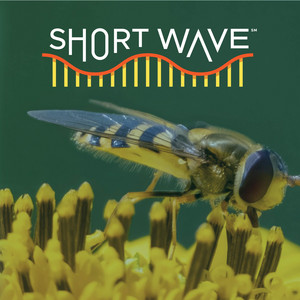
Yeah, so they're a type of fly called a hoverfly.
They're stripy.
They're often confused with bees.
And they're an unsung pollinator.
They're in the second most important group after bees.
And they migrate, often hundreds of miles, which explains why they're in the middle of the ocean.
Craig, who's also a bit of a naturalist, thought scientists might be interested in studying these insects in the open ocean, since most bugs are studied from land.
So he started collecting fly samples whenever groups of hoverflies landed.
And he sent them to a research team at the University of Exeter.
I'm sorry.
I think bees are way cooler than flies.
But OK, what did the team learn about these flies?
Okay.
So Eva Jimenez-Guri, a biologist on the team, says they were surprised by how much pollen the hoverflies were carrying.
And these 86 flies were carrying more than 100 species of plants.
Wow.
Okay, I'm impressed now.
Yeah, and that included common nettle, black elder, and meadowsweet.
And when the team looked at wind trajectories for the flies Craig collected, they determined that some of them likely came from the Netherlands, northern Germany and Denmark, more than 300 miles away.
So Eva and her team published the results in the Journal of Animal Ecology earlier this month.
Wait, what does it mean that these hoverflies are carrying so much pollen over these huge distances?
Yeah, Eva says this is likely the first time scientists have looked at the pollen that flies are carrying over water at this distance.
Gerard Talavera, an entomologist who wasn't involved in this paper, says these flies could have a big impact on pollination when they arrive at their destinations.
And he says hoverflies could be important in introducing brand new genes to faraway plants on their journey.
And this exchange of genes that can happen in both directions might help plants to adapt to climatic change, for example.
So next, the researchers want to test if this long-distance pollen survives the journey and can actually pollinate plants.
Hmm.
Okay, let's jump to a totally different part of the world, the Amazon rainforest.
Burleigh, what is the news over there?
Yeah.
So a new study out in the journal Nature Plants found that trees in the Amazon rainforest have increased in size on average in the last three decades.
The researchers say that's likely a result of more carbon dioxide in the atmosphere from burning fossil fuel.
Wait, what?
Our greenhouse gas pollution is actually helping these trees get bigger and bigger?
Yeah, in a way, the trees grew by about 3% each decade.
The researchers studied, which is more than expected.
They say.
That's a reminder that trees play a significant role in taking in carbon dioxide CO2, and helping fight climate change.
But the researchers wanted to clarify that this finding doesn't mean the Amazon is totally fine.
Even though the trees seem to be getting bigger, deforestation does pose a huge threat to the Amazon.
And climate change more broadly is linked to drought, which kills trees and means the forest can't store as much carbon.
Right.
So what does all that carbon mean for the long-term health of the Amazon then?
Yeah, so it means that the forest is resilient for now.
Here's one of the study authors, Adriani Escavel-Muhlbert.
The Amazon has this capacity to tolerate changes in climate.
Now we have to stop deforesting because we need those forests to provide the services for us.
And they can resist, at least for now.
Another study author Becky Banbury Morgan added it's important to remember this study is just one snapshot of the rainforest.
It doesn't tell us how the trees will continue to respond in the future, especially with those climate-related factors like heat stress, wildfires and drought.
OK, let's go under the sea now.
Under the sea.
And listen to some sounds that, wait, fish make?
I had no idea fish can even make sounds.
I mean, I didn't really realize this either until I started reporting on it.
But fish can make sounds.
They sometimes use their teeth or their fins or like muscles attached to their swim bladder.
Here, Elsa, take a listen.
So that's a long-spined squirrelfish vibrating its swim bladder off the coast of Curacao, an island north of Venezuela.
And it lives in the coral reef there.
And here is a three-spot damselfish, and it's rubbing or snapping its teeth.
Okay, why are these researchers even listening to these fish?
So these sounds allow them to take a sort of census of which fish are living in a certain area.
And scientists have sound libraries like this for various birds and whales, but it's much more limited for fish.
So these researchers just built a sound library of 50 fish species, which they wrote about in the journal Methods in Ecology and Evolution.
Wow.
But to record these sounds, like, is it as simple as sticking a special microphone into the water?
Like, how did they do this?
Well, they do use underwater microphones, but they couple those with a 360 video system.
Here's Aaron Rice from Cornell University and a co-author of the study.
By combining 360 video and being able to sort of look all the way around us.
For the first time, we can actually match the visual image of the fish with the sound that it's producing.
Although the researchers do note that this camera mic system needs improvement to like more accurately match the visuals with specific sound.
Okay.
Well, tell me, how can these sounds help marine biologists?
Yeah, if they listen to a fish population, they can decipher which fish are thriving there, whether they're mating, because they make different sounds for courting, and also whether they're migrating to different parts of the ocean.
And that can tell scientists something about their environment.
Here's Mark Dansker.
He's a marine biologist and lead author of the study.
You can't really listen to the corals.
You can listen to the fish, and they can tell you something about the overall health of the reef.
He's hopeful that knowing more about which fish exist in which reefs and how many of them there are there can tell us more about the reef without using like more intrusive methods like catching fish.
Very cool.
I think so.
Elsa, thank you so much for hanging out with us.
It's always a pleasure.
Oh, I love doing this, you guys.
We love having you on the show.
Thank you so much.
I love being here.
Thank you to both of you.
You can hear more of Elsa on Consider This NPR's afternoon podcast about what the news means for you.
This episode was produced by Jordan Marie Smith and Rachel Carlson.
It was edited by Rebecca Ramirez, Patrick Jaron-Watananen, and Christopher Intagliata.
Tyler Jones checked the facts.
Tiffany Vera Castro and Patrick Murray were the audio engineers.
I'm Burleigh McCoy.
And I'm Regina Barber.
Thank you for listening to Shortwave, the science podcast from NPR.
Support for NPR and the following message comes from the Robert Wood Johnson Foundation.
RWJF is a national philanthropy working toward a future where health is no longer a privilege but a right.