Ted Audio Collective
You're listening to Ted Talk's Daily where we bring you new ideas to spark your curiosity
every day.
I'm your host, Elise Hugh.
Europe's bloodiest war in generations is still happening in Ukraine.
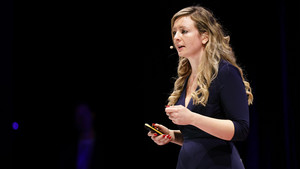
And war reporter Bel Tru has been on the front lines covering this conflict.
In her 2024 talk, she unpacks what's risky to the social fabric about the way war is
currently covered.
And why it's so important to change the framework for telling these stories.
It's coming up after a short break.
And now our Ted Talk of the Day.
If you load up my social media feed right now and give it a quick scroll, it's like experiencing
frighteningly different alternate universes.
And if you weed out the trolls, the extremists, those people I would say who cling to the extremes
of reality, every day normal people's experiences of major world news events are so findingly
different.
It would make you question if there is a reality at all.
We live in a world where there are a thousand or one ways to communicate.
And yet we've completely forgotten how to speak to each other.
As a journalist, I'm among the few people who really can and should talk to all sides.
That irreverence where I can chat to a fighter on the front lines in Libya, but also march
into a presidential office in Kiev demanding answers is what drew me to this job.
I'm guest you could call me an accidental war correspondent.
I don't really like the phrase war correspondent as I think it's a bit dehumanizing but it's
the quickest way to explain what I do.
But it's accidental because honestly I'm really frightened on front lines.
And I'm also really terrible at identifying military hardware.
There's a running joke that journalists think everything is a tank.
It's kind of true.
But the region where I was born, the region I grew up in and the region I specialized
in the Middle East has been ravished by war.
Really after that beautiful explosion of hope with the 2011 uprisings was largely stolen
by authoritarian regimes.
Since then my scope is widened to include conflicts like Ukraine as the tectonic plates of global
politics have shifted.
And so in many ways I see a really wide spectrum of sides, probably quite a unique spectrum
of sides that transcends those echo chambers that X and matter are desperate to funnel
us into.
And what I'm seeing right now is more division among people than ever.
And that division is more violent than ever.
And that division is so fundamental it's almost existential.
One person's perception of reality cannot exist alongside someone else's.
Whole communities are being otherwise.
Genocidal language is being bandied around like people are using song lyrics.
To borrow a phrase from a colleague who I deeply respect who was a journalist for many years
and now works in disinformation.
What we're seeing right now is the total collapse of discourse.
Now the first group to be blamed for any breakdown in societal communication is usually
the mainstream media.
I'm not entirely sure what everyone means by the mainstream media.
I know that I'm frequently accused of being it like it's a cartoon villain.
Which I guess is kind of flattering right?
Little of me, Bell True, responsible for every major media outlet on the planet.
But although I'd like to defend my compromised profession, there might be a tiny nugget of
truth in it.
And that truth might just be key to fixing this.
I'd like to tell you a story.
For the last few years, I've been covering Europe's bloodiest war in generations, Ukraine.
In April 2022, when the Russians withdrew from around the capital key, my team and I
went up there.
After a pretty horrendous day of reporting, we stumbled upon the body of a young Ukrainian
man.
He'd been bound, he'd been shot in the back, and his body had been dumped by this abandoned
Russian camp.
We spent a year trying to find out who he was, what happened to him, what happened to
his family.
And in the process, we uncovered a devastating part that plagues every conflict, the desperate
search for the missing and for the dead.
During the course of filming this investigation, which became my first feature length documentary,
the body in the words.
We met a teenage boy, a Ukrainian teenage boy called Ladislav.
Ladislav's mother, his only parent, have been shot dead by Russian soldiers as she
tried to deliver humanitarian aid outside of Kiev.
Ladislav was desperately looking for her body and in fact, he'd actually been given the
wrong corpse to commit at one point.
Orphan and alone, he moved in with his lawyer, who was helping him in the quest.
All he had left were a few belongings and a pet head chock.
The reason I'm telling you this today is because when we did the initial first screening,
the first feedback we got was that while this was definitely a documentary about war, there
wasn't a single image of a frontline trench in it.
In fact, the only videos of tanks and soldiers appeared at the beginning when we were setting
the scene.
We had that footage from our own reporting from our own archives. We had the footage of
incoming projectiles of frontline artillery positions, but for ever reason, it had ended
up on the cutting room floor.
So consciously, we'd realized that the most impactful way to show the devastation of
war was in the image of a teenage boy, his head chock and his heartbreak.
Civil war reporting didn't need a constantly front load violence.
The 24 hour news cycle that we have pinging relentlessly into our phones was really born
in and because of war.
I think it's interesting that the first dedicated 24 hours a day news network, the first global
ones, CNN, really cemented its name in 1990 with its on the ground coverage of the First
Gulf War.
The 19th and 19th World War II, the 19th World War II, was a huge part of the war.
The 19th World War II, the 19th World War II, was a huge part of the war.
It was a huge part of the war.
It was a huge part of the war.
It was a huge part of the war.
It was a huge part of the war.
It was a huge part of the war.
It was a huge part of the war.
It was a huge part of the war.
That doesn't really go beyond visualizing the dictionary definition of war.
Now don't get me wrong.
This is an incredibly important part of war to show.
But I worry if it drowns out, if it dominates other sides of conflicts like the devastating
impact on civilians whose lives are upended, who lose their loved ones, who have to live
with life shattering injuries, then maybe it tips into the fetigization of violence.
I think part of the problem might be the historical patriarchal structures within the news industry,
which is still a little bit present today.
Breaking news, there are female war correspondents.
There are even women, editors and chief.
But to me it's not about what gender you identify as.
But how we as journalists perceive and communicate what we see.
And so often, frontline coverage has been quite macho.
In fact, for a long time it was known in the industry as the bang bang.
The bang bang.
What a phrase, right?
Some of the most devastating moments in human history reduced to the literal sound of
the murderous machines.
Of course there are always human interests and news pieces.
But in journalism, they're always called the softer stories, which puzzled me because
sometimes they're the most gut-wrenching part of any conflict.
And I was really struggling with this and what makes good journalism after a particularly
tricky trip to Ukraine last year, where I just met so many families whose lives have been
upended that I decided to print off a sticker and put it on my laptop where it remains
today.
And that sticker reads truth and compassion.
For so long I'd lived by the maximum, the truth will set you free.
But as I went from horror to horror, from war to war, I realized that sometimes the truth
was a bit blurry.
And if we only peddle our own truth, we're in danger of not seeing all sides of the story
as difficult as it is sometimes to reach across that divide.
And that's where we cycle back to the collapse of discourse.
Right now, any of you, without even turning on the news or opening a news channel or newspaper,
you can access from your mobile friends through social media some of the most horrific images
from world news events ever brewed in the darkest cauldron of the human psyche.
And this has only been made worse by social media companies getting rid of their trust
and safety divisions.
It's really staggering to see what humans can do to humans.
These days I'm seeing on networks like Telegram, these videos being shared, and they're met
with likes and smiley emojis and messages of encouragement.
In the case of Ukraine, some of these videos that show the haunting last moments of
soldiers' lives as they're cowering in the trenches and you see that bird's eye view of the
grenade dropping on them.
Some of those videos are shared on X to comic music.
Now it's not the fault of course of conflict journalism, that's not the only reason that
we got here.
But I wonder if the history of Bang Bang journalism, if the entertainment of the news industry,
if the pursuit of clicks and likes hasn't some way contributed.
Of course it's gone well beyond where any news agency can even stomach, let alone be held
responsible for.
The violence has morphed into our inability to hold our own pain and yet see the suffering
of others.
It has polarized all of us so much that we cannot imagine that there is another side
of the story, let alone that there might be a humanity to it.
It's a world where it becomes an extremist position to call for a deeply needed humanitarian
ceasefire.
It's a world where we have a broken discourse.
But it's a world maybe the conflict journalism can step up.
And now back to the episode.
For the last few months and I'd like to share a few more stories.
I've been covering the most bitterly divided war of our time, Gaza.
This is the fourth war in Gaza that I've covered, although I should say that foreign
correspondents are not permitted to be actually inside Gaza, apart from one military in
beds.
So it's up to our brave Palestinian journalist colleagues who were spearheadering the
coverage at great risk their own lives within Gaza.
But if we go back a few months, in Israel, the horrors of Hamas' bloody rampage on the
seventh of October spurred a lot of society to back the military offensive in Gaza.
But what I learned when I was on the ground was that not everyone was behind it.
I spoke to family members of those who have been held hostage in Gaza right now by militants.
I spoke to family members of those who were killed on the seventh of October.
And some of them said to me that they didn't believe that a destruction and a collective
punishment of Gaza would do any good.
They said not in my name and some of them have joined protests calling for a ceasefire
that are taking place in Tel Aviv right now, despite the fact they're facing global criticism
from people on their own side.
There was one interview that struck struck me, with a man called Yonatan and Israeli man
and his mother had been killed on the seventh of October.
And this interview impacted me so much I actually had to put my phone on mute because I needed
to take a minute to breathe.
Yonatan told me, vengeance is not a strategy.
Violence will not fix violence.
Invest in peace.
To experience such a searing level of pain like to have your mother murdered, but yet to
see the suffering of others is the deepest will of compassion that I feel that we can all
learn from.
It's a will of compassion that's perhaps needed right now as the death toll is soaring
in Gaza.
As some of the world's most respected rights groups like Save the Children are saying
Palestinian civilians and children have been killed at a historic rate.
And it is a deep will of compassion that I feel journalists could learn from to build
a better journalism.
A journalism that turns from the patriarchal tendencies to fetishized violence that tells
the true impact of war in and out of the trenches.
A journalism that could go some way to helping us heal society.
A journalism that might even be able to help fix this broken discourse.
I'm talking to you like I'm the mother-teraser of journalism, right?
Like I haven't put on a helmet and a flat jacket and stood repeatedly in front of a camera
and talked about the bombs landing all around me.
Like me and my editors haven't messed up news coverage choices and watched with horror
the weaponization of words.
I don't know what to say to you all today.
I know I can and will do you better.
I know that we the journalists, the storytellers with our platforms can help put us on a better
path.
I know that we the viewers and the readers with our ability to direct news coverage through
our consumption can help put us on a better course.
It's why I won't take this sticker off my laptop so it reminds me every day.
And it's why I will continue to shout from the rooftops.
We trust and compassion together can set us free.
Thank you.
That was War Reporter Bell True speaking at TedExperLin in 2024.
If you're curious about Ted's curation, find out more at TED.com slash curation guidelines.
And that's it for today.
Ted Talks Daily is part of the Ted Audio Collective.
This episode was produced and edited by our team Martha Estefanos Oliver Friedman, Brian
Green, Autumn Thompson and Alejandra Salazar.
It was mixed by Christopher Faisy-Bogan, additional support from Emma Taubner, Daniela Balorezo
and Will Hennessey.
I'm Elise Hugh.
I'll be back tomorrow with a fresh idea for your feed.
Thanks for listening.