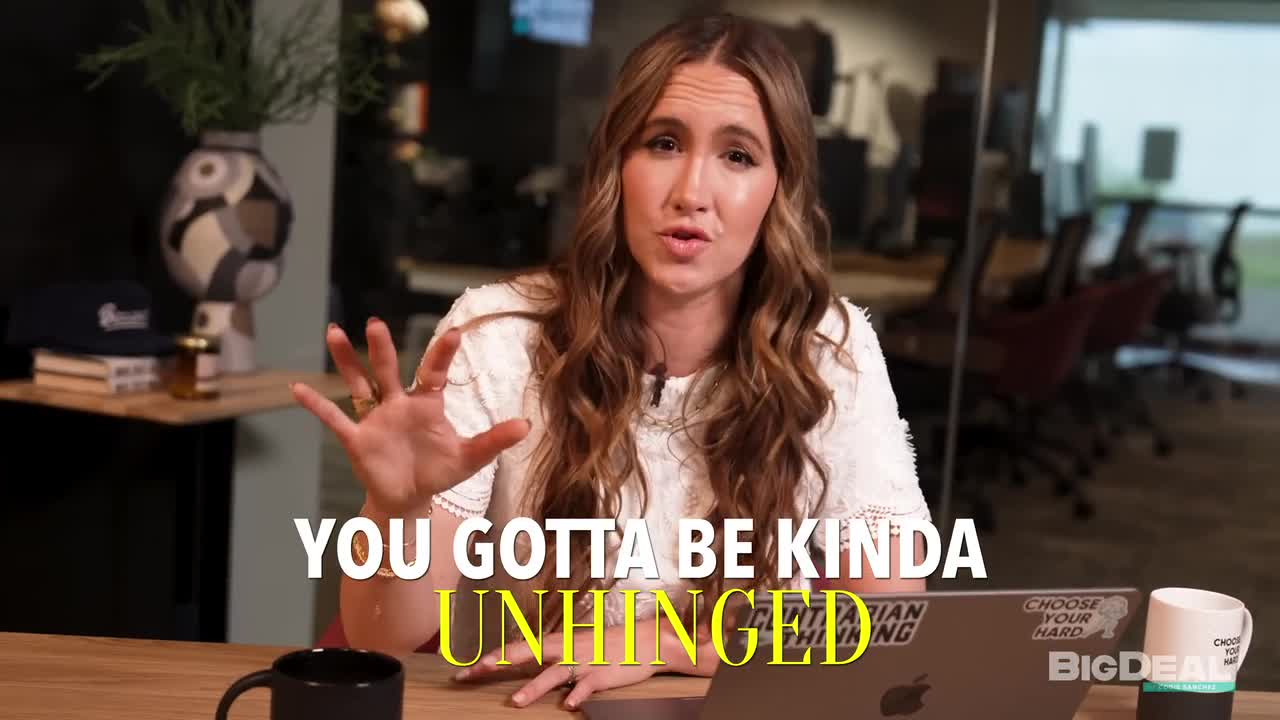
When you are starting a business, you got to be kind of unhinged.
And today on this podcast, I want to talk about how do we move fast, but make sure that we give ourselves enough time.
And then two.
I want to nail the number one thing that most people get wrong when they're building a business.
I think most people actually kill their business by caring too much about what other people think.
Hi, and welcome back to The Big Deal Podcast.
I'm Cody Sanchez, and today we're going to learn some things that you will never learn in business school.
But you need to know if you want to make a lot of money.
And I want to start out with this line from Warren Buffett, one of the best investors and business builders of all time.
He says, you can't produce a baby in one month by getting nine women pregnant.
And this applies to almost every part of investing and building.
Most people though don't realize it.
So they want, you know, six pack after one month at the gym.
And I get it, speed is essential, but you gotta have time.
You need a long enough runway for the really interesting stuff to happen.
So first let's talk about runway and thinking about reasonableness when it comes to making money.
So if you look at my resume, by the way, If you see me on social media, you might be like ah, she's always had a lot of money.
She's always built businesses.
But that's not actually how it was.
You know, in the beginning, it started out, I was a Walmart model.
Shocking, not a runway model.
I was a reporter in Latin America.
I was on Wall Street.
I did private equity.
I owned laundromats.
Now I'm a YouTuber.
I'm a fund manager.
When you zoom out, there's a common thread of ownership and actually investing.
Throughout all of this,
Even though it looks completely disjointed, that thread actually becomes a moat.
My point here isn't for me to tell you my entire background.
The point here is to say it's going to take a minute, so set that expectation.
But here's how to make it go way faster.
When you are starting a business, you got to be kind of unhinged.
So let me tell you just a few of the absolutely unhinged things I did to grow my business.
And hopefully you can steal some of these ideas.
So to start, I didn't have a five-year plan.
I didn't have a five-month plan.
I didn't have a business plan.
So one of the first things we did, we actually printed out these, there's about 5,000 stickers.
I think I spent like, I don't know, maybe a thousand bucks on that.
And then I went to a newsletter conference that I was not invited to because this business Contrarian Thinking started as a newsletter.
We covered the walls, bathrooms, hallway mirrors.
We spent about $10,000 on hats because my plan was to put those everywhere.
Small problem, it was a stolen logo because I did it on Fiverr, so that didn't work out great.
I still have those hats to this day.
Actually, throw me that pink one over there, will you?
Don't sue me.
I think this company is called like Brain Braindead or something like that ended up giving away those hats to a bunch of people in order to get newsletter subscribers.
It worked out.
We also taped like contrarian thinking logos to every wall in my house, so in every zoom meeting it was behind me, even though it was just like me, a ring light, my dog.
These billboards are kind of cool.
So i i did a little tradesies to get billboards that said uh, short stocks by laundromats and i put them all over miami like some of this stuff is not that scalable right, but it worked because it was cheap and it was free.
So if it was free it was me.
You can afford to look a little crazy right now.
It is okay in the beginning for you to do crazy things to get started.
Gates said if everything you do needs to work on a three-year time horizon, you're competing against a lot of people.
But if you're willing to invest on a seven-year time horizon, you're competing against a fraction.
So have long-term plans.
But allow yourself to be scrappy in the beginning, because I think most people actually kill their business by caring too much about what other people think.
By the way, nobody ahead of you is going to care.
When you're young and dumb, you can be young and dumb.
A perfect example of this is a company called Clulee, for example, that they did this video, which is the most ludicrous video I've ever seen, and now it is all over Twitter.
Profile says you worked at Bananas On.
Yeah, yeah, I've been there for the past eight years doing, like, senior software engineering.
So, you know, like, coding.
Really?
I know I look a little young for my age, but I promise you I'm 30 years old.
Okay, well, maybe you are just way older than you look.
This video got them more than 10 million impressions, and now everybody knows the name of them and their founder.
And, like, it was pretty cheap to produce.
The problem is like the Sam Altmans of the world.
Well, they would never be able to do this because it would make them look really silly.
So when you're young and dumb, use that to your advantage.
If you don't do crazy things, how can you expect to have crazy success?
And maybe tell me in the comments what are some of the craziest things you've done to build your company?
What are the craziest things you're thinking?
I'll tell you if it's a terrible idea or not.
And also tell me, where did you try something and it totally failed?
Maybe I can tell you why that didn't work.
Okay, next now we need to talk about how do you 10x your company.
So you've gotten it off the ground, you've got this little baby.
The baby's moving because you're doing crazy things.
But now how do we get this company really motoring?
How do we get you to have the life in the company that you want?
Well, hiring is the only thing a founder does.
That is truly important, and there's many founders that say that.
Sam altman, who created open ai um elon musk, has like a beautiful quote where he talks about the fact that the best people out there are not worth 2x.
Others they're worth 10x and sometimes they're worth 1000x.
And so everything you do should be to find your top performers.
In fact, there's like an amazing story actually about Steve Jobs.
He used to work at a company called Atari.
So he Didn't really like to shower.
He refused to wear shoes, so he did like smelly feet out everywhere and he wanted to sleep at the office.
And the founder at the time was getting all this heat from the other employees telling him like no way can I work in a place where that guy is such a grosso.
And what's funny is the founder knew that Steve was so good that he was worth a thousand other engineers.
So what did he do?
He let that motherfucker sleep at the office.
He let him not shower very often because he was that good.
And if you go through the biggest business billionaires of all time and see their common thread, they all have a story like this.
In fact, like one of my favorite investors, who runs a company called Renaissance, and he said that the best engineer they had, the best performer that they had used to type with his toes during the day, which is like can you even imagine such a thing?
Why would they let somebody do that?
Because your top performers will make your life so much easier.
I have talked to hundreds of founders about their biggest mistake, and it is not a how, but a who.
They chose the wrong business partner.
I've done this twice, by the way.
I chose the wrong business partner and entered business hell.
And at one point, I had to pay a million dollars plus to get that business partner out of my life.
So the question is, how do you find the right people, not more people?
The thing about high performers They look the same every single time.
And a high performer typically hits the top five.
So that's a known performer, meaning you already know the guy.
You're like, oh yeah, that guy was on my team.
He's amazing.
I already know he's a high performer.
They have already done the job, which basically means that you want to hire somebody who's an engineer, who's already been an engineer before.
You don't want to have untested talent.
They have worked at a company that is just like yours.
So if you're a media company, they've worked at a media company before.
They actually have worked on your problem set before.
So say, you're a fast-growing startup and the issue is like you can't handle all the inbound you have.
You don't want somebody that's only worked at Dell where they just kind of like business as usual, even if they were an engineer at the same type of company that you have.
And then finally, you want them to work in a company your same problem size.
If you are a startup, you want somebody that's been in a startup before.
Really hard to bring somebody down from Google to startup land again and say hey, you gotta be an employee here with none of the resources.
So that's what we call cheetah versus house cat matrix.
Why?
Because we think that cheetahs and house cats, they're both cats.
One of them has stripes, one of them has spots, but what's the real difference?
You only want one if you're taking down really big deals, right?
The cheetah moves faster.
The cheetah's got real teeth.
And I think a lot of times we end up hiring people or bringing people into our mix because they're a cat.
They're just like a little, they're a house cat.
They just want to hang around.
They want to eat a bunch of your food and they want to not do much, sip some milk.
Like we're not interested.
We want hunters here.
So how do you find these people in the wild?
Well, When I ran a finance business in Latin America, I realized a couple things.
Our top reps weren't a little better.
They were 10x better even in like a really small market, which would be like Venezuela or Uruguay versus Mexico and Brazil.
And so we gave the best people the best markets, and all of a sudden they were 20x better.
So I was like okay, if I realize that all the things are true about top talent being high performers, then do I just go put my resumes on a job board.
No.
We've got to actually go out and find them, or what we call the four Cs to top level talent.
So let's break it down.
First, curate.
So you actually have to start hiring before you start hiring.
So let me give you an example.
I have this employee that works for me, Jacob.
He's one of our writers.
And I read his work for a year.
And I sent him a DM way before I needed a writer.
And what was wild is, like, this DM kind of went like this.
It was like, hey, I loved that line you wrote in the newsletter XYZ.
This is amazing.
Really cool.
And his response was like, oh, you know, yeah, that's so great.
Thanks.
I really appreciate it.
Then we developed a relationship that lasted for a year and I just stayed in touch with him until I actually needed him.
This is the long game for you dudes out there.
This is how you hire people.
It's also how you get chicks at least good ones is.
You take a long amount of time to make sure that you treat these potential hires Like talent.
You are slowly but surely going after them.
And so, a couple ways you can do that really tactically.
One, bookmark stuff that makes you say, damn, I wish I wrote, built, sold that, did that.
And then follow up with those people.
Ping them on LinkedIn and Twitter and just say, hey, this is really cool.
What do you do?
Tell me about you.
Keep a little Excel spreadsheet that's what I do of top talent and just like check in with them every so often.
So that's curate.
The second is cultivate.
So in this case with Jacob, for instance, I was like complimenting their stuff.
I was asking smart questions.
I was sending them ideas.
Then I might hire them for a one-hour consult, like nothing crazy.
I'm not trying to get them in completely.
I get to test before I buy.
So another example of this is a guy I have here, Brad.
Brad helped as an interim leader or head of content because I had been in touch with Brad for years.
Two years ago, I told him, if you're ever on the move and leave your company, let me know.
He wasn't ready then, but when he left his last role, I pounced.
He was like, I'm ready to do consulting.
I'm happy to come in and build your team.
So he helped me for basically four months hiring and finding the best talent out there.
So you're gonna start following up with people continuously over time.
Three close.
When it's time to go, go hard.
There's nothing worse than, like matthew mcconaughey says, if you're gonna do it, don't half ass, it go all the way.
So fly them in, meet their spouse, pay more than you're comfortable with.
I wasn't even looking for a company president when i met mark.
This is my new president.
I wanted a cro.
I didn't want to pay the cost of having a president, but after one conversation i was like this is our guy.
So I was like I'll move your family out, I'll change the org, let's go.
You don't wait for top talent to fit your role.
When you find top talent, you bring them in.
And I actually obsess on this at our scaling workshops and in SMB Boardroom, where we teach you guys how to find the best talent, how to close the best talent and how to make sure that talent makes you money and stays.
So if that's something interesting for you guys, you should click the link below to come to SMB Boardroom.
This is only for people who already have a business and you guys want to grow it.
Okay, step four, continue.
Top performers, they will not stay forever, and that's okay.
But when they leave, don't be a dick.
Keep them close.
You know, I talk shop with people who left before, like Joe, who used to head content for me.
We stay in touch.
Why?
Because they're gonna be your next referral source.
They're gonna send you talent better than any recruiter.
So Joe, for instance, he now runs his own seven-figure business.
We still trade notes.
And even though he left, I'm super proud of him.
I'm proud of him for becoming an owner.
So shout out Joe.
But he also helps me all the time.
He's like, check out this guy.
You should hire him.
Hey, I'm using this guy.
Do you want them?
And the reason why is because it is so rare.
How many of you guys have had a boss that when you left you're like I would light this fucking place on fire?
If I could light it on fire, I'd be thrilled.
I can't wait for this person to fail.
That's not what you want to do.
When you bring top talent in, you want to treat them like the way that you thought they were when they came on board.
Because, like Steve Jobs says, a small team of A-plus players can run circles around a giant team of B and C players.
So if you want a business that doesn't feel like a colonoscopy every single day to go into it, you got to hire people who are better than you.
Our last segment though, is culture starts at the top, which means that if your team isn't acting the way you want them to, it's probably you.
I think that culture doesn't drip down, it radiates out.
It's like a cold, it spreads person to person, desk to desk.
It's the people sitting three seats over.
It's the one employee's text, like when everything goes sideways, how does your team react?
And you all know, there's probably somebody in your business, in your team, who sets the tempo.
You're like that person is a cancer and I wish they weren't here.
And they're dragging the whole team down.
Or alternatively, they're what we call your Bobby.
They're the person who drives everybody forward.
So like, my Bobby runs BizScout.
It's our platform for buying and selling small businesses.
And usually the best A players are Swiss Army Knives.
He basically can do anything, as evidenced by the fact that he goes and beats people up for his side hobby.
But when we interviewed Bobby, I thought I was vetting him, but it actually wasn't like that.
He was vetting me.
He was like, this is how you know if you've got a high performer, by the way.
He goes, how big do you think this company's gonna get?
Why?
What's your 10-year vision for the company?
And why not this, why not that?
What's the worst thing someone who's partnered with you would say about you?
And when was the last time you fired someone for underperformance?
Why?
What will you do if this company runs out of cash?
He even asked about our summer plans.
Basically, he's like, do you guys work or am I just going to have to do the work?
So the point is finding somebody like Bobby cheat code for a business, and you know it's a Bobby because they vet you too.
And when this person comes, that starts vetting you right back because they have, you know, just as many options as you do.
I want you to start doing what I'm doing, which is highlight the Bobby.
Every time they do something good and you see the difference, start to say it.
In your meetings every single week, we have like a get shit done award winner of the week.
That should be highlighting the person who is actually moving the needle.
When that happens, then it becomes the norm.
Everybody does it.
And it's how BizScout managed to go from a napkin sketch to 56000 listings and 21000 buyer-broker connections.
So builder's biggest competitive advantage isn't AI.
It is actually your humans.
So go find your Bobby, realize you got a long runway and make sure that you know how to spot a Bobby when you see one.
Crew, this is so cool.
The podcast is growing like crazy, and it's only actually because of one thing, you.
I don't know if you know this, but the only way the Big Deal Pod grows is when you share it with somebody else.
We don't do ads.
We don't do pay for play.
We don't go on other people's podcasts and talk about it.
So if you think there was something helpful here, if we made you money, we made you think about your business or life differently, the most beautiful thing you can do for me is share it.
And the most beautiful thing you can do for someone that you care about is to share it with them.
Help them grow alongside you.
So please share the pod.
That's how we grow.
And also tag me on anything you share.
I love resharing other builders across Instagram, Twitter, and all other platforms.
Thank you from the bottom of my heart.
You're super important.