This is a special edition of the Global News Podcast from the BBC World Service.
I'm Valerie Sanderson.
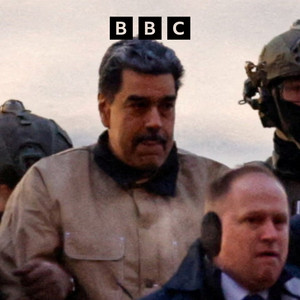
The world is still adjusting to the US operation to remove Venezuelan President Nicolas Maduro from power.
What does it mean for the region?
What does it mean for international sovereignty?
And what does it say about President Trump's willingness to flex his muscles on the global stage?
The BBC has been taking questions from our audience about Venezuela and the global impact of the US mission.
So let's hear from my colleague, Matthew Amaralewala.
He's been speaking to our South America correspondent Ione Wells, our diplomatic correspondent Paul Adams in Washington and the BBC's Sumi Samaskanda, who's on the border between Venezuela and Colombia.
Let's get straight to your questions and to Sumi.
The first question here, a pretty obvious one.
Why did this strike happen?
Why did Donald Trump, the U.S., capture Venezuela's president?
Yeah, that's an important question, isn't it, Matthew?
And we have a couple of answers to that question.
Indeed, what we've heard from President Trump, his secretary of state, Marco Rubio, is that they saw Nicolas Maduro as the head of a drug trafficking organization that was directly a threat to the United States.
So the United States, the Secretary of State, had said that they had designated two drug trafficking organizations, the Tren de Aragua, as well as the Cartel de los Soles, the Cartel of the Sons, as drug trafficking organizations.
And because of that, they said that Nicolas Maduro, who they deemed as the head of one of those cartels, was trafficking drugs directly into the United States.
That was the official justification they gave for why there was a direct threat to the United States.
As a result of that, we saw strikes on what the US has said were drug trafficking boats off the coast of Venezuela, in the Pacific, in the Caribbean as well.
More than 30 strikes, more than 100 people killed.
After that, we also saw President Trump change the narrative a bit.
He then started talking about Venezuelan oil.
What he said was stolen oil and stolen land.
Now, it's not entirely clear what he means by stolen land, but by stolen oil.
He's talking about Venezuela's large oil reserves and the American companies that were once a big part of extracting that oil from Venezuela and processing it.
When Venezuela nationalized, the oil companies, or a few American companies that were involved in that process, lost out a lot of money.
And this is what President Trump is talking about when he says those companies need to be reimbursed.
And last but not least, it's important to say that the Trump administration has cracked down on migration as well migration across the southern border.
In the last few years, Venezuelans have made up a big part of the people who have been flowing across the US southern border into the United States.
President Trump has claimed that those are drug traffickers, but there is not proof that the vast majority of those who have entered are drug traffickers.
Regardless, they want to stop that flow as well.
We'll unpick a lot more of that, certainly oil and those other issues in a moment or two.
But Ione, in terms of the strikes from Saturday, how many people were actually killed?
It's really hard to get reliable data on this.
The government hasn't published official death tolls so far.
We know that at least 32 Cubans were killed, who we know to be members of Maduro's security personnel, because Cubans traditionally made up most of his security network.
There is an anonymous network of doctors in Venezuela that tends to be fairly reliable.
They get data from various hospitals around the country.
They said yesterday that they had recorded at least 70 people dead from these strikes.
They had calculated 43 bodies that had been taken to a morgue as well.
There have been reports too, that some civilians have been impacted by the strikes, including one older woman reportedly killed and potentially more injured as well.
Paul, in terms of international law, what is the consensus, legal or illegal, this move?
I think it's fair to say, Matthew, that there is no consensus.
This is a case of international law versus domestic law.
In terms of international law.
Well clearly, the UN Charter says that it is illegal to use force against the territory of another country unless there has been the consent of the UN Security Council or some kind of direct threat.
In terms of domestic law, the US federal agencies have congressional approval to conduct arrests against wanted suspects pretty much anywhere in the world.
And so that would include going and nabbing Maduro from the heart of the Venezuelan capital.
Now, there is a question about the use of force as the American troops forces went in.
Well, the argument there has been that in the conduct of such arrest operations, this is not an invasion.
This is not regime change.
This was an arrest operation that the federal forces involved have the authority from Congress to defend themselves as appropriate.
And since helicopters did come under fire, then force was used.
Opponents of that will argue that those helicopters wouldn't have come under fire at all had they not been flying directly into the Venezuelan.
Then, as far as the court in New York is concerned, I think it's worth noting that clearly Mr Maduro will try to argue that as the head of state, he enjoys legal immunity.
I think the consensus there is that the courts won't really care how he got there.
They will simply examine the charges against him.
Sumi, Donald Trump said on Saturday the US will run Venezuela.
What do we think he means by that?
That's a question many journalists have been asking President Trump, and we don't have an entirely clear picture yet.
What we understand is that President Trump and his administration want to be able to dictate to Venezuela's interim leader, Desi Rodriguez, what she does.
They want her to meet a few key demands.
I mentioned drug trafficking.
They want to see the flow of drugs stop.
They also want to see U.S. companies be able to enter Venezuela and extract oil again.
And they've also talked about clamping down on the flow of migration.
But really, how that will look is not clear.
President Trump has said he's not afraid of boots on the ground again.
There could be further U.S. military intervention if the interim president doesn't comply.
But right now it looks like creating a US-friendly government in Venezuela that will meet the Trump administration's demands.
Ione, who is currently in charge in Venezuela now?
Where is the army in all of this?
And a question from Vincent Chua, who says if the new president does not want to do a deal with Donald Trump and do what he wants, what actually happens?
So, despite what Donald Trump's saying, in reality the Venezuelan government is still in charge day to day.
And that is led by the now acting president, Delcy Rodriguez, but also other ministers who were also in power under Maduro.
The army has said that it is. recognizing Delcy Rodriguez as the acting president.
So so far remaining loyal to her, which is really important in Venezuela because the military is hugely powerful.
Any leader would very much struggle to govern without them.
It would be potentially dangerous to attempt to do so.
I think that's a really interesting question we've had from a viewer.
What happens if Delcy Rodriguez doesn't do as Donald Trump wants?
Well, he has said that if she doesn't, in his words, do the right thing, code for doing what he wants.
I think that she could face the same fate as Maduro, or even worse.
So I think, even though the US is not advocating actually in charge, it certainly is holding a degree of influence over the government there right now through these threats which they have seen what could happen and what happened to Maduro.
Paul, just remind people you touched on it before, but remind us what Maduro was actually charged with and is there any chance that this case actually gets thrown out?
OK, well, let's look at the charges.
I'm going to refer to my notes because I want to make sure we inform the viewers correctly.
Essentially, three main areas, narco terrorism, cocaine trafficking and weapons offenses.
Now, these were all part of an initial indictment that dates back a few years, to the first Trump administration, but has been revised more recently.
Conspiring with US designated agents.
Foreign terrorist organizations like the Trender Agua you've already heard referenced, and also the FARC, Colombian rebels.
The use of the Venezuelan military and intelligence resources to move large quantities of cocaine to the US and the possession of illegal weapons to facilitate that movement.
Those are in broad terms the charges being brought against President Maduro and his wife.
He could face life in prison if convicted on these charges, just as the former Panamanian dictator, Manuel Noriega, did when he was taken out of Panama City again by the US military back in 1989.
Donald Trump's been talking about him just in his remarks at the Kennedy Center just a short time ago, says that he's a violent guy, that he ran torture chambers in Caracas and has killed millions of people typically Trumpian exaggeration, perhaps.
But clearly there is a view here that President Maduro is a very bad guy.
I think, as to whether or not the charges will stick.
Most people recognize that this is a case that's going to go on for a very long time.
It probably will be still going on after Donald Trump leaves office.
It's a complicated case.
There are a lot of moving parts to it, and it has only just begun.
This is a special edition of the Global News Podcast.
You're listening to our South America correspondent Ione Wells, our diplomatic correspondent Paul Adams in Washington and the BBC's Sumi Somaskanda on the border between Venezuela and Colombia, answering some of your questions about the US operation in Venezuela.
Tsumi, to you, and you heard the list of charges that Paul was going through.
Of course, what was not mentioned was something you said in your first answer, which was oil, because that's a huge part of all of this, because Donald Trump has said the quiet bit out loud, hasn't he several times?
He certainly has.
Look.
What's important to know is that Venezuela has the largest oil reserves in the world, at around 303 billion barrels.
Its oil capacity is completely underutilized.
That's because of endemic corruption and also a lack of investment for many years here.
President Trump has been very clear.
He sees Venezuela as really a vast source of potential for American oil companies to reap the benefits of those oil resources here in Venezuela.
In fact, the Washington Post had even reported that President Trump informed oil companies before and after that operation to remove Nicolas Maduro from power in Venezuela.
Imagine he didn't notify Congress but did, according to the Washington Post, notify those oil companies.
So really interesting to see that this has been a massive focus of President Trump.
Although we originally talked about drug trafficking and migration, it is clear that being part of Venezuela's oil industry is a massive factor in why President Trump has engaged with Venezuela militarily.
I know you wanted to pick up because we've had a question which is a pretty simple question, but right to the point that says why isn't Venezuela rich from all the oil it's actually got?
And who will Donald Trump, if they control the oil, actually sell it to?
Well, in terms of why Venezuelans aren't feeling particularly rich from it at the moment, in part as Sumi touched on there, it is due to widespread economic mismanagement over the last couple of years, as well as corruption in the country, but also a lack of investment, really that has led to underproduction.
It does have the biggest reserves in the world, but there's only about a million barrels produced per day, which might sound like a lot, but actually that's only 08 of global production.
And so this is one of the reasons that Donald Trump thinks that it has more potential for US companies to re-enter Venezuela once again.
At the moment, most of the oil that Venezuela produces goes to China.
So I think what Donald Trump is suggesting is that certainly more of that oil could go back to the US again.
Um, in practice though, i think we shouldn't get ahead of ourselves and remember there are still big barriers to this actually happening.
One is will these companies want to invest in a country that is politically socially, economically risky and unstable still at the moment?
Two is that uh oil prices are quite low at the moment.
There's a an oversupply of oil globally uh, meaning that again, it's not a particularly attractive time to be investing.
And three, the security question too.
I think companies will be wondering whether or not it is sort of safe and secure for them to be acting in the country right now.
Plenty more on Venezuela in a moment.
But of course, two days after that operation in Caracas, we've had more comments from Donald Trump and those surrounding him about Greenland.
Let me ask you, Paul, about this.
Are there real alarm bells beginning to sound in European capitals about whether Greenland is next in this sort of action from Donald Trump and his foreign policy?
Oh, yes, there most certainly are.
And you only have to look at the text of the statement released by several European countries just today to realize just how real those fears are.
You know, there's no immediate prospect of a kind of military operation or a takeover of Greenland.
And in fact, when Donald Trump was asked about this on Air Force One a night or two ago, he rather brushed away these concerns and said let's talk about that in a couple of months time.
But the EU statement says that NATO has made it clear the Arctic is a priority and European allies are stepping up.
Security must be achieved collectively through NATO.
There are constant references to the North Atlantic alliance.
Essentially, the fear is that Donald Trump isn't interested in NATO providing a kind of security umbrella for Greenland, a part of the world that everyone acknowledges with the melting of the Arctic ice cap is becoming more and more militarily and perhaps commercially strategically important.
That he's simply interested in looking after that himself as part of this new expanded Monroe Doctrine.
And that the North Atlantic Alliance let's face it, Greenland is part of the North Atlantic is not how he sees that security being guaranteed.
That is a real fear, not just in the case of Denmark, but across Europe.
Yes, and the Danish Prime Minister saying only yesterday if there was an attack on Greenland, it would be the end of NATO.
So a really blunt assessment there.
Sumi, Paul touched on it, but just tell me a little more about why does Donald Trump want Greenland?
He said it before and people perhaps thought he was half joking.
Now they are taking it incredibly seriously.
Well, on the one hand, it's important to know that Greenland is home to some critical minerals that the US would like to access, so uranium and iron.
But President Trump has said it's not about the minerals.
It is about national security.
As Paul just touched on, it's being seen as a territory that is important strategically and militarily.
And President Trump has said Chinese and Russian ships are all around Greenland.
And he sees it as important for the U.S. to own to be able to gain that access militarily as well.
It is important to note as well that that NATO military alliance of course the US knows it is the biggest provider to that military alliance.
And President Trump, therefore, sees it as within the U.S.'
's purview to own an important piece of being strategically ready.
If you look at how the US is now viewing the world and Donald Trump's second term as this being part of the US'.
's sphere of influence.
President Trump sees Greenland as necessary to be part of the US in order for the US to be secure, even if that means angering allies like Denmark.
Paul, let me go back to you and talk more about Monroe Doctrine, because Mike Clinch says, with the situation in Venezuela, also in Ukraine and also in Gaza, is the concept of international law and the UN-led world order now dead.
Well, that's a, you know, a fear that has been voiced really since Donald Trump came back to office.
In terms of the Monroe Doctrine, you know, the revitalizing of a 1823, is it 1823 doctrine originally passed by the or announced by the then US?
President James Monroe doctrine.
Essentially, what we're seeing now is an expanded version of that.
In fact, people talk about it as encompassing everything from the Aleutian Islands in the west to Greenland in the east and everything from the Arctic in the north to the Antarctic in the south, with Donald Trump saying anything that happens in that geographic space is is a US vital national interest.
Any attempt by an outside power, whether it be China or Iran or Russia, to exert influence or extract benefit from anything in that space and Venezuelan oil would be a good example of that then that is to be resisted by the United States, that countries there should essentially direct their policies towards the American national interest.
That's why we see quite a significant amount of political influence being wielded, whether it's to see changes of government in Central and South America or access to key resources like Venezuelan oil.
All of this Donald Trump is saying is vital American strategic and security concerns and everyone else should keep their hands off it.
Yes, and that's why people certainly in Cuba, in Colombia, are watching very, very closely.
Only in terms of what is happening on the ground politically in Venezuela.
Donald Trump ruled out really early on over the weekend elections, but you have Maria Corina Machado, tentatively perhaps, returning to Venezuela, but the US president saying there is no respect for her, and yet she was largely seen as the real winner of the last set of elections.
Yes, there's a couple of points here.
Constitutionally in Venezuela.
In theory, if they've sworn in an acting president, they are meant to have elections within 30 days.
Now, I understand there is a mechanism for that to be extended at least once or twice.
But certainly, as you say, Donald Trump has said that he doesn't think that's a realistic timeline and that, in his words, the US needs to fix the country before there can be elections.
Now, contrast that with what we've heard from the opposition leader, Maria Corina Machado.
She said that her party, the opposition movement, would be prepared to go and contest free and fair elections again, which they are confident they would win.
After the last elections in 2024, they published what were seen to be reliable voting tallies from electronic voting machines, saying that they, not Maduro, had won that election.
But she has been somewhat...
I say somewhat, majorly sidelined by Donald Trump so far.
He said that she doesn't have the respect and support in Venezuela, something which I think many of the opposition would contest.
Really briefly on this.
I was listening to an interview from Marco Rubio over the weekend and he was talking about the problems with Duro.
He just wouldn't, he said, do a deal, make an accommodation with Donald Trump.
Is that what this is all about?
That the leaders of any sort of country are required now to do what the US president is actually demanding.
Well look, I think, to put it bluntly, Donald Trump has made it pretty clear what could happen to government ministers or the acting president in Venezuela if they don't do what he says.
It is still a sovereign country.
He doesn't suddenly have the right to control Venezuela.
But I think he's made it clear that he feels he can control them through these kinds of threats.
We've only got a couple of minutes left.
So a final thought, because there are huge dangers here potentially, aren't there, in Venezuela?
There are plenty of militias.
You have an army still in place, a new president and all sorts of historic precedents where interventions from the US have gone horribly wrong.
Yeah.
I mean, just think of Iraq and Libya and Afghanistan.
I think it is clear that the Trump administration, as it figured out what to do about Venezuela, thought we are not going to go down that path.
This is not going to be about regime change, because if you're going to go down that route, you're going to involve Venezuela.
Massive deployment of American military forces, huge diplomatic and economic efforts to put countries back on their proper footing.
It hasn't worked in the past.
There's no earthly reason to think that it would work again now.
And so perhaps the sensible thing is to leave the Deeply unpopular but secure, or relatively secure, government structure in place.
And then, instead of trying to remove it and put something else in its place, you merely threaten it to do what you want it to do.
And that's why essentially what Donald Trump is saying to the government in Venezuela is you know, there are still arrest warrants out there.
We could still come back in with further attacks from the air.
There are all sorts of ways in which the United States can continue to exert pressure.
But regime change and taking over a country, not this time.
I'm Valerie Sanderson.
Until next time, bye-bye.