This BBC podcast is supported by ads outside the UK.
Continente é de toda a gente.
Vocês, mecânicos que põem o país a andar.
Vocês, contabilistas que contam cada cêntimo.
Vocês, barbeiros que cumprem o trabalho à risca.
Vocês merecem Mac.
E merecem combinar quatro produtos no vosso menu ao almoço por apenas seis euros.
De segunda à sexta, das onze às quinze, só no Mac.
You're listening to the Global News Podcast from the BBC World Service.
Hello, I'm Oliver Conway.
We're recording this at 16 hours GMT on Friday the 20th of February.
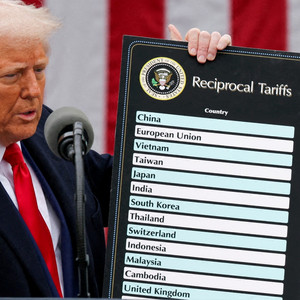
The US Supreme Court has ruled against President Trump's tariff policy, delivering a significant blow to his economic agenda.
British police continue to search the former home of Andrew Mountbatten, Windsor.
And BBC analysis of Russian war casualties in Ukraine finds that 2025 is likely to be the deadliest year so far.
Also in the podcast, we were able to demonstrate that those body parts were linked to a specific line, to the specific line that had been killed illegally.
A breakthrough in tackling wildlife poaching.
Just before we came into the studio, the US Supreme Court delivered a significant blow to President Trump's economic agenda, striking down a major part of his tariff policy.
He's often said that tariff is his favourite word and, on his return to the White House, wielded them as a diplomatic tool to try to bend other nations to his will on a range of issues.
But according to the Supreme Court, he doesn't have the power to do so.
Rather, it is up to Congress.
President Trump had been warning that such a decision would be an economic and national security disaster with catastrophic consequences.
But the judges ruled against him by six to three.
Justin Wolfers is a professor of economics at the University of Michigan.
He says it is an extraordinary day for the global economy.
First of all, countries don't pay tariffs.
I want to be really clear on that.
Who has paid tariffs is the American companies who brought it in.
But that's one of the big questions.
Will people be eligible to get refunds for what happened so far?
But I want to hit you just with one big point.
What if we had a trade war potentially caused much of the world's economy, including the United States, to go down the toilet, and all along, the whole darn thing turned out to be unconstitutional and illegal.
Wow, what a day and what a world we're in.
The BBC's Matthew Amrulli-Waller asked our correspondent in Washington, Gary O'Donoghue, for his assessment.
One of the biggest cases of either of Donald Trump's terms for him to lose in the Supreme Court?
No question.
Most certainly the biggest economic case.
Tariffs are a pillar, a central pillar, of not just his economic policy but his foreign policy, his outlook on the world.
But I will say this.
In recent times when he's been asked about this case, He's not really put a lot of store by winning it.
He's always said, actually, oh, we'll just find a different way of doing it.
And you know, there are tariffs that can be imposed under different parts of the legislation national security legislation.
Some of those aluminium and steel tariffs are already imposed under a different provision in the US code.
That has been challenged in the court but not really overturned in any sense.
He's managed to keep those.
So he may try and do some of that, just reclassify these as national security issues and do it that way.
But in the short term, you've got to remember that over this last calendar year 2025, the tariffs brought in somewhere in the region of 280 odd billion dollars.
That was a 200 billion dollar rise on 2024, the year before.
So that's a lot of money and that's got into, you know, improving the position in the deficit, et cetera, et cetera.
So that is a big hole that they will feel.
And, you know, there will be importers.
There may be foreign companies.
There may be consumer groups even who may feel, do you know what?
We'd like a bit of our money back.
So this could spawn a whole load more court cases in the coming months.
Politically though Gary, you watch the president every day, and we are likely to get a reaction from him, because the one thing he absolutely hates from any quarter is to be reined in, to be told no.
That's right.
And of course, you know, the majority on this case, the majority is 6-3 against the president.
And that's, of course, the normal times.
That's the conservative majority he has on the Supreme Court.
And it's gone against him. this time.
And he won't like it.
And of course, what they say about the Supreme Court, it's not final because it's infallible.
It's infallible because it's final.
There's nowhere to go from here in terms of challenging this.
And they will have to comply if they want to be within the law.
I'm pretty sure they've got a plan B for this, because if you go back to the oral arguments in the autumn and you listen to the tone of the questioning from people like Amy Barrett and Neil Gorsuch and others,
It was pretty hostile to the government's case, so I think they may have seen this coming.
Gary O'Donoghue, our North America correspondent.
As tensions between the US and Iran continue to escalate, Norway has withdrawn 60 soldiers from the Middle East.
It comes after President Trump said he would decide whether or not to launch strikes on Iran in the next 10 days, echoing threats he made before the US attacked Venezuela.
In response, the Iranian authorities have warned that US military bases in the region would be a legitimate target in any conflict.
Defence analyst, Mark Urban, says the build-up of American assets is now significant.
There are now hundreds of American warplanes within striking range of Iran, which was not the case when we had those protests early in January.
And President Trump made a threat at that time that he wasn't really able to carry out.
The second thing is they've put air defence and missile defence batteries in Jordan, the UAE, Saudi Arabia, Israel.
And the third thing is the we get the sense from the types of planes and other equipment that they're putting in that they are thinking about a sustained campaign.
In other words, not something that would just happen for 24 hours, like the one at the end of the so-called 12-day war in June last year, where the Americans came in after the Israelis, but something that could go on for weeks.
Because frankly, the questions about this and how you get the Iranians to comply either on the nuclear issue or you escalate to a type of regime change type of objective, are really substantial.
Nobody can be quite sure how that can be achieved by military action from the air alone.
Mark Urban and President Trump have said he is considering limited military strikes on Iran.
We have more on the military build-up in the area on our YouTube channel.
Search for BBC News and you'll find global news in our podcast section.
Despite increasing warnings about the potential downsides of artificial intelligence from lost jobs to misinformation, high energy use to massive water consumption the US government is strongly opposed to any regulation saying the focus should be on innovation rather than safety.
Now the White House technology advisor has said the Trump administration totally rejects efforts to agree international rules for AI.
Michael Kratios was speaking on the final day of a big AI summit in India.
Delegates had been hoping to agree a statement setting out a joint approach to handling the technology.
That's now been delayed until Saturday.
Our technology editor Zoe Kleinman is there.
There are two contrasting stories for me to tell you from the AI Summit here in Delhi.
The first is there's a real air of excitement and optimism about AI and its promises.
And there's been a show of unity from the VIPs who've travelled here from all over the world.
That's the tech brothers, the tech bosses, and also the world leaders.
But on the other hand, there's also concern about the potential dangers of this technology as it advances.
And there's also a lot of division over how best to regulate it.
They've been calls for a UN-style body to oversee AI governance on a global level, but the US government has today completely vetoed that in no uncertain terms.
Meanwhile, I caught up with Sir Demis Hassabis.
He's a British computer scientist and the co-founder of DeepMind.
And I asked him another pressing question, which is, given the massive disruption that AI is likely to have on jobs and the working world, what should we be encouraging our children to study at school?
I think it's still very important to have a STEM education, I would still say.
If you know how to code or do math.
Even though these systems will start being able to code, you still need to orchestrate them and actually understand what it is they're doing and give them the problem that they need to solve.
So I think if you have a technical background, I think you'll still be at an advantage in using these systems.
He's got a Nobel Prize, so Demis Hassabis does know what he's talking about.
But he did also tell me he thinks that more people will be able to be creative with the tech and build new things where there have been barriers in the past if they haven't had the sufficient technical skills, as AI gets better at doing this stuff and helping them more.
Zoe Kleinman at the AI Summit in India.
A day after the arrest of King Charles' brother Andrew, police are still searching Royal Lodge, his 30-room former home near Windsor Castle.
Andrew Mountbatten-Windsor is being investigated over alleged misconduct in public office.
The former prince hasn't responded to the BBC's requests for comment about recent allegations arising from the Epstein files, but he's previously denied any wrongdoing.
Andrew was released on Thursday evening after 11 hours in police custody.
So what happens now?
I asked our UK correspondent, Daniel Sandford.
The investigation started 11 days ago, and they started with this email that seemed to suggest that Prince Andrew had been forwarding government documents to Jeffrey Epstein.
And they'd been doing this assessment phase until yesterday, which was all about working out whether or not they should start a full investigation.
And then yesterday, very dramatically, they went in. and arrested the king's brother.
But what they'll need to do is to kind of build a context behind that email and any other emails which might suggest wrongdoing.
So that means they'll be needing to get hold of any other communications there may have been.
So are there still old emails sitting on servers, for example, controlled by the palace?
Are there any emails on servers controlled by the UK government?
Can they get access to those?
Can they get access to any of the FBI documentation but in an unredacted form?
So those Epstein files that anyone can look through, many of them have names and email addresses blacked out.
And so what they'll be trying to do is build up a picture that would explain whether or not that email and any other emails that suggest he was sending documents to Jeffrey Epstein exist, have a context which might explain a perfectly innocent reason behind that, or whether there's a context that can be found which suggests there was some kind of corrupt reason behind that.
And only once they've managed to build that bigger picture will they probably go back to the King's brother Andrew, and ask him further questions about what they've uncovered.
And then there'll be the big moment when, between them, the Thames Valley Police, the force that are leading this investigation, and the Crown Prosecution Service, which is the decision-making body on whether or not a charge can be brought, will have to decide whether or not to charge the King's brother with misconduct in public office, which is the kind of formal name for the offence, and whether he would then go forward for trial.
And just to clarify, that email came to light as a result of the publication of the Epstein files in the US.
Yes, I mean.
Ironically, a lot of the interest in Andrew around the Epstein files has been around his relationship with Virginia Dufresne, who he'd originally said he'd never met, and then there were these pictures that seemed to show that he had met her, and then emails came out suggesting that they did in some way know each other.
But it turns out that it's actually nothing to do with those sexual allegations.
That's actually ended up with the King's brother getting arrested.
When the big dump of Epstein files happened in January.
Buried in amongst that big dump of files was this email where essentially, Andrew had returned from a trip to Asia which he'd made on behalf of the UK government as a trade envoy, had received some reports from that trip.
And what you see in the email chain is apparently Andrew receiving those reports and then, five minutes later, forwarding them to Jeffrey Epstein, a man who, by then, had already been convicted of sexual offences in the United States.
And briefly, are there any restrictions on the former Prince's movement?
There are not.
Sometimes, when people are arrested, when the police release them for further investigation, there might be some kind of police bail.
They're told that they need to report to a police station every week or they maybe have their passport removed.
In Andrew's case, he's been released under investigation is the term.
And all that means is you're free to go about your daily business, but we are still investigating you.
Daniel Sandford.
And still to come on the podcast.
It's not the general Italian pizza and mandolino, but also tiny realities outside the mainstream have a right to exist.
We hear from one of the smallest communities in Italy, overshadowed by the Winter Olympics.
Until 20th of February, deliveries are free.
Continente Online.
O supermercado online mais barato segundo a deco protesto.
Saiba mais em continente.pt.
Continente.
It's toda a gente.
Available now on the documentary from the BBC World Service.
Join me, Mike Lanchin, as I hear how a unique peace community of Israeli, Jews and Palestinians who've lived side by side for more than 40 years has coped with the conflict and pain following the October 7th Hamas attacks and the war in Gaza.
Listen now by searching for the documentary wherever you get your BBC podcasts.
I've spent the last three decades trying to better understand money across the boardroom, the newsroom and the trading floor.
That's longer than most podcast hosts have been alive.
But even I've got questions.
Join me, Maren Subset-Webb, every week for my show Maren Talks Money from Bloomberg Podcasts, where I have in-depth conversations with fund managers, strategists and experts about how markets really work.
And join me for a separate episode where I answer listener questions on how to make those markets work for you.
Follow Merrin Talks Money on Apple Podcasts, Spotify or wherever you listen.
The BBC has identified the names of more than 180000 Russian soldiers killed so far in the war in Ukraine.
The true figure is likely to be much higher, as many deaths on the battlefield are not recorded.
The analysis from the BBC Russian service found that the number killed last year is likely to be the highest since the war began.
It also reveals that rural parts of Russia are bearing the heaviest toll.
Olga Ivshina has the details.
It seems that the spikes in Russian losses in our name-by-name list, which we compiled together with the Russian outlet MediaZone and a group of volunteers.
It seems the spikes coincide with the meetings between the Russian president and the American president, or roughly around those dates.
So it would be fair to think that Russia is always trying to push hard on the front line before the important diplomatic negotiations, seeing this as a trump card during those talks.
Now it's long been suggested that President Putin has tried to shield certain parts of the Russian population from the war in terms of sending men there.
Tell us about how other parts or the various parts of Russia have been affected.
Yes, we did a detailed analysis of our name by name list which, as you said, contains more than 100.
180,000 names now.
And we see that the majority of losses come from small towns and rural areas disproportionately.
But on the other hand, the majority of Russian population has long been living in the major cities more than 100000 citizens.
So this means that the way the losses are distributed is made so that people from the major cities may not notice the true scale of losses.
They notice it to some degree, but not the true scale.
Now, the fact that so many people died last year.
Is that having any impact on attitudes towards the war inside Russia?
It's a very good question, which is very hard to answer.
Since the start of the invasion, Russia has introduced draconial laws, sort of war censorship.
And people know that they may go to prison even for very fact of calling this invasion a war and not so-called special military operation, as Moscow insists.
That's why it's very hard to notice any dissent or anything like that.
People prefer to stay as silent about it as possible.
Olga Ivshina from the BBC Russian service.
For the first time, DNA from a dead lion has been used to prosecute the poachers who killed it.
Investigators in Zimbabwe were able to identify a missing animal from body parts found in a village, leading to the arrest of two poachers.
In the past it's been difficult to prove from body parts alone that a lion was killed deliberately.
Richard Hamilton has the story.
In 2024, investigators noticed that a radio collar on a lion in Hwangae National Park near Victoria Falls had stopped working.
At the time that the lion was fitted with the collar, blood samples had also been taken and stored in a laboratory for research purposes.
The investigators tracked the animal's last known location and in a nearby village they found lion meat, claws and teeth.
Two men from the village were arrested.
The presence of body parts is not in itself conclusive proof of a crime, as the animal could have died from natural causes.
But DNA samples were taken and compared against a new national database enabling the individual missing animal to be identified.
Marcus Bergener is from the South African branch of the organisation Traffic.
Wildlife forensics is done, and has been done in the past, to link wildlife parts to a species and prove that those parts come from a certain species.
This case was very different.
In this case, through the forensic lab work, we were able to demonstrate that those body parts were linked to a specific line, to the specific line that had been killed illegally.
And that is the first time that we're aware that that has ever been done.
The evidence was presented in court and two poachers were jailed.
Lions are among the most trafficked big cats in the world, with body parts traded for ornaments, jewellery and witchcraft.
This case has been hailed as a step change for wildlife crime investigations.
Traffic says.
It shows that when technology, law enforcement and long-term investment come together, it sets a powerful precedent for tackling organised poaching across Africa and the world.
Richard Hamilton reporting.
The Winter Olympics, which finish on Sunday, are being held in the Italian mountain resort of Cortina, the same place they were staged 70 years ago.
But even as some enjoy this renewed moment in the spotlight, people in one of the region's oldest communities say it's revived a longstanding frustration around recognition and identity.
As the BBC's Carla Conti reports.
Away from the adrenaline of the games, another story has been unfolding here.
The Ladins are one of Italy's smallest and oldest linguistic minorities.
I asked Roland Verra, president of the General Latin Union of the Dolomites what, in his opinion, defines Latin identity.
The primary character is being intimately connected with the Dolomites, with these beautiful mountains full of legends and of traditions.
Latin endured because these valleys were once hard to reach.
It lived through empire, fascism and migration.
In the neighbouring South Tyrol region.
It is recognised as an official language alongside Italian and German.
Here in Veneto, where Cortina sits, it is not.
As the Olympic spotlight returned, Latin leaders had hoped for some acknowledgement of that history.
We awaited at least...
Some mentioning, showing that it's not the general Italian, let's say pizza and mandolino, but also tiny realities outside the mainstream have a right to exist.
They say letters to organisers received no reply.
In a statement to the BBC, the Milano Cortina Organising Committee said it has the utmost respect for the cultures of the territories shaping the Games and that it has promoted local identities throughout its activities.
It added that it must follow the host city contract agreed with the International Olympic Committee, which requires the use of the IOC's two official languages, French and English, alongside Italian.
But for Latin representatives, the concern goes beyond what appears in official communications.
Walking through Cortina, you'll notice something beyond the Olympic branding.
There are blue, white and green flags hanging from balconies across town.
Here, Ladens make up around half of the town's population.
Elsa Zardini is the president of the Union of the Ladens of Ampezzo.
At that point, we decided...
We decided to put out our flag, a very special flag that reflects the colours of our land the green of the meadows, the white of the snow, the blue of the sky.
This is not just about ceremony, she says.
The first Olympics in 1956 transformed Cortina from a mountain town into a luxury destination.
Major events like the Winter Olympics push up house prices to levels we simply cannot afford.
Our children cannot buy a home here, so they will have to leave.
Once we are scattered, our culture becomes much harder to live and pass on.
Speaking to both Elsa and Roland, it becomes clear that Latin culture is not simply a relic of the past.
It is spoken at home and even sung by young musicians, like the Latin band Gotha.
When the crowds leave and the meadows are packed away, the Latins will remain in these valleys.
Whether their children can afford to stay may determine what survives long after the Olympic flame goes out.
Carla Conte reporting.
It's one of the top architectural wonders of the world, with millions of visitors every year.
But the Sagrada Familia church in Barcelona is still not finished, more than 140 years after work began.
Today though, a major landmark was reached with the completion of the tallest tower, which has changed the skyline of the city.
Tom Bailey told me more.
So today has been this real kind of landmark moment in this epic building project that's been going on actually since the late 1880s.
And what's been happening today is the basilica has reached its highest point.
It now stands at 1725 meters tall, after this central cross was attached to the central tower, which is known as the Tower of Jesus.
And this was a very, very elaborate process that involved cranes and workmen up on rooftops to winch this vast cross into place.
Now, to give you some scale here, it weighs over 12 tonnes.
It's 17 metres tall and it's 13 metres in width, this cross.
It's made of over 15,000 pieces of white ceramic, and the idea is that it reflects the sunlight.
So this was hoisted into place in this operation, which was actually originally planned for last week, but due to gales which buffeted Barcelona, it actually took place today.
Now, as you'd expect, this drew quite a lot of attention, people in the streets below watching.
And also thousands more watching on a live stream, which streamed all the pictures of this going on.
And if anyone was watching, they would have seen exactly why it was a good idea to postpone this during windy weather.
It looked very, very precarious for the guys up there on the roof.
Yeah.
And what does it exactly look like?
You've got those four towers that have been there for a long run, then the central one, which is relatively new.
And this is at the top.
Yeah.
So this is, as I say, known as the Tower of Jesus.
It's that very, very tall central part of the basilica.
And this is made of ceramic pieces.
And each one is the seven different shades of white.
There's 15,000 ceramic pieces of seven shades of white.
And this is to really put into place Gaudi's vision of this sparkling spire at the top of his masterpiece, reflecting the Spanish sunlight.
So That's the way it looks.
It's certainly very eye-catching and it is the newest addition to Barcelona Skyline.
Yeah, and how much more work is there to go?
Well, I say this has been going on since the 1880s.
It's a very, very long project.
And on the latest projections, it's expected to take around another eight to nine years.
So 2034 is when it's expected to be finished.
There's a bit more intricate carving going on on the outside, a new staircase on the inside as well.
So still plenty more to go.
Tom Bailey.
And that is all from us for now, but the Global News Podcast will be back soon.
And don't forget our sister podcast, The Global Story, which looks more in-depth at a single issue.
This edition was mixed by Dafydd Evans and produced by Richard Hamilton.
Our editors, Karen Martin.
I'm Oliver Conway.
Until next time, goodbye.
Arrested on his birthday.
Andrew Mountbatten-Windsor, the former prince, has been released under investigation after being held on suspicion of misconduct in public office.
Join me Iqra on What's in the World as we break down the details of the arrest, what this could mean for the British royal family and how this might connect to the Epstein files.
What's in the World is a daily podcast from the BBC World Service.
We cover news and trending topics every weekday in less than 15 minutes.
Find us wherever you get your BBC podcasts.