NPR. This is the indicator from Planet Money.
I'm Darian Woods. And I'm Adrien Ma.
Have you ever had two friends who fell out with each other and then you're left kinda asked to pick sides?
Well, this is the position a lot of countries find themselves in with the U .S. and China right now.
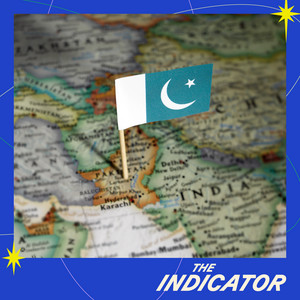
Pakistan happens to be one of these countries stuck in the middle.
It's got China to its north, but historically, it's also had close ties with the U .S. And to make this situation even trickier for Pakistan, it's got other relationships to manage.
It's got Iran and Afghanistan to its west, India to its east, and that one's looking particularly dicey right now.
But on today's show, we're focusing on Pakistan's ties with the U .S. and China.
How is it juggling these two important economic relationships?
We asked Pakistan's Minister of Finance whether U .S. aid cuts and tariffs could push America's friends into the arms of China.
Open an account and get up to $1 ,000 or more with a qualifying deposit.
Get started today at etrade .com.
terms and other fees apply.
Investing involves risks.
Morgan Stanley Smith Barney LLC.
Member SIPC. E -Trade is a business of Morgan Stanley.
This message comes from Capella University.
Imagine an education that teaches you the skills you need to succeed.
At Capella University you'll get a competency -based education To learn more about how bystanders are being affected by the financial tug -of -war between the US and China, we spoke to Pakistan's Minister of Finance, Mohammad Aurangzeb.
Mohammad's actually pretty new to politics.
He was a bank executive working all over the world, and took the plunge into politics last year.
I was running the largest bank in the country, which is a systemically important bank.
So in some sense, you're already intertwined with the fortunes of the country.
And the fortunes of the country were not looking great a year ago.
Once you took into account sky -high inflation, incomes hadn't grown in a decade.
And so this is a time when Mohammed looked around at who was lending money.
China, yes, and also the IMF, the International Monetary Fund.
It's one of those key global financial organizations.
It's based in Washington DC and the U .S. holds a lot of sway there.
But lending from the IMF has strings attached.
Usually it's some combination of increasing the ability of the government to collect taxes, reducing government spending, and deregulating business.
And that's exactly what the IMF was asking Muhammad to do.
For Pakistan, we have known the what and why for the longest time.
It was always a question of the who part of it.
Right, you knew what to do, but you didn't know how to get there.
And it's always about implementation and execution.
So you said the what was known.
Tell us what was the what.
Well, you know, as a country, we've gone through these boom and bust cycles.
The country has been languishing in tax to GDP of between 9 % to 10%.
Right. So it hasn't been able to tax a lot of its population?
Indeed. Indeed. And that's what we have been working on, and we are moving in the right direction.
Mohammed says that making the tax system fairer, along with stronger enforcement, has been helping to get more of the country to pay taxes.
Also, the country's been moving more financial services digitally, which can help reduce corruption.
We bring down the leakage in the system.
When I say leakage, it's an euphemism for corruption, because it takes two to tango.
He says it's a combination of stronger tax collection, more prudent government spending, and higher interest rates that brought down inflation.
Pakistan's Central Bank had interest rates at 22 % last year.
That was to reduce people borrowing money and therefore, intentionally slowing down the economy to stop the cycle of rising prices.
22 percent interest. I mean that really makes, like, the U .S. interest rates look tame by comparison.
Sure, but, you know, it worked.
Pakistan's inflation is actually looking even lower than the U .S. right now.
In March, we clocked 0 .7 percent.
So, it's a very, very good achievement for the country to have moved in that direction.
Yeah, inflation is less than 1 percent.
That seems like quite an achievement.
Did you celebrate at any point where it got, I don't know, below 2 %?
Was there a Minister of Finance Inflation Party?
Yeah, no, I think the real celebration is where the common man or common woman is seeing the impact of that lower inflation.
Okay, so they weren't really like dancing in the streets?
No, at least he wouldn't admit to that.
And one reason might be that, yeah, sure, he solved one problem, inflation, And now he has another headache.
Policies under the Trump administration.
Foreign aid cuts and tariffs.
Right, and let's just take the aid cuts first. The overall size of Pakistan's economy is more than $330 billion.
Since 2020, the U .S. has sent about $270 million a year in aid to Pakistan for health, education, and building things like roads.
But Mohammad downplays the current aid freeze.
Overall, we didn't have a huge reliance on this funding.
Are there going to be issues?
Yes. Are they going to be manageable for a country like Pakistan?
It's also yes. OK. But what about those tariffs?
They certainly caught Pakistan's attention.
29 % tariffs announced in early April.
Like many countries, that was temporarily dropped to 10 % for 90 days.
And in the interim, Pakistan is sending its top officials over to negotiate a possible deal.
The country imports cotton from the U .S. that it spins into fabrics and then sews into clothes and linens.
Can we import more cotton?
Can we import more soybean on the agriculture side?
The U .S. has already expressed that the access to rare earth and some of the minerals in like copper, which is going to play a very important role in the energy transition.
The U .S. wants to have access to that.
I think we are in a good position to manage that to a very large extent.
What do you make of the argument that as the U .S. cuts its foreign aid to countries like Pakistan, that steers countries closer to China?
Yeah, with respect to China, you know, it has been a, you know, a long standing and very strategic relationship for us.
And it's been led through investment and trade.
If you know, the Belt and Road initiative of China, the China -Pakistan economic...
Yes, China's big effort internationally to build infrastructure, ports, lending and assisting with construction all around the world.
And in fact, Pakistan has a project with China called the China -Pakistan Economic Corridor.
Basically, it's a bunch of lending from China to Pakistan to build ports and roads and rail, and that's to allow China to access oil and gas shipments that arrive at Pakistan's ports.
Phase one was exactly about that infrastructure.
Where we are now with China is sort of phase two, which is really now business to business So a lot of companies which are coming in, forming joint ventures, whether it's truck tire manufacturing, or whether it's the likes of BYD.
The electric vehicle company BYD.
Yeah. So they are coming in.
But going forward, using the infrastructure that we have now, is to start assembling and exporting from Pakistan.
In short, Mohammed says both China and the U .S. are strategic allies.
So Pakistan will continue to work with both countries.
It's an and -and discussion.
It's not an and -or discussion.
For leaders like Mohamed all over the world, they've taken different responses in the face of the Trump administration's tariffs.
Some have flattered Donald Trump, sending him gifts and compliments.
Some have retaliated.
That's what China's doing.
Many countries are doing nothing, just waiting for the dust to settle.
And others are just quietly trying to cut a deal.
Mohammed's answers today suggest that's what Pakistan's trying to do while still staying friends with China.
This episode was produced by Lily Quiroz and engineered by Jimmy Keeley.
It was fact -checked by Sierra Juarez.
Cake and Cannon edits the show and the indicators of production of NPR.
These days there is a lot of news.
It can be hard to keep up with what it means for you, your family, and your community.
Consider this from NPR as a podcast that helps you make sense of the news.
Six days a week we bring you a deep dive on a story and provide the context, back story and analysis you need to understand our rapidly changing world.
Listen to the Consider This podcast from NPR.
On the Sunday story from UpFirst, a whistleblower inside the federal government says Doge employees may have taken sensitive data from government systems and covered their tracks.
There's really no way to tell what or where that data is now.
Listen now to the Sunday story on the Up First Podcast from NPR.