the unmissable news stories of the day.
This is the Beijing Hour.
Examining the events that impact and shape China and the rest of the world.
This is the Beijing Hour, one hour of news and information brought to you every weekday.
Now here's your host.
Shane Begum with you on this Thursday, November 13th, 2025.
You're listening to the Beijing Hour, coming to you live from the Chinese capital.
On today's program...
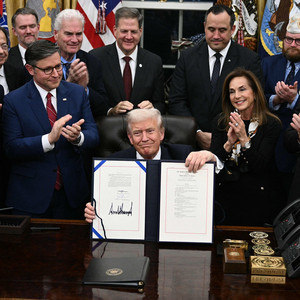
The US president signed a bill ending the longest government shutdown in American history.
Brazil wants to extend negotiations at the COP 30 climate conference in order to give nations more time to bridge their differences.
Israel's allowed the opening of a third crossing into Gaza, improving the delivery of aid into the northern part of the strip.
In business, China's double 11 shopping festival has set many new records.
And today we continue our special series on China's path toward its dual carbon and sustainable development goals and efforts to overcome challenges in the carbon market.
Now checking the day's top stories.
U.S.
President Donald Trump has signed a bill ending the longest government shutdown in American history.
The move comes hours after the House of Representatives passed a funding package to reopen the federal government.
The bill will provide back pay for federal workers, restart food assistance programs and restore the nation's air traffic control system.
However, it only funds the government through January 30th.
The shutdown lasted 43 days.
Poppy Imputing has more from Washington.
We've got to this point the longest historic shutdown, when senators eight of them broke loose from their Democratic party and joined with the Republicans so that this bill could be passed.
Ultimately, that did result in a victory for the Republican party.
It was 222 to 209, so you can see there it was a very, very thin majority.
It's very possible that when this reopening of the government expires, the funding that's being provided expires at the end of January, that we could find ourselves in a similar situation, so Americans holding themselves there with bated breath.
Look essentially, what's in this bill is not much that is substantive in terms of the political landscape prior to the shutdown.
This happened because Democrats wanted to attach to the next round of the fiscal budget guarantees that health care subsidies that are set to expire at the end of the year would be extended.
So, in terms of what's in this current bill, it really includes issues that are short term, such as reversing the firings of those 4000 or so federal workers.
It also includes funding the food nutritional assistance program, SNAP, for the whole of 2026.
One thing that it does do in addition is the Senate did guarantee that there would be a vote on those health care subsidies in December, but there is no guarantee from the House that they would take up the issue.
That was Poppy Imputing on the temporary funding for the U.S. federal government.
Economists have estimated up to 11 billion in permanent economic losses, despite the reopening of the government.
Analysts warn that the shutdown could deal a lasting blow to public confidence in government operations.
More than a million federal workers have not received pay since last month, which disrupted consumer spending and travel.
Over 42 million Americans depending on federal food aid under the SNAP program have only received half of their usual benefits.
Nearly 40% of those are children.
Six million people depending on federal heating assistance could face fuel shortages and disconnections.
State agencies warn that some northern households may confront life-threatening cold if heating assistance is cut.
Small businesses are losing about $3 billion every week.
And for more on what will happen after the end of the current funding period.
In January, we spoke with Professor Joseph Mahoney at East China Normal University.
The key issue is that in late December, we'll see votes on whether the health care subsidies continue which, in turn, will impact how both sides move forward on broader spending bills which, could you know, this could lead to another impasse and shutdown.
Now one possibility is that they extend the health care subsidies until after the midterms or beyond.
And then, you know, maybe the Republicans retain power and they can fight for them later.
Or maybe they'll hold the line, Republicans will hold the line again, and fight to stop them.
My guess is that we'll see some sort of compromise on the subsidies, because so many Republican voters actually depend on the Affordable Care Act presently.
And now that Republicans appear to have won the shutdown, they don't want to risk losing the next one.
So you know, one of the keys will be whether the Speaker of the House allows a compromise bill to the floor in December.
Now, if he does, then he might do so by risking his own speakership, given how previous Republican hardliners have responded to similar developments, bringing down their own speakers when they saw any whiff of compromise towards the Democrats.
Now, this may in fact be an outcome that some Democrats are perhaps hoping to encourage.
The deal to keep the government funded is widely seen as a win for the Republican Party.
Professor Mahoney said, it'll strike many Americans as a political failure for Democrats who backed down despite widespread support for the Affordable Care Act and declining ratings for President Donald Trump before the shutdown.
U.S. aviation authorities warn that flight cancellations are not likely to ease right away.
Passengers are still stranded at airports nationwide under a shortage of traffic controllers.
Flight tracking website FlightAware says nearly 900 flights were canceled and more than 1000 were delayed by Wednesday afternoon.
Walter Morris has more.
Air travelers across the United States are feeling the continued fallout from the government shutdown.
This week, thousands of flights have been canceled and tens of thousands delayed, after government-mandated flight reductions began last Friday.
First it was delayed and then it got canceled completely.
So now I have to wait a whole other day.
They're only sending out one flight a day.
The U.S.
Transportation Secretary says flight cuts are necessary to maintain air safety.
Images from major US airports this week show long lines amid the reductions Combined with an uptick in security agents and air traffic controllers calling out sick.
The disruptions are testing passenger patience.
I will never travel again.
If I travel again, it'll be I will drive because I don't trust any airports.
Many international travelers are feeling the ripple effects of the domestic flight disruptions.
Experts recommending passengers continually check the status of their flights and build extra time into their connections.
In a social media post on Monday, US President Donald Trump took aim at air traffic controllers, calling out, telling them they must get back to work now, and threatened that anyone who doesn't will be substantially docked.
For those who have not missed work, Trump said he's recommending $10,000 bonuses.
This is not politics.
This is not ideology.
The president of the US Air Traffic Controllers Association has defended union members, saying the shutdown and staffing shortages make a demanding job more stressful.
The added stress leads to fatigue.
The fatigue has led to the erosion of safety and the increased risk every day.
Air traffic controllers across the US missed their second paycheck this week.
Some, like Amy Lark, say they have to make difficult decisions because they can't afford basic necessities.
So when you walk into an operation and you know your coworkers have taken a second job, they're up till midnight driving Uber because they can't pay their bills.
Everyone's questioning if they can pay their mortgage.
I have co-workers who cannot pay for child care.
So now they have to figure out how they're going to come into work.
And as lawmakers in Washington take steps toward reopening the government, it's still unclear when workers will be paid.
Having to have those conversations at home with your family, with your kids, explaining that hey, Christmas might look a little bit different this year, right?
That's difficult on the family.
That adds a stress that we've never had to deal with in the past.
And that was a report about the possible lingering effects of the US government shutdown.
Venezuela says it's placing its entire military in a state of readiness after the United States moved its largest aircraft carrier closer to Latin America.
The mobilization also includes a volunteer militia and almost 200,000 soldiers.
Washington says its military buildup is aimed at stopping drug trafficking.
Venezuela has been accusing the U.S. of attacking its fishing vessels.
Steph Gibbs has more from Caracas.
We deploy to exercise ourselves are testing command, control and communications.
A 48-hour military exercise across venezuela, stretching from the amazon region to the andes.
Venezuela's defense minister says the country is prepared.
It wants peace, but if they try to touch venezuela, he said, they will find us here.
The same day, the national assembly passed a law which declares a shared responsibility between the state and all its citizens to defend against internal and external threats.
Once approved by the body, it was signed by President Maduro.
If we, as a republic, as a people, must go to an armed struggle to defend this sacred land of the liberators, we must be ready to win, to triumph through the path of patriotism and courage.
So I sign and execute the law for the creation of national integral defence commands.
Signed, approved and ratified.
He was speaking shortly after the United States confirmed that its largest aircraft carrier, the USS Gerald Ford, had arrived in the Latin America region, moving from its previous deployment in Europe.
It is the biggest US military build-up in the Caribbean for over three decades.
In addition to the aircraft carrier, At least eight warships, a nuclear submarine and 10 F-35 fighter jets are among the assets currently in the region, together with around 15000 troops.
The official mission is to combat drug trafficking.
In recent weeks, the United States has attacked 19 small boats, all allegedly carrying drugs, in the Caribbean and Pacific, killing 76 people.
The policy has drawn some condemnation in the region, notably from the president of Colombia, Gustavo Petro, who on Tuesday said he will end intelligence sharing with the United States until the attacks on the boats stop.
Meanwhile the government here describes the US military buildup as old-fashioned gunboat diplomacy.
It insists it will be standing firm.
Stephen Gibbs in Caracas.
And for more on the tensions in the Caribbean.
Wang Ziheng spoke with Professor Jiang Shishui from the College of International Relations at Sichuan International Studies University.
Venezuela has called the US military buildup in the Caribbean as an imperialist threat and responded with military exercises.
How do you see this affecting the region?
Well, this kind of a military buildup in the Caribbean will definitely affect security's situation not only in the Caribbean area but also in the whole Western Hemisphere.
This will damage the harmonious international relations among the countries in the Western Hemisphere.
So I hope that the U.S. will stop over there.
But well, I would probably say that I don't believe that the US will really apply military force by sending ground troops to Venezuela, because Venezuela is quite a big country and its military force is quite powerful.
So I don't believe that Trump will really send troops into Venezuela.
Now, as tensions rise between the two countries, what do you think the wider implications are for global security and international relations?
Well, not as in the world today.
We can see that the war between Russia and Ukraine is deepening.
The tensions between Hamas and Israel is becoming less intense.
So I really don't believe that this kind of tension will appear in the Caribbean between Venezuela and the US.
And of course, if...
If the U.S. continues to push forward its military buildup, then world peace will be in danger.
And well as you know, the so-called global economy will also be negatively affected and will invade a neighbor.
This is totally a kind of action which cannot be accepted by the peace-loving people in the world.
That was Professor Jiang Shishui sharing his thoughts on the military buildup in the Caribbean.
Coming up, Brazil wants to extend negotiations at the COP30 climate conference that it's hosting.
Berlin is setting up a committee to re-examine its security-related trade policies toward Beijing.
This comes as China just overtook the United States to become Germany's number one trading partner.
What's driving this sudden rethink?
Is it politics, pressure, or protectionism?
How will Germany's biggest companies, from autos to chemicals, react as the rules of engagement shift?
And where will a possible new phase of Sino-German relations lead, and what might it mean for Europe and the world?
Join us on this week's Chat Lounge, wherever you get your podcasts, and on CGTN Radio.
15 minutes past the hour.
Brazil says it'll extend negotiations at the COP30 climate conference to give nations more time to bridge divisions on climate goals and the finances required to achieve them.
COP30 Strategic Director Tulio Andrade says countries have engaged in open and honest discussions.
Parties very far from one another.
What we are seeing is a movement in which they're getting closer.
And they're getting closer by combining one position... with the other.
The good news is about the changing dynamics.
We have been having, especially due to geopolitical difficulties, quite a divisive house for a long time.
What we are seeing now is a healthy dialogue, a healthy dialogue that we haven't seen in a long long, long time.
This is already very good news.
Brazilian presidency managed to secure the inclusion of several key items on the agenda, while promising consultations on more contentious points.
The Alliance of Small Island States wants the summit to officially address what it calls underwhelming emissions-cutting commitments.
A coalition of developing nations mentioned concerns about the financial support that wealthier countries are obligated to provide.
Global South countries also criticize unilateral trade measures such as the European carbon border tax.
A Brazil's bank on its close ties with China, India and other major developing countries, to find common ground.
A boat convoy has kicked off the People's Summit in Brazil as part of a parallel event to COP30.
The vessels bore signs denouncing the exploitation of territories and criticizing corporate influence on climate negotiations.
COP30 is taking place in Belém Brazil, and this year's event is especially significant as the world continues to grapple with the climate crisis and its impacts on vulnerable communities.
Carolina Pasquale is Executive Director of Greenpeace Brazil.
The Amazon is a tipping point and that the population here are suffering.
We are suffering from droughts.
We are suffering from climate change, from fires.
There is no 1.5 without a forest.
And at the same time, there is no forest without 1.5.
People's Summit serves as a call for stronger, more inclusive climate action, urging leaders to listen to those most affected by the environmental crisis.
Spanish Queen Letizia has visited Beijing Foreign Studies University as she accompanies King Felipe VI on a state visit to China.
Her visit underscores the remarkable rise in academic exchanges and collaborations, a clear sign of the growing closeness between the two countries.
Ken Brown has more from Madrid.
Chinese class underway in Madrid.
Professor Luo Huiling has seen extraordinary growth in numbers over the past decade.
The first year that I taught Chinese language and culture, I only had six students.
Now we have to divide our first year class into two groups, because there are 80 and they don't all fit in one classroom.
Some students have even already traveled to China.
About China, two things.
The culture, history, well, three, history and the cooking.
I do like a lot their culture. festivities like what they do for New Year's for example.
Meanwhile, in China, close to 35000 students took up Spanish last year, a 20-fold increase since the year 2000.
And the cross-cultural appreciation works both ways.
Chinese students in Madrid only have good things to say about Spain.
La paella, the attitude to time, and the center of Madrid is really beautiful.
I really like it here.
The Complutense University of Madrid is over 700 years old and one of Spain's most prestigious universities, recently opened a research center in collaboration with the Renmin University of China.
Now Chinese, Spanish, and international students are learning from each other.
Across town, the Nebrija University of Madrid has just opened an institute with Nanjing University.
Rector Montserrat Comendio-Quindelán, a former Spanish Secretary of State for Education, sees a need for cross-border cooperation on artificial intelligence.
AI is a major disruptive force.
Clearly, I think China is really leading in the sense that it has understood very early on that the implementation of AI through education is the way to develop the talent needed to use AI in the right way.
So I think there are a lot of things that we can learn from each other.
On the royal itinerary was a visit to the Beijing Foreign Studies University, a nod to an important part of a relationship that continues to grow economically, politically and academically.
That was Ken Brown on Closer.
People-to-people ties between China and Spain through the education sector.
Spain's king says his country expects to strengthen ties with China and tap into opportunities from China's 15th five-year plan.
He listed trade, industry, technology, and green energy as key areas of cooperation.
Pau Vivas Lopez of Spain's Podemos party says China's vision for high-quality growth deserves global recognition.
I think that the most impressive idea is the new quality productive forces, because China connects innovation, sustainability and social justice within the same vision.
And it shows that technology should not only serve to the economy accumulation, not that they improve people's lives and protect the planet.
That's things important for China.
This combination of planning and modernization is something the world needs to understand.
That was an official from Spain's Podemos party.
Coming up.
Israel's permitted the opening of a third crossing into the Gaza Strip to improve aid delivery.
Welcome to Climate Watch, the podcast that brings you the latest on climate change, energy and sustainability, all in under 30 minutes.
Each week, we speak with global experts, from energy policy pioneers to wildfire historians, uncovering the stories that matter most.
Climate Watch is your go-to source for insightful, inspiring conversations.
Tune in to Climate Watch on your podcast platform and let's navigate the path a sustainable future together.
22 passed now.
UN humanitarians say Israel's announced the reopening of a third crossing into the Gaza Strip.
The Zikim crossing in northern Gaza will allow the entry of humanitarian cargo.
No supplies reached northern Gaza directly during the crossing's two-month closure.
The United Nations Office for the Coordination of Humanitarian Affairs, said cargo will be scanned outside the access point, offloaded from Israeli trucks and reloaded onto Palestinian trucks for distribution in Gaza.
The United Nations has begun final checks ahead of reopening.
UN Secretary General, António Guterres, is calling for greater respect for the fragile ceasefire in Gaza.
I strongly appeal for the ceasefire to be fully respected and to pave the way for the negotiations of phase two, leading to the creation of the conditions for the self-determination of the Palestinian people and the creation of the two-state solution.
Oskar Teresch also addressed the ongoing humanitarian efforts in Gaza, stating that the United Nations is increasing aid to the region despite some obstacles.
We are indeed at the present moment substantially increasing, even still with some obstacles and difficulties that are not yet removed, but we are substantially increasing our humanitarian aid in Gaza.
The UN chief's comments come as international pressure mounts for a sustainable resolution to the conflict in the Middle East.
The Gulf Cooperation Council has been a staunch supporter of a ceasefire in Gaza and regional peace.
GCC foreign ministers gathered in Kuwait earlier this year.
They issued a communique calling for an immediate truce and endorsing the post-war reconstruction plan.
GCC Secretary General Yassam al-Budaiwi says the organization supports the recently signed Gaza ceasefire framework.
He also spoke exclusively to CGTN about what they think should be the next step for Gaza and China's role in maintaining regional peace and stability.
We're hoping that the Security Council of the United Nations takes its responsibilities and finalizes this and comes up with hopefully, a Security Council resolution that provides the roadmap to how to help the Palestinian people, help the people in Gaza, make sure that we take the assistance to them rebuild, make sure that something like this doesn't happen again by Israel.
This is what we need.
The most important file we coordinate with our friends in China is Gaza and Palestine.
Very honored and humbled by their stand.
China has recognized Palestine many, many years ago.
China plays a very important role in the Security Council to help the Palestinian people and especially the people in Gaza.
Also, we are very glad to see China's role in taking the relationship between Saudi Arabia normalization normalizing the relation between Saudi Arabia and Iran in 2023.
China played a role and the agreement actually was signed in China.
That was the Gulf Cooperation Council Secretary General on China's efforts in securing a peaceful Middle East.
Typhoon Fenghuang moved northeast overnight with little change in strength, after making landfall in southern Taiwan on Wednesday.
The regions endured intense rainfall and powerful gusts for days, especially in Yilan and Hualien counties on the island's eastern parts.
A barrier lake in Hualien breached, but evacuations prevented casualties.
Island-wide transportation, including flights and train services, has been disrupted.
Under the combined impact of the typhoon's outer circulation and a cold front, the east coast on the Chinese mainland is also bracing for strong winds and rain.
Hundreds of fishing boats have returned to port in Wenzhou.
In the Philippines, Typhoon Fenghuang has killed 18 people, with thousands of families picking through the ruins of their homes.
Even though the storm has moved on, floodwater is yet to recede in dozens of towns across northern Luzon.
Gretchen Malalad reports from Isabela Province.
The sun is out, but floodwaters are still lingering across parts of northern Philippines.
In several towns, Entire neighborhoods remain underwater days after Typhoon Fung Wong barreled through.
Relief operations are now underway across the flood-affected areas.
Local governments are racing to repack and deliver food supplies to families most in need, especially those still in evacuation centers or trapped in villages submerged by floodwaters.
In some communities, homes remain underwater up to their rooftops.
Residents are using boats to navigate, check on their homes or retrieve what little they can salvage.
We're now traveling through the flooded outskirts of Ilagan in Isabela province, where entire communities remain underwater.
This is one of the more than 30 villages still cut off after days of relentless rain and dam releases.
So officials are fairing food, water and medicine to residents who've been trapped Since the weekend.
Several roads remain impassable, with heavy equipment clearing debris.
But in many areas, boats is the only way in and out.
Others who have second floors decided not to leave.
They're staying on their rooftops, hoping the waters go down soon so life can somehow return to normal.
But for most families, home is still out of reach.
I can access the kitchen of our house because it's on the upper level.
But in our living room, the floodwater is higher than I am.
I removed some of the leaves and branches that fell.
I'm monitoring our house when the water goes down.
We have a two-story home, so we'll start by cleaning the second floor first.
Hopefully, by tonight, we can clean the ground floor.
Residents say they've grown accustomed to flooding in their village, but back-to-back typhoons have pushed their endurance to the limit.
Many admit that each storm now feels harder to recover from, as the cycle of loss and rebuilding repeats again and again.
This now becomes a way of life of the city of Ilagan because we are used to it.
We are very vulnerable and very susceptible to typhoon.
Every year we are being visited by typhoon, but you see how resilient we are.
Some roads have finally cleared enough for vehicles to pass, allowing heavy equipment to move in and clear debris left behind by the storm.
Across the country.
The death toll has risen to at least 18, with more than 14 million people displaced.
For families waiting for the water to recede.
The storm may be over, but life remains at a standstill.
That was Gretchen Malalet reporting.
The U.S.
Mint's officially ended production of the penny, marking the end of a 230-year tradition.
Introduced in 1793, the penny once had significant buying power, but now costs nearly four cents to produce, making it increasingly obsolete.
Treasury Department estimates that the move will save taxpayers $56 million annually.
President Donald Trump ordered the penny's cancellation, citing its wasteful production costs.
Despite the coin's decline in use, many Americans still hold nostalgic value for the legal tender.
At 29 past the hour, Beijing down to plus one this evening.
It'll be sunny in 13 on Friday.
Nanchang's cloudy overnight in 13, then sunny in 21.
Elsewhere in Asia, Islamabad's down to 10 overnight, then sunny in 21 degrees.
Vientiane will see a light rainfall with a low of 20 overnight.
Tomorrow, sunny in 30.
Phnom Penh will be getting light rain overnight in 24 degrees, followed by cloudy skies in 30.
In Africa, Nairobi is getting a light rain and 25 degrees on Friday.
Kampala will see a light rainfall tonight and tomorrow.
The low is 19 degrees, the high 26.
Juba will see a light rain this evening and tomorrow with a low of 24, a high of 35 degrees Celsius.
It's time for a short break.
So far this hour, the U.S. is ending the longest government shutdown in American history.
Brazil wants to extend negotiations at the COP30 climate conference in order to give nations more time to bridge their differences.
Israel has allowed the opening of a third crossing into Gaza, improving the delivery of aid into the northern part of the Strip.
Shane Begum with you.
Stay with us here on The Beijing Hour.
Listen up.
Can you hear the heartbeat of our world?
It's vibrant and pulsating with the essence of life itself.
From the stem of trees to the gurgle of rivers.
From the silent strength of mountains to the icy whispers of glaciers.
Even the solid ground beneath our feet In the midst of all, beats the heart of humanity.
What if those other heartbeats were to stop?
Would ours keep on ticking?
Ever wondered what's actually going on in Africa through the perspective of an African?
How are things really going between China and Africa?
What's the narrative of this relationship?
Well, get a perspective with China Africa Talk.
Hear from African diplomats. entrepreneurs, academics, Chinese natives, and more.
Get on our wavelength every week to find out what's real with China Africa Talk.
Find us on your favorite podcast.
We'll see you there.
Examining the events that impact and shape China and the rest of the world.
This is the Beijing Hour, one hour of news and information brought to you every weekday.
Now here's your host, Shane Bigum, with you on this Thursday.
Still to come, in business, China's Double Eleven Shopping Festival has set many new records.
And today we continue our special series on China's path toward its dual carbon and sustainable development goals and efforts to overcome challenges in the carbon market.
To contact us.
You can email radio at cgtncom or follow our ex-account at cgtmradio.
First of all, the check of the day's headlines.
Here's Wang Zihang.
Thank you, Shane.
China has strongly condemned the Japanese Prime Minister's remarks regarding Taiwan, calling them a blatant provocation and a grave violation of the one China principle.
Addressing Japanese lawmakers, Sanei Takeichi insisted that a conflict in the Taiwan Strait could constitute what she termed an existential crisis for Japan.
The Chinese foreign ministry said Takeichi's actions grossly interfere in China's internal affairs and infringe its sovereignty, warning that China will never tolerate such provocation.
The ministry demanded Japan immediately retract its remarks or bear all consequences.
It further emphasised that the Taiwan question is China's internal affair and any foreign attempt to intervene is doomed to fail.
Thailand's King Maha Vajralongkorn has arrived in Beijing, beginning a five-day state visit to China.
Chinese President Xi Jinping and Premier Li Qiang will meet with the Thai king separately.
This marks the first visit to China by a Thai monarch since the two countries established diplomatic relations five decades ago.
U.S.
President, Donald Trump has signed a government funding bill ending a record 43-day shutdown that had financial consequences for federal workers, caused travel disruptions and led to long lines at food banks.
The funding bill passed the House Wednesday night with a mostly party-line vote of 222 against 209, after the Senate approved it earlier in the week.
The legislation will reopen the government and provide relief for federal workers, but it does not include an extension of tax credit for health insurance under the Affordable Care Act.
House Minority Leader Hakim Jeffries promised that Democrats would continue to push for affordable health care.
We will continue to fight to lower the high cost of living.
House Democrats will continue to fight to address the health care crisis that Republicans have created.
And House Democrats will continue to fight to extend the Affordable Care Act tax credits for tens of millions of Americans.
This fight is not over.
Speaker Mike Johnson fired back, criticizing Democrats for using the shutdown to leverage political gains.
And then they admitted many of them and we could name them here, but I'm not going to take the time.
They admitted that they were using the American people as leverage in this political game.
They knew that it would cause pain, and they did it anyway.
The whole exercise was pointless.
It was wrong, and it was cruel.
The new deal extends government funding through January 30 and adds more debt to the federal budget, which now stands at 38 trillion.
Iraqi Prime Minister, Mohammad Shia al-Sudani, has celebrated his Reconstruction and Development Coalition's victory in the country's parliamentary elections, securing the most seats in eight provinces, including Baghdad.
With voter turnout surpassing 56.
Al-Sudani described the results as a clear mandate for reform and rebuilding.
He highlighted his coalition's political agenda, which focuses on national unity, transparency and sustainable development.
Al-Sudani made clear his intention to build an inclusive government, working with all national powers and ensuring that all voices are heard, including those of voters who abstained from the election.
Despite his coalition's success, no party secured a majority and coalition talks will now be crucial.
All right.
Thank you very much.
That's Wang Zihang with headlines.
Coming up in business, China's Double Eleven Shopping Festival has set many new records.
The Beijing Hour, your window on China.
And the rest of the world.
36 past the hour.
Turning to business now.
Stock markets on the Chinese mainland closed higher on Thursday.
The Shanghai Composite Index rose by 0.7%.
While the Shenzhen Component Index gained nearly 2%.
In Hong Kong, the Hang Seng Index added around 0.5%.
Tokyo stocks also ended the day higher with the Nikkei APA more than 0.4%.
China's postal and express delivery firms have handled a record 14 billion parcels during the Double Eleven shopping season starting last month.
In three weeks, daily deliveries averaged more than 600 million.
This year, delivery companies took extra steps to keep operations smooth and efficient, boosting capacity and speed.
Since its launch in 2009, Double Eleven's continued to drive strong consumer spending in China.
The weeks-long shopping festival continues to highlight changing consumer habits in China, with shoppers showing a stronger preference for high-quality and experience-based spending.
The shopping frenzy has also spread overseas.
In London, a branch of Chinese e-commerce giant Alibaba, hosted live stream events selling collectible PopMart toys during the festival.
For more insights.
Tian Liu spoke with Managing Director Benjamin Cavender from the China Market Research Group.
So what differences have you noticed at this year's shopping festival?
There is a feeling that consumer behavior is starting to stabilize, that consumers are starting to spend.
However, their spending is shifting quite a bit in terms of what they're buying or how they're spending their money.
In past years you used to see really gaudy numbers around extreme growth in purchases of premium electronics, premium clothing cars, high ticket items.
I think what we're seeing very clearly this year is there's been a shift towards comfort purchases.
So, for example, if somebody needs a new phone, they buy it, but otherwise they're not really running out the door to buy something expensive.
So you're seeing a lot of purchases of sort of, like you know, winter clothing, food products that people really like.
So it's much more sort of lower value items that people feel like they need to make their life better.
As consumers have maybe stepped away from some of the luxury purchasing is more of a focus on small indulgences.
So cosmetics, for example.
I think maybe trying something new, new brand, new product that has new functional characteristics.
I think for electronics this year, The big search has actually been for AI-enabled devices.
So you are seeing some of these sort of guilty pleasure purchases.
You know, PopMart has done quite well with Labubu.
And how significant is the global expansion of this Chinese shopping festival?
And when do you think it might reach the United States?
Yeah, you know, the global story around Singles Day has been going for a few years now.
It's been getting bigger and bigger. bigger and bigger.
And I think what we've seen with brand clients is increasingly they're also advertising around Singles Day in the UK, across Europe, in the US as well.
I think the challenge in some of those markets is that Singles Day is competing with a variety of other shopping holidays that already exist.
So, if you take the US market, for example, we already have Black Friday, Cyber Monday, leading into Christmas.
So Singles Day kind of falls in the midst of all of that shopping already.
But I think reality is consumers are interested in some of these new shopping formats.
So especially things like live streaming, i think will in future years uh, propel singles day forward and make it kind of a more central part of the overall promotional sales process for brands over the course of a year.
Singles day was originally conceived, as you know, a single shopping day targeted really at individuals who maybe weren't in a relationship, who could take the chance to buy something that was purely about themselves.
Now, of course, in China, over the past 10 years, it's really morphed quite a lot to the point now where it runs for four or five weeks, depending on the year, and it's not really so much about an individual purchasing for themselves anymore now mostly that they need for the whole family and actually maybe 20 30 percent of their annual consumer spend sort of falling within this shopping holiday window.
I think that the idea of marketing at the singles probably still works in Europe, in the US, and there's probably room to grow there.
The challenge will be whether or not brands are willing to commit the kind of spending they need to commit to marketing and promotional activity to make it as big in those markets as it is in China, because in China.
Typically, these discounts the promotions.
They apply to pretty much every product in a brand's portfolio.
Often, they're quite a bit deeper discounts than you might find in other markets.
So that partly explains why it's been so successful here.
That was Managing Director Benjamin Cavender from the China Market Research Group.
China's battery industry has recorded strong growth in the first three quarters, with sales jumping nearly 50.
Rising global demand for new energy vehicles continues to fuel the surge.
Battery exports also climbed more than 30 from a year earlier, and China strengthened its lead in the global industry.
You're listening to the Beijing Hour.
Up next a special report on China's drive to net zero emissions and efforts to overcome challenges facing the carbon market.
Devastating hurricanes. unprecedented heat waves, catastrophic flooding.
An upward trend of extreme weather and climate events is leading to significant losses across the globe.
In the fight against climate change, no one is a bystander.
China has pledged to peak the nation's CO2 emissions before 2030 and achieve carbon neutrality by 2060, to shed light on the country's journey towards sustainable development.
Our reporters traveled across China to capture the stories of individuals, enterprises and public institutions who are striving to make a difference.
CGTN Radio brings you a special series, Greener China, A Journey to 2060.
Join us on your favorite podcast platforms and search Climate Watch to witness Chinese people's awareness actions and the challenges we face as the country journeys into a greener future.
Today we bring you the last episode in our special reports on China's path toward a greener future.
And we'll conclude the series with challenges in the carbon market and how to overcome them.
China's national carbon market is a key tool in the country's push to reach carbon neutrality by 2060.
While the market's been growing rather steadily, experts point to ongoing challenges, from limited coverage and low carbon prices to difficulties in maintaining high-quality emissions data.
Ma Jing takes a a closer look at these issues and how the system is expected to evolve.
China's national carbon market is in its early stages and certainly needs improvement.
Currently, there are not many options in our carbon market.
In contrast, the EU's carbon market is more like a big Walmart with all kinds of products and a steady stream of both suppliers and customers.
Welcome to our special series, Greener China, A Journey to 2060.
Today we continue our discussion on China's Emissions Trading System, or ETS, where carbon allowances are sold and bought to help reduce greenhouse gas emissions.
Previously, we explored why China needs an ETS or carbon market, and the actions the country has taken to build one.
In this episode, we turn to a tougher question.
In what ways does the system still fall short?
To find out, I spoke with Shu Cui, grain finance researcher from Xiamen University, Tenkaki College.
One of the biggest challenges our copper market faces is its limited scope.
There is not much variety in who can take part or in the kinds of products being traded.
Take the emissions trading system in the European Union as an example.
It covers emissions from a broad range of energy-intensive industry sectors, such as electricity and heat generation aviation, marine time transport steelworks, and so on.
A carbon market with only a small and exclusive group of participants can be fragile.
Right now, access to China's national carbon market is restricted to fewer than 4000 companies in sectors that are required to control their greenhouse gas emissions.
Meanwhile, EU ETS, the world's first carbon market and one of the largest, includes over 11000 compliance entities.
It's open to financial institutions too, which can act as the counterparties for compliance entities, bring in more trading strategies and help make carbon prices more stable.
To better manage the risk of carbon price volatility and improve market liquidity, the EU ETS has introduced futures trading, which now makes up most of the trading volume.
In China though, the market relies mainly on spot trading.
Spot trading, to put it simply, is about trading on the spot.
You pay now and you get your allowances now.
Futures trading is what we call a forward-looking transaction.
You're still making a deal today, but you're locking in the prices for something you'll trade later, say three months down the line.
There's no immediate exchange.
Instead, the actual trade happens in the future, based on the price you agree to now.
But why does this matter?
Well, futures give companies a way to manage uncertainty.
We all know carbon prices are likely to rise as emissions controls get tighter.
If a company knows it might struggle to cut emissions, locking in a lower price today maybe 50 or 60 yuan per ton can help them avoid paying 100 or even 150 yuan in the future.
That can be a huge cost-saving move.
Zhang Gao, executive general manager of China Carbon Emissions Registration and Clearing Corporation, acknowledged that China's national carbon market remains in the early stages of its development.
At this moment, the focus is on letting the market do the main job, which helps shape a more effective carbon pricing mechanism.
Carbon price is mainly determined by the supply and demand for carbon allowances, while also being influenced by government regulations and behaviors of market participants.
According to the World Bank, China's average carbon price last year was about US13 per ton of carbon dioxide, far lower than the EU's US61.
That might sound like a good deal for businesses, but it's actually a problem.
Lianluning, A researcher at China Biodiversity Conservation and Green Development Foundation, noted that when carbon price is low, polluting stays cheap.
When the carbon price is too low, it doesn't create much pressure for companies to cut their emissions.
If the cost of polluting is cheap, why bother to change?
Low carbon prices also offer little reward to companies that are actively reducing their carbon emissions and hoping to profit from the carbon market.
For now, compliance companies in China receive their allocated carbon allowances for free.
As long as they stay under that cap, they're in the clear.
But Associate Professor Zhu Cui sees free allocation as a major reason. why the market is sluggish.
Free allowances mean less pressure for companies.
If a company emits less than its allowance, it can simply hold on to the surplus for next year, especially since free carbon allowances are expected to tighten in the future.
So many are reluctant to sell.
In that case, Companies with higher emissions who want to buy extra allowances often cannot find any on the market.
As a result, the trading volume of China's national carbon market stays low.
On the flip side, companies need time to adjust.
Transitioning from emitting greenhouse gases for free to actually paying for their pollution isn't easy.
Xu Gang, The production director of a cement company, expressed concerns about the potential costs they'll face in the carbon market.
I think, as national policies continue to roll out, emission targets are likely to become stricter and there will likely be fewer free carbon allowances available.
Associate Professor Zhu Cui pointed out the same trend.
In the future.
In order to promote Looking ahead, to reduce emissions effectively and hit its 2060 carbon neutrality goal, China will need to gradually tighten the gap and shift toward paid allocation.
The carbon prices will continue to rise too.
In fact, since its launch in July 2021, China's national carbon market has seen a steady rise in carbon prices, with last year's levels nearly doubling the initial figures.
On a broader scale.
Low carbon pricing remains a global challenge, even after a decade of strong growth.
According to the World Bank report on state and trends of carbon price in 2024, the High-Level Commission on Carbon Prices pointed out that in 2024, only seven out of 75 carbon pricing instruments in operation throughout the world reached 63 US dollars per ton of CO2 equivalent.
That's the minimum level of price required now to limit temperature rises to well below 2 degrees Celsius.
It concluded that the majority of these carbon pricing instruments are not ambitious enough.
I think data is also crucial for carbon trading.
In addition, researcher Lian Luning reminded me of the importance of emissions data in the functioning of a carbon market.
The measurement of companies' greenhouse gas emissions follows a process called MRV, which stands for monitoring, reporting and verification.
Zhu Cui explained the process.
The MRV process starts with tracking how much greenhouse gas a company emits.
Regulatory authorities then collect and analyze the data before reporting their findings.
After that, third-party organizations would verify the emissions data to make sure it's accurate and reliable.
The problem is that we lack standardized methods for monitoring emissions and verifying the data.
As a result, the data's quality is not consistent.
Zhang Gao from China Carbon Emissions Registration and Clearing Corporation admitted that compromised data quality could impede further expansion of China's national carbon market.
The carbon emissions data in many companies are not very clear and their accounting methods need to be made more scientific and standardized.
We won't consider bringing these companies into the national carbon market until their data quality improves.
Earlier this year, Chinese authorities emphasized the importance of leveraging advanced digital technologies like tamper-proof blockchain and high-precision sensors to support the entire monitoring, reporting and verification process to measure greenhouse gas emissions.
For companies already participating in the market.
Associate Professor Zhu Cui observed that trading tends to spike right before compliance deadlines.
This shows that many businesses are only trading because they have to, rather than strategically managing their carbon assets or seeking opportunities for profit and innovation.
The road ahead is challenging, but Zhu Cui told me there are clear steps forward.
When China's national carbon market was first established, it only included the power sector.
This year, three major high-emission industries steel, cement and aluminum smelting have been added to the market.
As a result, the market's coverage has grown from 40 to 60 percent of China's total CO2 emissions.
Zhang Gao said they aim to boost that number to 75 percent by 2030.
We plan to include the eight most carbon-intensive industries in China, including chemicals and aviation, into the national ETS by 2030.
At the same time, we are considering introducing a paid allocation system to distribute carbon allowances.
As it develops.
We aim to find ways to bring more companies into the market and explore new types of trading methods and products.
Paid allocation systems aren't entirely new in China.
They've already been tried out in some regional pilot platforms for carbon trading.
Take the China-Beijing grain exchange, for example.
They've started to use paid allocation to help stabilize carbon prices, as observed by Zhu Cui.
It's an effective way to smooth out any sharp ups and downs in carbon prices.
When prices drop too low, environmental authorities can step in and buy back carbon allowances.
That reduces the supply on the market, which naturally pushes prices back up.
And if prices rise too high, they can issue more allowances for purchase into the system.
With more supply available, the price starts to come down.
And this kind of mechanism helps keep the carbon market stable.
Introducing such practices and the paid allocation system to the national market is now high on its agenda.
From expanding market coverage and improving carbon pricing to building a more transparent system, each step reflects China's commitment to making its carbon market a key driver of its climate goals.
The road to carbon neutrality won't be easy, but the direction is clear And the momentum is growing.
That was Ma Jing reporting from Hubei.
And that's the end of our series on low carbon transition in China.
Thank you very much for listening.
You're listening to the Beijing Hour.
It's time for us to go for the day, but first a check of the weather.
Beijing down to plus one this evening.
Friday will be sunny and 13.
Nanchang's cloudy overnight, 13 degrees, then sunny and 21.
Elsewhere in Asia, Islamabad's 10 overnight, then sunny and 21 for Friday.
Vientiane will see a light rainfall and 20 degrees overnight, then sunny and 30 degrees.
Phnom Penh will be getting a light rainfall with a low of 24, followed by cloudy conditions and 30.
In Africa, Nairobi is getting a light rain and 25 degrees on Friday.
Kampala will see a light rain Tonight and tomorrow, the low is 19, the high 26 Celsius.
That's it for this edition of the Beijing Hour.
Making news today, the US president signed the bill ending the longest government shutdown in American history.
And Brazil wants to extend negotiations at the COP30 climate conference in order to give nations more time to bridge their differences.
On behalf of the staff.
This is Shane Biggum in the Chinese capital, hoping you'll join us for the next edition of the Beijing Hour and open a window to the world together at precisely 6 pm.
Beijing time.
We meet you on podcast and on air every weekday.
The Beijing Hour, your window on China and the rest of the world.
He can't live without the Yellow River in his eyes.
The Yellow River is so noble and elegant.
Both my grandpa and dad made the living from the river.
Would you like to move away from the Yellow River?
I don't think I will.
I love it so much.
The Yellow River, the second longest river in China, is regarded as a shaping force in the history, economy and culture of northern China.
Today, about 100 million people live within its water basins, making up nearly 9 of the country's population.
How is climate change felt at its headwaters?
And what are the locals doing to cope with it?
What are the descendants of the boatmen doing?
What has kept some people from leaving their home village by the river?
And what has drawn others back?
Could the fading fishing community revive in a time of digital transformation?
From 2021 to 2024.
Our reporters visited the upper, middle and lower reaches of the Yellow River, talked to the herders farmers boatmen, fishermen and eco-activists who share a close bond with the river, and present their stories in pictures, podcasts and videos, all in our 12-part series, The Yellow River Mosaic, available only on CGTN Radio.