This BBC podcast is supported by ads outside the UK.
Have you ever wiped with a piece of dry, single -ply toilet paper and wondered, is this as good as it gets?
Well, it's not. It gets a lot better thanks to the wet, extra -large cleaning power of Dude Wipes.
They comfortably clean up whatever TP leaves behind on your behind.
It's time to stop being an A -hole to your B -hole and start experiencing the confident clean of Dude Wipes.
available at amazon and major retailers nationwide dude wipes best clean pants down this message is sponsored by green light with school out summer is the perfect time to teach our kids real world money skills they'll use forever green light is a debit card and the number one family finance and safety app used by millions of families helping kids learn how to save invest and spend wisely parents can send their kids money and track their spending and saving while kids build money money, confidence and skills in fun ways.
Start your risk -free Greenlight trial today at greenlight .com slash iHeart.
That's greenlight .com slash iHeart.
This is the Global News Podcast from the BBC World Service.
I'm Andrew Peach and at 13 Hours GMT on Friday the 1st of August, these are our main stories.
The US announces sweeping new tariffs on imports from dozens of countries.
They've been met with relief by some and with disappointment elsewhere.
As President Trump's special envoy, Steve Whitcough, inspects aid sites in Gaza, we have a special BBC investigation on the children who've been shot since the start of the war.
Also in this podcast, South Korea's former president resisted attempts to take him from his prison cell by lying on the floor in his underpants.
And... It's like a little collection of very sort of sacred objects.
Some of them are actually human remains, burnt bone.
These were believed to be the Buddha's own, hence the importance of this.
Sacred jewels linked to the Buddha are returned to India.
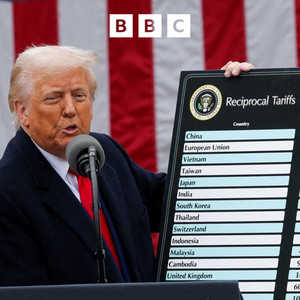
Back in April, Donald Trump stunned the world by announcing sweeping new import tariffs causing chaos in the financial markets.
For the United States, it marked a shift from decades of free trade towards a new era of protectionism.
In the months that followed, some of the rates have been reduced by a negotiation, but now he's announced tariffs on imports from about 70 countries that haven't yet reached a trade deal with the US.
Most of them are due to come into effect in seven days, leaving the door open for more talks.
As we record this podcast, European markets have fallen, with French and German stocks particularly hit, falling around 2%.
I've been talking to our Deputy Economics Editor, Darshini David.
The detail is dizzying.
It feels like another day, another raft of tariffs from President Trump.
But look, the key thing to remember in all of this is that the vast majority of American imports already had their tariffs settled ahead of this deadline through those trade deals or arrangements, we should say, that were done and also various tariff letters.
But what we've learnt in recent hours is what other countries will face.
And there's been disappointment for some, for example, Canada's some exports there will face 35%.
And there's been disappointment, too, for the likes of Taiwan and Switzerland.
But some smaller countries actually will face smaller tariffs than they had initially presumed.
Lesotho is one. But the key things to remember here is that the vast amount of uncertainty about what this tariff regime would look like has now gone, which helps businesses around the world.
And also, overall, on the whole, what we know so far, these tariffs are less aggressive than what President Trump had threatened in April.
And therefore, the risk to the global economy is smaller than it was.
And there's always another deadline, isn't there?
Today we're supposed to be the final deadline, and we get the rates today.
He says, oh, there's still another week for negotiations.
Yes, indeed. I mean, China, there's an extension to, not an extension so much as a different deadline.
Some of these countries are being given a week.
And the idea is that that is meant to give some breathing space to, and let's not forget them, all those people who have to deal with the nitty gritty of working out exactly what the tariffs are, who's owed what, and how you deal with that.
Even for those which have been told, look, we have a trade arrangement, we could see some more movement there as well.
Because never forget, these talks are ongoing.
And we know this is a president who's all about the art of the deal.
When the principle was first outlined, most economists, the vast majority, said this is basically bad news.
President Trump believes in them.
And one or two people around him really believe in this as a way of managing the U .S. economy and its relations with others.
But economists generally thought it was a bad idea.
Is there a sense of that playing out?
Let's not forget that full extent has not really kicked in until now.
It's kicking in to a lesser extent than we previously thought.
It is still, economists reckon, bad news for American consumers in terms of higher prices on many imported items. It is also bad news, therefore, for growth.
Does it mean that it brings back jobs and production to the US?
West, while President Trump has managed to get other countries, richer countries, that is, to agree to buy more American as part of these arrangements.
But that is still highly uncertain it'll bring back jobs and production to the US in the way that he thinks.
Also, he sees this as a way of raising tax dollars.
But the more of an impact it has on growth, the less revenue is being raised.
So you can't have it always.
Our deputy economics editor, Darshini David.
Well, Well, let's hear from two countries affected.
First, Thailand, which, along with Australia and Japan, seems to have come off relatively well.
It's seen its previously announced rate of 36 % reduced to 19%.
Here's our Southeast Asia correspondent, Jonathan Head.
Thailand was told it had a deal two days ago, but had to wait for President Trump's big announcement to know what its tariff rate would be.
19 % is a relief for the government and for Thailand's manufacturers.
That puts them on more or less the same level as their competitors.
As most of what they export to the U .S. cannot be made economically over there, most companies expect their U .S. customers to stick with the same suppliers, although the tariff does mean that many imports from this region are likely to cost the U .S. consumer more.
The negotiations for this deal were fraught, and we still don't know what Thailand had to give in return for the tariff reduction.
The US wanted free access to Thailand's lucrative agricultural market, for example.
And many details, in particular the vexed issue of transshipment products with large amounts of Chinese content, have yet to be worked out.
Switzerland, on the other hand, now has the highest tariffs in Europe at 39%.
Our correspondent in Geneva is Imogen Fowkes.
Reaction here to Donald Trump's 39 % tariffs.
HRF's higher even than the 31 % he originally threatened is total shock.
Right until the last minute, Switzerland hoped for a deal.
Last May, Swiss President Karin Keller -Suter said she'd been told she was next in line after the United Kingdom to strike a deal with Washington.
She said it might even be 10%.
But after a phone call with Donald Trump last night, she said there was no agreement.
Switzerland's pharmaceutical industry, which is key to the Swiss economy, has called it a dark day.
The Swiss tech industry says thousands of jobs are at risk.
Leading politicians are urging the government to continue negotiating, but no one seems too hopeful.
The key problem for Donald Trump seems to be that Switzerland sells more to the US than it buys.
But the harsh reality is the Swiss produce things the US needs but doesn't make, chief among them specific machine tools and pharmaceuticals.
Meanwhile, many things the US produces – cars, for example – are just never going to be on Switzerland's shopping list. So there's no way Switzerland, a country of just 9 million people, can possibly balance that deficit.
Today, the mood is despondent.
August 1st, Trump's deadline for tariff deals is also Swiss National Day.
That's Switzerland's equivalent of the 4th of July.
As they celebrate, the Swiss feel they're being unfairly punished for producing high -quality products that the world's biggest economy loves to buy.
There's more online at bbc .com slash news.
President Trump's special envoy has inspected one of the widely criticised aid distribution sites in Gaza that are backed by Israel and the US.
Steve Witkoff's visit coincides with the largest airdrop of aid so far into Gaza.
Israel doesn't allow international broadcasters, including the BBC, to report from Gaza, so our correspondent Emir Nadir is following developments from Jerusalem.
Steve Witkoff was accompanied by the US ambassador to Israel, Mike Huckabee, who posted images of the GHF site, saying they were there to learn the truth about the distribution of aid.
One image showed a crowd of Palestinians waiting behind barbed wire, with armed contractors standing by.
There have been further civilian deaths this morning.
Pictures shared by a local journalist show the bloody body of Rayan Fakhawi lying on a stretcher.
In another picture, a man in distress holds the young boy in a tight embrace.
It's been reported that the boy was killed by Israeli sniper fire near the GHF Shakoush aid site.
Latest figures, published by the UN, say at least 859 Palestinians have been killed near GHF aid sites since the organization replaced the UN -led food distribution model in May.
The GHF has rejected the numbers.
A large airdrop of supplies has also been taking place in the territory coordinated by seven nations.
The German armed forces alone delivered 14 tons of supplies from two aircraft. Since the start of the war almost two years ago the Hamas -run health ministry says more than 60 ,000 people have been killed, almost half of them women and children.
The BBC World Service has compiled material on over 160 cases where children have been shot in Gaza and found that in 95 cases the child was shot in the head or the chest. In most of these cases the victim was under 12 years old.
This report from our population correspondent Stephanie Hegarty contains disturbing details.
tales. In this video, a man and a small child are lying on a street in Gaza City.
Civilians, a voice behind the camera says, a father and his daughter.
The toddler lies face down, as if sleeping.
The man reaches out, brushing her with the back of his hand.
Moments later, it's clear that both are dead.
This video was broadcast on Qatari network, work, Al Arabi TV, in late December 2023.
It said the man and child had been shot by Israeli snipers.
But there was no details of what exactly happened or who they were.
For months, we tried to find out more about them.
A comment underneath a post of the video online named the man as Mohammed al -Majdhalawi.
We found his death certificate and that of his daughter, two -year -old Leanne.
This is Leanne playing with her mum in a family video taken before the war.
Her case is just one of 95 we've gathered material on of children who were shot in the head or chest in this war in Gaza.
To compile this list we verified media reports, spoke to human rights researchers on the ground, as well as 30 doctors and nurses who treated these children.
We looked at hundreds of photos and videos as well as scans, medical reports and journals that they shared.
In 57 cases, a witness account alleged it was the IDF who shot the child.
Two were allegedly shot by Palestinians, one by celebratory gunfire and the other in a gang conflict.
For 36 cases, we have no account of what happened.
But what were the circumstances of Leanne's death in Gaza City in November 2023?
This is Leanne's sister Shahid, who was with her father and Leanne, as well as her mother and brother that day.
She says the family were evacuating from a school shelter after the area was bombed and they walked down a quiet street.
We were walking together.
We were ahead of our father.
He was playing and singing with Leanne.
As they passed a junction, Shahid says she saw a tank up the street to her left. When we saw the tank, we started to run.
We looked back and he was lying on the ground.
She says she and her brother ran back to help and realised their father had been shot.
They tried to grab Leanne.
when they were shot at again.
I tried to reach my sister to hold her.
Then I was shot in my arm.
I held her hand and tried to pull her away.
That's when I got shot.
Her father told her to run and they never saw Mohammed or Leanne again.
We found a satellite image taken just two hours before the shooting and in it we can see a tank 280 metres from where the family were shot.
Military expert Stuart Ray pointed out several other tanks, Armoured vehicles, military diggers and defensive sandbanks, indicating this was an IDF position, fortified by tanks and infantry.
When presented with our findings, the IDF said its soldiers operate against terrorist organisations in complex urban environments and unintended or erroneous harm may occur in the course of combat.
It said the details of Leanne's case have been recorded and will be examined by the competent authorities.
Three experts in international law looked at our findings.
They told us they raised serious questions over whether these shootings were a result of recklessness, negligence, or willful attack.
K fought for the IDF in Gaza in early 2024.
He wanted to remain anonymous, so his words are voiced by an actor.
I asked if he was surprised to hear that so many children had been shot in the head, allegedly by the IDF.
I'm not super surprised.
I'm not shocked that there exist soldiers who would do that.
In reserves, a lot of it comes down to discretion of the soldiers.
Do you think there's a lack of accountability?
I would definitely say there's a lack of accountability.
Kay described his unit killing at least eight unarmed people, including two boys he described as young teenagers.
Anyone you see off the humanitarian road, shoot.
Shoot to kill. That's what we were told.
Our commander qualified that.
Of course, if it's a woman or a child, don't shoot.
Try to detain them.
Don't be stupid. As time went on, the stakes kept getting higher and higher.
And then ultimately, when we lost some people in a firefight, it was just destroy everything, kill everyone, you see.
We put Kay's allegations to the IDF and they said, the IDF remains committed to minimising harm to civilians as much as possible.
Outer board from Stephanie Hegarty.
A set of sacred jewels believed to be linked to the Buddha have been returned to India by the auction house Sotheby's after mounting pressure from the Indian government.
The Pipral Har gems, described by archaeologists as one of the most astonishing finds of the modern era, were due to be auctioned in Hong Kong in May, but the sale was called off after threats of legal action.
The treasure, including 1 ,800 pearls, rubies and sapphires, was unearthed in the late 19th century by an English estate manager in colonial India.
The historian William Dalrymple told my colleague Sean Lay about their significance.
significance these wonderful gems were dug up by a guy called william claxton pepe and although it seems very odd now that you know an ordinary individual could just sort of dig out a spade and a pickaxe and go to work digging a sacred buddhist site this was the norm in the 19th century and some of the most amazing discoveries of what particularly early buddhist history were just ordinary individuals employed either by first east india company or the raj This character, William Paxton Pepe, dug up the Priprawa stupa in 1898.
And you mentioned the word stupa.
That's kind of like a Buddhist reliquary.
Yes. I mean, a stupa is to Buddhism what I suppose a tabernacle is to a Catholic church. It encloses what believers take to be the real presence.
So just as Catholics will genuflect in front of a tabernacle, Buddhists will believe that stupas represent the real embodiment of the Buddha because it contains fragments of his relics.
And one of the very first things we know about early Buddhist history is that there was a great battle between eight early Buddhist kings for the relics of the Buddha and that they all came to blows and then finally an agreement was made that they would all get one eighth.
This is not a new thing to dispute over the Buddha's relic with a very ancient history.
There was this huge collection of jewels.
What sort of things?
It's like a little collection of very sort of sacred objects.
Some of them are actually human remains, burnt bone.
These were believed to be the Buddha's own, hence the importance of this, and other fragments of gold and crystals.
The majority of what was found there then was kind of effectively handed over to the British Raj, but some of them were kept by the family.
Correct. So I think there was division of three different things.
I believe that the relics of the Buddha were given to the king of Siam, that's what's now Thailand, who in turn gave them on, on fragments of them to the rulers of Sri Lanka and Burma.
But the other fragments like urns and stone kists and more sort of substantial remnants were given to what was then the Imperial Museum in Calcutta, which is now the Indian Museum, where they remain.
And then the family took a portion of some of the prettier bits, including these sort of fragments of gold leaf.
I certainly first came across this when they lent it to a wonderful exhibition in New York three years ago.
And you could see children coming in in school groups and chatting to each other and joking with each other.
And then when they'd walk into this area, they felt this sort of sacred presence with all the chanting and so on.
They'd fall silent.
So it was very respectfully done.
I think that was the first time that these things came out of hiding, so to speak.
Now, the decision was made to put them up for auction at Sotheby's in Hong Kong.
And at that point, the Indian government intervened and made it pretty clear that they thought that this was was the sort of thing that should be returned to India, that it was a kind of colonial kind of hangover from the days of empire, and that, frankly, they shouldn't be put up for auction, not least because the Buddhist connection.
What did you make of that argument?
There's two converging arguments here.
One is the argument, quite right, that these are extremely sacred relics.
And you wouldn't expect to find, for example, the Bragant of the True Cross to to be put on sale in Sotheby's as if it was an artwork or a statue. And so quite reasonably, people objected to it on that ground.
But there's also the very strong feeling in India at the moment that so much of their greatest treasures are not in museums in India, but in museums in Britain, like the British Museum or the BNA or in the Met.
And Mr. Modi, on a recent visit to New York, did a viewing of, I think, 120 of these statues, which are now back in India, awaiting a new museum, which will be built in the centre of New Delhi.
So I think India's very proud of that, rightly.
And I think it's a very happy ending that it's back now in India.
The historian William Dalrymple.
Still to come. And if you want a perfect example of the Edinburgh spirit, how about this?
Dan Borman, a comedian who got 1 ,000 people to watch him fold a fitted sheet.
just one of many acts performing at this year's edinburgh fringe festival it's finally happened your kid could be part of the first generation to never suffer the rough touch of toilet paper on their tender tush all thanks to new flushable little dude wipes available in bubble bum scent or fragrance free because we know little butts can make a big mess But with Little Dude Wipes, you can keep your kids' keister clean.
Without the burn and debris, toilet paper can leave behind on their behinds.
Experience the confident clean of Little Dude Wipes.
Available exclusively at Walmart nationwide.
Hi, I'm Cindy Crawford and I'm the founder of Meaningful Beauty.
When Dr. Sabah and I decided to do a skincare line together, he said to me, we are going to give women meaningful beauty.
And I said, that's exactly right.
We want to give women meaningful beauty, which means each and every product is meaningful.
It has a reason to exist. It's efficacious.
You're going to get results.
And then you just go out and live your life.
Meaningful beauty. Confidence is beautiful.
Learn more at MeaningfulBeauty .com.
This summer, healthy habits could lead to big prizes during Symbiotica's Summer Giveaway.
Start with supplements that support how you feel and how you show up.
Symbiotica's liposomal glutathione and vitamin C are a powerful antioxidant duo that support natural detox, glowy skin, and lasting energy.
It's just what your body needs during those long summer days.
Plus, right now, you have a chance to win a 2025 Rivian, a luxurious wellness retreat, and a year's supply of products.
Head to Symbiotica .com slash Summersweepstakes to enter today.
This message is sponsored by Greenlight.
With school out, summer is the perfect time to teach our kids real -world money skills they'll use forever.
Greenlight is a debit card and the number one family finance and safety app used by millions of families, helping kids learn how to save, invest, and spend wisely.
Parents can send their kids money and track their spending and saving, while kids build money confidence and skills in fun ways.
Start your risk -free Greenlight trial today at greenlight .com slash iHeart.
That's greenlight .com slash iHeart.
former south korean president yun sun yul who's currently in custody has been resisting attempts to be taken out of his prison cell by lying on the floor in his underwear let's get the story from mickey bristow our east asia editor who reminded me why mr yun is in prison essentially his troubles began in december last year when he declared or tried to declare martial law in South Korea.
That was revoked a few hours afterwards, but plunged South Korea into a political crisis.
Mr. Yoon was suspended from office shortly afterwards.
In April, the constitutional court in South Korea decided to essentially get rid of him as president, and he himself was then charged with insurrection, a charge which he faces the death sentence or or even life in prison.
And so that's why he's in prison at the moment.
He also faces a number of other charges relating to meddling in previous elections in South Korea, breaking the law.
And that's why prosecutors wanted to speak to him.
And they went along on Thursday to his cell, to the detention centre in Seoul, to try and get him out.
And he refused, as you indicated there.
Just update us with what's been happening today then.
Yeah, that's when former President Yoon took off his prison clothes, prison uniform and stripped down to his underpants, his vest, and he laid on the floor and he refused to go for questioning.
These investigators, they held back.
They went back every 20 minutes, half an hour or so to try and get him out.
He refused. They decided not to use force because they thought that perhaps there could be some kind of accident and the former president might get hurt.
So they decided to leave it, but they've indicated that they could use force in the future Interestingly, afterwards, former President Yoon's lawyer really criticised this action, saying that Mr Yoon wasn't a well person.
He also criticised the fact that prosecutors have revealed details about this incident.
They said, essentially, it's an insult to the dignity of a man who was, until very recently, the president of South Korea.
Certainly, it's a humiliating change in circumstances for Mr Yoon.
Vicky Bristow reporting.
Officials in Malawi say the country has successfully met UN targets in the fight against HIV AIDS.
It was among the worst hit countries in the world with around one in seven Malawians being HIV positive in the 1990s.
Officials say that figure has now halved.
As we'll hear from our Africa regional editor Will Ross.
Malawi was so badly hit by HIV AIDS that after the 1980s, life expectancy dropped from 56 to 38 years.
But now, the head of Malawi's AIDS commission says remarkable strides have been taken.
Beatrice Matanje said the country successfully met the UN targets of ensuring 95 % of people living with HIV know their status.
And of those, 95 % are taking life -prolonging antiretroviral drugs.
Beatrice Matanje said urgent action was still needed as adolescent girls and young women are disproportionately impacted by new infections.
She says every week around 59 young Malawian women become HIV positive.
She's called for targeted interventions including sex education and programmes to empower young women socially and economically.
Now, not many places have more cash than the world of artificial intelligence right now.
That's reflected by the eye -watering sums being offered in the race for talent at some of the world's biggest tech giants.
So reports that Facebook founder and Meta boss Mark Zuckerberg offered an AI researcher $750 million to join his top team may not be a surprise, although the worker turned it down.
Sean Farrington has been talking about this with behaviour economist at the University of Exeter, Lucas Balafutis, and the BBC's technology editor, Zoe Kleinman.
This is a really interesting point in this sort of AI journey, if you like.
You know, Zuckerberg once bet the farm, didn't he, on this digital world called the metaverse.
And now he's gunning for AI with all of the wealth and the aggressive talent buying that only a US tech giant with deep pockets can really throw at it.
You might have already heard the term AGI, which stands for Artificial General Intelligence.
And Zuckerberg's version of it is super intelligence.
That's what he's calling it.
Now, it's worth saying there's a lot of hype around this so far hypothetical branch of artificial intelligence.
But there's a huge promises and lots of exaggeration made about it.
So AGI is said to be an incredibly powerful AI tool that can basically function like we can.
It can carry out a wide range of tasks.
It can transfer knowledge between them so it can sort of learn what it's doing from having done the similar things before.
It can reason, it can make decisions, it can improve itself over time.
Sounds familiar? Very much like humans.
And what the tech bosses say is that this is going to help us to leave much more efficient and productive lives because basically this AGI will be able to do everything.
Zuckerberg's vision for super intelligence is what he calls personal empowerment, which I suppose means a sort of super coach or therapist or maybe PA as well, all rolled into one.
But the thing about it is none of them are really giving huge details about how this is going to work exactly when it's coming, although they say it is coming, and also what the risks of it are, which could be tremendous if you think about about how powerful this tech is.
And Zoe, I just wonder, you have three quarters of a billion dollars.
Could it be that even if you wanted to work for a company like Meta, you actually feel like that's not what you're worth in the world of AI at the minute?
Do people have that sense?
I think there are some people working in AI who can name their own paychecks because this is such an incredibly lucrative and powerful space.
And it's also an enormous global arms race.
And if you have a skill within that sector that's needed to create this giant machine, then I think that you are certainly laughing all the way to the bank at the moment.
Yeah, I mean, the figures are eye -watering.
The question is whether it's a big bubble or not.
Zoe Kleinman, thank you very much. Our tech editor, Lucas Balafutas, is behavioural economist at the University of Exeter.
Lucas, why else might you turn this down?
Well, I mean, you summarised it pretty well at the beginning when you said it's about who you want to work with and why.
And I don't think you need a behavioural economist to tell you that it's not just about the paycheck we get at the end of the month, right people are motivated also by things like the culture of the company they work for the kind of work they're asked to do so it's about scientific freedom possibly and creative freedom on the one hand versus something like a heavier focus on product development that they might be looking at if they switch to meta loyalty to their current teams people are motivated by all sorts of things and they're not purely rational money maximizers but let me also say that all
of this let's say intrinsic factors aside as zoe was saying people at the frontier of ai the really skilled ones they know they are worth a lot right so i'm sure they currently have a great deal and they probably also have equity where they're at which they would not matter though lucas further afield golden hellos generally can they be too big do you maybe not want to be attracting somebody just because of the money?
If you're meta, you probably do want to attract superstars.
As we heard before, a single breakthrough in AI can instantly mean hundreds of billions, right?
So paying someone one billion for it is actually possibly a bargain.
So from the perspective of meta, maybe a good strategy.
We are in the middle of a very intense talent arms race.
And if you can get these highly skilled people, and that's a very specific segment of the market at the really top, right?
If you can get them and also remove them from the competition, that's worth a lot.
Lucas Bannafutas from the University of Exeter.
From the world -famous Fringe to the renowned International Festival, the wide range of Edinburgh festivals start today with thousands of shows scheduled throughout August. Artists and performers travel from across the world to perform on hundreds of stages around the city.
Our media and arts correspondent, David Stiletto, has more.
Rising up like the sun to meet the challenge.
It's a female sketch comedy inspired by toilet graffiti all around Manchester.
It's something that you've got to share.
My show's called Chokeslam.
It's a one -woman solo show about my love of pro wrestling.
Welcome to Edinburgh, and there is definitely something for all tastes here.
And this is a biscuit -related comedy troupe.
We have a jammy dodger, a bourbon, a rich tea, of course, the king of biscuits, a custard cream.
But I never got to see it with mine own eyes.
But there's also, of course, the main festival.
And this year, the star attraction is Brian Cox's return to the stage for Make It Happen.
It's a play about the financial crash of 2008 in which he asked to play the 18th century economist Adam Smith to bring judgement to contemporary Britain.
I've just entered my 80th year, you know, I'm 79, so I'm going, well, it's now or never.
You've got to start telling, you've got to start living up to something.
On the smaller stages, one popular theme is comedy about various mental struggles, such as Anna Hale, who has...
I have something called emetophobia, which is a fear of vomiting.
That's a natural route for an hour of comedy, isn't it?
Yeah, absolutely. La, la, la, la, la, la, la, la.
It is a show about anxiety, and singing, and audience participation.
And she saw me coming.
Did I say anxiety? And to prove that this isn't just a place for those who've got thousands to gamble on a show, meet Naren.
She begins each day in the countryside, and then heads off to do her relaxed comedy show about autism.
Why are you in a tent?
I'm in a tent because everything is super expensive and for me I find it important to represent working class people as well.
And if you want a perfect example of the Edinburgh spirit, how about this?
Dan Borman, a comedian who got 1 ,000 people to watch him fold a fitted sheet.
A thousand people came to see you fold a fitted sheet?
Yeah, I'm as surprised as you are.
And while his comedy is about more than just sheets, I thought we need a big finale.
Dan fold the sheets.
He's actually my flatmate, so I don't think he knows what I've been doing.
You give that a fold, third corner, you find that in there, still inside out, you look for the tag.
At this point you've just got a square with a corner.
I've seen magic in my time.
Thank you. It's been a pleasure.
Witchcraft, total witchcraft. I don't believe it for a second.
David Southo in Edinburgh.
And that's all from us for now.
There'll be a new edition of Global News to download later.
If you'd like to comment on this edition and the stories we included, drop us an email, globalpodcast at bbc .co .uk.
You'll also find us on X at BBC World Service.
Just use the hashtag Global News Pod.
This edition was mixed by Kai Perry.
The producer was Judy Frankel.
The editor is Karen Martin.
I'm Andrew Peach. Thank you for listening.
And until next time, goodbye.