It's not really about protecting workers.
It's about trying to get the American deficit under control.
If the United States has to pay more interest on its bonds, that can go bankrupt as well.
Trump will get something he wanted, that's for sure.
The question is, how much will American people pay for that?
This kind of policy of Donald Trump might lead to inflation, and then he might even lose the support of the voters.
So we're gonna welcome a period of time what I call mosaic globalization.
We are definitely moving into a new world order and I don't think it's going to be one that the United States is going to like as much as it hopes it will.
The CHAT Lounge. CHAT Lounge.
CHAT Lounge. The CHAT Lounge unpacks views and opinions on hot issues in a more casual way.
History doesn't just echo.
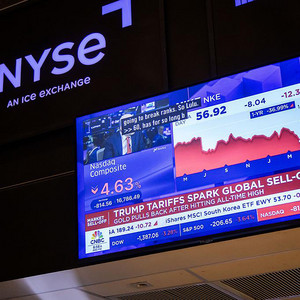
It warns. As Washington ramps up tariffs, and the world braces for economic whiplash, we're watching a 21st century rerun of Herbert Hoover's Great Depression Playbook.
From China's counter -strikes to cracks in America's economy, we unpack whether this trade war is strategy or self -sabotage.
Welcome to the Chat Lounge, I'm Chun -Yun, joining our chat on whether the US will have the last laugh by wielding its tariff stick are Professor Joseph Mahoney, a professor of politics and international relations at East China Normal University, Professor Hans Peter Borghoff, chair of the banking and finance department, University of Hohenheim, and Professor Tzu -Chian, a Fellow of the Belt and Road Research Center at Minsu, University of China.
Thank President Donald Trump has announced a 90 -day tariff pause for more than 70 trading partners with notable exceptions Canada Mexico and China America's three biggest trading partners.
For China which had just unveiled a flurry of a counter measures in response to America's sweeping tariffs the pressure is only intensifying tariffs will now spike to over 120 percent.
So what just happened?
Did the US president suddenly recall a few hard lessons from history, or is this just the next move in an escalating trade showdown?
Very briefly, shall we start with Professor Qichang here in Beijing.
Okay, well if you want to talk about the latest situation right now, Well, the whole world didn't expect all this because this is not like a, you know, a statement shift. It's not how you run a country or even how you run a big company.
This is more like kids playing games in the sand ground.
Okay, you change or overthrow whatever you just said and, you know, make another decision.
Well, it's okay on the sand playground, but it's not okay when you're running the number one country in the whole world.
Look, basically, Trump, the only thing, is an opportunist, which means he is a shrewd man, a businessman, and every trail about his operation this time can be found in this book called The Art of Deal.
So he knows how to make a deal.
First of all, he throws out a very, very unexpected, shocking requirement that all, everybody, and then he makes some zigzagging in all his details, makes himself unpredictable by all his opponents.
Nobody guesses what his next move would be, and then suddenly he withdraw every move or push forward every move.
So sometimes your mindset or your spiritual world get crushed, and then you have to understand and you have to sympathize with them and accept what he has to offer.
So this is the basic classic business negotiation tactic he is making here.
Well, I think for the smaller economies, he made it, congratulations Mr. President.
But for the bigger economy and major players like China, like the European Union, I don't think he's getting anywhere.
But I think the only loser here today is the consumers and also stock investors in Wall Street.
Just trillions of US dollars just it vaporized within just three days.
So congratulations.
But they've gained some territories already back, right?
No, it's not back. Well, if you take a look at the major loss in the games by counting all the turnovers, is actually been evaporating a lot of the cash.
Many of the investors in Wall Street are actually been leveraged up, which means you only have $100 dollars, but basically you always put down your bet on like thousands of dollars or tens of thousands dollars of the trade on warrant, on options, on the futures.
That's how it goes in everyday Wall Street trade.
So every time when you lose like 10 percent or 20 percent on your position' you get wiped out, you're going to knock out.
That's the situation.
So sometimes when it dropped like 10 % a day, you get wiped out.
And sometimes you started to sell short and then they rise up again for another 10 % and then you get wiped out again altogether you lose like 20 % even though the whole market looks like it's zero change.
It just goes up 10%, it goes down 10%, there's zero change, but you get wiped out twice and lose 20%.
But that's what the situation looks like.
So it's a major lose for many of the investors I have friends in Hong Kong, in New York, they've been investing for more than 20 years in them, they've been bleeding out for these turbulences in the past several days.
This is not good news.
And this is just the stock market I'm talking about.
I'm not even beginning with the T bond or the bond market, which is larger -sized market.
So you don't think this is the end of the tariff war?
Now, according to my business modeling, well another round of the impact will start from the maybe the early, maybe the end of the June.
And also the third round of the impact will be starting at the maybe end of September or early of October.
This is the window of the next two rounds of the impact will come in after that.
This is not an end.
This is just a beginning.
Trump wants you to understand the gravity of the change of the tariff regime for the whole world.
It is because everybody has already seen this change and shocking turbulence.
So many small economies get awed and they get, you know, feared.
So they come to a D .C.
to talk to Trump and try to make a deal.
That's how Trump are describing trying to kiss his ass.
Well, I think he made it to his original intentions by all these, you know, very unexpected moves.
But this is not what he wants to get, only to fulfill his own ego.
he wants to get more, so just wait and see that round two and round three to come.
Alright we will. And professor Gorgov, Germany's incoming chancellor, Friedrich Mertz said Europe's determination to fight back would be behind the US President Donald Trump's 90 day pause.
Is that so? Well tariff policy is European policy and European Union, so for sure Europe will fight back and it will fight back united although Europe is left out for the moment at least for the extreme excesses of tariffs.
I mean, there's still tariffs which are higher than in the past and they're still counterproductive, for sure, but it's a change of strategy.
Let me say something about what my colleague just said.
I don't think that the government is so coherent.
I think it has many faces, despite this sometimes clownish appearance of the president who does this and that, and try to irritate everybody to hide what he's really doing.
I think there are some people in the government who say, yes, we can't go on like that.
And the other ones who say, we must work on cooperation because we must make United States again, a reliable partner.
They're the ones who say, well, you can't attack the whole world with a trade war all the time.
We start now to attack our enemies, understand such categories as piecemeal, so let's start this China and maybe Mexico, somebody we always hate, and Canada, which we want to take over and be just do damage to these countries and leave the other one out.
And there's also the other ones, people who understand a little bit of economics.
And I wouldn't start with the stock market.
I mean, the crucial point is the bond market.
If the United States has to pay more interest on its bonds, I mean, they've got a gigantic state debt and they can go bankrupt over that.
And they already pay a lot of money on interest every year.
If this soars up, they're in deep deep trouble and this party within the government understand that we get into deep trouble.
And you've seen these conflicts, yeah?
I mean, on a mask saying something but another member of the government calling him it really block it and stupid and things like that.
so this is not as coherent as it looks and for the countries all about it well now we've got three months break to bargaining and we are not sure because all this is pretty erratic we're not sure what will be on the agenda for donald trump in three months from now you simply have no idea there are some external conflicts there's israel the hamas as iran there are many other things where united states might also need some allies now and so it's very very or should i say uncomfortable situation also because the us government and it's not coherent, and we're not really sure what happened behind the face
of Donald Trump and behind his back and by the people who prepare the decisions.
Indeed, a lot of to deal with in the coming three months, but for now Professor Mahoney, what's your take here?
Some people are saying that this might be the key impact from the treasury secretary.
What's your take? Well, I think the first thing is there's been some discussion about whether or not he has a coherent strategy, whether or not He's being guided by a pseudo scholar, someone like Navarro, who as we all know, invented sources in the book that was supposedly influential on Trump when Trump was looking for economic advice ahead of his first term in office.
My guess though, is that it is a general mistake, a serious mistake to underestimate Trump.
I don't think he's a genius, a stable genius, but what he has managed to accomplish is something that I don't think we should sell short.
That said, when he got 104 % tariffs against China, that was really already enough to likely prevent Chinese manufacturers from exporting to the US.
So whatever else he adds on top of that in terms of tariffs is really irrelevant.
The larger problems could come from things like the suggestion from some of the administration officials that they might force American stock exchanges to delist Chinese companies.
We know that they could attack Hong Kong and apply the same banking and finance rules to Hong Kong that they apply to the mainland.
There are a lot of things that could still do.
I think my sense is, he didn't anticipate China resisting so much, and he didn't anticipate that EU resisting as much as it did.
And they started to see some things in the bond market that made them uncomfortable.
And so they adjusted the strategy.
they made a tactical adjustment and they've narrowed now on China especially.
Now, was that always part of the strategy?
Maybe not because I think if it was they wouldn't have started by attacking the whole world.
I think they would have tried to isolate China from the very beginning.
But nevertheless, I think that's where we are now.
And the question is, do we continue down this path, which could lead to decoupling?
Or is he still trying to gain leverage to exact concessions.
There's one more point that neither of my colleagues have mentioned, but I'm sure they're both aware of it, and that is he does seem to be trying to manipulate the bond market.
He does seem to be trying to strengthen that market while also inducing the Fed to lower interest rates so that he can reduce the deficit or the debt servicing costs that the United States faces while he's simultaneously slashing government and government spending.
However, we've also seen some analyses suggest that he might be trying to also pressure countries to exchange their US dollar reserves, and at the same time, induce lower interest rates so as to decrease the relative value of US dollar while still maintaining its hegemonic status.
Now, that's a little bit too much economics, I think, for an everyday discussion.
But basically, he may have more narrow strategic goals trying to create market conditions that otherwise wouldn't exist, trying to manipulate the market in ways that benefit the United States.
And this isn't really about a long term tariff regime at all.
And this may go to the point that he's made to the US citizens that don't worry, this is short term pain.
In other words, he may have an off ramp, but at the same time, he may still ultimately be targeting one country in particular.
And that's China. The chat lounge.
The chat lounge unpacks views and opinions on hot issues in a more casual way.
So you're saying if he reaches his goal about the bond market, would he quit imposing more tariffs on other countries, or at least not on China, but what about other countries?
Well, I think the thing that we learned about Trump is, you know, during his first term, he forced Canada and Mexico to renegotiate NAFTA.
And they did that, and then he hit them again, for spurious reasons.
We know all of the tariffs that he's launched against the world is spurious, they have nothing to do with reciprocal tariffs, they're about to trade deficits.
So we understand that he's not a reliable partner, he's not someone who will strike a deal and keep to it.
We know that he will keep coming back for more.
We saw, I think, the European response to go zero for zero, and he said that's not enough.
I think if I saw the headlines correctly, he insisted that Europe also had to commit to buying 350 billion of US energy.
So even if you come back to him and you try to negotiate in good faith, he seems to be pressing even further and even if you strike a deal with him, if he senses weakness, if he senses that he can get something from you later, while at the same time abandoning American commitments to foreign aid, abandoning American commitments to the World Trade Organization, the World Health Organization, climate change.
So he's someone who ultimately will always be out for himself or his country or however you want to understand that horrible mess.
So I don't think that anyone can trust him.
And I think the thing that pressing question for the world today, beyond Canada, Mexico and China is, do you pause and count yourself grateful, and therefore, you know, help them gain leverage in trying to isolate and diminish these three countries, when it was really quite frankly, it was really China that shocked him that forced him to, you know, with Europe coming into the picture, but it was really China's strong response, which he did anticipate, and likely China dropping treasuries that started moving the bond market.
It was China that forced this pause and the rest of the world needs to be prepared that if he manages to break China in some way, and I don't think he can, but if he does, that in three months he's coming after them, right.
So that's what you have to assume whether or not that's his long term strategy or not, we don't know.
Because, you know, he may be making it up as he goes.
But one thing is certain, Washington isn't backing down from its tariff strategy anytime soon because they still got this 10 percent universal tariffs on the over 75 countries or trade bodies.
Now back to what our theme today is, learning lessons from history.
History has shown that such an approach has failed before.
In 1930, Republican President Herbert Hoover implemented the Smoot -Hawley tariff act with extensive tariff hikes.
So Professor Mahoney, are the economic or political and geopolitical contexts of these two eras comparable?
Some people are saying, they don't think this whole period is like the 1930s.
They say unemployment is not the same.
the depression was induced by the lack of capital, and the Federal Reserve tightening the money supply, and the regulatory standards for banking was not federalized.
Many banks were overextending and creating their own monies, et cetera, et cetera, all contrary to what the Trump administration is faced with and is dealing with.
So if they're saying the 1930 example is not enough to support the conclusion that this may lead to a chaos today.
So tell us your perception on this.
Well, as a good Marxist, and I say that with the understanding that all Marxists are good, it's always a mistake to, you know, try to apply one distinct historical experience and generalize that to another.
Certainly there were a number of conditions that created the Great Depression.
And clearly the Smoot -Hawley -Terrefact did nothing to make it better.
And And there are some strong arguments that it contributed to making things worse.
Nevertheless, again, I think we have to question whether or not this tariff strategy is really comparable to brutally in the sense that we don't really know that he aims to continue this long term that he may have more short term objectives.
If he tells the American people, look, you're just going to have some short term pain, but things are going to work out.
But, we know that's a lie, because it takes a long time to rebuild an economy.
You have the right investment in education and healthcare, infrastructure, all these things that are necessary.
And in addition to this, you have to have a good system that can work in the interstate model.
Currently, we have all these states that have different rules and regulations with regard to labor, with regard to environmental regulations.
And it's not likely that he would be able to really rebuild this in a short period of It would take likely decades, so I don't think that that's really a realistic objective.
I think he'll be long dead before the U .S. if the U .S. ever regains its manufacturing prowess.
I suspect that this is a finance game that he's playing, and as a result, it's not really about protecting workers.
It's about trying to get the American deficit under control, and to be clear, what's really different now, someone asked me if the economic problems that we're going to face this year are going to be worse than what we saw in 2021 due to COVID.
And I said, well, the thing that we need to keep in mind is that the problems that we're facing today, what Trump is doing today is largely a result of COVID in so much as during 2020 and 2021, the Fed expanded the money supply 20%, the US under Trump's leadership, spent trillions of dollars trying to paper over their catastrophic response to the pandemic, which they were unable to manage precisely because there were 50 states with 50 different agendas.
So there are a lot of different reasons why we're engaged in this.
Part of it's trying to manipulate financial markets, part of it's trying to regain some strategic autonomy.
And, you know, part of it is fitting the Jacksonian Great Power Competition paradigm that we believe to be at the center of Trump's foreign policy thinking.
What you're saying, you're saying that the because of there are a lot of differences in what he's doing is probably experimental or can be feasible?
Well, I think one of the things is, you know, there are people in Washington, and honestly, I believe that they should be thinking this, that the US is reaching a tipping point, that there is sort of an existential crisis with regard to how long the US will be able to sustain this sort of deficit in the face of a rising China, in the face of what everyone acknowledges will come sooner or later, de -dollarization.
And once the polarization comes, then whatever remains of U .S. power, as much as it's a house of cards built on U .S. dollar hegemony, will evaporate.
So there is sort of this need to try to strike, while you can try to manipulate markets to shore up the dollar, shore up your finances, and at the same time knock back some of your leading competitors so that you can buy more time at the top.
That's what they're doing.
And in the broader context, of course, there's the dark magic of climate change, which threatens to diminish the global South and China.
And the countries in the global North are best positioned for this.
This may be why he has strategic ambitions towards Canada and Greenland and certainly being able to project power into the Arctic, which is one of the keys for exerting control militarily over the world.
So there are a lot of different things in play, certainly sparking some chaos and then hoping that the US still occupying the global position as the world leading economy, still having the world's most powerful military and still having a control over the global financial system, and the US dollar that the US would be able to survive that chaos better than others.
Professor Borghoff, what's your expectation?
Do you think the States or the Trump administration can survive such counter action from other countries?
Let me go back to the narrative of my esteemed colleague as a free market liberal, as a banking professor, I'd say it's a little bit different.
I mean if you look at the crisis of 1930 for sure the smooth holy tariff was not that important except that it proved that this policy is not very successful because at that time the main topic was instability in the banking sector for whatever reasons which are much more complex than we can gets to today, but the banking sector was in trouble.
And you could see that the very moment the bank started to fail the economy break down.
And that's something that the United States is not confronted with today.
The banking sector looks, after all the efforts were made, comparatively stable, even the U .S., although they had some crisis in 2023.
It looks pretty stable.
So in this respect, we have less stress in the U .S. economy, far less stress.
On the other hand, for sure, trade has become much more important, and supply chains have become more important.
But I don't think that has to do much with corona.
Well corona, yes, made us aware in the West of a dependency on Chinese production.
but we are reacting to this, we're doing this strategy of de -risking every large corporate group, looks at where else can we get this product, and this will stabilize the global market economy if we follow this path.
And also, in just fighting for the world power.
And we should never forget that small is beautiful, even in countries.
Countries who are smaller are much easier to manage.
I mean, Chinese knows just how big this country is.
You see it in Russia.
These large countries are really difficult to manage.
Small countries can be managed much more efficiently.
do not fight for world power, so there is always this equilibrium between being small and being large and I don't think that neither the US nor China will really fight for the world power of the future because both have their specific weaknesses, they don't control the world, that's good.
So that's an equilibrium we love to have which gives room for creativity for different kinds of countries, different kinds of lifestyles.
I hope we will not have to understand the world just from this global power conflict perspective and the future.
And now, going back to Trump, if the United States can survive, yes, for sure, the United States can survive.
It's an extremely strong country with a large population, comparatively young population, very creative population, with large natural resources.
And what about the Trump administration then?
What about the Trump administration?
You know, back in 1930, during the Great Recession, actually retaliation from other countries put the United States in a very hard situation, right?
And hardships. official, I mean, I don't believe that after doing things like that, and if he follows his path further, that he will win the next election even if he allows himself a third term which is normally forbidden.
So I don't think he'll win the next election, but on the other hand, I think he's got enough support to stay president for the moment.
So there is no fast change to expect it.
But there can be an overturn of the US policy in the long term.
What is really attacking the global economy, in my view, is for example technology.
I mean everything that is on the net, every product that is on the net and has a computer can be controlled by the country where it's produced.
And that's the problem for the US.
We don't trust American weapons anymore in Europe.
We want to rebuild our own weapons.
But it holds for cars, cars from US, cars from China.
Everything coming from a different power system can be controlled or we fear they can.
And this will be for sure a change in the world economies with regards to supply chains, which leads to much more localized production and for sure to an inefficiency.
So, the bad we use is I don't think that we can grow on like we did in the past, because this world is changing in a negative way.
This has been the Chat Lounge.
When we return, we'll explore whether widespread U .S. tariffs may accelerate the formation of a post -American global trade order.
Stay with us. Welcome back to the Chat Lounge, we continue our discussion on whether the US will have the last laugh by wielding its tariff stick.
To Professor Chu, who has been silent for quite some time, from the Chinese perspective, what's your take?
We've already seen China introduce its calendar measures, right.
This 11 -pronged response includes export controls on rare earths, the WTO case, bans on certain US imports, and trade restrictions on specific American companies.
So how effective are these countermeasures likely to be?
It seems that President Trump doesn't care that much about this and further raise the tariffs on China.
Well, I think the signal is loud and clear.
That is, China want to counterfight what is that, you know, unfair.
And which is also discriminatory towards China.
Or China don't want to break the boundaries of the trade and economic cooperation with America.
That's for sure. That's the reason why we have pulled out a White Book immediately after all this happening and telling the whole world, including American people that this corporation, this trade relations, how important it is, and what kind of benefit has been serving both sides of the world and also serving the rest of the whole online, we have it because unlike the mindset of Trump, which is purely business oriented, Chinese people will have its own understanding mindset of national pride.
We have taken it enough in the past 200 years, so we were not allowed it to happen again.
This is why I'm telling my students because we experience the past, we know what the feeling was like when somebody just tried to mouth it on your head, and shit on your head.
This is not a good feeling, no matter how much they pay you to do so.
By making really hard effort in the past 70 years.
So this is our bottom line.
And as for how is it going to be effective?
Yes, I do think that's going to be effective.
Well, not to be fully effective, but I think it will be very effective.
The reason why I don't think it's going to be full in effect is because our trade surplus is probably four times the size of the United States can benefit from China.
So I think instead of posing them on 34 % of the tariff or another 40 % of the tariff, we should quadruple the size of the punishment, which means no matter how much America is trying to pose on China, China should quadruple it and make it back to America again.
That is how we can make it even.
And now we try to do it in a reciprocal way.
I think China just wants to show an attitude that we're going to counter fight, but we don't want to give the thing worse, So you give us 30%, we give you 30%, you give us 50%, and then vice versa.
And also, probably your argument is that, okay, you're not hurting America because you are a trade surplus.
But no, that's not a truce.
It's because in Americans' side, what China has been blocking, America is mostly agriculture sector, mostly manufacturing sector.
sectors. This is not the largest dough in the bilateral trade from America to China.
But consider that, in America, many of the people are working for more lucrative service centers, like finance, like legal services.
But even though they're making more money, but their people are less.
On the contrary, when we're talking about when China tried to punish America in soybean, In agriculture product.
In manufacturing product.
We're talking about the car parts, even though less money they represent, but more people they represent.
And most of them are actually overlapping with the major voter for Trump.
According to reclamation, while for example when we try to put on the same size tariff counter fighting America on agriculture sector alone, we will be touching about nearly a million of farmers in American side.
That is probably the size of several agriculture states in America and the farmers they stand for together.
This is a very large voting communities.
And also, this is only a direct impact that we're talking about.
If we're talking about their whole family, if we're talking about the whole supply chain that they're represented, there are going to be millions of population that are representing Tennessee, Alabama, Oklahoma.
The states are naming them.
So it's going to be serious.
Even though, well, Probably Americans know what they stand is just a, you know, pennies and nickels, selling the chickens, soybeans and eggs.
But their numbers of people are a lot.
So this is just one thing to begin with.
And also we're talking about the trades or workers union, the 5 Worker's Union.
If America want to turn itself to be a very large manufacturing states, again.
OK, if you want to make the best top -notch, state -of -art, engineer, machine, car, electronic devices, you're going to sell them, right?
So, sell them to who?
European or Japan or South Korea?
They all put together they will not even be equivalent enough towards the size of Chinese market.
And by the way, apart from America market, China right now is the second largest effective market.
By effective, we mean we have largest number of people on one hand, and also these people can't afford to buy things produced in some other, you know, mature economy like European Union like America.
So, like our friends has been mentioning, you don't fight the whole world right now.
You've been pissing off the whole European Union.
They won't buy your stuff that easily right now.
And also you try to piece up Chinese market.
Well, 400 million growing number of middle income class if they are going to say no to made in America.
What does this product made in America good for?
This is going to be a problem you're going to face in the next five or 10 years.
So even though you're saying that Chinese counter fighting is not that powerful, which I fully agree we should quadruple it, but also it's gonna hurt America while it kick America in the softest of belly, right on especially in a voting, you know aspect May I say a few words because I'm very astonished a bit about the sounding of what you said dear colleague nobody is shitting on the head of China.
Don't feel injured in your pride I mean this just Donald Trump is a rude guy.
He's a TV guy. He's not that's not America and if you've got conflicts in Europe that's not Europe as well we treat each other in a more decent way.
And I mean, I just listened to an interview with the ambassador of Russia in Germany a few days ago.
And he described 200 years of Russian history like they've been always a victim, always a grasp from us out.
But the truth is in this time they've been imperial power, they occupied a lot of other countries, attacked a lot of other countries.
So the same we had in Germany after 1918, we felt like the poor victims which gave us the right to be aggressive.
That's a dangerous thinking.
I mean, China is the second largest economic part of the world and one of the great countries the world and you rebuild your country from bad times of civil war into a modern state.
You can be proud of that, you don't have to feel like a victim." I mean this is bargaining.
And in bargaining somebody like Donald Trump says things which are rude that doesn't mean he's trying to destroy your pride.
He wants to have the best side of you.
And if you react like that and say oh my pride is here so no I've started irrationally aggressive that doesn't help you, it doesn't help Europe as well.
If you react like that I mean he's insulting Europe all the time this type.
person. Yeah. So and then ignores it and understand.
So let's be careful with wording to use in this international discussion.
It must be respectful and we as professors, we are able to do this a perfect way.
And if politicians don't do this, because they want to get vote from certain kinds of people.
Well, let's smile about it.
And I try to keep policies as rational as possible, because that's that's what we should do for the benefit of the people in different countries.
So what are you saying?
Are you saying? I'd like to ask thing.
Sure. Okay. I'd like to strike a position between these two gentlemen.
On the one hand, I sympathize with Professor Chu.
Trump, both in his first term in his campaign, in his first term, many of his officials, his vice president now in his second term, they have said a lot of things that have demonized China.
They said a lot of things and created an environment where Chinese were targeted both in the United States and abroad, and certainly they have tried to turn the world against China.
But whatever the ...
I mean, we know that Europeans sometimes have a hard time telling people apart.
Nevertheless, Trump has said a lot of nasty things, and so has Vance, and they've said them in recent days, and Chinese people are sensitive, and they have a right to be sensitive, as are Americans.
Americans are some of the most sensitive people in the world.
So, as far as the vitriolic discourse, I think China historically has tried to keep a very measured tone.
I think Beijing has kept a very measured tone.
I think it's been very, very civil on the Chinese side.
I don't think there's been a lot of pomp, there's been an attempt to respond very soberly.
I don't agree with Professor Chu that they should have quadrupled the tariffs, in so much as once you cross a certain line, it doesn't matter anymore.
Whatever that number is, whether it's 104 percent or 84 percent, or creating an entities list, at that point the trade begins to break down.
We know that China has been sourcing foodstuffs from Brazil, making itself less dependent on American farmers in case that we ran into this type of problem.
But as for the idea that this discourse has to remain civil, I think that it's categorically unfair to allow someone to demean a people in racist ways, in ways that imperil their hard won modernity, that aim to diminish them worldwide, that deserves a fair and strong response.
And to be completely clear, China has worked really, really hard, and by China, I mean Beijing, to resist the nationalist urges of the Chinese people who are absolutely outraged in many cases and to maintain a civil discourse.
But at the same time, they also politically have to acknowledge that anger.
otherwise they will be viewed by their own people as not reflecting their sentiments.
So I think that on the whole, Beijing has done a very, very good job of finding the right balance while also remaining civil.
But I think individual Chinese have every right in the world to to say whatever they want about what's being said, or in reaction to what's being said to them.
And Dr. Jie, do you have anything to add?
Oh, well, thank you for both of the gentlemen.
I think both your idea is really valuable and for the record, yes, I think 400 % of the tariff, retaliation is just my attitude.
I just want make the voice and the message loud and clear.
But when I'm suggesting my government, I'm talking to them like okay we're gonna have reciprocal counter strike back for sure.
But also open the window on the talk to them.
This is my, you know, official suggestion to them.
Still make the conversation channel open to America because some technocrat in American government are still rational.
So they're probably going to be some space to, you know, talk to each other at least to understand each other, what's the position, and is there any leeway that we can turn around, so this is my suggestion to our leaders, for our government and our leaders.
But yes, I agree with Joseph and also I agree with Hans.
We need to be very rational to look at the situation, but also if you understand the real trade structure between China and America, all these huge trade surplus are not created by these, you know, giant, you know, a tribal or the giant business conglomerates.
These are made by, you know, people, small families, small traders, one by one.
They've been working over time.
They've been trying to lower their prices, offering to these exporters or importers in America.
And for example, you probably have already seen analyzed for every $100 of Nike shoes.
Only 14 % or 15 % goes to the Chinese pocket, and also 15 % more or even 85 % more of the profit actually goes to all circles in America's side, importer, wholesaler, retailer, logistic delivery, parts and supermarkets and everything, they will take the 85%.
These supplies have been mounted together actually by hundreds of millions of small family They've been working very hard together, and they only earn teeny tiny net cost and pennies to support their family.
For example, when you go to a Papa & Mama shop, when you go into a street stand and have some snacks at night, it's already two o 'clock in the morning.
If you're hungry, go there.
You see a Papa & Mama shop stand down there, provide you some services and food, and they charge you some money for working that late.
And then after you wipe up your mouth, they said, OK, these hamburgers should be $1.
But now you're charging 1 .2 dollars.
This is too much. I'm going to punish you.
I don't think that's fair.
That kind of a feeling, I think you can fill it.
This is just not fair, especially to those millions of small families, workers, working classes.
They don't need that.
We're not talking about Samsung, Sony, this kind of the large companies making those trade surplus?
No, they're not. All these toys, all these t -shirts, all these socks, sneakers, TV screens are made by the honest workers.
So they don't deserve that.
And they only benefit like 15 percent of the whole deal.
And the other 85 percent of the profit goes around in America and contributing to the huge gap you have seen in America like 0 .1 percent of the current problem in America and then Trump want to ignore that problem and channel the anger back into you know the the very you know hard -working working -class people in China who only earns like 15 % altogether or the millions of them so that is fair we're talking about.
Well I mean the trade show plus is just calculated based on the 50 % for sure I mean we just make this clear Maybe 100 percent, 85 percent staying U .S., are contributing to the GDP of the U .S. and other part of the trade surplus.
May I say one thing about drummer from the last few days?
I mean the last few days showed also something which is interesting for me, which is that even for somebody like Trump the path he can walk on is much more narrow than he believes.
And this is due to free capital markets.
I mean control in the world of TikTok and Twitter X, it's called now I think.
and these kind of social media, the voters seem to be less able to control their government than there had been in time of function journalism in the Western countries.
But the capital market reacts very fast and very strongly, and we've seen this in Great Britain where the government a few years ago made a policy which was not viable and the capital markets responded immediately and what forced the government to abandon this policy.
And similar things might happen in the United States.
It will go back to the voters as well, if the policy of Trump leads to strong inflation, because inflation is destabilizing even the United States.
We've seen this in Germany as well.
Inflation is not good because it hurts exactly the small people who are working hard and have problems with making ends meet.
And this kind of policy of Donald Trump might lead to inflation and then he might even lose the sport of the voters.
Last time he was lucky.
He made it last time attack on the Central Bank to get the interest rates down, which was bad for information.
And made this policy at the end of this term.
And so everybody said, oh, Biden didn't fight inflation, although it was cause of Trump that we had this merge of the surge of inflation in the United States.
Now he starts very early.
And this policy is a tariff policy might probably expect that lead to higher inflation.
And that's what also destabilizes voter base in the long run.
The problem for me, if you rightly have, demonstrate is the relevance of small people in China producing this product.
They have not much time.
That's the main problem here for us.
How fast will this mechanism work to control the erratic policy of the US government?
That's my main trouble.
How much do we lose on the road to go there?
And I think that we'll end up in the sensible policy because capital markets control these kinds of policies, bomb market control these kinds of policies.
I'm pretty sure of it.
As long as we keep capital markets free, They react to such policies in a way that they punish misbehavior.
So, you're suggesting we should swallow whatever Trump stuffs in?
Definitely not. Now, you should swallow that.
I mean, he's bargaining.
If he doesn't get a tough answer on a tough claim, he thinks that everything's possible and gets more erroneous about the state of the world, but you shouldn't overshoot in this respect.
That's what I would say.
We don't have to give everything tit for tat.
You didn't do this in the beginning, I know and never imagined that, but I think it doesn't make any sense to overdo in this respect.
We cannot stay calm at that point.
This policy is not, is not efficient for the United States seemingly as well.
They're hurt by that as well.
For me, there's another point, I mean, as I said before, we have a development of de -globalization due to technology, because maybe if the United States really follows this path, it leaves this free market world, and the free market world will be much smaller.
This will be Canada, Australia, Europe, and a few other countries around the globe.
For me, one of the major question will be, if this happens, will China be in or out of this free trade world, which relies on trust, reliability, decent rational behaviour, and these things?
That's for me the most interesting question.
But, unluckily, from the outside you don't see much about what China thinks and does.
So it's hard for me to judge if it's possible.
Maybe what China, you know Beijing, is thinking and what will happen will just happen and we should do what we need to do you know I want to respond to what professor Borgov earlier said you know you're quite curious about China's behavior probably in your eyes it's not so rational, right?
But I want to quote the respectable Singaporean diplomat Kishore Mahbubani, who once told a group of European entrepreneurs or officials that sometimes the Europeans don't understand the logic behind Chinese behavior.
Why are you so assertive or sometimes act aggressively in Europeans' eyes?
It's because the Europeans don't remember history.
The reasons behind that Chinese reaction goes a lot to 100 year humiliation period.
Obviously, a lot of people wouldn't understand that.
An American friend of mine asked me, he said, only China raised the tariffs.
Everybody else backed down.
Why does China, like Trump, raising tariffs on Chinese imports so much?
Why didn't China do what Japan or South Korea does?
be more, what he calls, seemingly rational in this regard. But, again, I want to refer you to the Chinese history of the hundred -years humiliation.
I had this point before, in a way, don't be captured by your history.
We Germans know what happens if the history captures you.
And we were unable, in Europe, I mean we had so many wars between the different nations of Europe, what is real Europe nowadays.
We were able to overcome our history.
Understand it. I mean, today, China is a superpower, the second strongest power in the world.
You are not a victim.
Maybe you've been a victim in the past. Every nation has once – if it's long history – it has been a victim for some time.
Aggressed. Can you tell about this German history if I want to feel like a victim?
I could. You don't have to.
Get free of that if it's possible for you because it allows you to, how should I say, be more cooperative with your neighbours.
don't always, might also lead to a feel of inferiority but there's not the slightest need for it.
I mean Germany is a rich country and proud of this country as it is today and China is a very successful country.
That's what I say, if you say you can explain by history...
And also culture...
Yeah. Culture of this country...
It's fantastic to understand how we came to where we are, but it should not really lead us to mistakes that's what I just wanted to say.
And believe me, this reliance on history led, in my country's history, to terrible mistakes which led to loss of millions of lives.
But even Germany is trying to fight back, right?
Your chance... We are all fighting back, no doubt about it.
It's bargaining and we should with a person like Donald Trump I mean we all agree if you're not tough with him he believes it can do everything you like.
So you're saying China cannot stand this test. No I definitely not.
I say you should keep moderate answers which are in your interest instead of overshooting because in the end you still want to have your products imported to the United States, which is absolutely fair because you have strong protection base, very efficient protection base, and should use this advantage on the world market.
I think there are two points here, though.
I think that there's a little bit of confusion.
I don't think, I haven't talked to anybody in China right now who feels like China is a victim.
I think most Chinese, whatever they're feeling about the U .S. or their own government, I think most people that I've talked to, and this includes liberals who sometimes disagree with what Beijing is doing, they realize that Beijing had to respond the way they did.
They realize that Trump will keep taking bites out of you.
And I don't think anyone here feels like a victim.
I think everyone is rather confident that China is standing up for itself and doing the right thing.
So I don't think this discussion of victimization is something that is really being played in China.
And to a larger point, perhaps this is something that he's not aware of in Europe, in fact, many years ago, we began to face in the academy, pressures to not reiterate victim narratives that China was now a major power.
And certain topics like Orientalism became taboo, because in order to be a great power, you have to act and be confident as a great power.
So I would suggest that that's really the cultural milieu that is taking place today.
That said, you know, Germany was an aggressor in the past, and China wasn't.
And there are still people alive today who experienced atrocities at the hands of the Japanese or who had to fight for their lives in the Korean peninsula.
And there are people who are still extremely angry with what the U .S. does vis -a -vis Taiwan or undermining the situation in Hong Kong or contributing to the problems in Xinjiang.
So there is still quite a bit of behavior.
And we saw this with the Biden administration putting missiles in the Philippines selling advanced weapons to Taiwan.
in his first term, Trump put advanced weapons in Korea and the Korean Peninsula.
So there have been very, very direct pressures on China economically, militarily.
And everyone here is, I think, very well aware of that.
But no one here is feeling like a victim.
Everyone realizes that there's an aggressor and that the only way that you can take care of yourself is to prepare for the worst case scenario, be open to positive developments if the other is willing, but at the same time, take a step forward with your own agenda.
And also it's about how well you can guard your principle.
It's all about principle this year.
All right, we had enough on this.
But back to what Professor Borghaus said earlier, the impact on the US.
You've already mentioned it would hurt small people, both in China and the States or around the world.
But what about other impact?
Bridgewater founder Ray Dalio said, we are seeing a classic breakdown of the major monetary, political, and geopolitical orders.
Could widespread U .S. tariffs accelerate the formation of a new order, post -American global trade order, through such mechanisms like an ARCEP or BRICS Plus or the EU's strategic autonomy agenda?
Professor Brogoff? First of all, yes, I think the dollar is endangered to lose its leading role, but on the other hand, I see no big alternatives looming up.
There's a euro, which might be a good alternative, but Europe must still work on using its currency more efficiently, having a more coherent policy, getting more joined into areas of politics where we should have a strong external policy.
Europe is I think, in the global standards the most reliable partner you could think of at the moment, with all its weaknesses, I'd say.
I don't see any other currencies because the countries backing these currencies if they're too small or at least not reliable enough in the long run.
And so that's why I say the dollar is not replaceable in the short run but might have some problems in the long run particularly with Europe maybe it's with the yen, I don't know, but these are the three convertible currencies where we've got got some more controllable government behind we can understand that's my problem, what do we understand about decision process in China from the outside?
And whereas Europe is very transparent, you can see what happens and it play supporting to rules.
The ECB is independent.
So this works nicely with regard to the trade story.
Yes, I think it might speed up developments, which I already see, especially in the high -tech area where we've got a de -globalization because dependencies, the strategic dependencies, if you take products from other power zones, are looming up and this makes us trying to get out of these risks.
So this might speed up development, which is already there, but that's my personal point where we are at the moment." The Chat Lounge.
The Chat Lounge unpacks views and opinions on hot issues in a more casual way.
What about, Professor Chee, do you have different opinion here?
Well, we're facing a very difficult moment right now.
I think, like you just mentioned, this whole impact, we're going to have a very big and a long spillover effect towards the whole world trading system, economic systems. I don't think it's going to be easily to be offsetted, to be very honest. And if we cannot solve all these irrationality this year and the whole impact will last for another nine to 10 years at least, this is from economic analyze because you have to understand that we have what we call the investment circle, we have our inventory circle, investment circle and also the micro large circle in the economy.
So every investment circle, which means you dump your money to build the factory, to buy the machines, to hire people, train people and then to you know, dig the mining pit for the raw materials.
So altogether, you build a supply chain and you will form a rather matured network to produce something like an iPhone, like a robot, like a car.
So usually this circle will take like 9 to 10 years, longer one will be 12 years.
This is how economics works right now.
I think we are at the end of the old investment circle from the year of 2023 and beginning of the year of 2024, America is probably one year or half a year ahead of China and Japan.
We are at this round of the New Investment Circle, which means right now many of the companies just wrapped up their last round of decision -making on investment, for example, building the factories like BYD, should they build another EV factory like Apple, should they build another assembly line in India or in Malaysia?
They have already done that.
Now is the new point to start to make the next round of the decision.
So where should we build our next assembly line or factory?
And where and how much money should we down put in?
So we basically, originally, we have two choices.
Number one, we can build a better, bigger factory, for example, in China, or in America to make a better generation of the iPhone or Ev to provide a next generation of better product for all of our consumers And consumer get better goods and Apple and BYD earn more money, everybody gets happy about it and economy grows up.
This is just one scenario.
Second scenario, we have tariff war, we have conflicts.
So everybody's getting afraid to try to move their factory to some so called safer zone or insensitive zone so they will build the same kind of factory again to another place, which means the first factory that you have already been built is gone, no use or have be utilized and now you need to build a new one just to shift away your capacity and that means redemptive supply.
That means oversupply.
That means the waste and low efficiency on the investment so and that's going to be very sticky so if you down put your factory, your whole supply chain, within one location again, say put them in Malaysia, say put them in Ecuador or Mexico and they're not going to move anytime soon.
You're probably going to stick with this region for another six years, five years to start with, or normally 10 years.
That's the reason why I'm saying if we're not going to solve this problem, when every major economic players have made their decisions from the next round of the economic activities, and then it will be sticky, then we have to start with that new plan.
It's going to be another 10 years.
So we're going to welcome a period of time, what I call mosaic globalization or the segregated globalisation.
We're still going to have globalisation.
We're still going to trade with each other.
But we're going to take a lot of, lots of detours.
Go buy lots, lots of bypassing systems, so we can, instead of talking to each other, we're going to pass the words, pass the money around the whole Earth, you know, going through different hands, you know, grease different pounds to make the deal done.
So extra costs, lower efficiency, slower speed.
That's something the future we're going to face in the future.
We can offset that partially by RCEP, by some regional free -trade dome, to form that segregated globalization, that's for sure.
But it's nothing even near what we have already experienced in the past 20 years, the full globalization.
So, this will only be something second, we can choose from.
So it's not going to be a good thing.
So, yes, I agree with Hans.
Well, sometimes we need to do whatever we have to do.
But before that, we can make a call.
Sometimes I don't think we need to be that uptight.
Trump is not uptight at all, so we can be like him a little bit.
Well, we can maybe give him a call to say, Hey, what the hell, Donald?
What you're doing? What's your plan?
You hear him out. And if you don't like his plan and if you feel really angry, and then you do this counter strike back, no problem at all.
So I still think conversation and give them a call.
This is something that we can do, but still I think also you need to understand why Chinese people get pissed off.
This is just not only about economy, and also for the record, American people also understand that giving China a tariff war is also hurting them.
They have been seeing the price tag goes up in a supermarket and a Walmart.
They've been bleeding out as well, but why the voters supporting their leader to do so?
It's not about economy at all, because of the pride, because of this feeling.
So sometimes people will pay for their feeling, and support their feelings.
This is fair for either side, in every country of the world.
I think if we swap positions, the American people or the American government would probably choose the same way as we do.
Well, we've already heard something, you know, that possible new order or not new but some adjusted global order.
But through this, what kind of impact will it have on the United States itself?
I think Professor Burgoff and Professor Mahoney both mentioned the impact on the bond market, but some analysts argue this kind of market turmoil with the deliberate outcome meant to pressure investors into the bond market and ease the federal debt burden.
So Professor Mahoney what's your interpretation of that?
Do you think that's something Trump can get eventually?
Well, I think that he was at risk of not getting it and that's why he made the tactical adjustment to have a pause in the last few days, whether that was due to countries dumping securities or because people were losing faith in the US.
We haven't seen conclusive analysis of that yet.
I'm an American, and I'm a permanent resident of China.
My children are Chinese.
I don't want either country to suffer.
I don't want my brother to suffer.
don't want my parents to suffer in the United States.
And it is possible.
I have seen some scenarios where both countries can come out of this still a winner.
And that may be the ground upon which we might see some sort of dealmaking at some point.
At the same time, I've seen analyses saying that Trump has described this as, you know, sort of hard medicine for the US but eventually it'll be worth it.
But I also am hearing from a lot of Chinese that it's good for China to face this now and to go ahead and push through their own structural reforms, to go ahead and push through more stimulus for demand, to go ahead and continue to advance the dollarization and alternative mechanisms for SWIFT, to start looking for alternative markets, to continue to cultivate those around the world, and that this is a historic opportunity to build faith and understanding with other countries.
I'm not ideologically disagreeing with Hans Peter here, I would suggest that one of the greatest weaknesses of China is that it is too transparent sometimes.
It's not conniving.
It tends to be extremely rational when it makes decisions.
It doesn't play these sort of games that some plays with the intention of creating uncertainty so that he can maximise some sort of strategic advantage.
To go to your direct question, I think it is possible that he could achieve some sort of breakthrough with regard to finding a better position for the US to service its debt.
But I suspect one of his other objectives is to try to perpetuate the dollar as a global currency.
But I think what he's doing ultimately accelerates that decline.
Now is this an intentional strategic retreat?
You know, is the United States, under the Jacksonian paradigm, under this what appears to be sort of a new Monroe doctrine, in so much as he's targeted Canada, the Caribbean, Mexico, where you're going to exert great power relations and push people out of your backyard, as he was trying to do to Chinese companies operating in Panama.
I don't know, again there's so many different ways to analyze what he's trying to do.
But if he is trying to put in place a strategic retreat, if he is trying to diminish China to drop by the US more time, to consolidate a strategic retreat, one in which we are in a multipolar world, one in which there will need to be more than one currency, whether it's the dollar or the euro, although, you know, he very much just likes the year, very much just likes on the euro, he's not going to live forever, he might be diminished politically in two years, we don't know.
But I do think China has a number of historic opportunities to strengthen itself and to create alternatives and to push through its own painful reforms that were also derailed in part due to COVID.
China might also find a silver lining but in the meantime I do think it will be fraught and we are at advanced risks for rapid economic destabilization, if not a global recession.
And to put a very fine point on it, we know that the men and women in China's armed forces are standing at the ready right now, that there's a lot of concerns that things could spiral out of control, and that China is prepared for worst -case scenarios.
Professor Borghoff, do you have a different expectation?
Well, I don't know about the yes.
I see for Europe as well, that is kind of American policy in a way strengthened Europe, because we must start to become more efficient.
We try to solve our problems ourselves.
It starts with defence, where some European countries understood that we cannot rely on US defence only, and then we working on that right now.
I've seen similar things in Canada.
Canada has been a very disunited country until Donald Trump stepped up and said, I want to have you.
And one day, over Canada and now Canadians being French speaking or English speaking, doesn't matter.
I think most of them say, we don't want to be U .S. Americans for sure.
So I think we have such pressure leads also to the positive developments.
Is it a better world we're going to?
I'm not sure about it because it just depends on the degree of damage we have. That's why I always say, we shouldn't follow it to nationalism and things like that because this will lead to the use of weapons and war is a worse story there are some people say this kind of conflict lead to higher levels of conflicts and higher levels of conflict in the end we're at, remember Japan in Paul Harbour, yeah, and these wars destroy so much wealth these great power conflicts destroy so much wealth so many lives we must be really careful and maybe stay on a very conservative base it's a trade conflict we
can solve it if it takes time to solve it we'll have damage, but escalating such conflicts doesn't make any sense.
Last question to all of you.
Well, there's a Chinese idiom, which goes trying to steal a chicken, only to lose the rice used to lure it.
In Chinese, that's a toji butun shibami.
Well, in the end, will Washington emerge victorious or end up paying a far steeper price than anticipated?
Probably, this time, we start with Professor Borghoff.
I think Washington will lose, and depends on how much they'll lose, it depends on how long they stay on the wrong path.
And they should never forget especially for example Israel, yes we deliver more goods to them, but they earn a lot of money in the digital world with us, with their digital companies, so both sides profit from an open world and the main winner in the last decades has been the United States in their respect.
And Professor Chublis?
I think that for sure Trump will get something he wanted, that's for sure.
Otherwise, he wouldn't make all this fuss, you know, to go through all the troubles.
So he will definitely gain something.
But the question is, how much will American people pay for that?
That's another question.
So I think America will renegotiate for some favorable term for itself, and also get some other country to pay for it.
But American people will also pay a lot.
And also, the credibility of America will be the ultimate, you know, victim of all this fuss.
So I think with that comment I would rest with my case.
And last but not least, Professor Mahoney.
I think that – I don't know who Washington is.
If that's the Trump administration or the Republican Party, I think if they continue down this path, they're going to get hammered in the midterms. I don't think we're going to see the renaissance of the American working class.
I don't think they really want to be low -wage factory laborers.
I don't think that's their dream.
I don't think that we've seen all of the aggression that we're gonna see from Trump We've heard things like one and a half million dollar docket fees Coming down the pike to be aimed at any Chinese ships that dock not just Chinese products But any ship that was made in China or even if a company just owns a Chinese ship Even if it's not using it to ship something to the United States, so I think we have to anticipate more aggression And I think generally this type of aggression undermines trust and confidence in people around the world.
Trump has undermined that confidence in his nearest neighbors, the people who do the most intimate trade with the United States and Canada and Mexico.
I think he's ruining the relationship with Europe.
He won't be able to sustain this long term because people will simply see that the U .S. fails to govern itself effectively, and then they try in various ways to externalize those costs on to other people around the world.
So how can you continue to trust a country that does this, that has a self -serving policy with regard to the supernatural currency?
So I think that this will be the final push where we will see real alternatives being built.
It may take some short term, it may take the long term, but we are definitely moving into a new world order and I don't think it's going to be one that the United States is going to like as much as it hopes it will.
On that note we wrap up our chat for this session.
Many Many thanks to Professor Joseph Mahony, professor of politics and international relations at East China Normal University, Professor Chi Chian, fellow of the Belt and Road Research Center at Minzu University of China, and Professor Hans -Peter Borglauf, chair of the Banking and Finance Department, University of Hohenheim, for your time and insights.
Share us available on all major podcast platforms. Please email us your comment at Radio at CGTN .com.
Thank you for listening.
Join us again next week for more chat at the chat lounge.
Bye for now I cannot marry you while your mother regards stepping into the world of timeless elegance with mrs. Spring fragrance a captivating audio book by edith eaten by manly cause the green leaf still clings to the bow Experience the lively yet complex lives in Chinese American communities at the turn of the 20th century as Edith Eaton's delicate prose weaves together themes of tradition, change, love and identity.
Follow the journey of Mrs. Spring fragrance and witness the struggles and fights of those living on a rapidly changing exotic land while holding on to their cultural traditions, or more importantly, to their identities.
Join Books and Beyond for Mrs. Spring fragrance.
Let the stories come to life in your imagination.
Thanks for watching.
Subscribe to Books and Beyond for free on your favorite podcast platforms or log onto radio .cgtn .com for more.